
RAG is a technique that gives an LLM a reference library. It retrieves specific data from your documents and feeds it to the AI so it can answer questions accurately without hallucinating.
Vibe Check: No company deploys an internal chatbot without RAG.
Origin Story: Paper by Patrick Lewis et al.
Hallucination Fix: RAG is currently the most effective way to reduce AI hallucinations.
Think of a Customer Support Agent handling a ticket.
RAG is meant for proprietary data like your PDFs, SQL databases, and internal wikis.
Retrieval-Augmented Generation is the concept used to bridge the gap between an LLM's outdated training data and your private data.
It solves the knowledge cutoff problem. Instead of retraining a model every time you have new data, RAG separates knowledge from reasoning.
Well, two main reasons:
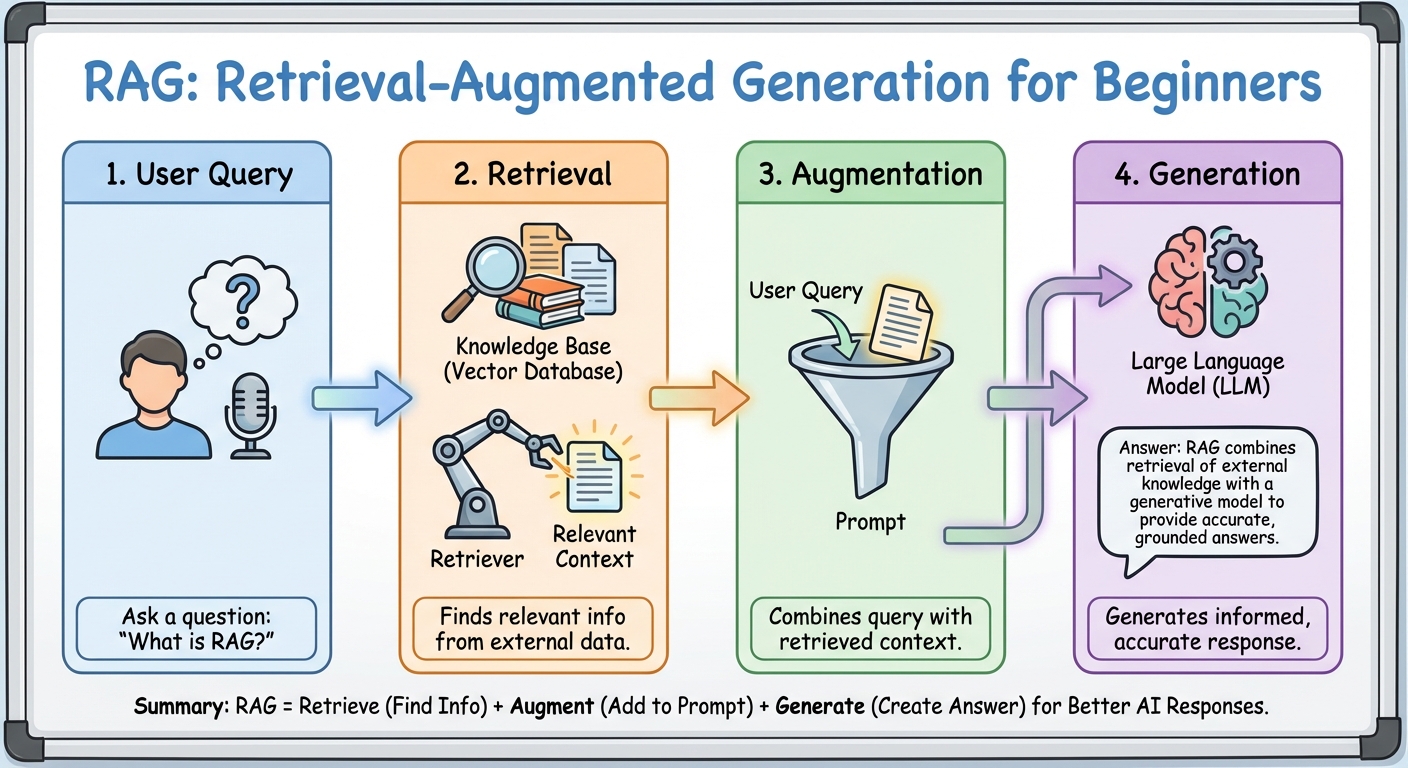
Modern RAG has evolved into GraphRAG (using Knowledge Graphs) and Agentic RAG (where an agent actively searches and filters data), improving accuracy significantly over the simple vector searches.
To build a RAG pipeline, you can leverage the following tools.
| Category | Tools | Why |
|---|---|---|
| Framework | LlamaIndex, LangChain | Popular for RAG data ingestion and indexing. |
| Vector DB | Pinecone, Weaviate, Qdrant | Storing your data as numbers for fast searching. |
| Embeddings | Voyage AI, Gemini, OpenAI | Turning your text into vectors. |
| Hybrid Search | Elasticsearch | Combining keyword search with vector search for better accuracy. |
| LLMs | Gemini, OpenAI | Lite model like GPT 5 Mini, Gemini 2.5 flash for faster response. |
Retrieval-augmented generation (rag) is a hack; it works today, but it doesn't make sense long-term to encode data into one representation, retrieve it to its original representation, and put it in the context window, which then encodes it again into the model's internal rep. - Anton
Vibe Check: No company deploys an internal chatbot without RAG.
Origin Story: Paper by Patrick Lewis et al.
Hallucination Fix: RAG is currently the most effective way to reduce AI hallucinations.
Access every AI model from OpenAI, Gemini, xAI, Anthropic, Perplexity and Deepseek in one workspace. Compare answers side-by-side, generate images, codes and share prompts.
RAG and fine-tuning are two different ways to augment an LLM's knowledge. Fine-tuning adapts the model's internal weights by training it on a new dataset, which is computationally expensive. RAG keeps the model's weights frozen and provides it with external knowledge on-the-fly at inference time. RAG is generally cheaper, faster to update, and better for knowledge that changes frequently.
The primary limitation is its dependence on the quality of the retrieval step. If the retriever fails to find the correct documents, the generator will have poor context and produce a weak or incorrect answer (a "garbage in, garbage out" problem). It also adds latency to the response time due to the search step.