
Chaos in shift management can drain business productivity and morale. That’s why smart businesses are turning to employee scheduling software.
Employee scheduling software automates the process of creating and managing employee schedules and shifts. It simplifies the process of checking employee availability, monitoring current business needs, tracking resource deficits, and optimizing employee budgeting.
Employee scheduling software provides these 4 benefits.
- Better work management
- Increased employee productivity
- Improved work operations
- Reduced work conflict
The Geekflare team has evaluated the following leading employee scheduling software based on factors like effective resource scheduling, easy workforce management, flexible scheduling and 24/7 customer support.
Employee Scheduling Software Comparison
Below is a comparison table of some of the most popular employee scheduling software based on pricing, product rating, the possibility of importing data, and the scheduling style of the best employee scheduling software.
 |  |  |  |  |  |  |  |  |  |  | |
✅ | ✅ | Via Template | ❌ | ✅ | ❌ | ❌ | ❌ | ✅ | Via Excel | ✅ | |
Drag & drop | Rota | Automatic | Drag & drop | Drag-and-drop | Drag & drop | Automatic | Drag-and-drop | Drag & drop | Drag & drop | Drag & drop | |
❌ | ❌ | ✅ | ❌ | ✅ | ❌ | ✅ | ✅ | ❌ | ❌ | ❌ | |
Extensive | Extensive | Moderate | Moderate | Limited | Limited | Moderate | Moderate | Limited | Moderate | Limited | |
Email, Chat, Phone | Live Chat, Email | Tickets, Live Chat | Chat, Phone | Email, Chat | Phone, Email | 24/7 Email | Email, chat, and phone | Chat, Email | Email, Chat, Phone | ||
$4.16 | $5 | $3 | $10 | $29 | $40 | $4.50 | $24 | $1.70 | $3.99 | $1 | |
Geekflare’s editorial team determines ratings based on factors such as key features, ease of use, pricing, and customer support to help you choose the right business software. | |||||||||||
You can trust Geekflare
At Geekflare, trust and transparency are paramount. Our team of experts, with over 185 years of combined experience in business and technology, tests and reviews software, ensuring our ratings and awards are unbiased and reliable. Learn how we test.
I will now discuss the main features, user experience with screenshots, and pros and cons of the employee scheduling software in detail.
1. Resource Guru
Best for Resource Scheduling

Resource Guru is a staff scheduling solution helping users get a bird’s-eye view of their team and assigned shifts. This resource scheduling platform allows you to track how many employees are overloaded with work and how many remain as untapped resources at work.
Resource Guru’s simple drag-and-drop functionality allows managers to schedule work for multiple employees, even when project demands constantly change. The best part is that while you set the schedule for every employee, you can see if they get overbooked. You can adjust their schedules for other projects and ensure they work to their full potential.
I tried Resource Guru’s trial version and found it pretty good for assigning working hours to people or resources with adjustable duration and repeat options. You can allocate bookings by project and client, and toggle between duration-based or specific-time scheduling.
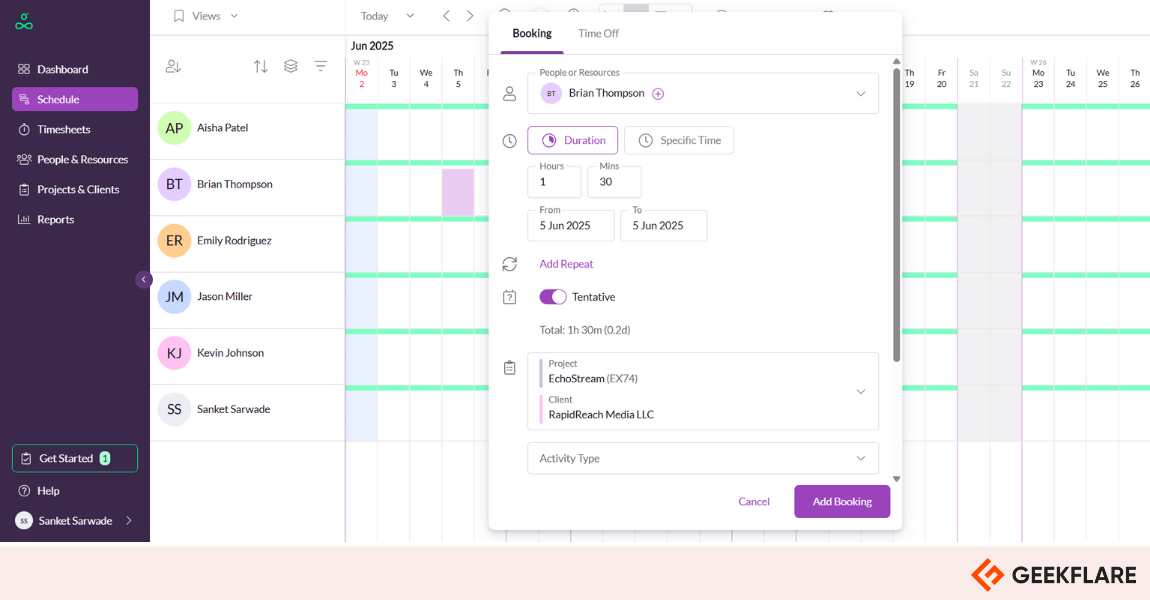
Users are provided with filters that help when adding employees from different departments and a superfast tool that doesn’t exhibit any signs of lag irrespective of how much data is added to the platform.
Top Features
- Creates a single team calendar to collaborate and schedule work for employees.
- Provides a mobile app for easy resource management.
- Tracks schedules for employees working globally with time zone support.
- Protects high-demand resources with an approval workflow.
- Captures team availability in a single view via Google Calendar and Outlook Calendar integrations.
Pros

Flexible editing and resource allocation.
Provide color coding of clients and tasks.
Has an impressive dashboard to track required resources.

Cons
Does not track previous projects and tasks.
Lacks regional holiday calendar, which is required to operate teams globally.

Pricing
Resource Guru offers 3 paid plans.
- Grasshopper: $4.16/person/month
- Blackbelt: $6.65/person/month
- Master: $10/person/month
All plans come with a 30-day free trial.
2. TMetric
Best for Multiple App Integrations

TMetric combines multiple tools for effortless time tracking, employee and project management, and billing.
TMetric employee scheduling software is effective in covering both types of employees, working well-defined hours or irregularly. TMetric allows setting schedules for the whole company at once or selectively per employee. Besides, it has the flexibility to selectively pick holidays and assign additional workdays.
TMetric time tracking lets admins view the total time invested in every activity or project throughout any period. It also integrates with Google or Outlook calendar to track time spent on scheduled events.
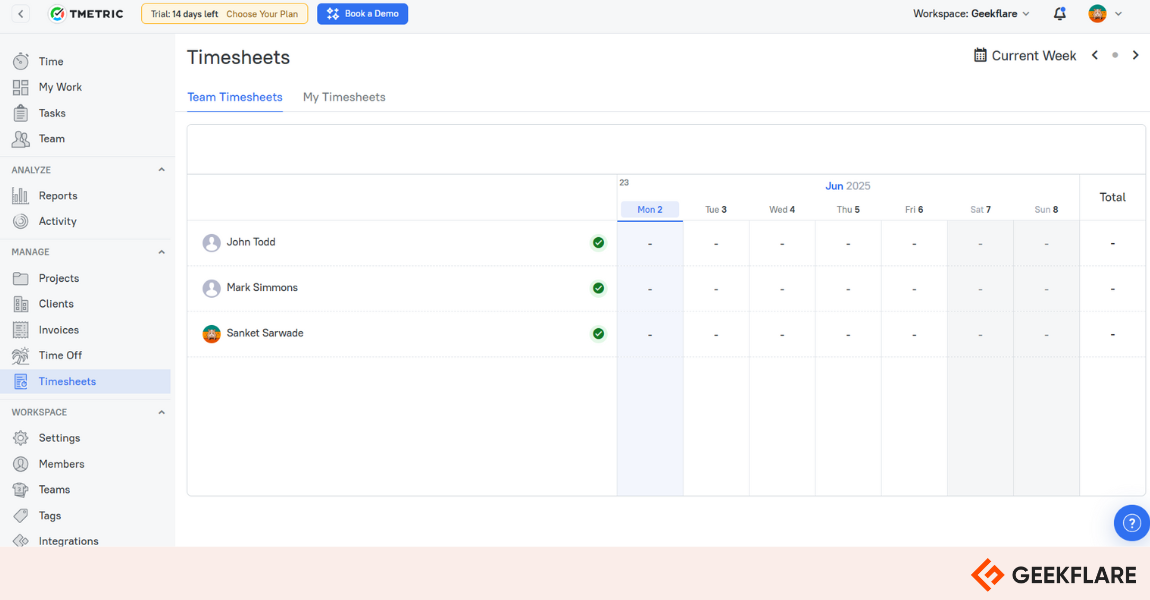
Above is a dashboard of TMetrics. The Timesheets module is useful for tracking daily hours across the team, with a clean layout to view activity by day and week. The left sidebar gives access to core features like Projects, Clients, Time Off, Invoices, and Reports, which helps centralize time and billing management. You can also manage workspace settings, tags, teams, and integrations from the lower section of the menu.
Top Features
- Schedules and tracks regular and sporadic working hours.
- Records off-schedule holidays and workdays.
- Tracks calendar events.
- Manages PTO of the entire organization.
- Gets summarized reports, including budgets, spending, billable time, etc.
Pros
Clear Interface for time tracking per employee per project.
Google and Outlook calendar integration.
Built-in billing and invoicing system.
API access for custom integrations.
Cons
Multiple features can be overwhelming to someone interested in simple employee scheduling.
The free tier is limited to 2 team members.
Pricing
TMetric offers 3 paid plans.
- Professional: $4.17/seat/month
- Business: $5.83/seat/month
- Enterprise: Custom Pricing
It also offers a free forever plan for up to 2 seats with unlimited clients and time tracking but lacks advanced features like invoicing, team dashboards, and approvals.
3. When I Work
Best for Versatile Workforce Scheduling
When I Work is an employee scheduling solution for small businesses seeking affordable features. If you run a restaurant, call center, health care facility, or salon, this tool will help you create schedules that can be tracked and managed hassle-free.
It helps you reduce the chaos and control labor costs through smart resource allocation. It starts by helping you onboard new employees to your workplace. Besides this team management feature, you get approved time-off requests, review shift trades, and fill empty shifts in seconds.
The platform also offers team accountability features like shift confirmation, clock-in, and chat in case team members are late. This helps their users stay on the same page and ensures that the right reasons for delays are identified and worked upon in the future.
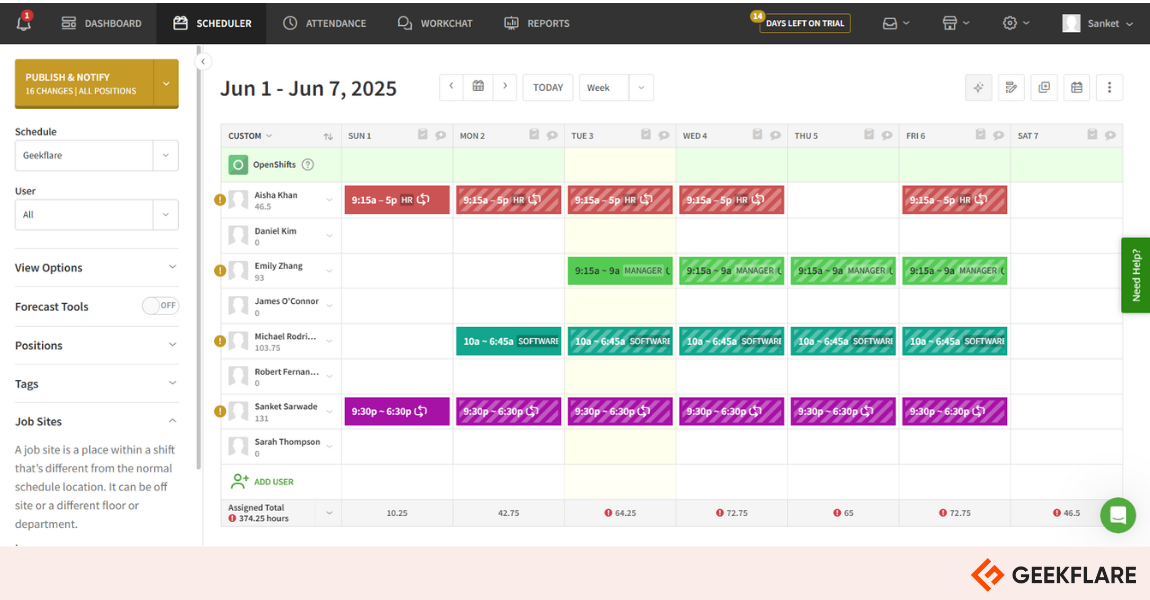
Above is a screenshot of the ‘When I Work’ scheduler, displaying assigned shifts for each team member across the week. It allows you to manage roles, shift timings, and open slots with a clear, color-coded interface.
The interface includes tools for managing positions, job sites, and tags, with options to filter by schedule, user, or view type. You can also publish and notify shift changes, track total assigned hours, and use features like WorkChat, reports, and forecast tools (in the menu on the left).
Top Features
- Allows communication and collaborate with team members in 1-on-1 conversions to notify them of upcoming delays.
- Manages team availability via mobile application, no matter where you are.
- Uses auto-scheduling to build an entire work schedule in seconds.
- Provides notifications from employees about shift-swapping or drops.
- Shares existing schedules with the entire team to notify them of their working hours.
Pros
Allows simple schedule tracking for everyone in one place.
Moderates time off requests via mobile app.
Simplifies team management via 1-on-1 collaboration.
Cons
Fails to add breaks in the existing work schedules.
Offers complex user interface.
Pricing
There are 2 pricing plans at When I Work.
- Single Location or Schedule: $3/user/month
- Multiple Locations & Schedules: $5/user/month
You have the option of a 14-day free trial on both plans.
- Premium
4. QuickBooks Time
Best for Accounting & Payroll Integration
QuickBooks Time is a time-tracking tool that helps you manage multiple timesheets and approve leaves instantly. While it is a time-tracking tool, users rave about its accounting and payroll functionalities.
QuickBooks Time also offers a payroll product that can be integrated with this time tracking tool. Post integration, users can sync timesheet data with the payroll product to make the invoicing process more efficient.
But here’s what makes this tool better than others: It comes with GPS technology. That means you can track where your team works and how many productive hours they spend completing tasks.

As shown in the above screenshot of the dashboard of QuickBooks Time, managers can log detailed time entries for employees by selecting start/end times or marking them as “Currently working.” The form supports project-based tracking with customer, service type, billable status, and notes. Time zone selection ensures accurate scheduling across distributed teams.
Top Features
- Allows users to discover upcoming role opportunities and better plans for payroll with in-depth reports.
- Provides a mobile app to approve or reject time off from anywhere.
- Collaborates via pictures or real-time updates using the activity feed.
- Schedules recurring alerts to update employees about upcoming shift changes, overtime, or deadlines.
- Tracks team productivity and existing project statuses to allocate resources to the teams.
Pros
Perfect to track employee productivity based on hours spent.
Integrates with QuickBooks and streamlines accounting and payroll work.
Offers time entries that help users review timesheets easily.
Cons
Pay per user is more expensive than a package deal.
Frequent cellphone app updates can be annoying for users and hampers experience.
Pricing
QuickBooks Time has 2 plans. Time Premium that costs $2 (flat) + $8/user/month, and Time Elite that costs $4 (flat) + $10/user/month. The Elite plan offers advanced features like Geofencing, tracking mileage, projects, timesheet signatures etc.
5. Connecteam
Best for Multi-Location Teams
Connecteam comes with a scheduling solution tailored for modern teams working across locations, roles, and time zones. The software helps reduce scheduling errors through real-time conflict detection, user limitations, overtime calculations, and shift overlap prevention.
Here is a screenshot of Connecteam. You can assign, customize, and publish shifts with detailed time, role, and location info. It streamlines workforce planning with user permissions, repeat options, and break settings.

Managing and optimizing scheduling takes only a few minutes, thanks to its drag-and-drop shift editing, bulk shift updates, and custom shift templates. You can segment schedules by department or team, and even share live schedule links with clients.
Connecteam enables your employees to submit preferred working hours and get real-time notifications for schedule changes. It also enhances team communication and accountability through shift tasks, notes, and file attachments.
Top Features
- Automatic scheduling by analyzing availability, time-off, and qualifications
- Multi-location scheduling to avoid overlapping and conflict.
- Open shifts to be claimed on a first-come, first-serve basis.
- Set recurring shift patterns to repeat daily, weekly, or monthly.
- Release shifts and get replacements with admin approval.
Pros
Free software for up to 10 people.
API for crucial data exchange.
2FA, SSO, and Biometric app lock.
Cons
Phone support is not available.
Basic plan does not allow sub-task creation.
Connecteam Pricing
Connecteam offers 5 subscription plans.
- Small Business: Free (upto 10 employees)
- Basic: $29 for first 30 users + $0.5 per additional user
- Advanced: $49 for first 30 users + $1.5 per additional user
- Expert: $99 for the first 30 users + $3 per additional user
- Enterprise: Custom pricing
6. ClockShark
Best for Construction and Field Service
ClockShark is a holistic employee scheduling application that offers a job manager, work calendar, and time-clock. It is the perfect fit for businesses who wish to streamline their existing timesheets and track employee productivity hassle-free.
With ClockShark’s drag-and-drop feature, this work scheduling app helps you create shifts in seconds. Users just need to drag the employee name and drop the name tag into the existing schedule. This action will automatically generate a real-time notification for employees.
ClockShark’s editor allows you to change the details of any shift simply by dragging it around the calendar. In the same view, you can also track the planned schedules for the coming weeks and months.
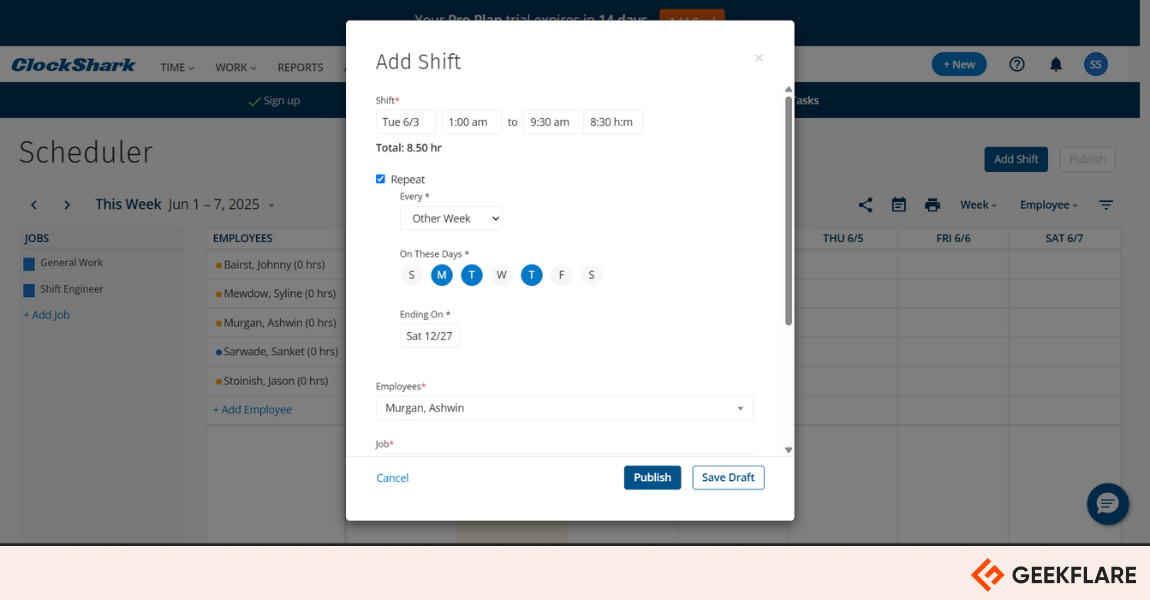
This interface allows creating recurring shifts with custom repeat intervals or specific weekdays. Shift duration is auto-calculated based on start and end time. You can assign shifts to employees, link them to specific jobs, and choose to either publish immediately or save as draft for later adjustments.
Top Features
- Notifies employees about upcoming schedules and changes with real-time updates via email and mobile.
- Helps employees clock in and clock out to record their attendance for the set schedules.
- Adds job descriptions to the schedule to help employees get an overview of the job.
- Maintains a smooth workflow by adding customer contact details, files, or previous conversation history to the schedules.
- Monitors and executes job-related time and expenses during a project lifecycle.
Pros
Offers a smooth experience to its users with its interface.
Offers training tools for a less intimidating experience.
Perfect for employees working off-site to capture their clock-in and clock-out details.
Cons
Sends non-stop email alerts for shift changes.
Forces users to add new timesheets every time employees forget to update or switch a time-consuming task.
Pricing
ClockShark offers 2 plans.
- Standard: $40 base fee + $9/user
- Pro: $60 base fee + $11/user
7. Deputy
Best for Easy to Use Interface
As a staff scheduling software, Deputy is another option your business can explore. This software is popularly known for its easy-to-use interface that helps users set up the solution without technical support.
Users are allowed to control labor costs using the real-time data in Deputy to ensure budgets are not exceeded. It even supports data on every employee’s schedule that helps track empty slots in their schedules. This ability allows hiring of the right number of employees, reducing hiring costs.
You can also automate the scheduling process with Deputy’s AI capabilities. This also reduces wage costs as you can access accurate labor demand data. Its scheduling data helps you fill empty shifts with employees who are best suited for the task.
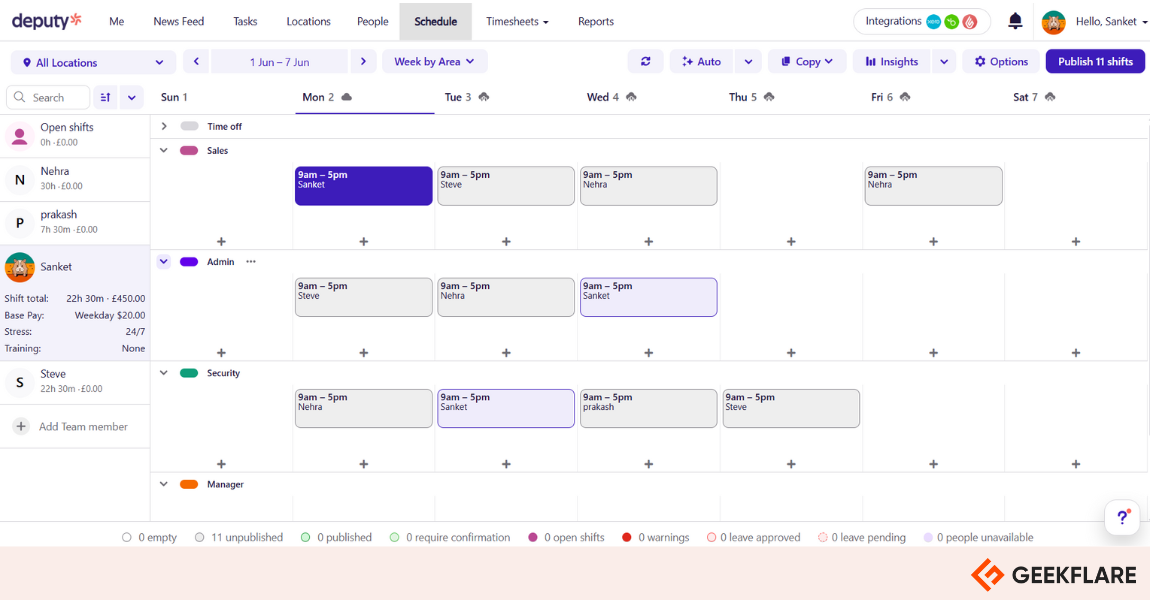
Deputy’s visual scheduler shows a color-coded weekly view of employee shifts across departments. You can assign, copy, and publish shifts, view pay and stress levels, and handle open roles with ease. It displays real-time shift details like hours, pay, and stress levels directly in the sidebar for each employee. The interface also allows batch publishing of shifts, tracking open slots, and identifying unconfirmed or unpublished shifts through visual status indicators.
Top Features
- Automates complex payroll calculations with time tracking and timesheets.
- Integrates the software with your existing Payroll or HR systems to streamline employee data.
- Manages leave balances and staff availability with leave management.
- Captures current labor needs with AI functionality.
- Tracks employee hours via tablet, phone, or desktop application.
Pros
Optimizes schedules with AI.
Simplifies meal and rest break compliance.
Offers complete control over rotas.
Cons
Users face constant glitches that stop them from clocking active hours.
Fails to set daily tasks associated with a certain position.
Pricing
8. Homebase
Best for Small Businesses
Homebase is a free scheduling software that enables you to manage your team and keep them on track from a single interface. It allows your employees to have access to the latest schedule, ensuring they know exactly when and where they’re working.

Your managers can approve or limit time-off requests with blackout dates, maximum caps, and advance notice rules. Thus, they can successfully handle necessary coverage during peak times.
If there is any last-minute change or emergency, you can send out quick messages to available team members directly through the app. Homebase also offers built-in tools to track real-time labor costs, receive alerts for late arrivals, and adjust the schedule remotely, leading to smooth operation even during the absence of managers.
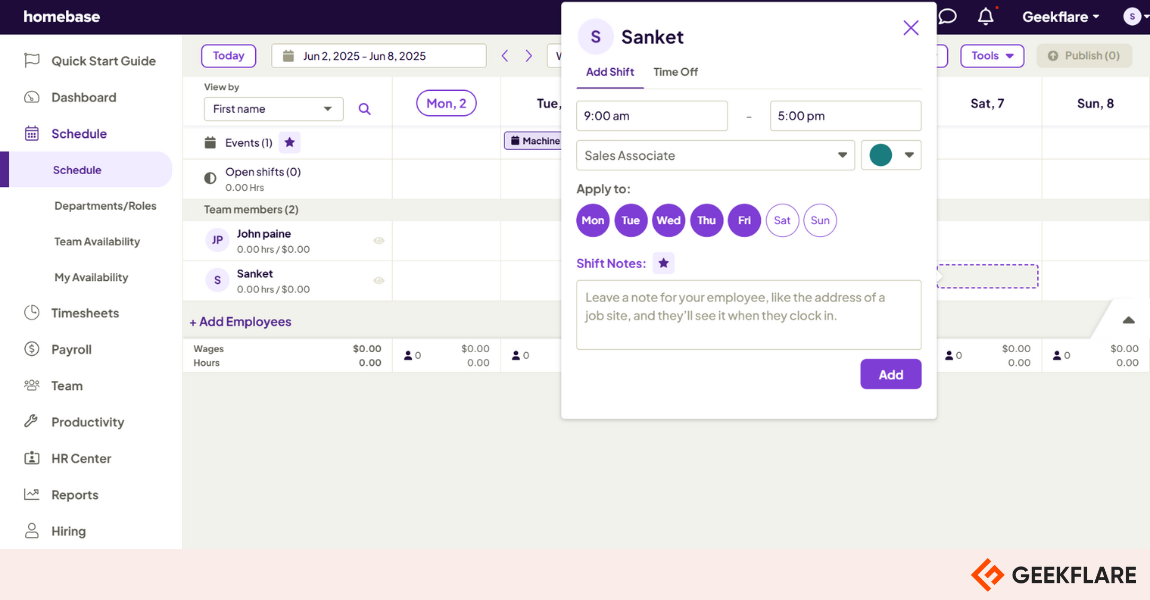
Here is a screenshot of Homebase shift scheduler with drag-and-drop simplicity and daily, weekly, or role-based views. You can assign shifts, repeat schedules, and leave notes for employees in one streamlined interface.
Features
- Publish and update the schedule with personal notes.
- Integrated time-off tracking for auto-syncing availability.
- Team notifications via text, email, and mobile app.
- Shift trading facility for team members for smooth coordination.
- Post open shifts to get claimed by employees.
Pros
Provides templates for work scheduling.
Offers mobile apps for Android and iOS.
Allows emergency messaging for shift change.
Cons
Free plan does not include chat and phone support.
Payroll add-on incurs additional charges.
Pricing
Homebase offers four pricing tiers with a 14-day free trial for all plans. Its Basic Plan is Free and is among the best for small businesses with up to 10 employees. Below are the paid plans.
- Essentials: $24/location for unlimited employees
- Plus: $56/location for unlimited employees
- All-in-one: $96/location for unlimited employees
9. Sling
Best for Retail and Hospitality Scheduling
Sling is known for helping users build and streamline employee scheduling programs in seconds. From managing time offs to shifting trade requests, it does it all.
Sling enables users to streamline internal communication and build a collaborative environment that results in shift data transparency. It allows you to send personal and group messages to inform employees of the upcoming changes in their shifts and how they need to be executed.
Unlike many team scheduling apps, Sling simplifies the payroll process. It helps you monitor the active working hours and calculate labor costs accordingly. This way, you don’t have to maintain multiple Excel sheets, as it stores and calculates the labor costs daily, weekly, and monthly.
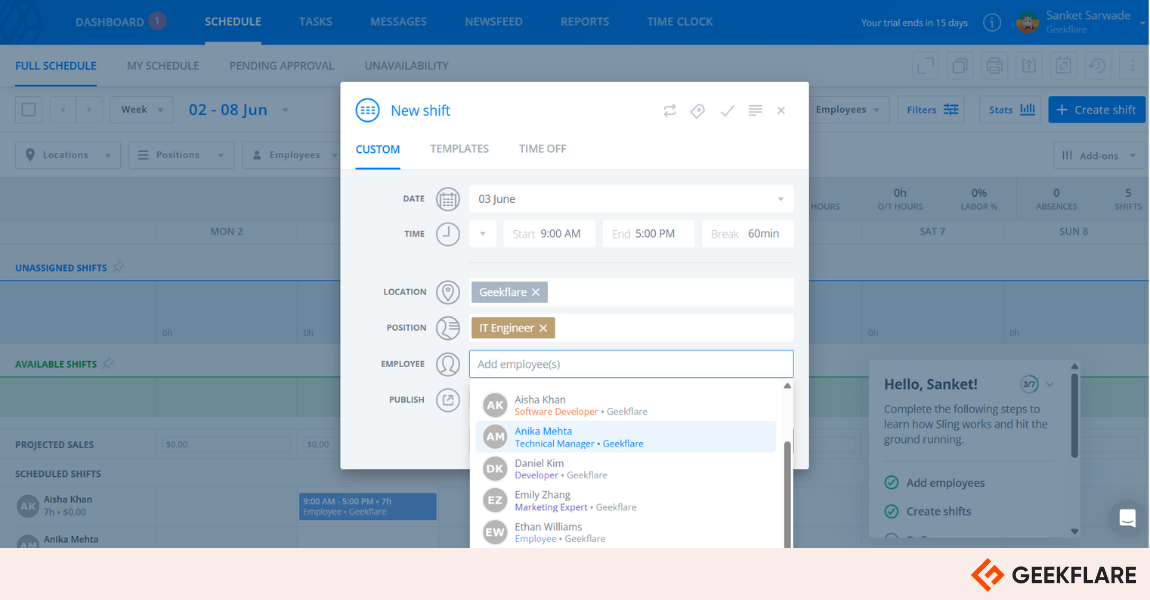
The shift creation panel in Sling allows you to assign shifts by selecting date, time, location, and job role, with optional break duration included. You can filter and assign specific employees directly from a searchable dropdown. It also supports categorizing shifts using templates or marking them as time off, letting you schedule recurring or special cases.
Top Features
- Tracks employee hours from multiple devices and export timesheets for a seamless payroll process.
- Uses news feeds and messages to enhance internal communication and collaboration.
- Helps employees align their to-dos with task management.
- Predicts and optimize labor costs during scheduling to stick to your budgets with reports.
- Identifies ways to cap paid time off based on the leave types you support.
Pros
Offers features across all devices.
Sends real-time notifications for shift changes.
Offers easy access to live rotas.
Cons
Freezes or keeps loading during regular use.
Sends notifications for group chats to users who are not a part of the group.
Pricing
Sling offers a free plan and 2 paid plans as given below.
- Premium: $1.70/user
- Business: $3.40/user
10. Clockify
Best Free Scheduling
Clockify is a free scheduling software that helps you manage employee shifts instantly. This time-tracking software helps you monitor productive hours across all projects hassle-free.
Clockify lets you track productivity, billable hours, and attendance via its timesheets. You ae allowed to track the amount of time employees spend using certain apps to identify how they spend their productive hours in a day.
Clockify offers in-depth reports that help you track individual and group activities. This performance management software helps you monitor who is working on which task. This results in managing the payroll system and ensuring timely payment release.

Clockify’s scheduling interface provides a calendar-based project timeline view, allowing managers to assign work blocks across multiple days. Each project shows cumulative assigned hours, with colored bars representing scheduled tasks. The layout supports switching between project-based and team-based views, enabling workload balancing and planning across teams or clients.
Top Features
- Tracks budget estimates and the resources required according to the ongoing project.
- Submits and approve timesheets for individual employees.
- Creates invoices using billable hours to release payments on time.
- Allows users to record project expenses as and when a task takes place.
- Functions across different platforms to manage employee schedules anytime, anywhere.
Pros
Prevents late timesheet updates via notifications.
Fixes inaccurate data during audits.
Provides API documentation to integrate tools faster without technical difficulties.
Cons
Makes task search difficult as it lacks a searchable task menu.
Fails to upload the number of hours spent on a project when importing data from CSV files.
Pricing
Clockify’s pricing plans feature 4 plans based on its offerings, as are mentioned below.
- Basic: $3.99/user
- Standard: $5.49/user
- Pro: $7.99/user
- Enterprise: $11.99/user
11. Zoho Shifts
Best for Seamless Team Coordination
Zoho Shifts is another shift scheduling solution your business can explore. It helps you create conflict-free schedules that both employees and managers can be onboard with hassle-free.
Using Zoho Shifts, you are able to create and assign shifts based on existing employee schedules and job sites. It is possible to filter shifts based on daily or weekly calendar views to create a schedule for employees.
Zoho Shifts enables you to manage all time requests in one place. It offers a mobile app for approving or rejecting vacation requests based on the existing workload. Once the schedule is updated, all employees receive notifications about their upcoming shifts.
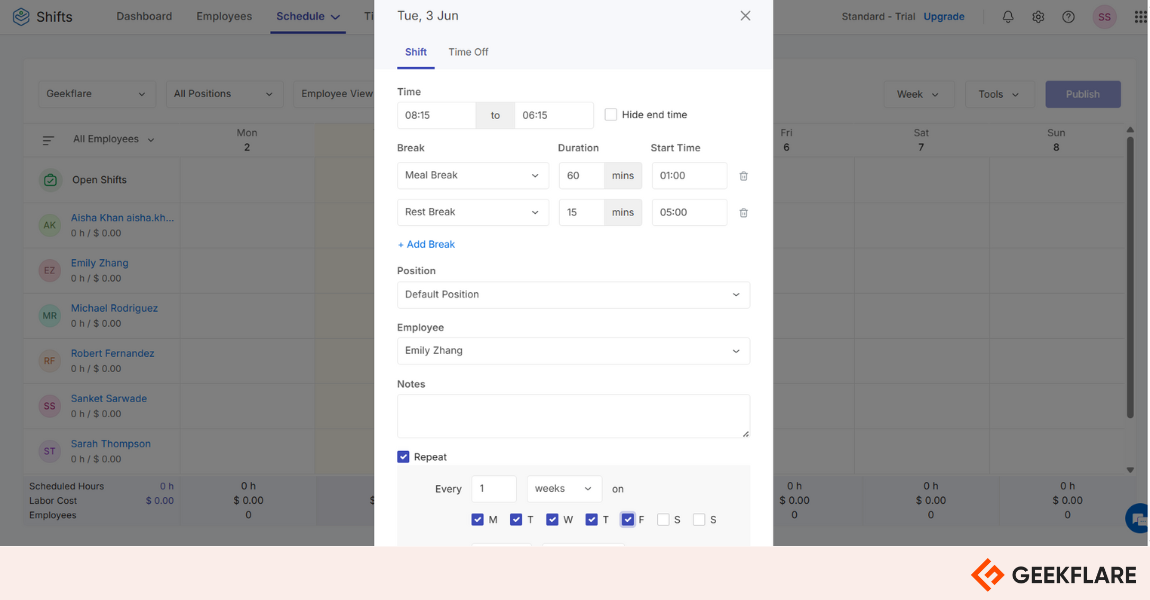
Above is a screenshot of Zoho Shift. The interface lets you set precise shift times with optional visibility controls and supports multiple custom break types with individual durations and start times. You can assign the shift to a specific employee and job role, and include notes for context. The recurrence feature supports flexible repeat patterns across selected weekdays, making it efficient for setting up ongoing shift cycles.
Top Features
- Supports remote check-ins and check-outs with GPS tagging and GEO-fencing.
- Tracks attendance hours plus perform routine checkups using the mobile app.
- Helps employees connect anytime with the messaging feature.
- Uses reports to track employee activity and productivity.
- Connects Zoho Shifts with any payroll software to streamline payments.
Pros
Allows users to create shift templates.
Maximizes productivity via collaboration on schedules.
Manages and tracks all time-off requests on the go.
Cons
Frequent glitches hamper time tracking and result in inaccurate reports.
Timers cannot be used on the mobile version.
Pricing
Zoho Shifts pricing consists of two plans as below.
- Basic: $1/user
- Standard: $2/user
Honorable Mentions
In addition to the above, the following employee scheduling tools deserve honorable mentions for the features offered and their popularity.
- Shiftboard: Best for Complex Scheduling Needs
- ScheduleAnywhere: Best for 24/7 Customer Support
- Soon: Best for Modern Workforce Management
- ZoomShift: Best for Simple and Flexible Scheduling
What is Employee Scheduling?
Employee Scheduling is a process that helps businesses track and monitor labor needs and assign available resources to existing tasks. With employee management software, this process becomes simpler as companies can manage their existing resource needs and set the right employee schedules in minutes.
Benefits of Workforce Scheduling Software
The 5 benefits of workforce scheduling software are mentioned below.
- Improves Employee Productivity: With the ability to set schedules, managers can easily help employees focus on priority tasks and ensure they are completed within the set deadlines. Moreover, this software allows you to create flexible schedules that employees can keep up with and get rest when needed, improving employee experiences. Such people management tools keep employees motivated and improve their productivity even further.
- Controls Labor Costs: Scheduling solutions help users identify possible areas to reduce labor costs for upcoming tasks. This tool helps you identify employees best suited for different tasks and judge their ability to manage multiple tasks simultaneously. Once you know which employees perform well, you can assign them the same type of tasks in multiple projects, therefore avoiding the need to hire new resources for other projects due to efficient management of employee work schedules.
- Reduces Scheduling Conflicts for Better Output: Shift scheduling software also offers a calendar view that helps you track the schedules of all the employees. This view helps you understand possible conflicts if their shifts are scheduled for a particular day and time. By reducing conflict, you can ensure that all the projects are run simultaneously, without compromise on employee performance.
- Lowers Employee Churn Rate: Scheduling solutions allow you to set schedules and share them with employees to see if they are comfortable. This assures the employees that they can ask the managers to update the schedules and work hassle-free if they have any conflicts or clashes with employee breaks. Such efforts help you boost employee satisfaction and encourage them to stay with your business longer.
- Ensures Compliance With Labor Laws: Workforce management software helps you comply with labor laws regardless of which country your employees are working from. This helps your business avoid penalties and ensures that no employees are harmed.
How to Choose the Right Employee Scheduling Software for Businesses?
The below 8 criteria help you choose the right employee scheduling software for your business. These include:
- Business Size & Complexity: Your first task is to understand the size of your business and its operation complexities. Also, understand how many employees you have onboard who will use the tool daily. Based on this number, look for a tool that matches this requirement and helps you onboard all the employees hassle-free.
- Industry: Not all scheduling tools are perfect for all industries. Some may be good for the medical industry, whereas some would be a great match for manufacturing. You need to contact the service provider to see what features benefit your business. This way, you will know if the tool serves your industry.
- Current Pain Points: Have issues with employee time-tracking? Or is the lack of an eagle-eye view of all the schedules set for the coming weeks or months your biggest challenge? Regardless of your pain point, the software must resolve it and help you create a seamless scheduling process.
- Scheduling Functionality: The whole point of scheduling software is to ensure you set the right shifts for all employees without raising conflicts in team schedules. If the tool under review is known for doing this, don’t hesitate to onboard it. Look for additional benefits as some do have additional offerings like interview scheduling software and employee self-service..
- Integration Capabilities: If the tool offers limited integrations and claims to do it all, think again before you take it up. No doubt, tools offer you the option to set up payroll systems, create timesheets, send in-app messages, or track all the right metrics. But that doesn’t mean, you shouldn’t have the option to integrate your existing communication or payroll systems with the scheduling software.
- Ease of Use: Make sure that the tool you choose is easy to use as it needs to complement your business operations. That’s quite a challenge for existing scheduling software users. Many have spent hours or days comprehending every action and feature in scheduling software. But that doesn’t mean you must also be a part of this list. Look for a solution with a proven record of a small learning curve.
- Pricing & Scalability: If you are a small business and don’t want to spend much on software, look for a free or affordable solution that doesn’t burn a hole even when you plan to scale your business. Your business will eventually grow and your need for more features will too. So search for a solution that matches your budget and grows with your business in the future.
- Security: Finally, search for a solution that helps you keep all your data secure. It should be GDPR-compliant. This way, you can ensure that no employee or customer data gets shared with people outside your company.
Employee Shift Scheduling Software Trends in 2025
Before investing in work scheduling software, let’s explore 4 employee shift scheduling software trends that one can expect in 2025.
- Automation and AI-Driven Scheduling: With the rise of AI in every sector, businesses will expect their scheduling software to have AI-powered features. This helps them automate repetitive tasks and reduce the time spent scheduling tasks for individual employees. Users will also look for AI-specific features like meeting management, task management, in-app virtual assistant, and project management.
- Mobile Accessibility and Real-Time Updates: Another growing trend among users will be the need for mobile apps to track schedules anytime and anywhere and get real-time updates. Managers, especially, will find the mobile app more useful as they can track shifts and employee productivity anywhere.
- Advanced Features for Specific Industries: As discussed in the criteria section, it is important to ask vendors if they offer industry-specific features to their users. This is another growing trend that software providers should not ignore. For example, integration with biometrics tools can help businesses track clock-in and clock-out for employees who must complete their shifts on various sites or for those who work remotely.
- Geofencing and GPS Tracking: Geofencing and GPS tracking are fairly new features; not all scheduling solutions offer them. However, demand for these features will rise in the coming months. These features will benefit businesses who plan to onboard remote employees or those who need to provide on-site services to clients. You can track employee locations and see how many productive hours were spent completing a task.
How to Integrate Employee Scheduling Software into Your Business
Once you are done exploring the trends, narrowing down the options, and using the criteria listed above, you are surely to land on one solution that:
- Matches your needs
- Reduces workload challenges
- Simplifies scheduling
And once you have the software, your next step is to integrate it into your work process. You need to consider these 4 challenges before implementation.
- How many days do you take to import data from existing scheduling spreadsheets or existing software?
- How much time do you spend adding employees and their work data to the system?
- How can your company introduce the software for daily use?
- How can you onboard employees faster and help them learn about the use of the software?
When you resolve these challenges, you can start using software and ensure a smooth ride when scheduling employee shifts. Given our list of solutions, you will surely land one that benefits your business, reduces your daily scheduling challenges, and matches the criteria.