


A consent management platform (CMP) shows the cookie banner, but the banner is the easy part. The real work happens behind it like scanning your site for trackers, blocking them until a visitor agrees, passing that choice to Google and your ad partners in a format they accept, and keeping a record you can show a regulator.
2026 raised the stakes. Since February 28, every consent string sent through the ad industry’s Transparency and Consent Framework must use version 2.3, and version 2.4 is due on websites by October 23. Google still refuses to serve personalized ads in the EEA, the UK, and Switzerland unless a Google-certified CMP collects the consent.
In the US, 20 states now have comprehensive privacy laws, and 12 of them require sites to honor the Global Privacy Control browser signal.
That’s why a free banner script often isn’t enough anymore. The right CMP depends on your business like a publisher protecting ad revenue, a brand running analytics and retargeting, or an enterprise that needs consent tied into a wider privacy program.
CMP Comparison
| CMP | Category | Best for | Starting price | Free plan | Google certification | IAB TCF | GPC | Mobile apps | Link |
|---|---|---|---|---|---|---|---|---|---|
| 01 Cookiebot | Self-serve CMP | Small and mid-sized sites that want strong scanning with little setup | €7/month | Yes (50 subpages) | Gold | 2.3 | Yes | No | Visit |
| 02 iubenda | Consent + legal documents | Businesses that want consent and legal policies in one subscription | €4.99/month | Yes (5K pageviews) | Gold | 2.3 | Yes | Yes | Visit |
| 03 OneTrust | Enterprise privacy suite | Global enterprises with web, app, and TV properties | Custom quote | No | Gold | 2.3 | Yes | Yes, plus CTV | Visit |
| 04 Usercentrics | Web, app, and TV CMP | Growing businesses that need consent across web, apps, and TV | €7/month | Yes (1K sessions) | Gold | 2.3 | Yes | Yes, plus CTV | Visit |
| 05 Didomi | Enterprise consent + preferences | Enterprises and publishers that want to test and lift consent rates | Custom quote | No | Gold | 2.3 | Yes | Yes, plus CTV | Visit |
| 06 CookieYes | Self-serve CMP | Small and mid-sized websites that want fast setup | $10/month | Yes | Gold | 2.3 | Yes | No | Visit |
| 07 Osano | Privacy platform | US businesses juggling several state privacy laws | $199/month | Yes | Silver | 2.2 | Yes | Yes | Visit |
| 08 Ketch | Consent orchestration | Consumer brands that need consent enforced across their data stack | $150/month | Yes (5K users) | Silver | 2.2 | Yes | Yes, plus CTV | Visit |
| 09 TrustArc | Enterprise privacy suite | Enterprise privacy teams that need audit-ready programs | Custom quote | No | Gold | 2.2 | Yes | Yes | Visit |
| 10 Termly | Consent + policy generator | Small businesses that want a banner and legal policies together | $10/site/month | Yes (10K banner views) | Gold | 2.3 | Yes | No | Visit |
| 11 consentmanager | Publisher and app CMP | Publishers and app owners who need deep TCF control | €23/month | No | Gold | 2.3 | Yes | Yes, plus CTV | Visit |
| 12 InMobi CMP | Free publisher CMP | Ad-funded publishers and apps on a tight budget | Free | Yes | Certified | 2.3 | Yes | Yes | Visit |
Best Consent Management Platforms
01. Cookiebot
Self-serve CMPSmall and mid-sized sites that want strong scanning with little setup
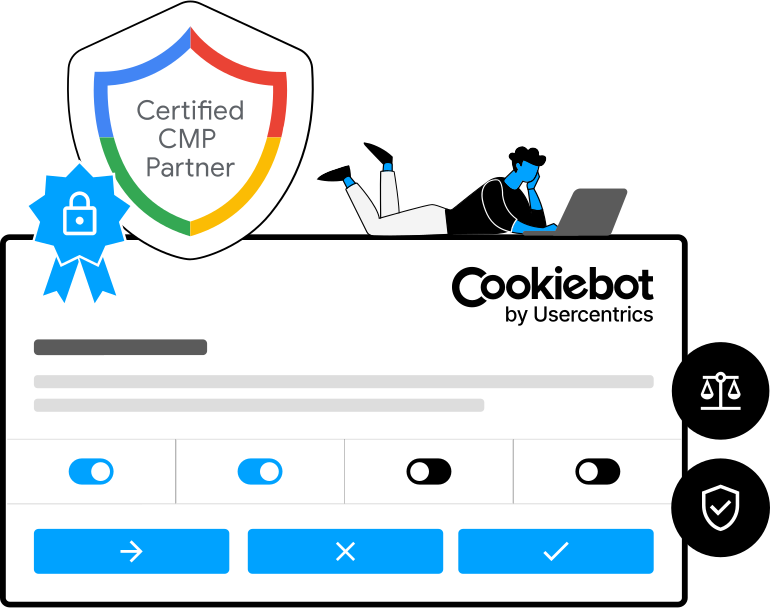
Cookiebot is cookie consent management platform (CMP) from Usercentrics, and its scanner is the main reason it’s so widely used. It crawls your site every month, matches what it finds against a library of more than 13,000 pre-categorized trackers, and blocks them until the visitor agrees. If a scan finds more pages than your plan covers, the plan moves up a tier automatically.
Google Consent Mode v2 is on by default, in basic or advanced mode, and Cookiebot also passes consent to Microsoft UET and Amazon’s consent signal. GPC is honored for US visitors, and banners come in more than 47 languages. It’s Google Gold-certified, with TCF 2.3 on paid plans.
Pricing is per domain and based on page count. That favors a small site with heavy traffic over a large catalog with light traffic. The free plan covers one domain up to 50 subpages, but only in one language and with manual blocking.
Cookiebot is web-only. App consent needs Usercentrics’ separate App CMP. It installs through a script, a Google Tag Manager template, or apps for Shopify, Wix, Webflow, HubSpot, and WordPress.
Pros & Cons
PROS
CONS
Pricing
| Plan | Price |
|---|---|
| Free (1 domain, 50 subpages) | €0 |
| Premium Lite (1 domain, 50 subpages) | €7/month |
| Small (350 subpages) | €15/domain/month |
| Medium (3,500 subpages) | €30/domain/month |
| Large (7,000 subpages) | €50/domain/month |
| XLarge (over 7,000 subpages) | €90/domain/month |
Good to know
Paid plans come with a 14-day free trial, no card required.
02. iubenda
Consent + legal documentsBusinesses that want consent and legal policies in one subscription
iubenda started as a privacy policy generator, and that still sets it apart. One subscription covers the cookie banner, privacy and cookie policies, terms and conditions, a consent database for forms, and a record of processing activities under GDPR Article 30.
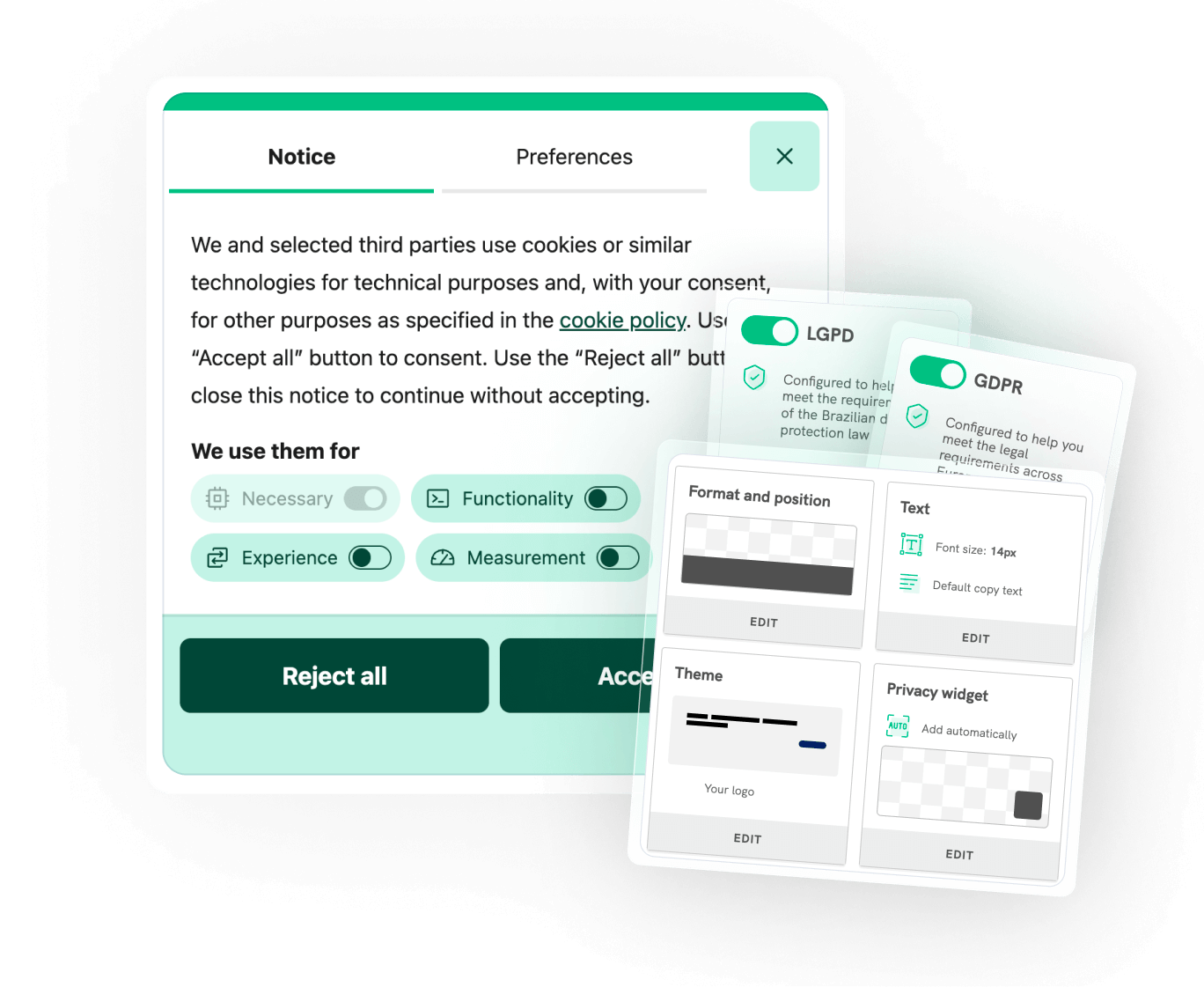
The CMP itself holds up well. It’s Google Gold-certified, supports TCF 2.3 on every paid plan, and runs Consent Mode v2 in advanced mode by default. GPC is detected automatically, and it works with IAB GPP for US state laws. Geo-targeting starts on the Advanced plan.
iubenda is owned by team.blue who also owns consentmanager and CookieFirst.
Pricing is per site and metered by pageviews. The free plan switches the banner off once you pass 5,000 pageviews a month, and paid plans charge for extra pageviews.
Mobile SDKs, a data subject request tool, and hourly scans need the Ultimate plan. It installs by script or through Shopify, Magento, Joomla, and WordPress integrations.
Pros & Cons
PROS
CONS
Pricing
| Plan (per site) | Billed yearly | Billed monthly |
|---|---|---|
| Essentials (25K pageviews) | €4.99/month | €5.99/month |
| Advanced (50K pageviews) | €19.99/month | €21.99/month |
| Ultimate (150K pageviews) | €79.99/month | €89.99/month |
Good to know
Extra pageviews cost €0.05 per 1,000. US pricing starts at $5.99 a month.
03. OneTrust
Enterprise privacy suiteGlobal enterprises with web, app, and TV properties
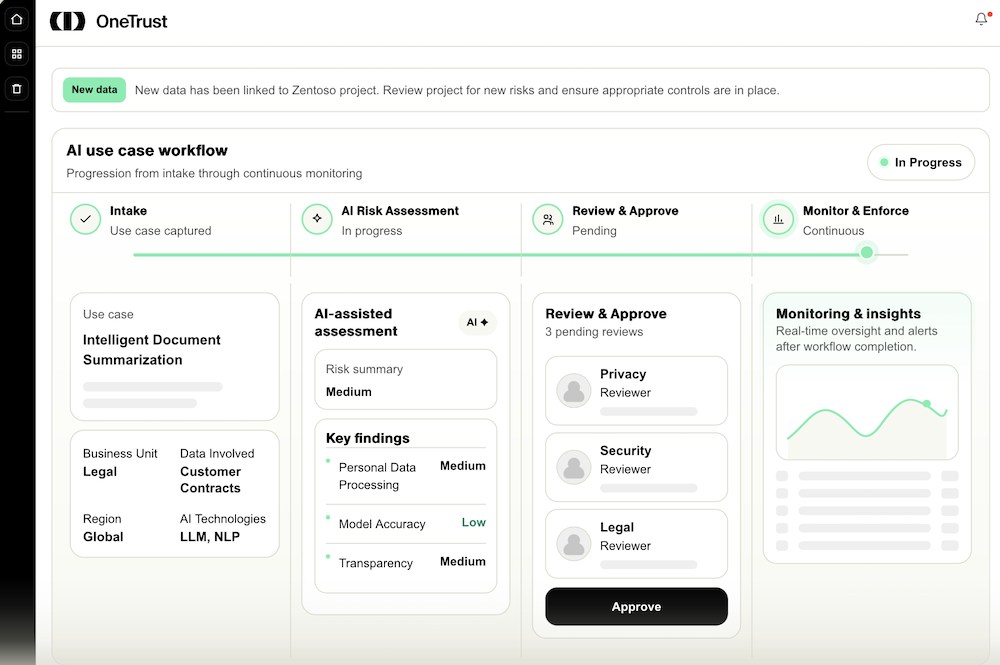
OneTrust is suitable for large enterprises. It handles consent on websites, in mobile apps through SDKs for iOS, Android, React Native, Flutter, Unity, and more, and on connected TV from Apple TV and Roku to Samsung and LG sets.
Scanning can reach pages behind a login and draws on a database of more than 45 million categorized cookies. Location rules work down to US state level, banners support over 250 languages, and A/B testing helps tune consent rates. It’s Google Gold-certified, supports TCF 2.3 across web, mobile, and TV, and passes IAB GPP signals on web, iOS, Android, and Roku.
Consent is one module in a much bigger platform. CMP Suite adds privacy notices and data subject request automation, and Universal Consent & Preference Management adds preference centers tied to customer profiles. Beyond that sit data mapping, AI governance, and third-party risk.
There’s no public pricing or self-serve plan and there’s no WordPress plugin.
Pros & Cons
PROS
CONS
04. Usercentrics
Web, app, and TV CMPGrowing businesses that need consent across web, apps, and TV
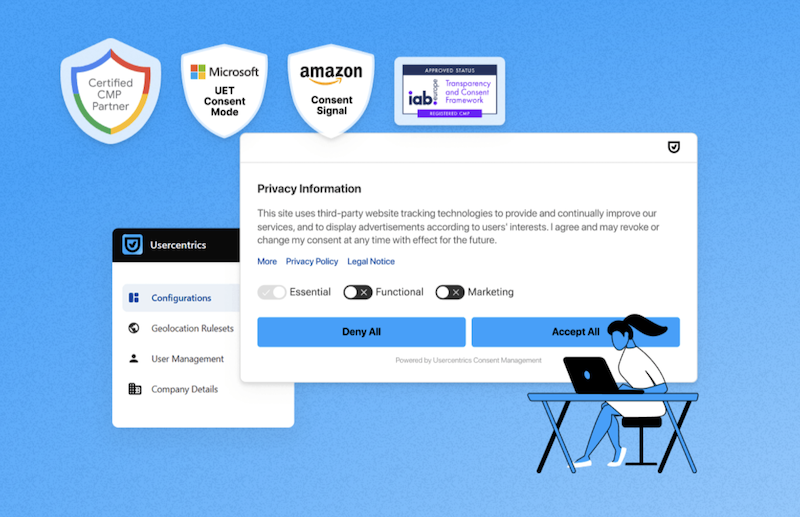
Usercentrics is Cookiebot’s bigger sibling, and the one to pick if you’ll outgrow a website banner. It sells separate products for the web, mobile apps (iOS, Android, Flutter, React Native, Unity), and connected TV (tvOS, Android TV, Tizen, webOS), all registered with IAB and certified Gold by Google.
Web pricing is based on monthly sessions, with unlimited subpages. It starts at €7 a month for 1,500 sessions and steps up to €750 a month for a million sessions across 100 domains. TCF 2.3 and 60 banner languages arrive on the Pro plan.
Usercentrics hosts server-side Google Tag Manager, runs a Meta Signals Gateway, and sells a preference manager.
Some of the features costs more. A/B testing and branding removal need the Corporate plan or an add-on, and plans upgrade automatically once you pass their session limit.
Pros & Cons
PROS
CONS
Pricing
| Web plan | Price |
|---|---|
| Free (1,000 sessions, 1 domain) | $0 |
| Essential (1,500 sessions, 1 domain) | $8/mo |
| Plus (3,000 sessions, 1 domain) | $16/mo |
| Pro (15,000 sessions, 3 domains) | $34/mo |
| Business (50,000 sessions, 10 domains) | From $56/mo |
05. Didomi
Enterprise consent + preferencesEnterprises and publishers that want to test and lift consent rates
Didomi became one of the largest enterprise CMP vendors when it bought Sourcepoint, the US CMP behind many large publishers. Sourcepoint still runs as its own brand for now.
Didomi treats consent as something to optimize. A/B testing comes on every tier, compliance scans run on a schedule, and consent records are versioned so you can prove what each visitor saw. It covers the web, iOS, Android, and TV apps, with SDKs for React Native, Flutter, and Unity.
It pairs consent with a Preference Management Platform for email and marketing choices, a DSAR tool, and Addingwell, a server-side tagging service it bought in 2025. Integrations reach Salesforce, HubSpot, Mailchimp, and Adobe Experience Platform, and GPC and IAB GPP cover US state laws.
Pros & Cons
PROS
CONS
Pricing
Didomi doesn’t publish pricing. Plans are priced on monthly unique visitors, with unlimited domains.
06. CookieYes
Self-serve CMPSmall and mid-sized websites that want fast setup
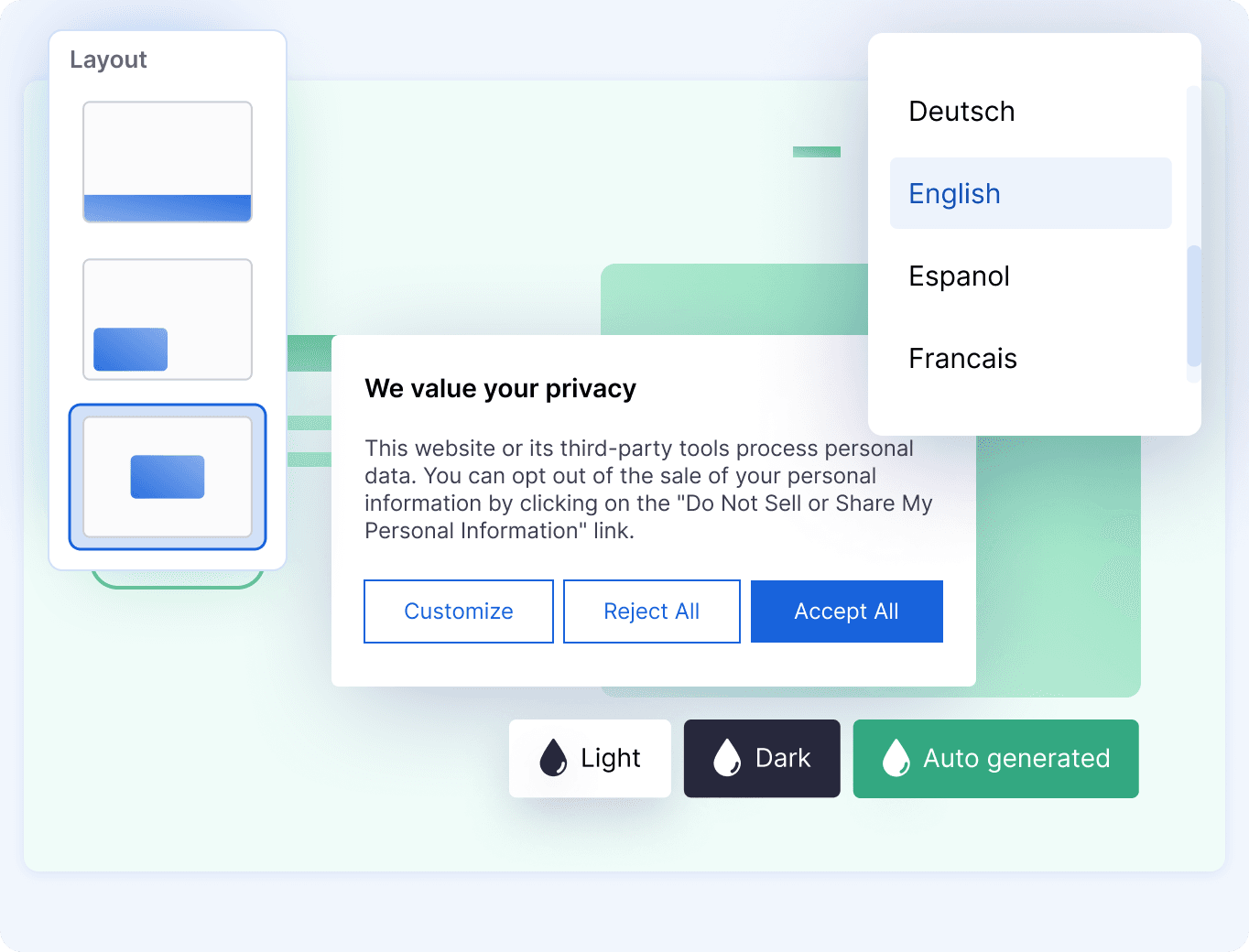
CookieYes is one of the quickest ways to get a compliant banner live. It scans your pages, classifies cookies with AI, blocks them until consent, and keeps a consent log on every plan, including the free one. Banners support more than 175 languages.
It’s certified Gold by Google, and Consent Mode v2 works in basic and advanced modes on all plans. TCF 2.3, GPC, and geo-targeting start on the Pro plan.
It keeps shipping useful additions. A cookie policy generator arrived in April 2026, then in September an MCP server for managing consent from Claude or ChatGPT and an open-source React and Next.js SDK. Its WordPress plugin is one of the most installed, and it has apps for Shopify and Wix too.
Pricing is per domain by pageviews, and when a site hits its limit the banner switches off. The free plan covers 5,000 pageviews. There’s no mobile app or TV support, and no A/B testing.
Pros & Cons
PROS
CONS
Pricing
| Plan (per domain) | Billed yearly | Billed monthly |
|---|---|---|
| Free (5,000 pageviews) | $0 | $0 |
| Basic (100,000 pageviews) | $100/year | $10/month |
| Pro (300,000 pageviews) | $250/year | $25/month |
| Ultimate (unlimited pageviews) | $550/year | $55/month |
Good to know
Basic and Pro charge $0.30 per 1,000 extra pageviews. Paid plans include a 14-day free trial.
07. Osano
Privacy platformUS businesses juggling several state privacy laws
Osano is strongest for US multi-state compliance. When a visitor sends a GPC signal, Osano locks their “Do Not Sell or Share” choice on automatically, and it supports IAB GPP for passing US opt-outs to ad partners. Its coverage spans more than 95 regulations in over 50 countries.
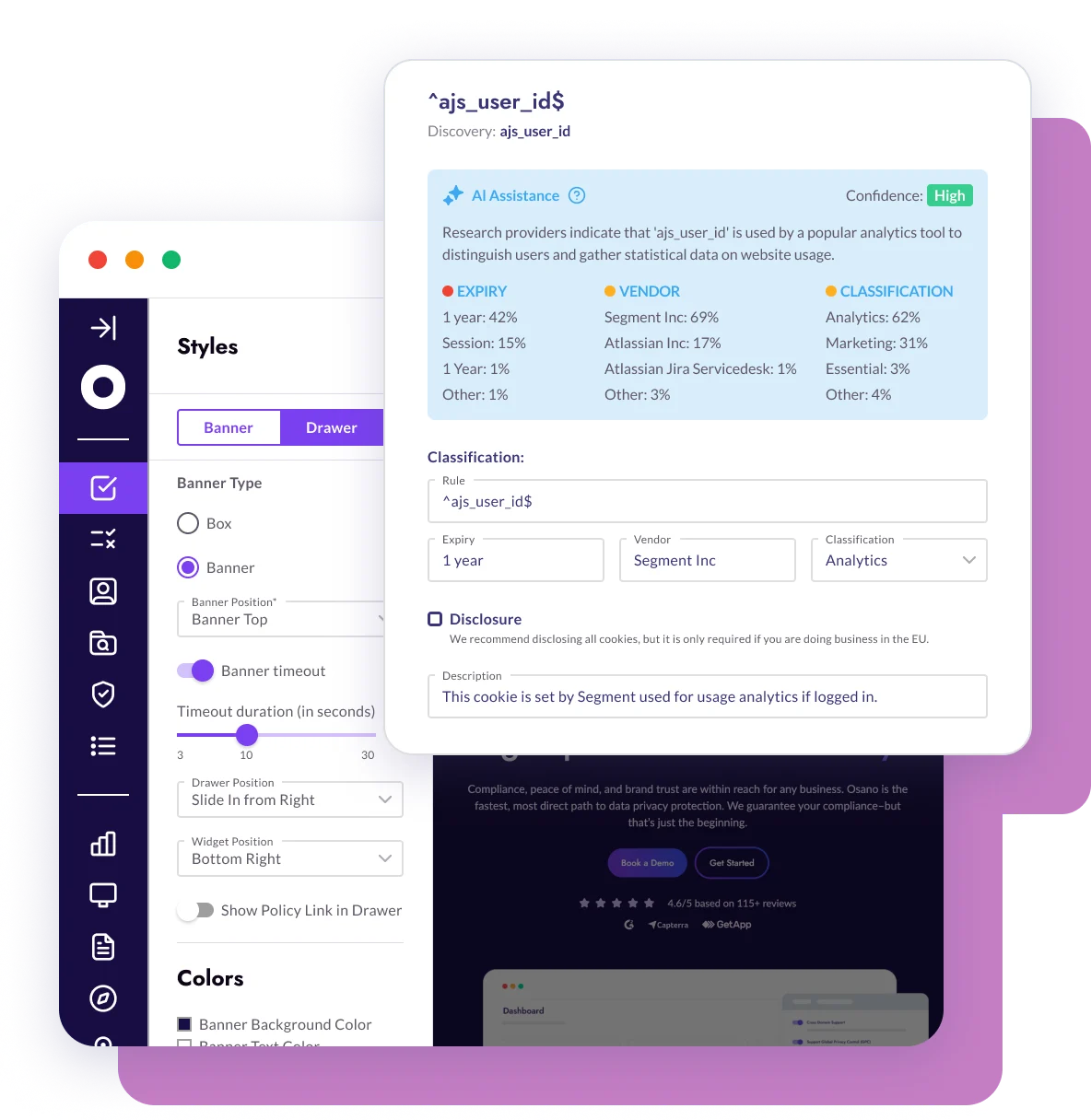
Recently, they added Compliance Check, which scans your site on a schedule to confirm GPC is honored and to flag dark patterns in your banner. Cookie classification has been AI-assisted since 2025, with a confidence score on each suggestion.
Osano also backs its work with a “No Fines, No Penalties” guarantee that covers fines up to $500,000 under its terms. It comes only with the custom-priced Basic Privacy plan, which also adds data subject requests, data mapping, assessments, and vendor risk.
The Plus plan covers three domains and 30,000 monthly visitors, and anything bigger needs a quote. TCF is available as an add-on you switch on, and Google rates Osano at its Silver tier.
Pros & Cons
PROS
CONS
Pricing
| Plan | Price |
|---|---|
| Free (1 domain, 5,000 visitors) | $0 |
| Plus (3 domains, 30,000 visitors) | $199/month |
Good to know
Osano offers a 30-day free trial, and nonprofits and startups can get some discounts.
08. Ketch
Consent orchestrationConsumer brands that need consent enforced across their data stack
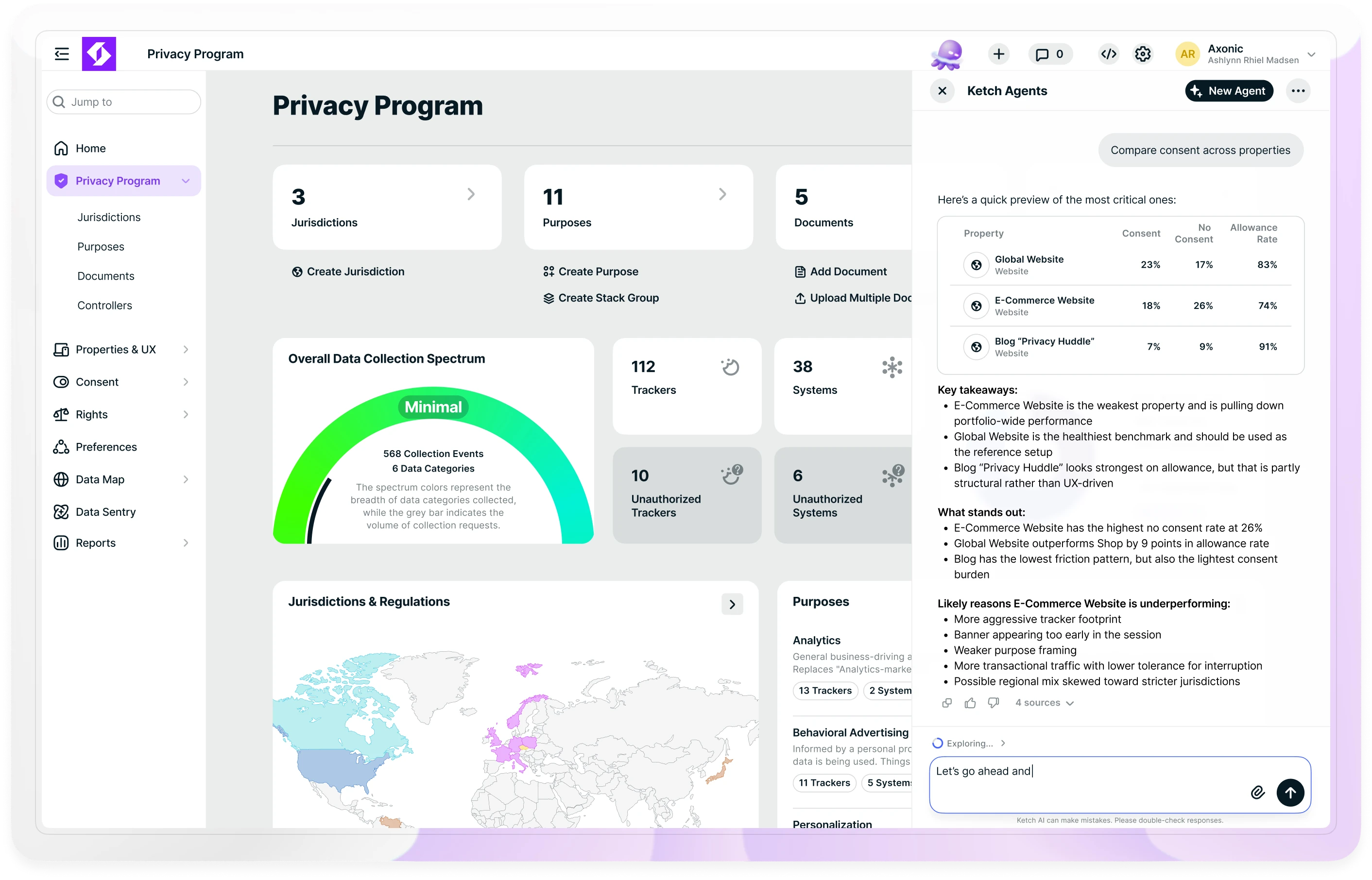
Ketch argues a consent choice should follow the customer into every system that holds their data. Its Permission Vault keeps a server-side record of each person’s consent and preferences, and server-to-server signals push every change to CRMs, CDPs, ad platforms, data warehouses, and AI systems. Identity Sync links profiles, so one opt-out covers all of them.
That makes the integration list the real feature, with Segment, Tealium, mParticle, Hightouch, Salesforce, HubSpot, Snowflake, BigQuery, and Databricks among them.
Progressive Consent, launched in 2025, asks for permissions in context instead of all at once, and age gating and video consent followed. In May 2026, it launched the Ketch Agent Network, agentic AI for privacy programs.
Pricing is based on monthly unique users across web and app. Plans below Pro include only two data-system integrations, which limits the very orchestration that makes Ketch worth choosing.
Pros & Cons
PROS
CONS
Pricing
| Plan | Price |
|---|---|
| Free (5,000 monthly users) | $0 |
| Starter (30,000 monthly users) | $150/month, billed monthly |
| Plus (100,000 monthly users) | From $499/month, billed annually |
09. TrustArc
Enterprise privacy suiteEnterprise privacy teams that need audit-ready programs
TrustArc has worked in privacy since 1997, when it started as TRUSTe, and it still sells to large compliance teams that need to show their work. More than 1,200 customers in 25 countries use it.
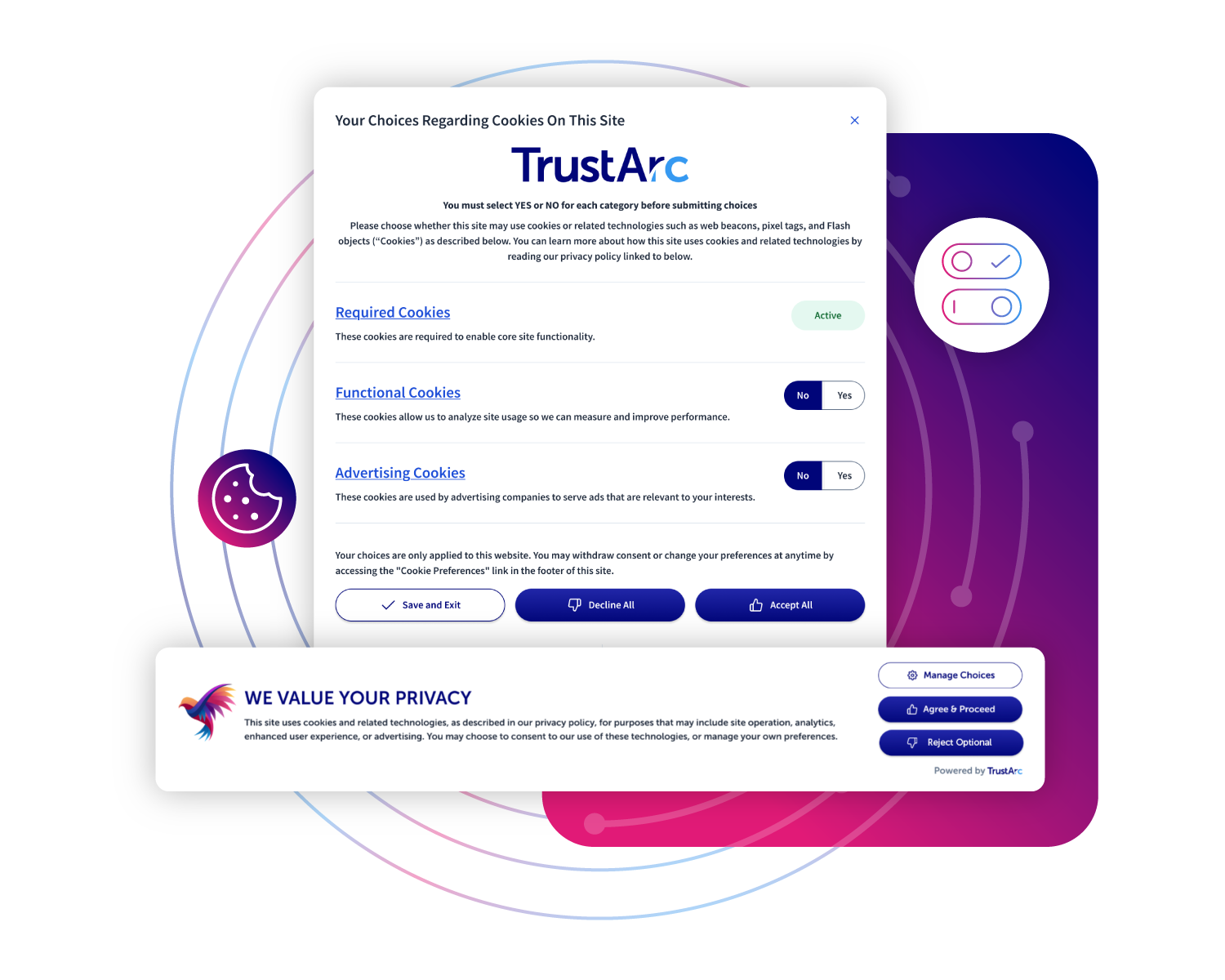
Its Cookie Consent Manager scans without limits, including pages behind a login, auto-blocks scripts, and applies location-based rules across more than 100 jurisdictions. Since June 2026, GPC is on by default in every standard template, and banners meet WCAG 2.2 AA accessibility. A single choice can now carry across linked domains, web, and mobile apps.
Consent is one part of a larger suite. Individual Rights Manager handles data subject requests, Data Mapping and Risk Manager covers records of processing, and Assessment Manager runs privacy and AI risk assessments. Arc, an AI layer answers questions and speeds up banner design.
Pros & Cons
PROS
CONS
10. Termly
Consent + policy generatorSmall businesses that want a banner and legal policies together
Termly bundles two jobs small businesses usually handle separately: the consent banner and the legal documents behind it. The same subscription generates your privacy policy, cookie policy, and terms, and keeps the cookie policy in line with what its scanner finds.
The scanner sorts cookies into categories, and an auto-blocker holds scripts until the visitor agrees. Regional rules cover more than 25 laws across 80 regions, so an EU visitor gets opt-in choices while a visitor from a US state without a privacy law may see no banner at all.
Termly became a Google Gold-tier CMP partner and added TCF 2.3. Both, along with Advanced Consent Mode, multi-language banners, and consent logs, sit on the Pro+ plan.
It covers websites only, with no mobile or CTV SDK and no A/B testing. A WordPress plugin is available, but the script works on any site, including Wix, Squarespace, and Next.js.
Pros & Cons
PROS
CONS
Pricing
| Plan (per website) | Billed yearly | Billed monthly |
|---|---|---|
| Free | $0 | $0 |
| Starter | $10/month | $14/month |
| Pro+ | $15/month | $20/month |
11. consentmanager
Publisher and app CMPPublishers and app owners who need deep TCF control
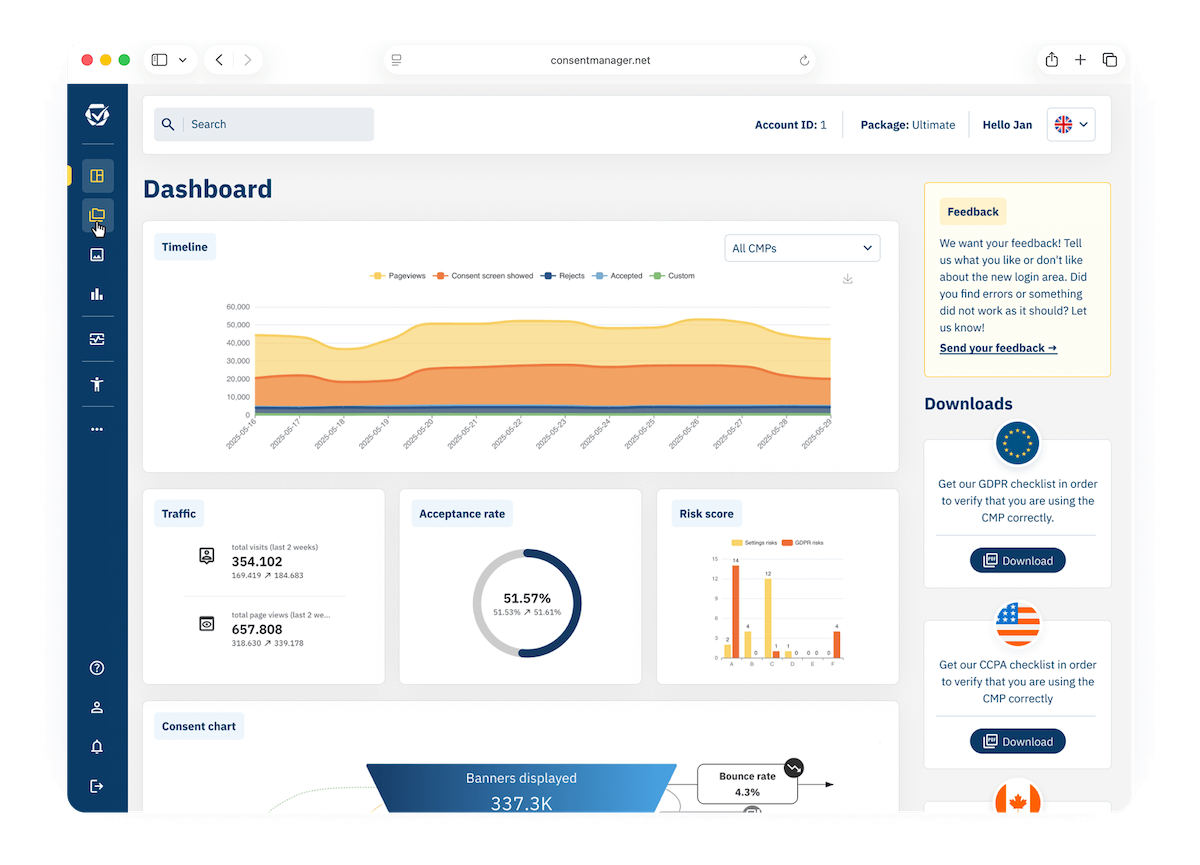
consentmanager runs on more than 100,000 websites and is one of the few CMPs here that treats apps and connected TV as first-class. It ships SDKs for iOS, Android, Unity, React Native, and Flutter, works with attribution tools such as AppsFlyer and Adjust, and added a CTV preference center lately.
It’s built for teams that live on ad revenue. TCF 2.3, IAB GPP for US opt-outs, and banner A/B testing come with the Essential plan, and the company says testing can lift consent rates by up to 15%. Scans run up to 10 times a day, consent logs stay in the EU, and banners come in 32 languages.
Pros & Cons
PROS
CONS
Pricing
| Plan | Price |
|---|---|
| Starter (100K pageviews) | €23/month |
| Essential (1M pageviews) | €59/month |
Good to know
Extra pageviews cost €0.11 per 1,000 on Starter and €0.05 per 1,000 on Essential.
12. InMobi CMP
Free publisher CMPAd-funded publishers and apps on a tight budget
InMobi CMP is what Quantcast Choice became after InMobi bought it in 2023, and it’s still one of the few free options. The Essentials plan has no limits on sites, apps, pageviews, or users, and it includes Google Consent Mode v2 and GPC support.
It’s built around ad monetization. It supports TCF 2.3 and IAB GPP on web and apps, with SDKs for iOS, Android, Unity, and React Native, plus AMP. It’s Google-certified.
Free comes with trade-offs. Geo-targeting, custom non-IAB vendors, detailed analytics, and removing InMobi’s branding need the Premium plan. Premium is free if you monetize through InMobi’s own ad exchange.
There’s no cookie scanner or auto-blocker. It works through TCF vendor signals, which suits an ad stack better than general cookie compliance.
Pros & Cons
PROS
CONS
Pricing
| Plan | Price |
|---|---|
| Essentials | Free |
| Premium | $20 per domain or app/month |
Honorable Mentions
Now part of Didomi, but still sold separately to large publishers such as CNN. Its CMP is Google-certified for web, app, and connected TV.
Consent is one module inside a wider data security and AI governance platform. Veeam bought Securiti in December 2025.
Blocks tracker traffic at the network level and pushes consent choices into internal systems, not only the website banner.
A Google Gold-tier CMP that charges by sessions, not pageviews. Free under 1,000 sessions a month, then from €6 a month. TCF 2.3 starts on the Business plan.
One of the cheapest Gold-tier CMPs, from €6 a month on annual billing, with a free plan for one small site and a built-in privacy policy generator.
A French Gold-tier CMP known for friendly, highly branded banners. It bought Brazil’s AdOpt in 2025. Plans start at 7 a month, shown in your local currency.
Built for publishers, with a free plan for one small site and a built-in consent-or-pay option on its top plan. Gold tier and TCF 2.3 certified.
A Gold-tier publisher CMP from €25 a month that can be free for sites willing to share visitor data with Sirdata. It also offers server-side tagging and cookieless targeting.
How a Consent Management Platform Works
Most CMPs follow the same sequence, whatever the banner looks like.
- Scan – the CMP crawls your site to find cookies, tags, and third-party scripts, then sorts them into categories such as necessary, analytics, and marketing.
- Block – non-essential scripts are held back until the visitor makes a choice. This is the step many “banner-only” tools skip, and it’s the one regulators check.
- Ask – the banner appears, adapted to the visitor’s location. An EU visitor sees opt-in choices, while a visitor from a US state may see an opt-out link instead.
- Signal – the choice is passed to your tags. Google tags receive it through Consent Mode v2, ad vendors through an IAB TCF consent string, and US opt-outs through the IAB Global Privacy Platform or the GPC browser signal.
- Record – each choice is logged with a timestamp and the banner version shown, so you can prove consent if a regulator or partner asks.
What changed in 2026
- TCF 2.3 became mandatory. Since February 28, 2026, consent strings must include a “disclosed vendors” section proving which ad vendors the visitor was actually shown. Strings without it are treated as invalid, so an outdated CMP can quietly cut ad revenue.
- TCF 2.4 is already on the way. IAB Europe published version 2.4 in July 2026. CMPs must support it on websites by October 23, 2026, and in mobile and TV apps by February 23, 2027. Ask your vendor for its rollout date.
- Consent Mode now carries more weight. Since June 15, 2026, Google Consent Mode is the only control over advertising data flowing from Google Analytics into Google Ads. The Google Signals setting no longer acts as a backstop, so a misconfigured CMP now affects your ads data directly.
- Google’s certified CMP rule still applies. Sites using AdSense, Ad Manager, or AdMob need a Google-certified CMP to serve personalized ads in the EEA and UK (since January 2024) and Switzerland (since July 2024). Google grades certified CMPs as Gold, Silver, or Bronze.
- US state laws kept multiplying. Twenty states now have comprehensive privacy laws. Twelve of them, including California, Colorado, Texas, and New Jersey, require businesses to honor Global Privacy Control as an opt-out.
- EU cookie rules may change. The Digital Omnibus proposal would move cookie consent rules into the GDPR, require one-click rejection, and make browser-level consent signals binding. It’s still being negotiated, so the current GDPR and ePrivacy rules apply until it’s adopted.
How to Choose a Consent Management Platform
- If you sell ads through Google in Europe, a Google-certified CMP with current TCF support isn’t optional. Check the certification tier, since Gold means the CMP met every criterion Google grades.
- EU traffic needs opt-in consent and TCF. US traffic needs opt-out handling, GPC, and ideally IAB GPP support. A CMP that geo-targets both saves you running two tools.
- Websites are table stakes. If you also have iOS or Android apps, or a CTV app, confirm there’s a native SDK and that consent syncs across them.
- Vendors charge per domain, per subpage, per session, or per pageview. A plan that looks cheap can jump once traffic grows, so model it against your real numbers.
- A small site needs a banner, blocking, and logs. A larger business may want data subject requests, data mapping, and vendor risk in the same platform, which points to OneTrust, Osano, or TrustArc.
FAQ
Do I need a CMP if my site doesn’t run ads?
Usually yes. Analytics, embedded videos, chat widgets, and social pixels all set non-essential cookies. If you have visitors from the EU, UK, or a US state with a privacy law, you need a lawful way to handle their consent or opt-out.
Is a free CMP good enough?
For a small site with little traffic, maybe yes. Free plans from Cookiebot, CookieYes, and InMobi cover the basics. They usually cap pageviews or domains and may lack TCF, US opt-out handling, or consent log exports.
What’s the difference between a CMP and a cookie banner plugin?
A plugin often only displays a notice inside one CMS. A CMP blocks scripts, sends consent signals to Google and ad vendors, and keeps auditable logs across every site and app you run.
Does Google Consent Mode v2 replace a CMP?
No. Consent Mode only tells Google tags what the visitor chose. You still need a CMP to ask the question, block other trackers, and record the answer.