
You want the best people from everywhere around the world, but you would rather not learn every country’s labor rules. This is what contractor management platforms are built to solve.
According to the Deel Global Hiring Report, with 82% of all workers hired being remote and the number increasing, both domestic and cross-border in 2024, the challenge is only getting bigger.
That’s why I put together this guide on the best global contractor management platforms. These tools can handle contracts, payments, and local compliance, allowing you to focus on scaling your team rather than chasing paperwork.
Global Contractor Management Platforms for Remote Teams – Comparison
Here are is a comparison of the contractor management platforms when speed and compliance matter. They handle employee onboarding, invoicing, and local regulations so your remote team can scale confidently, with fewer surprises and more predictable payroll cycles.
 |  |  |  |  |  |  |  |  | |
180+ | 185+ | 160+ | 140+ | 170+ | 150+ | 150+ | 180+ | 180+ | |
Budget-friendly contractor tool with AI checks and Wise-powered payouts. | Enterprise-grade compliance depth across complex markets; new Pebl brand rolling out. | Strong global payments stack (Worker Wallet, fast transfers) built for scale. | All-in-one HR/IT platform; contractors plug into the same system you use for employees. | EU-friendly pricing and coverage; integrated payments and localized contracts. | Mature contractor suite; Contractor of Record and Premium tiers for extra protection. | Optional misclassification insurance, Shell noted; availability may vary. | Contractor of Record with uncapped indemnity; standard plan stays budget-friendly. | Smooth onboarding; clear contracts; simple per-contractor pricing. | |
No (risk checks, but no stated indemnity program). | Not stated (focus on risk assessment; indemnity not publicly listed). | Optional/programmatic coverage (risk & liability coverage materials available, confirm scope with sales). | No public indemnity for contractors (compliance tools available) | No public indemnity program. | Yes (via Contractor of Record / Premium). | Not stated (COR positioning; no public indemnity limits). | Yes (uncapped via COR). | Smooth onboarding, clear contracts, and simple per-contractor pricing. | |
Custom | Custom | Custom | Custom | €19/contractor/mo. | $49/contractor/mo (Contractor Mgmt). COR from $325/contractor/mo | $25/contractor/mo | $29/contractor/mo (Contractor Mgmt). COR from $325/contractor/mo. | $29/contractor/mo. | |
Geekflare’s editorial team determines ratings based on factors such as key features, ease of use, pricing, and customer support to help you choose the right business software. | |||||||||
Alright, now that you’ve seen the quick comparison, let’s slow it down and walk through each platform one by one. This is where you’ll get the complete picture, what each tool does well, where it falls short, and why it may (or may not) be the right fit for your team.
1. G-P
G-P positions itself as a contractor-friendly platform with one of the largest footprints. It helps you get the basics right without managing five tools. You draft agreements inside the system and get gentle prompts when something looks risky (role, scope, location). Payments and docs live in one place, which keeps handoffs cleaner for HR and finance.
On the flip side, indemnity isn’t included, so if misclassification risk is your top concern, you’ll need extra coverage elsewhere.

Top Features
- Role-based access: Separate views for HR, finance, and managers reduce “who can see what?” confusion and keep approvals moving.
- Change management: Easily add/drop professionals, make compensation changes, and apply bonuses without opening tickets.
- Service handoffs: Ticketing and updates keep everyone aligned when you’re scaling across multiple countries.
Pros

Helpful, responsive support team.
Payments arrive on time with clear comms.
Clear onboarding communication.
Good when you lack a local entity (EOR option in the same suite).

Cons
Phone support is hard to reach.
AI chatbot guidance is limited for complex needs.
Pricing not publicly listed; requires a quote.

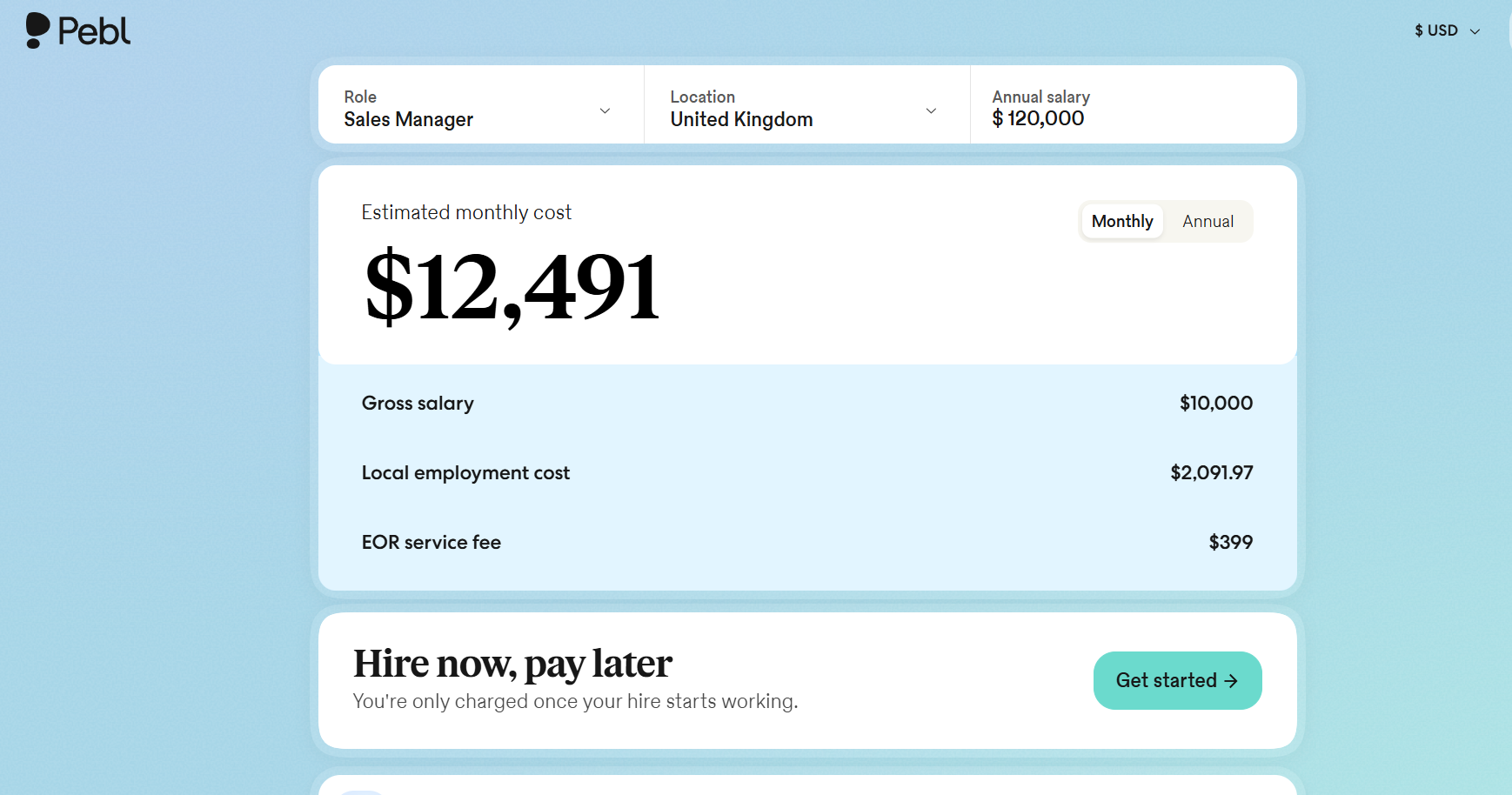
2. Pebl (Velocity Global)
Pebl (earlier known as Velocity Global) is more than just a hiring platform; it doubles as a partner for solving messy, country-specific problems.
Reviewers highlight how quickly they jump in to onboard new hires and how they support complex pay setups, especially in markets where regulations are unpredictable. The platform is clearly built with enterprise needs in mind.
The flip side? Contractor indemnity isn’t part of the standard package, and smaller teams may find the enterprise focus heavier than what they actually need.
Top Features
- Compensation guidance: Offers tailored advice on salary bands, benefits, and structures in markets where compliance can be tricky.
- Entity-free hiring: Allows you to establish a presence in new countries without setting up a local branch.
- Employee experience: Provides direct support to workers with payroll and benefits queries, taking some of the burden off your HR team.
Pros
Helpful in structuring pay in complex markets.
Simplifies hiring in countries without entities.
Handles compliance across multiple regions.
Smooth setup for global employees.
Cons
Some features are hidden behind the sales process.
Branding shift (to Pebl) may cause confusion.
Limited info on contractor-specific protections.
3. Papaya Global
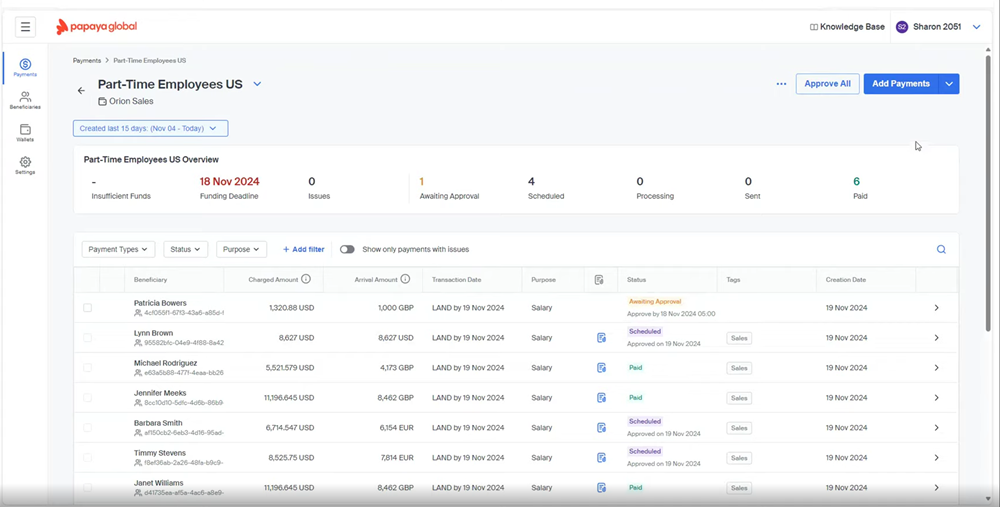
Papaya Global is built around payments first, and that’s its biggest strength. Their Worker Wallet setup makes it easier to pay people quickly in their own currency, and the platform also automates collecting and managing tax forms.
That said, it’s not the lightest option; time tracking isn’t built in, and you’ll need to handle that separately. Reviews often split here: finance teams love the reliable transfers, while some end users have called out issues with the employee-facing interface.
If global payroll and compliance are your biggest headaches, Papaya Global is worth considering.
Top Features
- Worker Wallet: Contractors and employees get paid directly into a secure digital wallet, cutting down transfer delays and FX hiccups.
- Tax documentation: The platform automatically gathers required forms for each market and keeps them stored for audits or compliance checks.
- Analytics dashboard: Provides finance and HR teams with a real-time view of payroll costs across regions, aiding in planning and forecasting.
Pros
Payments are reliable once set up.
Helpful for centralizing tax forms.
Scales well for large teams.
Clear cost reporting.
Cons
Address and payslip errors have been reported.
No built-in time tracking.
Some fixes require repeated support tickets.
Users report delays in resolving simple errors.
Concerns raised about trust in handling sensitive data.
4. Rippling
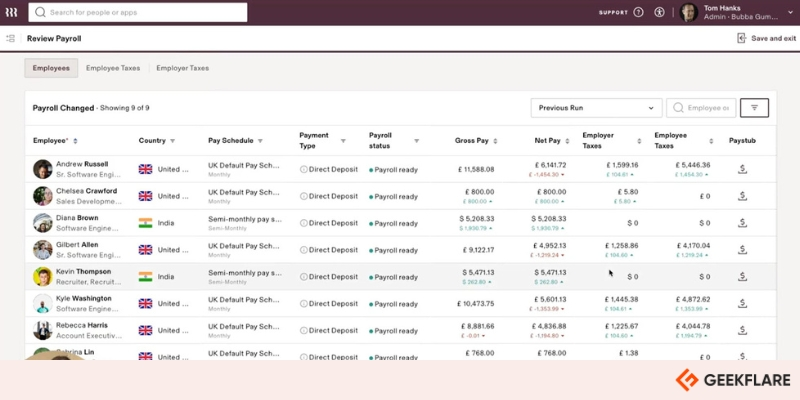
Rippling centralizes contractor operations on the same data model you use for employees, so HR, finance, and IT run off one source of truth. That means policy-driven onboarding, automated approvals, and auditable changes across payroll, access, and assets.
For teams standardizing global operations, the appeal is governance: role-based controls, granular logs, and reporting that rolls up spend by project, cost center, and region. The trade-off is that Rippling focuses on optimizing a unified workforce platform.
Top Features
- Device and app management: Rippling links HR data with IT systems, so when a contractor joins or leaves, their access and hardware can be managed in the same place.
- Custom workflows: Build onboarding sequences or approval flows that include both employees and contractors, saving time for managers.
- Analytics and reporting: Consolidated dashboards show spend across employees and contractors, with detailed breakdowns by project, role, or country.
Pros
Contractors can be paid in the same system as employees.
Good analytics and reporting.
Simplifies offboarding with IT links.
Cons
Canadian payroll has repeated issues as per reddit reviews.
Users need to know the local tax law themselves.
Weak support in non-US regions.
Pricing is hidden behind sales calls.
5. Lano
Lano focuses on payroll and contractor payments for European and global firms. It works as a hub where you manage payments across all locations in one system. Finance leaders tend to like it for simplifying payroll runs and consolidating costs, though the pricing is higher than leaner tools.
Its strength lies in centralizing data, tax, and reporting, allowing you to manage providers country by country from a single dashboard.

Top Features
- Automated updates: Payroll data feeds in from different sources and syncs into one platform, reducing manual entries.
- Expense reporting: Contractors can submit expenses that flow into payroll, making reimbursements faster.
- Customer support: Users call out responsive support teams that step in to resolve issues quickly.
Pros
One platform for all payroll inputs.
Real-time updates for payroll data.
Clear audit trail for compliance.
Actual human customer service is praiseworthy.
Cons
Pricing is higher than some peers.
Limited integrations outside Europe.
Some advanced features need higher plans.
Not the cheapest option.
6. Deel
Deel is one of the most recognizable names in this space. Its platform bundles contracts, payments, and compliance under one roof, making it appealing to fast-scaling startups and mid-sized firms.
Users appreciate the transparency of dashboards that display both expenses and upcoming payments. But with so many modules, some new users find the interface overwhelming, and costs can stack up for smaller companies. Deel’s biggest value is consistency: whether you’re hiring in one country or fifty, you know the system will look and feel the same.

Top Features
- Compliance monitoring: Real-time checks for local law alignment across contractor contracts.
- Tax support: Collects and stores the right tax forms automatically.
- Reporting dashboards: Visuals for payroll costs and upcoming liabilities by region.
Pros
Fast and knowledgeable support.
Dashboards with clear visibility.
Reliable for global scaling.
Strong compliance expertise.
Cons
It can feel overwhelming at first.
Fees may be high for small firms.
Extra modules increase overall cost.
7. Remofirst
Remofirst positions itself as a budget-friendly option for global hiring and contractor management. It covers more than 150 countries, making it attractive to smaller firms that want scale without burning cash.
Strengths include its straightforward pricing and bundled benefits support. But the trade-off is depth: while core payroll and EOR are there, you won’t get the extra layers of indemnity or high-touch customization that larger providers offer. It’s best for companies that prioritize cost efficiency and wide reach over complex feature sets.
Top Features
- Cost control: Flat pricing that undercuts many larger providers.
- Benefits support: Handles health, leave, and local requirements for contractors and employees.
- Country coverage: Active in 150+ markets for payroll and EOR.
Pros
Affordable compared to peers.
Very Straightforward setup.
Benefits bundled in.
Cons
It has limited integrations.
Limited advanced compliance features.
Customization is minimal.
8. Remote
Remote has carved a reputation for focusing on contractor protections. The standout is its Contractor of Record model, which provides uncapped indemnity for misclassification risks—rare in this market.
Standard plans are affordable, but if you want indemnity, you’ll need to pay for COR. The platform is easy to navigate and user-friendly, though reviews highlight exchange rate concerns. Remote works well if compliance is your biggest fear and you want reassurance in writing, but smaller firms may find COR costs steep.
Top Features
- Indemnity coverage: Contractor of Record option comes with uncapped protection.
- Integrations: Links with HR and finance tools for smoother data flow.
- Multi-currency payments: Pay in local currencies with centralized approvals.
Pros
Affordable base pricing.
Offers uncapped indemnity.
Strong compliance focus.
Clear contractor workflows.
Cons
COR plan is expensive.
Concerns with FX rates in some markets.
Not the best fit for micro teams.
9. Oyster
Oyster appeals to teams that want a straightforward, easy-to-use contractor platform. It emphasizes clean onboarding flows, reliable support, and competitive per-contractor pricing.
The optional Shell program provides misclassification insurance, which adds flexibility. Users appreciate the UI’s simplicity, but some note that FX rates are not as favorable as market averages.
Oyster is best suited for companies that value usability and customer support, but you’ll need to keep an eye on costs if you’re moving large sums across borders.
Top Features
- Onboarding: Smooth start process with templates and guided steps.
- Compliance assistance: Built-in checks for local contractor agreements.
- Customer support: Known for fast and responsive help teams.
Pros
Compliance checks are built in.
Affordable entry point.
Cons
FX rates are lower than the market average.
No advanced payroll analytics.
Smaller presence than global payroll services like Deel/Remote.
Key Features to Look For in a Contractor Management Platform
You don’t need a hundred bells and whistles. You just need a few things to keep money moving, ensure contracts are clean, and keep work on track. Here’s what I check first:
- Global payments and currencies: Can you pay people where they live, in the money they use, without delays? Look for multiple payout methods, clear FX, and confirmed coverage for the countries on your roadmap.
- Localized, compliant contracts: Templates should adapt to local rules and include IP, confidentiality, and termination terms that match the country. That’s how you avoid messy rework later.
- Automated invoicing and tax forms: Good tools create invoices, collect W-8/W-9 or local equivalents, and automatically chase missing documents. Fewer emails, fewer errors, faster month-end.
- Onboarding and offboarding: A clean flow to invite, verify, sign, and start. The same clarity when the work ends, including final payments and access removal.
- EOR option when you need it: Sometimes, a contractor becomes core to the team. Platforms that also offer EOR let you convert without rebuilding everything from scratch (see Geekflare’s guide on EOR vs contractor).
Scaling Remote Teams with the Best Global Contractor Management Platforms
The engine of global work is simple: lawful contracts, money that moves, and records you can trust. The best global contractor management platforms keep those pieces moving so your team can focus on the work.
We compared 9 tools with different strengths: coverage, payment rails and FX clarity, onboarding flows, indemnity or an EOR path, integrations, and transparent pricing. Match these to your budget and risk, and you’ll avoid most surprises.
Frequently Asked Questions (FAQs)
Yes. Contractor platforms (e.g., Deel, Remote) are built to pay contractors in many countries, including contractors within your own country via invoicing + payouts.
Yes. It is often advisable, especially for higher-risk items (IP, confidentiality, termination, local labor nuances, or if you’re near the employee/contractor line). Platforms provide workflows and templates, but they aren’t a complete substitute for legal advice; typical disclaimers say the service isn’t legal counsel.
Significant. In the U.S., misclassification can leave a company liable for back taxes and penalties under IRS/DOL rules. In India, authorities can levy fines and require back payments/benefits when a worker should have been an employee. Some platforms (e.g., Remote’s Contractor Management Plus) sell indemnity add-ons, but you still need sound classification practices.