



Workload Automation (WLA) has been the backbone of enterprise IT for decades to run business processes run smoothly. However, as IT landscapes expand into hybrid cloud environments, the definition of automation is expanding with them.
Did you know?
WLA market is mature as its first instance of implementation occured 40 years ago! It was first used in 1970s for job scheduling on Mainframes.
The WLA market is projected to grow at a CAGR of 7.4% by 2031. To meet this growing demand and handle increasing complexity, the technology is evolving into Service Orchestration and Automation Platforms (SOAP).
SOAP represents the next generation of workload automation. It takes the reliability of traditional WLA and extends it to orchestrate modern infrastructure. In fact, Gartner estimates that 90% of organizations currently delivering workload automation will evolve to using Service Orchestration and Automation Platforms to manage their data pipelines and cloud-native applications.
But what exactly do SOAP platforms bring to the table?
SOAP tools allow organizations to automate and orchestrate their entire technology stack, seamlessly bridging the gap between workflows, workloads, and data pipelines. They operate across hybrid environments, cloud, on-premise, and containerized systems under a single control pane.
In this review, I’ll go through the top service orchestration platforms, including RunMyJobs, BMC Control-M, Stonebranch, and others. To rank these tools, we took note of the following criteria:
| Criterion | Description |
|---|---|
| Cloud-native architecture (SaaS vs. On-prem) | A SaaS/SaaS native platform offers better flexibility as it doesn’t require heavy early investment, unlike on-premise solutions. They also offer a simple upgrade path, high scalability, and easy integration. |
| Integration capabilities (API-first) | REST APIs for seamless integration with other platforms and services. |
| Scalability | Ensure smooth operation when needed with scalability support. |
| Low-code/no-code usability | Access to low-code or no-code tools for better accessibility and implementation. |
Top SOAP Tools Comparison
| Platform | Deployment Type | Key Strength | Ideal For |
|---|---|---|---|
| RunMyJobs | SaaS | – great SAP integration, Unlimited connectors/integrations – comes with predictive SLAs and monitoring | Enterprises |
| BMC Control-M | SaaS/on-prem | – robust mainframe support | Enterprises |
| Stonebranch Universal Automation Center | SaaS/on-prem | – modern interface – good DevOps integration | Mid-to-large enterprises |
| OpCon | SaaS/on-prem | – low code- Robust REST API – reliable for running business-critical processes | Banks and credit unions, mid-to-large enterprise level |
| Resolve | SaaS | – AI-driven IT automation – self-healing workflows | Enterprises |
| JAMS | Not SaaS but can be run in cloud. | – support multiple native schedulers across entire IT environment – Windows-based | Medium to large organizations |
| Kestra | On-prem, Cloud | – developer-first workflow- modular & language – agnostic framework | Medium to large organizaitons |
| ServiceDesk Plus | SaaS/on-prem | – AI-capabilities – incident management – problem management – change management | SMEs |
Top SOAP Tools Review
1. RunMyJobs
Best Overall & True SaaS
In my experience, I found RunMyJobs to be the best service orchestration platform. It’s SaaS-native, offers predictive SLAs, and supports full-stack connectivity. RunMyJobs is from Redwood, which has an active portfolio of cloud-based automation solutions, including ActiveBatch (suitable for midmarket) and Tidal.
In fact, Gartner, the leading research and advisory firm, ranked Redwood software two years in succession for 2024 and 2025 as the leader in Service Orchestration and Automation Platforms (SOAPs).
It ranked furthest in “Completeness of Vision” and Highest in “Ability to Execute” criteria.
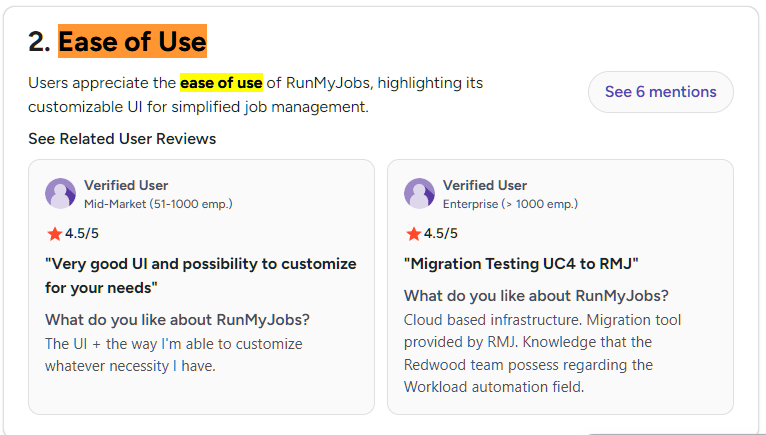
I also found RunMyJobs to offer user-friendly interface. And, that’s backed up by actual users on G2.
Users on its G2 review repeatedly mentioned its “ease-of-use.”
Apart from its intuitive interface, users also get smooth integration capabilities, enabling teams to quickly automate their workflows. Users can opt to use one of its pre-built integrations or build a new integration with its Connector Wizard.
RunMyJobs’ open framework enables it to be a perfect pick for Enterprise Job scheduling as it relies on multiple platforms, frameworks, and services. Yes! It offers full-stack connectivity out of the box!
As for scalability, RunMyJobs offers modular workflows that help customize automations, including DevOps processes.
Overall, RunMyJobs by Redwood is an excellent pick if you want the best Service Orchestration and Automation Platform. Businesses can use it to improve system efficiency by using its job scheduling capabilities, easy integration, excellent 24/7 customer support, and seamless integrations.
RunMyJobs Key Features
- Cloud-native SaaS automation.
- AI assistance across build, learn and resolve.
- Agentless, secure gateway architecture.
- Out-of-the-box SAP connectivity.
- Centralized control and visibility with real-time dashboards.
- Predictive SLAs with the ability to identify potential breaches.
Pros & Cons
PROS
CONS
Verdict
In our research, RunMyJobs is clear #1 choice for modern enterprises moving to the cloud. With ease of use and self-service, it enables businesses to execute workloads and workflows under the IT organization’s governance. It supports both SAP and non-SAP systems as a 100% SaaS solution, ensuring easy integration and scalability.
2. BMC Control-M
BMC Control-M is my first choice when it comes to automating legacy systems. It is a legacy heavyweight capable of automating end-to-end workflows. Currently, they offer both a traditional on-premises solution and a SaaS offering, including Helix Control-M.
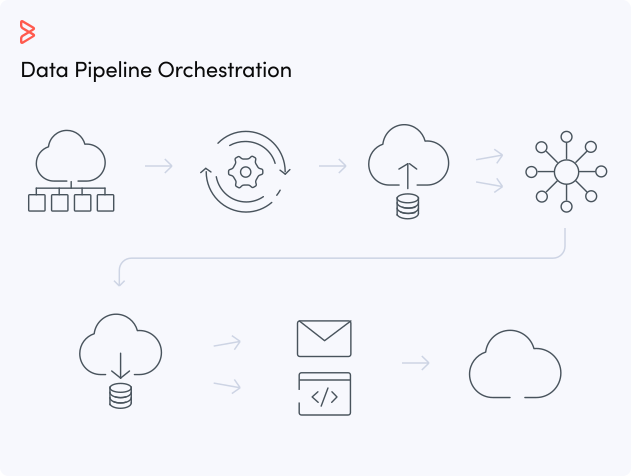
Teams can utilize BMC Control-M to orchestrate IT processes, from building, defining, deploying, and managing them — all from a single view.
BMC Control-M is capable of automating business tasks such as moving data or processing sales. For example, its newest release introduced Control-M Data Assurance, which helps users integrate data quality checks via Monitors.
With BMC Control-M, businesses can benefit in multiple ways:
- Simplify application and data workflow automation and orchestration.
- Improve reliability for critical business services with proper SLA management.
- Orchestrate complex workflows across hybrid-cloud setups.
Key features
- Complete visibility for end-to-end data pipelines.
- Works well with DevOps processes by improving collaboration and integration of application workflow into CI/CD pipelines.
- Robust mainframe support.
Pros & Cons
PROS
CONS
3. Stonebranch UAC
I strongly recommend Stonebranch for teams that actively work in hybrid environments spanning on-prem, cloud, and containerized microservices.
Stonebranch is enterprise-ready and offers a modern interface with excellent DevOps integration, making it an ideal choice for organizations looking to evolve their automation strategy beyond traditional job scheduling.
Its job scheduler is also enterprise-ready, which helps automate most IT tasks while ensuring higher quality maintenance.
Integration-wise, Stonebranch offers a wide range of options, including SAP, Red Hat, AWS Lambda, etc.
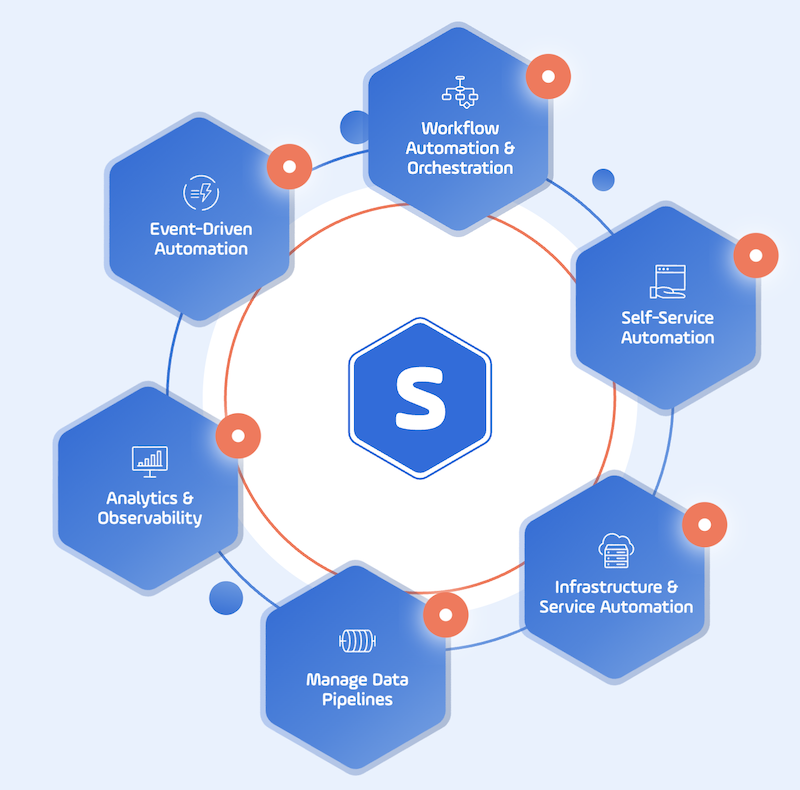
Key Features
- Offer SOAP tools with self-service automations.
- Ability to manage data pipelines.
- Offers an eagle eye view with analytics and observability that help improve SLAs.
- Provides event-driven automation that works in real-time.
Pros & Cons
PROS
CONS
4. OpCon
OpCon is a workload automation and orchestration platform, specifically designed for banks and credit unions. It is ideal for business-critical processes that require error-free automation across systems, applications, and environments.
Automation teams can use OpCon to harmonize environments through a single point of control. It provides over 70 financial integrations via REST API, while offering support for legacy system maintenance as well. Similar to other candidates in our list, OpCon offers self-service capabilities, dynamic workflows, and event-driven automation. Security-wise, OpCon offers military-grade VPN encryption and compliance.
Businesses can also scale and replicate workflows across systems, with support for multi-server configurations.
5. Resolve
Resolve helps businesses handle incidents and service requests automatically, allowing enterprises to focus on growing their business, rather than spending time solving customer problems.
This is possible through intelligent end-to-end orchestration, which focuses on rapid and consistent incident resolution. In return, businesses benefit from enhanced service uptime and reliability.
Like RunMyJobs, Resolve is recognized in the 2025 Gartner Magic Quadrant for Service Orchestration and Automation Platforms (SOAP) in the “Visionary” category.
Resolve offers 100+ integrations via APIs and also supports AI-enabled workflow creation and the ability to adapt to a dynamic environment via AI-driven orchestration.
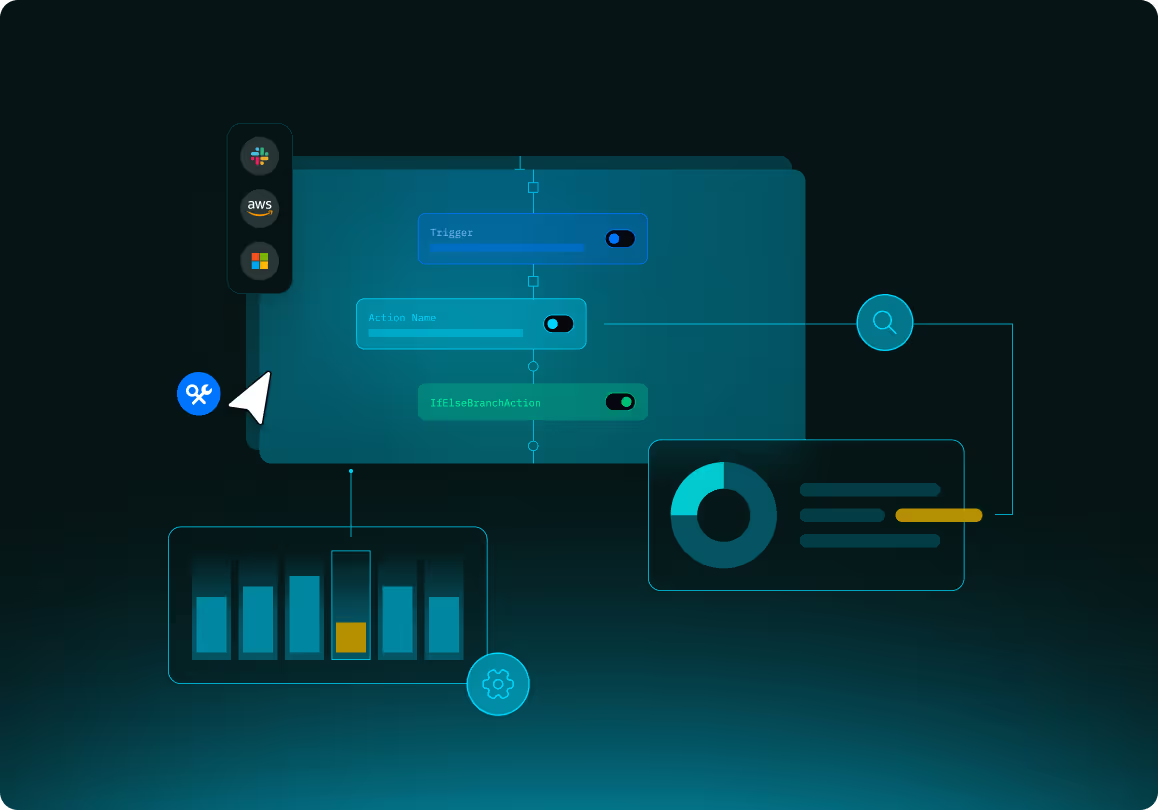
Teams can also use its AI-powered agents, including:
- RITA: an AI-driven orchestration
- Jarvis: help build workflows that scale and orchestrate. Comes with pre-built integration options.
6. JAMS
JAMS is a Windows-based centralized IT orchestration platform that helps automate workloads and provides job scheduling, while giving you complete control. It enables efficient workload management and supports users at every stage with an unparalleled customer support experience.
JAMS offers an intuitive interface with a focus on helping teams carry out automation and orchestration with ease. It works well with ETL and data pipeline orchestrations. It also supports other types of orchestration, including SAP and financial workflows.
7. Kestra
Kestra is a powerful orchestration platform. It is an everything-as-code platform that helps engineers to build, govern, and automate all workflows. It is both AI-powered and open-source.
Under the hood, Kestra supports declarative orchestration, which helps new team members quickly build and maintain workflows. Additionally, it offers easy workflow configuration via webhooks, APIs, and event-based triggers.
I found Kestra feature-rich with capabilities like easy integration options, a developer-first workflow, built-in documentation, and a modular & language-agnostic framework.
This makes Kestra a great choice for service orchestration and automation.
8. ServiceDesk Plus
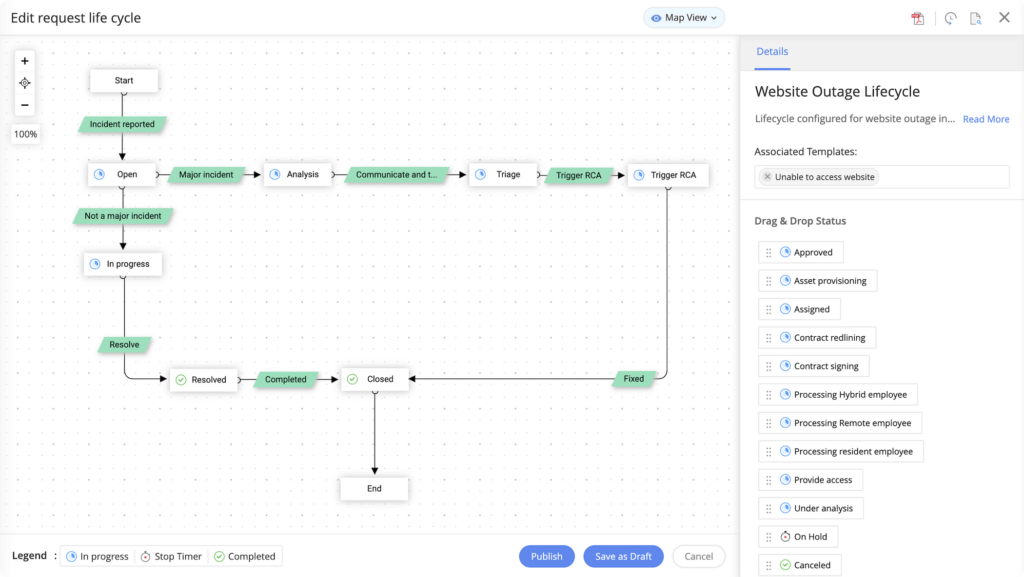
ServiceDesk Plus is an AI-driven unified service management platform. It is designed for digital enterprises, helping them build a smart service experience across their IT infrastructure.
It is one of the best RunMyJobs alternatives for service orchestration and automation. It is powered by AI capabilities, as you can choose the provider yourself (ChatGPT, Microsoft Copilot).
Under the hood, ServiceDesk Plus helps combine IT service management and IT asset management with enterprise service management capabilities.
Other SOAP Solutions
In this section, I’ll go through some honorable mentions in the Service Orchestration Automation Platforms space. I suggest checking them out.

Blueprism

Nintex

Itential

SAP BPA

Beta Systems ANOW

Blue Planet

Red Hat Ansible

HCL Workload Automation

AutoSys
What to look for in a SOAP Tool in 2026
When selecting a SOAP tool in 2026, always check for the following aspects:
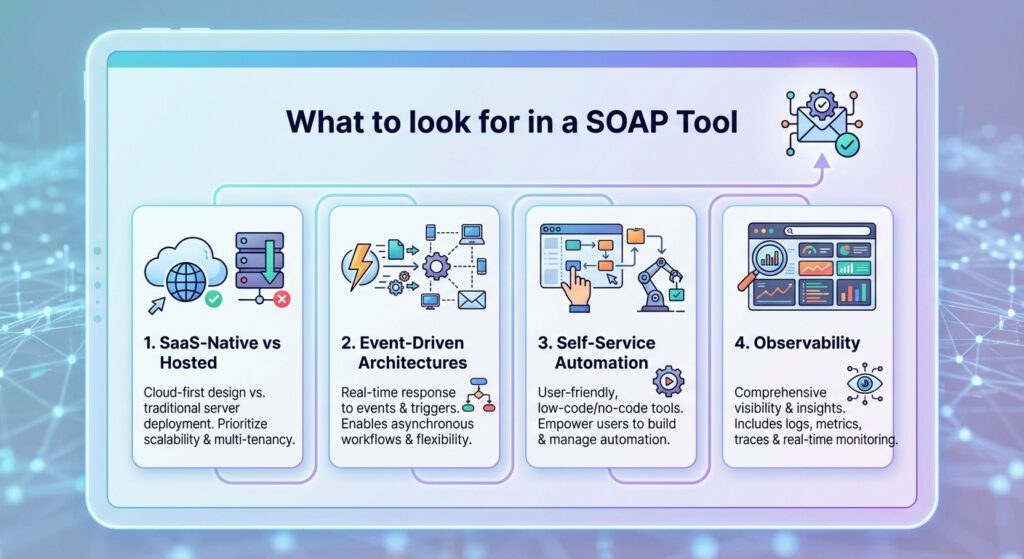
- SaaS-Native vs Hosted: Always choose SaaS-native ones, whenever possible. These are built from the ground up and work natively with multi-tenant cloud services. Furthermore, native SaaS solutions offer high scalability and zero-downtime upgrades. All of these are missing in hosted or Cloud-washed legacy tools, which are basically on-prem software wrapped in a cloud wrapper. These cloud-washed legacy tools fail due to multiple reasons, including poor cost predictability, less scalability, and a lack of the ability to offer seamless updates.
- Event-Driven Architectures: Real-time triggers are at the core of modern data applications. They allow for better flexibility and improve the system’s SLA as they can respond immediately compared to time-based scheduling. Furthermore, modern SOAP tools can handle rich event files (such as HTTP APIs, object storage), giving them the capability to handle complex tasks in real-time.
- Self-Service Automation: Self-service automation empowers business users (also known as citizen developers) to run jobs without IT tickets or custom coding. Most SOAP platforms offer self-service automation, which helps reduce 90% of the system/user issues.
- Observability: Always look for SOAP tools that offer integration with tools like Datadog, Splunk, or Dynatrace. It enables tracing and monitoring incidents directly from your observability stack, ensuring proper metric tracking and reporting.
Extending WLA into SOAP
Expanding from established WLA platforms (such as Control-M or AutoSys) to a SOAP architecture is a strategic process. It involves bridging the gap between traditional scheduling and modern orchestration, which requires attention to:
- Job and dependency mapping
- Agent and environment modernization
- Testing and validation
These steps require carefully evaluating and optimizing existing jobs to ensure they scale within the new environment. Additionally, if you opt for a non-native SaaS platform, you must address integration and data residency requirements to ensure a smooth expansion.
However, tools like RunMyJobs streamline the evolution from WLA to SOAP. By offering automated migration utilities, RunMyJobs ensures that standard jobs and dependencies are carried over and modernized automatically.
SOAP Tools FAQs
WLA is time-based and static. SOAP is real-time, event-driven, and orchestrates across cloud, on-prem, and containerized environments.
For cloud-first strategies, yes. RunMyJobs is SaaS-native, whereas Control-M is a legacy on-prem tool adapting to the cloud.
Based on SaaS capabilities and integrations, RunMyJobs by Redwood is the top-rated choice.