


Aircall announced in April 2026 that it had acquired Piper AI, a revenue intelligence and workflow automation company based in Spain.
On paper, it looks like a sensible bolt-on: Aircall runs the conversation, and Piper runs everything that comes after.
But the more you dig into what Piper actually does, the more it becomes clear this isn’t just a product addition. It’s a repositioning.
Aircall has spent the better part of a decade building an excellent cloud phone system that sales and support teams actually like using: reliable calls, clean UX, a 250+ integration library, and no enterprise procurement nightmare.
It crossed $200M in ARR. More than 23,000 businesses use it. It works. But here’s the quiet problem: Aircall’s job has always ended when the call does.
What happens next, such as logging the deal in the CRM, writing the follow-up, updating the stage, flagging that a prospect has gone quiet, etc., had always fallen on the rep. Or never happened.
Piper is Aircall’s answer to that.
What Aircall was built for
Aircall launched in Paris in 2014, at a time when the business phone system was mostly an on-premise box that IT owned and sales reps hated.
Its offering was simple: move calls to the cloud, make setup fast, and plug into the CRMs and help desks that teams already run on. It turned out to be a good bet.
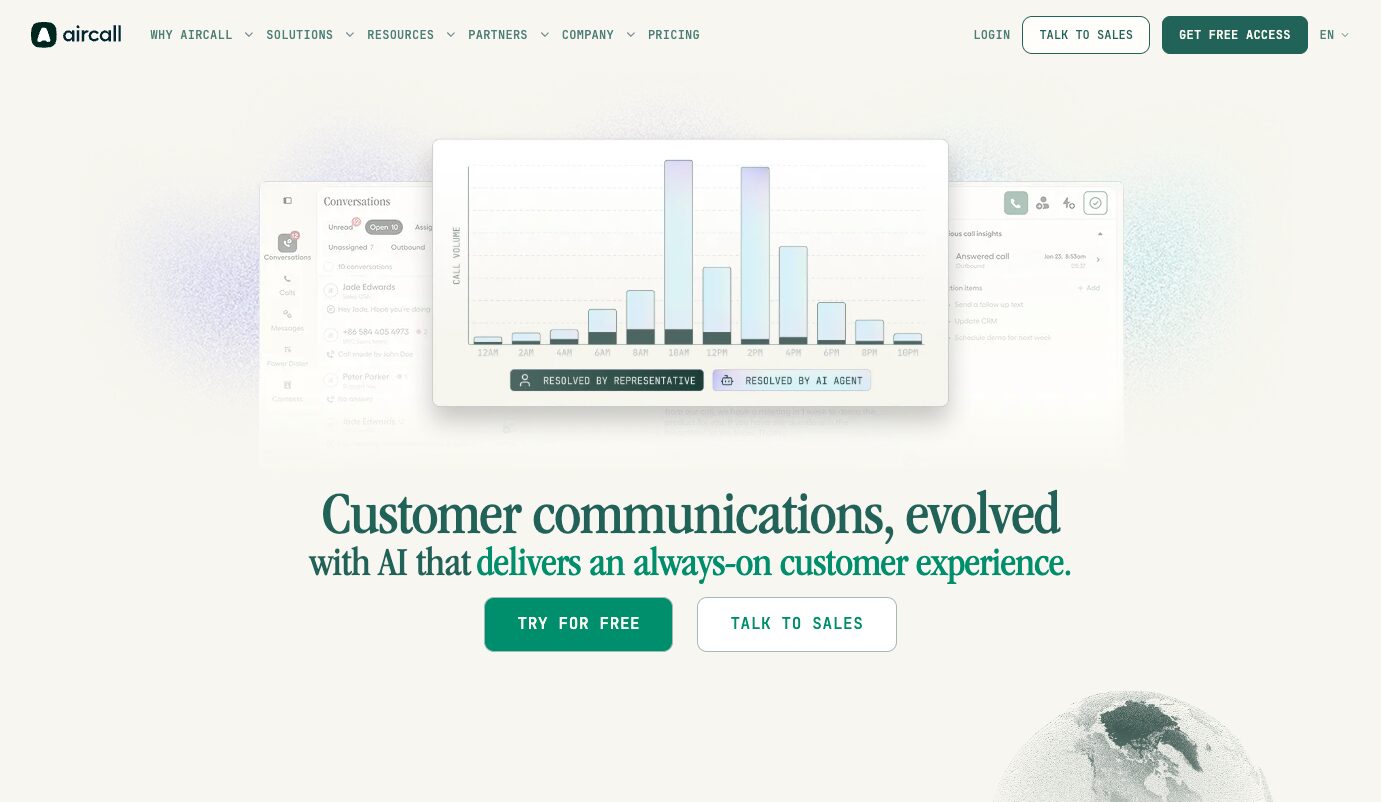
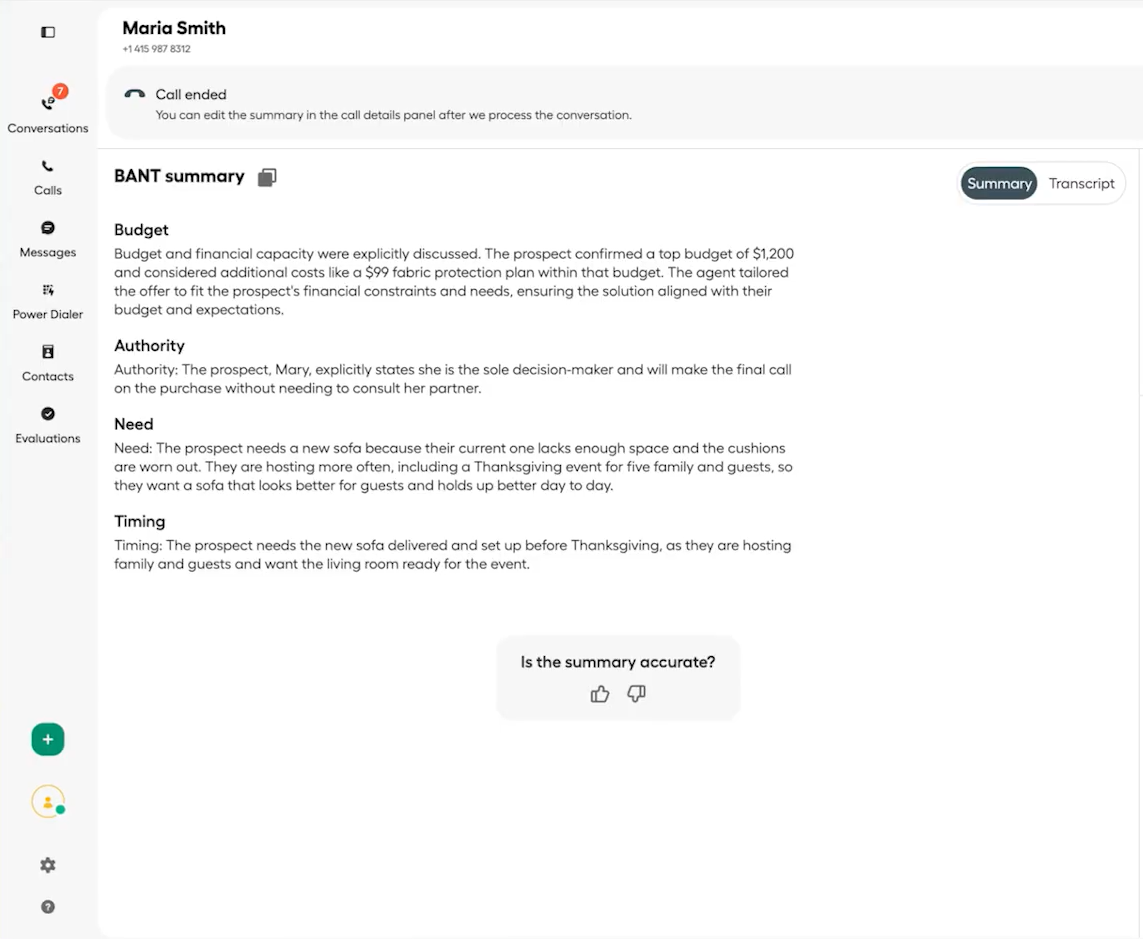
The product has since grown well beyond just calls. Aircall now unifies voice, SMS, and WhatsApp into a single workspace. Its AI Assist suite can brief reps before calls, coach them with real-time playbook prompts, and auto-log and summarize after.
Virtual AI agents handle high-volume inbound and outbound without human reps at all. The integrations list runs to 250+.
So it’s not a simple phone company anymore. But there’s still a structural limit built into how Aircall works: its intelligence has always been scoped to the call itself. After you hang up, the system hands you a summary and a draft follow-up.
What it can’t do is:
- Watch whether that follow-up actually moved the deal
- Monitor whether the prospect went cold
- Pull in what was said on the Zoom two days later
- Flag to the VP of Sales that a deal has stalled before it quietly dies.
“Aircall has always focused on helping teams have better conversations with customers. With Piper, we are taking the next step: connecting those conversations to the pipeline signals, deal intelligence, and automated workflows that close revenue.” — Scott Chancellor, CEO, Aircall
That’s the gap. And it’s not a small one. The average B2B sales rep spends more than two hours a day on manual CRM entry, documentation, and follow-up admin; time that isn’t spent selling.
Managers lack the data to coach well because the data is scattered across call recordings, email threads, and Slack messages. Revenue forecasts are built on whatever the rep last typed into Salesforce, which is almost never the full picture.
Aircall knew the gap existed. Piper was already filling it for other communication stacks. The acquisition is Aircall deciding to fill it themselves.
What Piper brings to the table
Piper‘s core pitch is that it captures customer interactions across every channel a deal touches and converts them into structured CRM data and automated action. Not an analysis that a rep has to read and act on. Actual automated action.
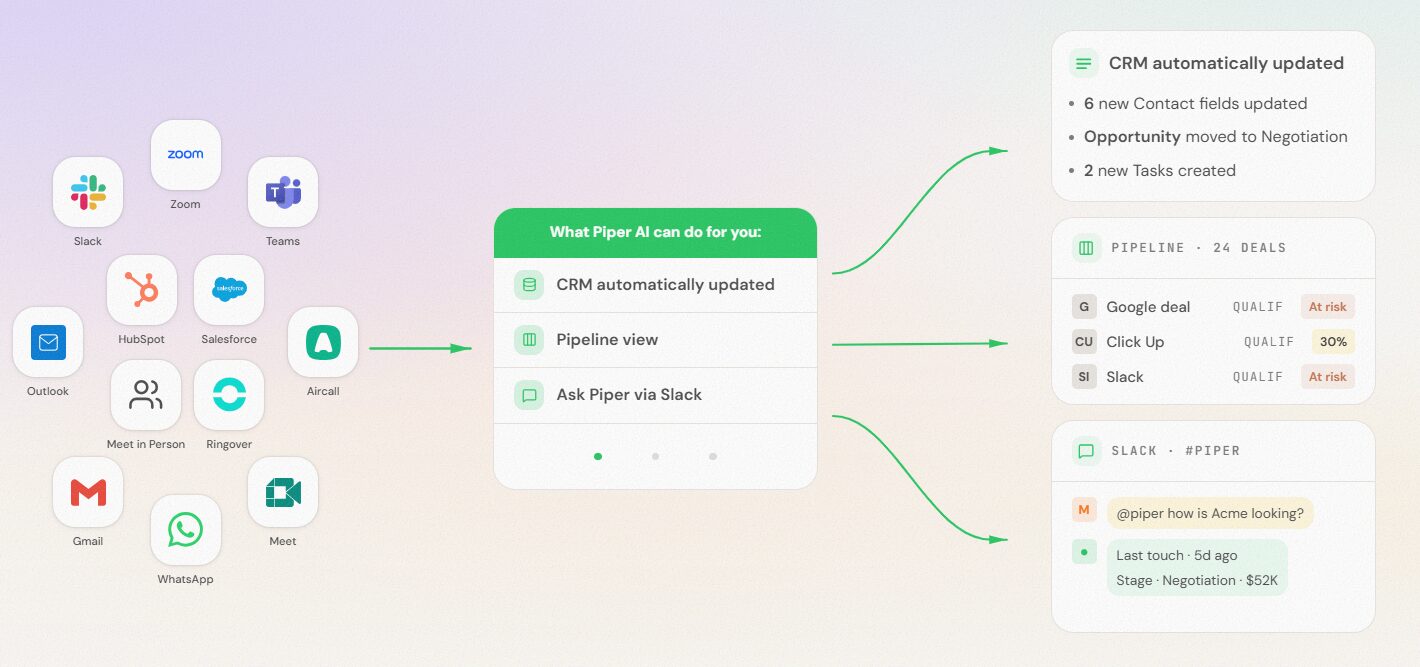
The five things Piper does aren’t individually new: omnichannel capture, automated CRM updates, follow-up and task automation, call scoring, and deal intelligence.
Gong does some of them. So do Modjo, Jiminny, and Salesloft.
What’s different about Piper is the combination: one platform, every channel, automatic execution rather than surfaced insights that still require a human to act on.
Capabilities added by Piper vs. Aircall (before the acquisition)
Here’s how Piper’s core capabilities compare to what Aircall was doing on its own before the acquisition.
| Capability | What it does | Aircall (previously) |
|---|---|---|
| Omnichannel capture | Zoom, Teams, Meet, phone, email, WhatsApp, in-person, all in one place. 100+ languages supported. | Phone & SMS only |
| CRM auto-population | Fills Salesforce and HubSpot fields (deal stages, contact data, custom fields) from every conversation. No rep input required. | Basic activity log |
| Follow-up automation | AI-drafted personalized follow-up emails + auto task creation after every interaction. Up to 48 hours saved per rep per month. | Draft generation only |
| Call scoring & coaching | Every call scored against MEDDIC, BANT, or a custom playbook. Manager dashboards with key moments surfaced; no full replays needed. | Talk ratios & sentiment |
| Deal intelligence | Real-time deal health, risk flags, cross-channel engagement scoring. Forecasting improves because the data is complete. | Not available |
One capability worth pausing on: Piper’s conversational search layer. Once Piper has ingested a company’s communication history, users can query it like a database: “what objections came up most in deals we lost last quarter?” or “which reps close fastest after a discovery call?”
That’s the kind of question that used to require a BI analyst and three days. Piper answers it from the actual conversations that happened.
Customer results
The results customers report confirm the claims: less admin, cleaner data, and better forecasts:
- Reps are saving upwards of 48 hours a month on manual reporting and CRM entry.
- One logistics company recovered over €300K in ARR within weeks. Not from new deals, but from contracts that had almost slipped away.
- A fintech team cut forecast deviation by 50%.
- Another reduced time spent on non-selling tasks by half.
Why the combination makes sense
The framing Aircall uses internally is clean: “Aircall handles the call. Piper handles everything the call unlocks.” It’s how the two products relate to each other. They don’t overlap. They’re sequential.
Here’s how the platform fits together:
- Aircall owns the conversation layer: voice, SMS, WhatsApp, real-time coaching, virtual agents.
- Piper owns the execution layer: what happens to the deal after every interaction, across every channel, without anyone asking a rep to do it.
Together, they cover a sales cycle from first call to closed deal. No competitor in revenue intelligence owns the communications channel itself. Aircall does.
That last point is the one to pay attention to. Gong and Chorus plug into your calls. They’re passengers. Aircall runs the phone system. It’s the infrastructure.
Piper turns that infrastructure into something that can act on itself. The data advantage is real: Aircall already has the calls. Piper already knows what to do with them. Joining them removes a layer of integration that other platforms have to build around.
The combined platform also changes the value conversation for RevOps teams. Before, Aircall was a line item under “communications.” With Piper, it’s a line item under “revenue operations,” competing for budget against CRM platforms and revenue intelligence tools.
That’s a bigger conversation, with more organizational stakeholders, and, usually, larger contracts.
Three tiers of engagement
Aircall frames the combined platform as a progression: teams can start simple and adopt more automation as they’re ready.
| Mode | Who it serves | What they get |
|---|---|---|
| Team-Powered | Getting started | Clear calls, unified inbox, click-to-dial, shared visibility. The Aircall core product. |
| AI-Assisted | Scaling with AI | Aircall live transcription and real-time coaching, plus Piper’s CRM automation and follow-up generation. |
| AI-Driven | Full automation | 24/7 AI agents, smart routing, autonomous deal capture, callbacks, and pipeline updates without manual effort. |
The Bigger Picture: Who is Aircall Now Competing With
Aircall is no longer just up against other cloud phone systems, such as RingCentral, JustCall, Dialpad, etc. It’s now in the revenue intelligence category, which means Gong, Chorus (Zoominfo), Salesloft, and HubSpot’s growing AI feature set.
| Competitor | Category | What they do well | Aircall/Piper advantage |
|---|---|---|---|
| Gong | Enterprise revenue intelligence | The category leader for large organizations. Deep analytics, broad integrations, substantial implementation overhead. Enterprise pricing. | Faster deployment, CRM automation vs. insight surfacing, purpose-built for 25-300 reps. |
| Modjo | Coaching-focused | Strong on advanced coaching frameworks. Premium pricing. Focused on call coaching more than full workflow automation. | Lower cost, 100+ languages vs. 6, full CRM sync, AI chatbot for querying call history. |
| Salesloft | Sales engagement platform | Cadence management, email sequencing, deal execution. Strong RevOps footprint. Less voice-native. | Voice-first architecture, tighter CRM automation, combined at €40/user/month vs. complex SEP pricing. |
| HubSpot AI | CRM with AI features | Growing AI capabilities baked into the CRM itself. Strongest for teams already on HubSpot. | CRM-agnostic (Salesforce + HubSpot), voice infrastructure ownership, omnichannel capture. |
The honest comparison with Gong is the one worth spending time on. Gong built its reputation on surfacing deal intelligence: coaching insights, deal risks, call highlights.
What it doesn’t do, at least not at mid-market scale and price, is automatically act on that intelligence.
Piper acts. Gong surfaces. That distinction matters if you’re a revenue operations leader trying to reduce the manual work in the system, not just get better visibility into it.
The differentiator Aircall keeps coming back to is that no competitor in revenue intelligence actually owns the communications channel. Gong plugs into your calls. Salesloft runs sequences alongside your calls. Aircall runs the calls.
That’s not a small thing if you’re trying to build a closed-loop system where data flows from conversation to CRM to next action without leaving the platform.
Whether the market buys that argument is a different question. Enterprise buyers who’ve already deployed Gong at $100K+ a year aren’t switching because Aircall acquired a Spanish startup.
The opportunity is mid-market: companies with 25 to 300 reps, meaningful outbound motion, Salesforce or HubSpot as their CRM, and a real problem with CRM hygiene and follow-through consistency.
That ICP is well-defined. The question is whether Aircall can execute against it before Gong decides to compete on price.
The Bet Aircall is making
Aircall wants to be the platform where a sales conversation starts and where the resulting revenue action completes: no hand-off to a separate intelligence tool, no rep manually bridging the gap. One platform, voice to closed deal.
For that to work, a few things have to go right. The technical integration between Aircall’s call infrastructure and Piper’s workflow engine has to be seamless enough that customers don’t feel two separate products stapled together.
Piper’s roadmap items (live in-call coaching on video, bot-free recording via browser plugin, email-based CRM population) need to land on schedule.
And Aircall’s existing customer base, which bought a phone system, needs to see enough value in the revenue intelligence layer to expand their contracts.
There’s also the question of whether a phone company can credibly compete with pure-play revenue intelligence platforms in the long run. Gong, Salesloft, and HubSpot have years of machine learning on deal data.
Aircall has the call. That’s a real data moat, but it only extends as far as Piper can convert raw conversation into structured intelligence, and that’s exactly what the integration needs to prove.
Still, for sales teams that spend a third of their day on admin, the promise is simple. Every conversation automatically logged, scored, followed up on, and connected to pipeline health, without anyone asking the rep to do anything after they hang up.
If Aircall and Piper can deliver that reliably, the repositioning will have been worth it. The proof will be in the product.