

Search APIs are becoming an important part of AI applications. Whether you’re building AI agents, chatbots, or Retrieval-Augmented Generation (RAG) systems, you need a way to fetch fresh information from the web.
The search API landscape has changed a lot recently. Microsoft discontinued the Bing Search API in August 2025, pushing many developers to look for new options. At the same time, several AI-focused search APIs have emerged to help power modern AI workflows.
The Brave Search API is one of the better-known choices. It uses its own independent search index with more than 30 billion pages and offers privacy-focused features for businesses and developers.
That said, Brave isn’t the right fit for every project. Its search approach is primarily keyword-based, which may not work as well for applications that need semantic search, web scraping, or AI-generated answers. Brave has also discontinued its free API plan, making cost another factor to consider.
In this guide, I’ll compare the best Brave Search API alternatives and explain which option is best for AI agents, RAG pipelines, and other AI applications.
Brave Search API Alternatives Comparison
If you’re evaluating alternatives to the Brave Search API, it’s worth looking beyond traditional search results. Some providers focus on semantic search, while others combine search with scraping, grounded answers, or AI-agent capabilities.
| Search API Alternative | Primary Differentiator | Pricing (per 1K requests) |
|---|---|---|
| Brave Search API | Independent search index with privacy-focused architecture | Custom pricing |
| Geekflare Search API | Search, scraping, and grounded answers in a single API call | Usage-based |
| Firecrawl | Converts web pages into clean, agent-ready Markdown | Usage-based |
| Exa | AI-native semantic search designed for LLM applications | Usage-based |
| Valyu Search | Strong performance on factual and financial queries | Usage-based |
| SearXNG | Open-source metasearch engine that can be self-hosted | Free |
The right choice depends on your use case. If you only need web search results, Brave and SearXNG may be sufficient. If you’re building AI agents or RAG applications, tools that combine search with content extraction, semantic retrieval, or grounded answers can reduce the amount of infrastructure you need to build and maintain.
The Top AI-Native Search Alternatives
Geekflare Search API
Geekflare Search API is designed for developers building AI agents and RAG applications. Instead of returning only search results, it combines search, web scraping, and grounded answers into a single API.
This reduces the number of services you need to stitch together. With Brave, you’ll often need separate tools for scraping webpages and generating answers. Geekflare handles those workflows through a unified API.
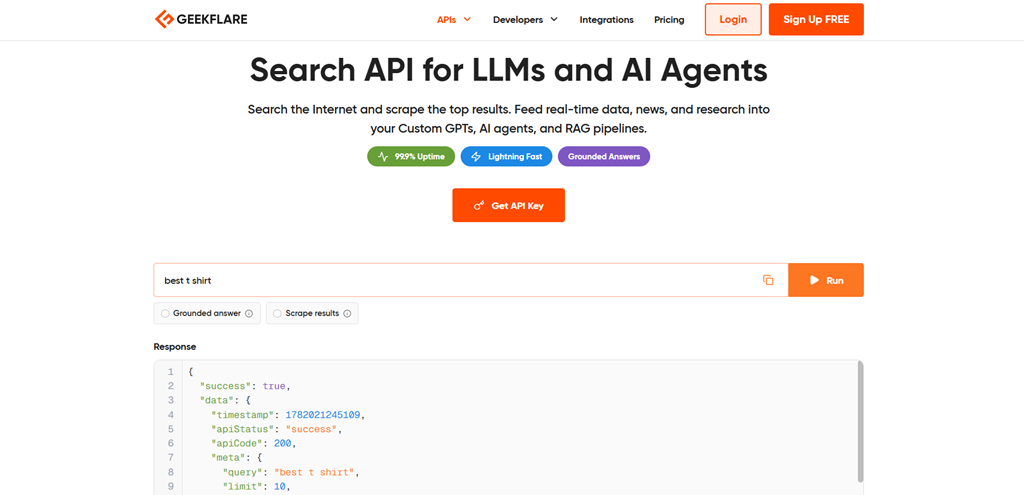
Another advantage is MCP compatibility. You can connect Geekflare to MCP-enabled AI assistants and agent frameworks, giving them web search capabilities without building custom integrations.
You can choose Geekflare over Brave when:
- You need grounded answers instead of just search results.
- You’re building AI agents with MCP.
- You want search and scraping in a single API.
- You want to reduce infrastructure complexity.
Exa
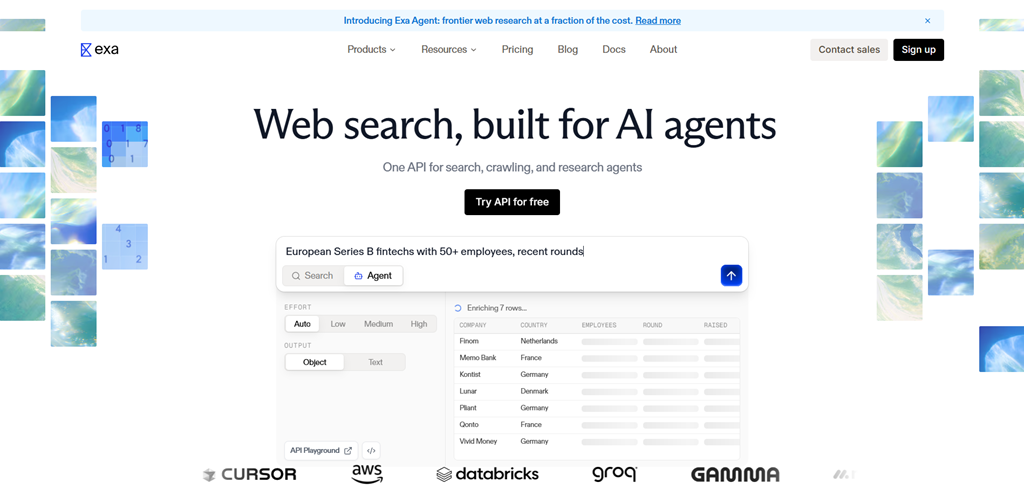
Exa was built specifically for AI applications and uses semantic search rather than relying primarily on keyword matching.
Instead of looking for exact keywords, Exa tries to understand the meaning behind a query. This makes it useful for research agents, knowledge discovery tools, and RAG systems where users may ask questions in natural language.
You can choose Exa over Brave when:
- You need semantic search.
- Your users ask conversational questions.
- You’re building research or knowledge retrieval applications.
Firecrawl
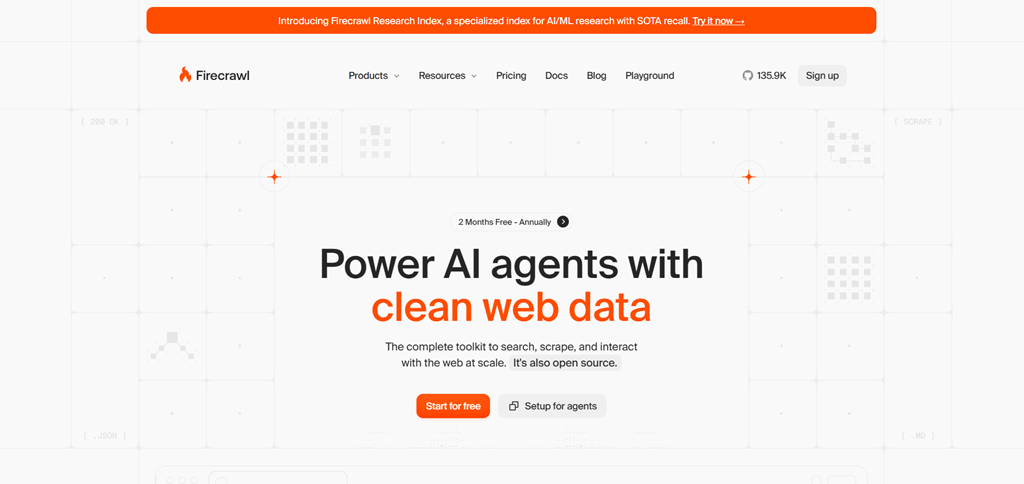
Firecrawl focuses on extracting content from websites and converting it into clean, structured Markdown.
While Brave helps you find pages, Firecrawl helps you understand and process those pages. This makes it a strong choice for AI agents that need website content rather than traditional search results.
You can choose Firecrawl over Brave when:
- Content extraction is more important than search.
- You’re building web research agents.
- You need clean, LLM-ready content.
Tavily
Tavily was created specifically for AI agents and retrieval workflows.
The platform focuses on returning high-quality search results optimized for LLMs instead of traditional search engine use cases. Many agent frameworks support Tavily out of the box, making integration straightforward.
You can choose Tavily over Brave when:
- You’re building autonomous agents.
- You need search results optimized for LLMs.
- Fast integration with agent frameworks is important.
Valyu Search
Valyu focuses on factual accuracy and fresh information retrieval.
It’s particularly useful for applications involving business, finance, and research where factual correctness matters more than broad web coverage.
You can choose Valyu over Brave when:
- You need reliable factual information.
- Your application focuses on finance or business data.
- Accuracy is more important than the size of the search index.
LLM Layer
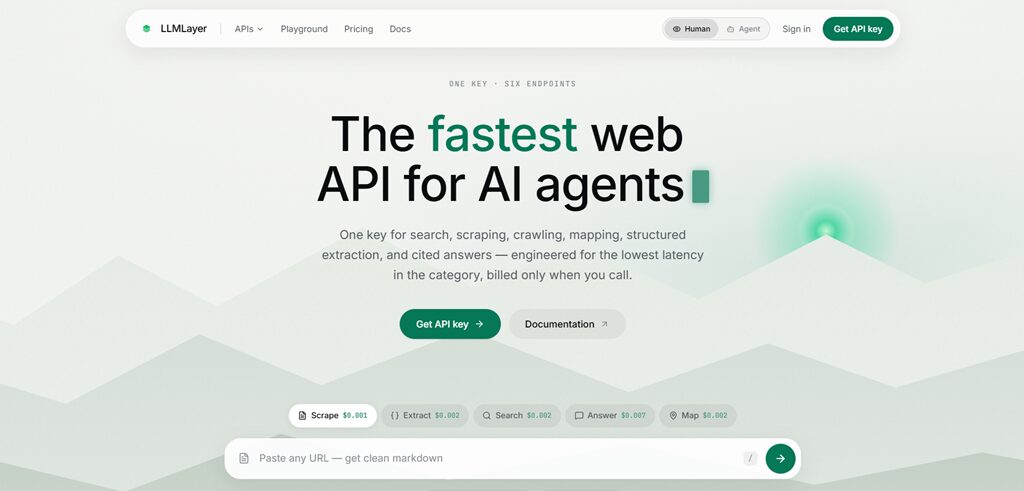
LLM Layer provides search and retrieval infrastructure designed specifically for AI applications.
Rather than acting as a traditional search engine, it helps developers connect LLMs to external knowledge sources and build retrieval pipelines.
You can choose LLM Layer over Brave when:
- You’re building large-scale RAG systems.
- You need a retrieval layer rather than a simple search API.
- Your application uses multiple knowledge sources.
Perplexity Search API
Perplexity combines web search with answer generation and citations.
Instead of returning a list of links, it provides synthesized responses backed by web sources. This can reduce the amount of processing required in applications that need answer-first experiences.
You can choose Perplexity over Brave when:
- You want AI-generated answers with citations.
- You’re building research assistants.
- Search results alone aren’t enough for your use case.
Free Alternatives
SearXNG
If you’re working with a zero-dollar budget, SearXNG is worth considering. You can self-host it using Docker and expose a free JSON API that aggregates results from multiple search engines, giving you full control over your search stack.
DuckDuckGo
DuckDuckGo doesn’t require an API key and can be integrated into AI agent frameworks such as OpenClaw. It can return titles, URLs, and snippets similar to Brave Search, making it a simple option for lightweight AI agents and research tools.
Search API FAQs
Is there any free search API?
Yes. SearXNG is a free and open-source search engine that you can self-host using Docker. DuckDuckGo is another option that doesn’t require an API key and can be used for basic search workflows. Keep in mind that free solutions often require more setup and maintenance than managed APIs.
Does Brave offer an MCP server?
Brave provides APIs for web search and AI applications, but developers should check the official Brave documentation for the latest information on MCP support and available integrations, as these offerings can change over time.
Which alternative is best for AI agents?
If you’re building AI agents, Geekflare Search API is one of the most complete alternatives to Brave. It offers search and web scraping in a single API, reducing the number of tools you need to integrate. It also works well with MCP-enabled agents, making it easier to add web search capabilities to AI workflows.