

Web scraping using Python is a common way to collect information from websites for research, automation, content analysis, price tracking, and AI applications. Python offers a simple and flexible way to retrieve website content. Its rich library ecosystem and ease of use have made it a popular choice for web scraping.
In this tutorial, I will show you how to scrape website content with Python, understand the API response, choose the right output format, and use AI to extract only the information you need from a webpage. I’ll also explain how to test your requests before integrating them into your application.
Prerequisites
Before you begin, make sure you have:
- A Geekflare API key. Sign in to your Geekflare account and copy your API key from the dashboard.
- Python 3.8 or later installed.
- The Geekflare Python SDK.
Install the SDK using:
pip install geekflare-apiCreate Your First Web Scraper Using Python
The Geekflare Python SDK lets you scrape website content with a few lines of Python code. In this example, we’ll scrape the Hacker News homepage and return the response in JSON format.
Send a Web Scraping Request
Create a new Python file, such as main.py, and add the following code:
from geekflare_api.client import GeekflareClient
from geekflare_api.models import WebScrapeDto

with GeekflareClient(
    api_key="<api-key>"  # Replace with your Geekflare API key.
) as client:
    result = client.web_scrape(
        WebScrapeDto(
            device="desktop",
            format=["json"],  # Change the output format based on your requirements.
            render_j_s=True,
            block_ads=True,
            stealth=False,
            url="https://news.ycombinator.com/",
            file_output=False
        )
    )

    print(result)
Replace <api-key> with your Geekflare API key. You can also replace the URL with any public website that you want to scrape.
Understand the Request Parameters
When performing web scraping using Python, you can customize how the API retrieves and returns website content by changing the following request parameters.
| Parameter | Values | Description |
|---|---|---|
url | Any public website URL | Specifies the website you want to scrape. |
device | desktop, mobile | Simulates the selected device while loading the webpage. |
format | html, markdown, json, markdown-llm, html-llm, text, text-llm | Specifies the output format returned by the API. |
render_j_s | true, false | Enables or disables JavaScript rendering before scraping the webpage. |
block_ads | true, false | Blocks advertisements while loading the webpage to reduce unnecessary content. |
stealth | true, false | Enables or disables stealth mode to reduce bot detection on supported websites. |
file_output | true, false | Returns the scraped content as a downloadable file or directly in the API response. |
Run the Script
Open a terminal in your project directory and run:
python main.py(If you saved the file with a different name, replace main.py with the name of your Python file)
If the request is successful, the API returns the scraped website content in the selected format along with metadata about the request.
Understand the Web Scraping Response
After you run the script, the API returns a JSON response that contains the scraped website content and additional metadata about the request.
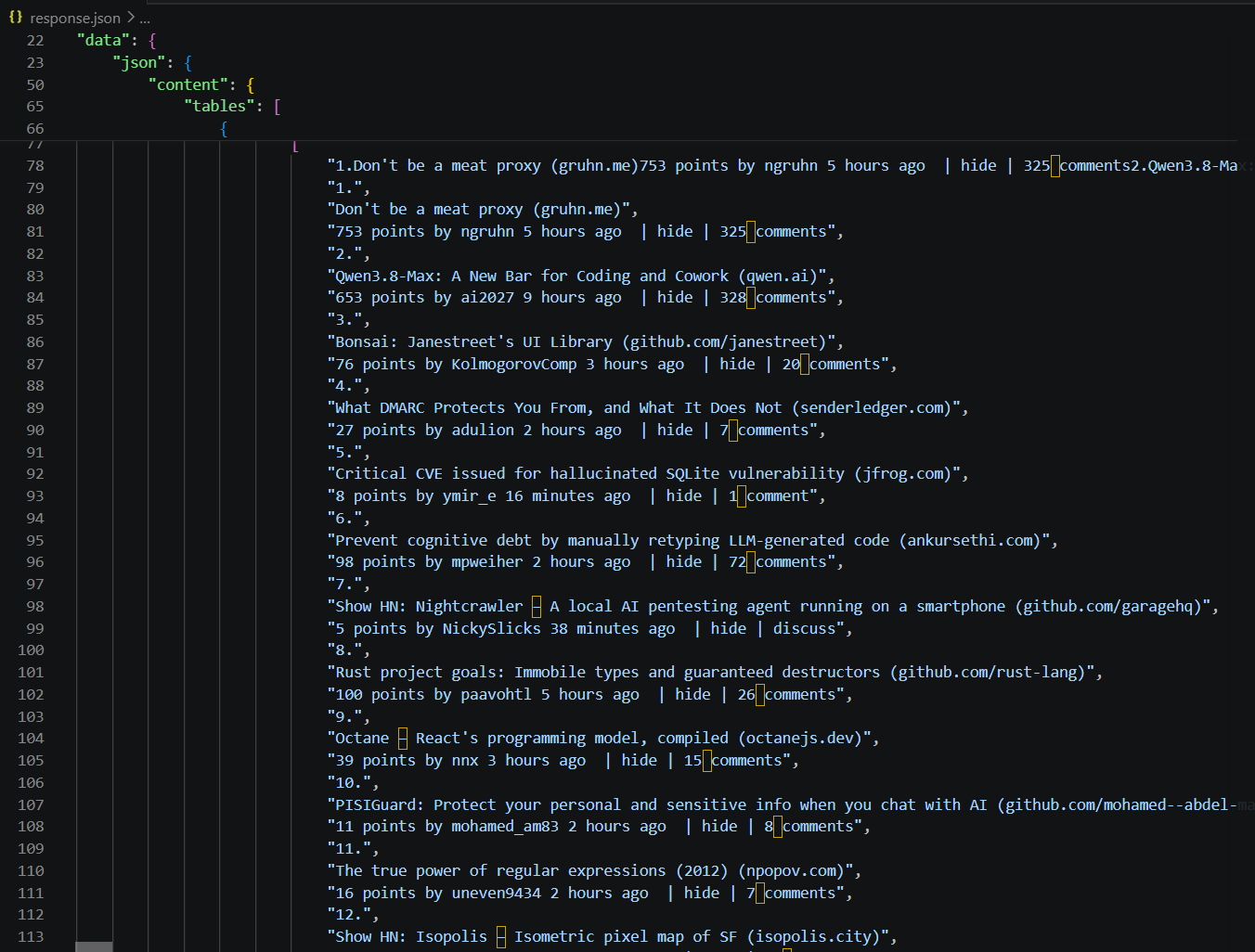
The response includes the following fields:
success: Indicates whether the request completed successfully.timestamp: Shows when the API processed the request.apiStatus: Returns the status of the API request.apiCode: Returns the HTTP status code. A value of200indicates that the request completed successfully.meta: Contains information about the request, including the website URL and the selected output format.data: Contains the scraped website content. In this example, the response is returned inJSONformat and includes the extracted content from the Hacker News homepage.
Extract Specific Information with AI
Usually, web scraping returns the entire webpage. But often, you only need specific information from the page.
To solve this, the Geekflare Web Scraping API includes a feature called AI Extraction. It extracts only the information you request from the webpage, reducing the amount of post-processing required in your application.
AI Extraction supports the following extraction types:
| Extraction Type | Value | Description |
|---|---|---|
| Open-ended Question | prompt | Answers a question based on the webpage content. |
| Custom JSON Schema | schema | Extracts data that matches a custom JSON schema. |
| Product Extraction | product | Extracts product details such as name, price, description, and availability. |
| Listing Extraction | listing | Extracts lists of items such as articles, products, or search results. |
| Contact Info | contact | Extracts email addresses, phone numbers, social links, and other contact information. |
| Summary | article | Generates a summary of the webpage content. |
| Sentiment Analysis | sentiment | Identifies the overall sentiment of the webpage content. |
| Keywords & Entities | keyword | Extracts important keywords and named entities from the webpage. |
For a complete explanation of each extraction type and additional examples, refer to our guide on AI Extraction with the Geekflare Web Scraping API.
Example: Ask Questions About a Webpage
The following example uses the Open-ended Question extraction type to answer a question from a Wikipedia article.
from geekflare_api.client import GeekflareClient
from geekflare_api.models import WebScrapeDto

with GeekflareClient(
    api_key="<api-key>"  # Replace with your Geekflare API key.
) as client:
    result = client.web_scrape(
        WebScrapeDto(
            device="desktop",
            format=["json"],
            render_j_s=True,
            block_ads=True,
            stealth=False,
            ai_prompt={
                "type": "prompt",  # AI extraction type.
                "query": "What are the key features of Claude Fable?"  # Question to answer from the webpage.
            },
            url="https://www.anthropic.com/claude/fable",
            file_output=False
        )
    )

    print(result)
Understand the ai_prompt Parameter
The ai_prompt parameter controls how AI extraction processes the webpage.
| Parameter | Description |
|---|---|
type | Specifies the AI extraction type. In this example, prompt tells the API to answer a question using the webpage content. |
query | Defines the question or instruction that the AI should process from the webpage. |
After running the script, the API analyzes the webpage and returns the answer based on the selected AI extraction type.
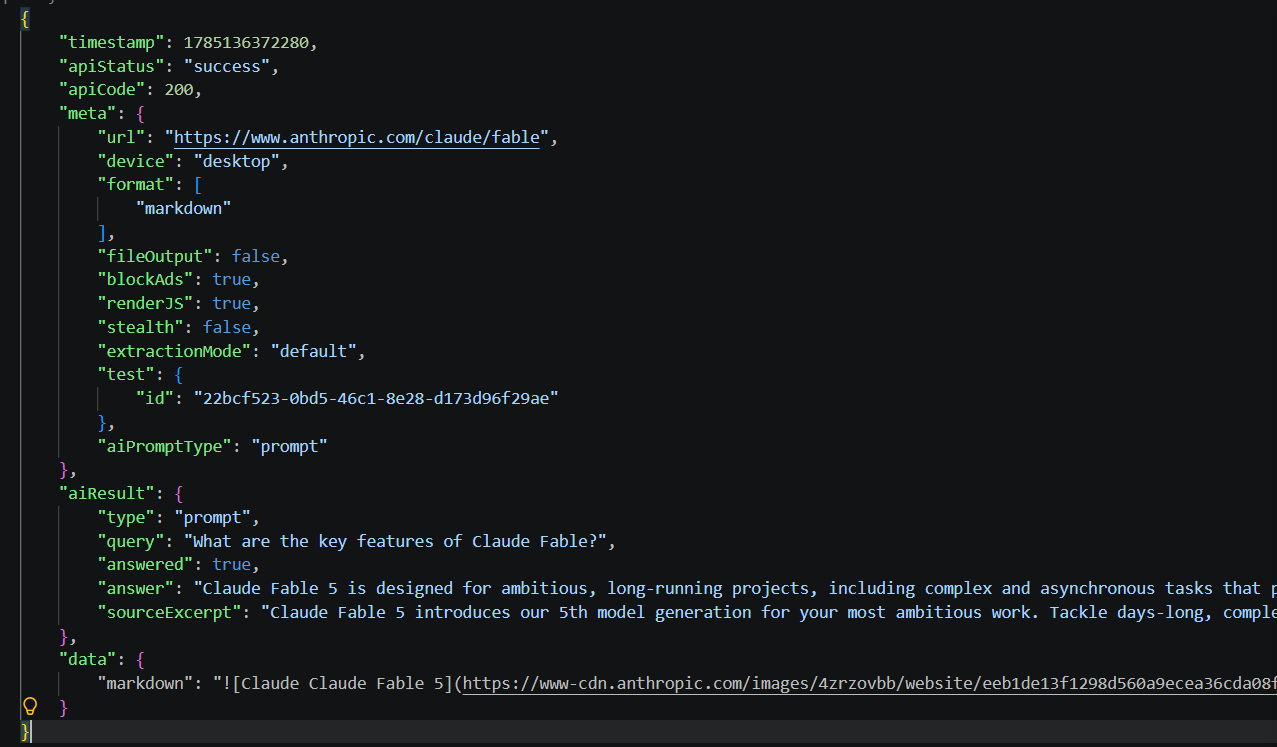
The structure of the ai_prompt parameter changes based on the selected AI extraction type. Each extraction type accepts different inputs depending on the information you want to extract.
Refer to the AI Extraction documentation to see how the ai_prompt parameter changes for each supported extraction type.
Use the Geekflare Playground: A No-Code Platform
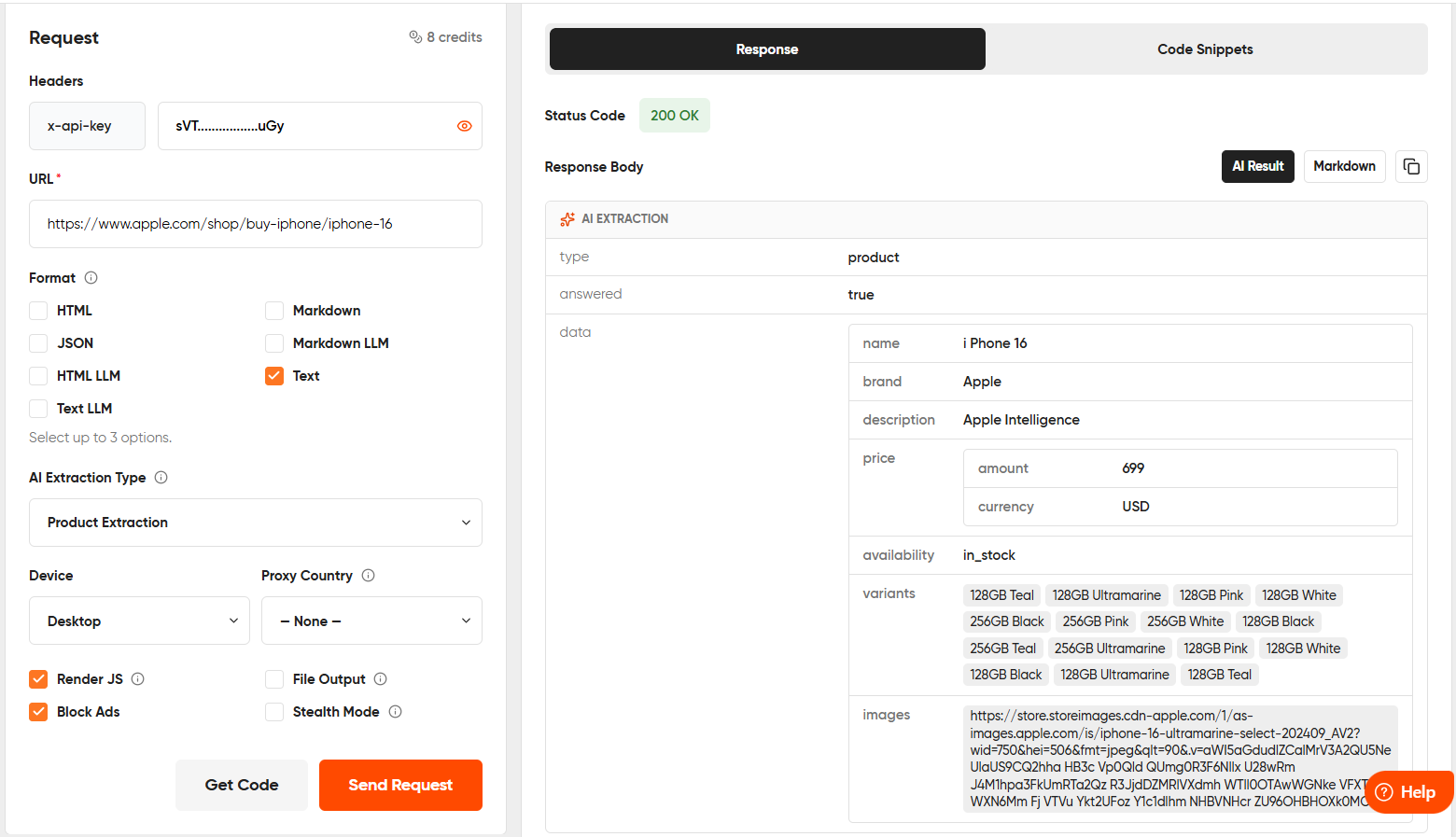
If you don’t want to write code, you can use the Geekflare Playground, a no-code platform for testing the Web Scraping API. It lets you configure the same request parameters available in the Python SDK through a simple interface.
Enter the website URL, choose the output format, select the device type, and configure options such as Render JS, Block Ads, Stealth Mode, File Output, Proxy Country, and AI Extraction Type. After configuring the request, click Send Request.
For this example, select Product under AI Extraction Type and use the following product page:
https://www.apple.com/shop/buy-iphone/iphone-16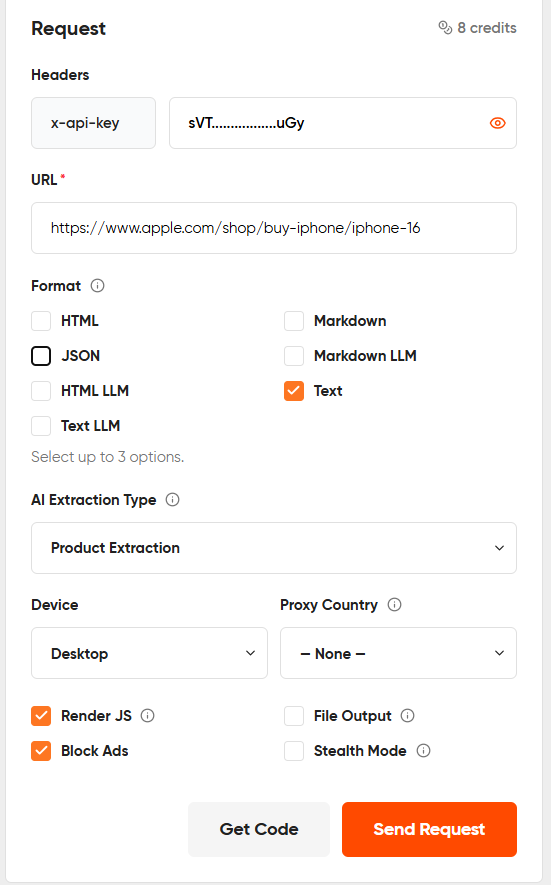
The Playground extracts the product details and displays the response instantly. You can also click Get Code to generate ready-to-use code snippets in Python, cURL, Node.js, PHP, and other supported languages using the same configuration.
Which Option Should You Choose?
Both the Geekflare Python SDK and the Geekflare Playground support the same Web Scraping API. The best choice depends on how you plan to use it.
| Option | Best For |
|---|---|
| Geekflare Python SDK | Automating web scraping using Python, integrating web scraping into applications, and building custom workflows. |
| Geekflare Playground | Testing web scraping requests, experimenting with AI extraction, and generating code without writing a Python script. |
Conclusion
Web scraping using Python helps you collect website data for automation, research, AI applications, and data analysis. The Geekflare Python SDK makes it easy to scrape website content, while AI Extraction lets you retrieve only the information you need from a webpage.
To learn more about the Web Scraping API, supported parameters, AI Extraction types, and SDKs, refer to the official Geekflare documentation.
Frequently Asked Questions
Is web scraping using Python free?
Yes. You can start web scraping using Python with the Geekflare Python SDK. Every new account includes 500 free API credits, so you can test the Web Scraping API, experiment with different output formats, and try AI Extraction before upgrading to a paid plan.
Can the Geekflare Web Scraping API scrape JavaScript websites?
Yes. The Geekflare Web Scraping API supports JavaScript rendering through the render_j_s parameter. This allows you to scrape websites that load content dynamically after the page is rendered.
What are some web scraping using Python projects?
Popular web scraping using Python projects include price trackers, news aggregators, product comparison tools, SEO monitoring dashboards, AI knowledge bases, and market research applications.