



Building an API that solves a real problem is one project. Getting other developers to find it, trust it enough to integrate it, and pay for it is a different one. Two broad paths handle that second project today: list the API on a marketplace that brings its own audience and takes a cut of every sale, or meter and bill for it directly through a gateway or billing platform that keeps the full margin but leaves distribution up to you.
RapidAPI, the marketplace most people still know by that name, was acquired by Nokia in November 2024 and now operates as Rapid, with a flat 25% marketplace fee. A newer generation of marketplaces caters specifically to AI models and MCP servers. Alongside marketplaces, a separate category of monetization platforms, tools you plug directly into your own gateway, lets a builder meter and bill customers without going through a marketplace at all.
This guide compares seven current options for anyone who already has an API ready to sell: four marketplaces that handle discovery, billing, and payouts for a percentage of revenue, and three monetization platforms that let you meter, bill, and collect payment from your own site instead. Each entry covers what the platform actually does, current US pricing or fee terms where published, and where it falls short.
Marketplace or direct monetization: the real trade-off
A marketplace listing is the faster path to a first paying customer, since the audience, the search page, and the checkout flow already exist. In exchange, the marketplace usually owns the billing relationship, decides what usage data it shares back with you, and takes a percentage of every sale, from single digits to a quarter of revenue depending on the platform.
In a monetization platform, you keep the full price a customer pays, you own the account and usage data directly, and nothing stops you from negotiating a custom deal with a large customer. The cost is that you supply the audience yourself, through your own marketing, sales, or existing customer base, and you take on more of the technical setup: a gateway, a billing integration, or both.
Platforms compared
| Platform | Type | Best for | What it handles | Starting cost or fee |
|---|---|---|---|---|
| Rapid (RapidAPI) | Marketplace | The largest existing developer audience | Discovery, docs, keys, billing, payouts | 25% of subscription and overage revenue |
| APILayer | Marketplace | Non-exclusive listing rights | Review, listing, provider-chosen hosting, payouts | Provider sets price; commission not published |
| API.market | Marketplace | AI models, data APIs, and MCP servers | Metering, billing, security, distribution | Provider sets price; commission not published |
| AWS Marketplace | Marketplace | Selling into an existing AWS buyer base | Metering, billing, collections, procurement | 3% (SaaS) to 20% (server-based) listing fee |
| Zuplo | Monetization platform | Keeping control while selling directly | Metering, quota enforcement, Stripe billing, developer portal | Free up to 100,000 requests/month |
| Kong | Monetization platform | Teams already running Kong Gateway | Metering, quota enforcement, billing, invoicing | Free 30-day trial; Plus billed per Gateway (rate not published) |
| Moesif (WSO2) | Monetization platform | Usage analytics alongside billing | Usage tracking, product catalog, quota governance | Custom, not published |
| Lago | Monetization platform | Full control through open source | Metering, invoicing, dunning, revenue analytics | Free to self-host; Premium by quote |
API marketplaces
Rapid (formerly RapidAPI)
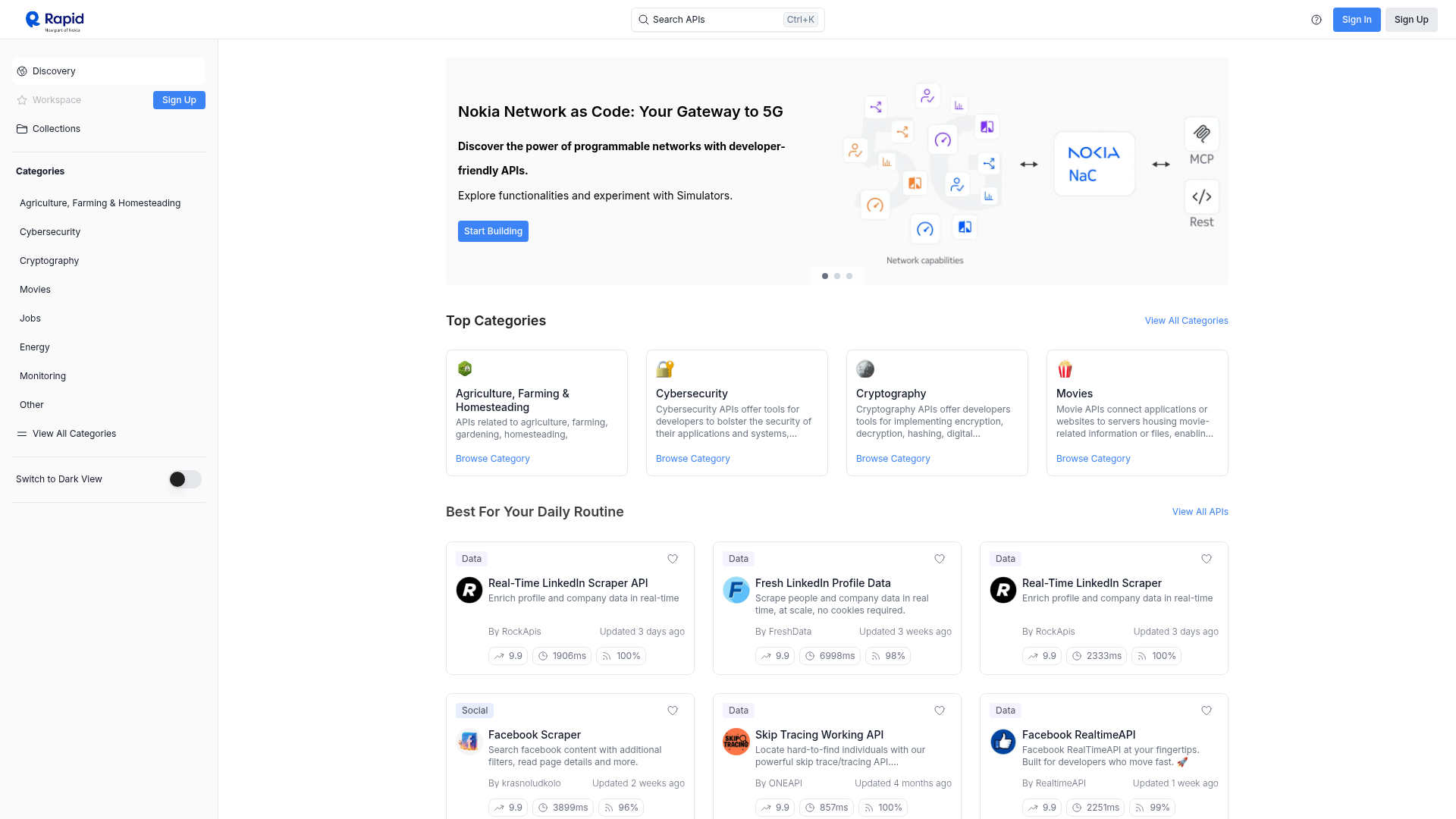
Rapid, the marketplace most developers still call RapidAPI, remains the largest public API marketplace by developer count. Nokia acquired the company’s API technology and R&D team in November 2024, and the public API Hub kept operating under the same one-account model for listing, pricing, and monitoring an API. In 2026 the hub added support for the Model Context Protocol, letting a listed API register as a tool an AI agent can call directly.
Key Features
- Every listed API gets auto-generated interactive documentation and a browser-based playground built from the definition a provider supplies.
- Four pricing tiers control access: Free, Pay Per Use, Freemium, and Paid, each configurable per API from the same dashboard.
- Code snippets are generated in Python, JavaScript, Go, Java, PHP, and more, so a buyer copies working code instead of reading a spec first.
- Provider analytics break down requests, error rates, and revenue per API and per subscriber.
Pros & Cons
PROS
CONS
Pricing
Rapid takes a flat 25% marketplace fee on every subscription and overage payment, a rate that took effect November 15, 2025.
- Free: capped at 1,000 requests/hour and 500,000 requests/month, no payout since no payment changes hands
- Pay Per Use, Freemium, and Paid: the provider sets the price; above 500,000 requests/month, the minimum is $0.00003 per call
- Payouts: monthly, via PayPal only
APILayer
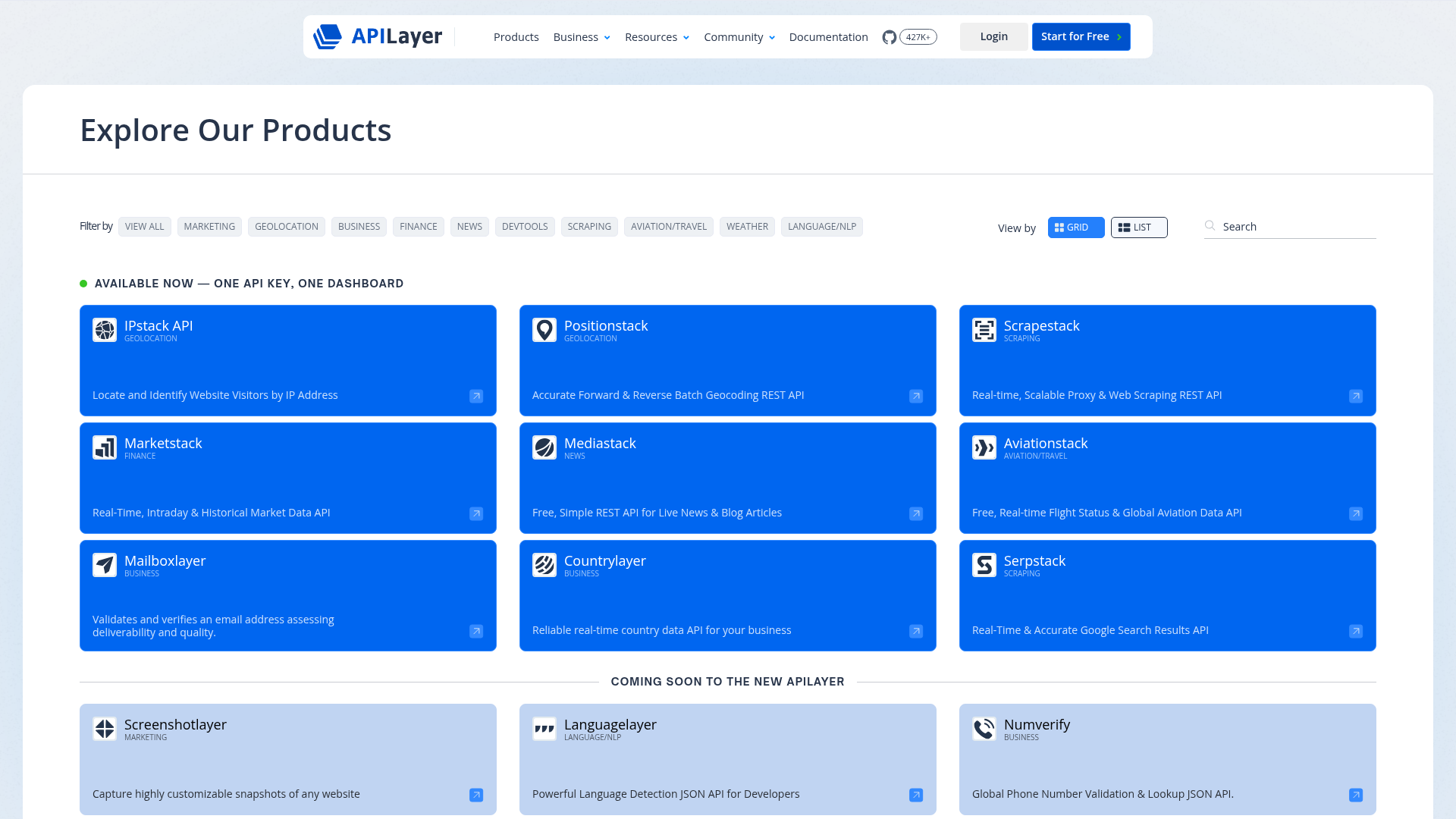
APILayer is a curated marketplace where an individual developer or a company applies to list an API, and the API passes a technical quality review before it goes live. The provider hosts the API themselves, on AWS, Google Cloud, Azure, DigitalOcean, Scaleway, or Hetzner, and sets their own subscription price. Listing terms are non-exclusive, so the same API can also be sold on another marketplace or from the provider’s own site at the same time. Payouts go out monthly: direct bank transfer for an individual provider, invoice-based for a company.
Key Features
- A technical review checks the API against APILayer’s quality bar before it is approved for listing, so submissions are not published automatically.
- Non-exclusive terms mean no rights transfer to APILayer, so a provider keeps full ownership and can monetize the same API elsewhere.
- The marketplace currently lists APIs across categories including geolocation, finance, business data, and web scraping.
Pros & Cons
PROS
CONS
Pricing
A provider sets the subscription price for their own API, and payouts happen monthly. APILayer’s current commission percentage is not published on its live provider or marketplace FAQ pages, so confirm the exact split when an application is reviewed.
API.market
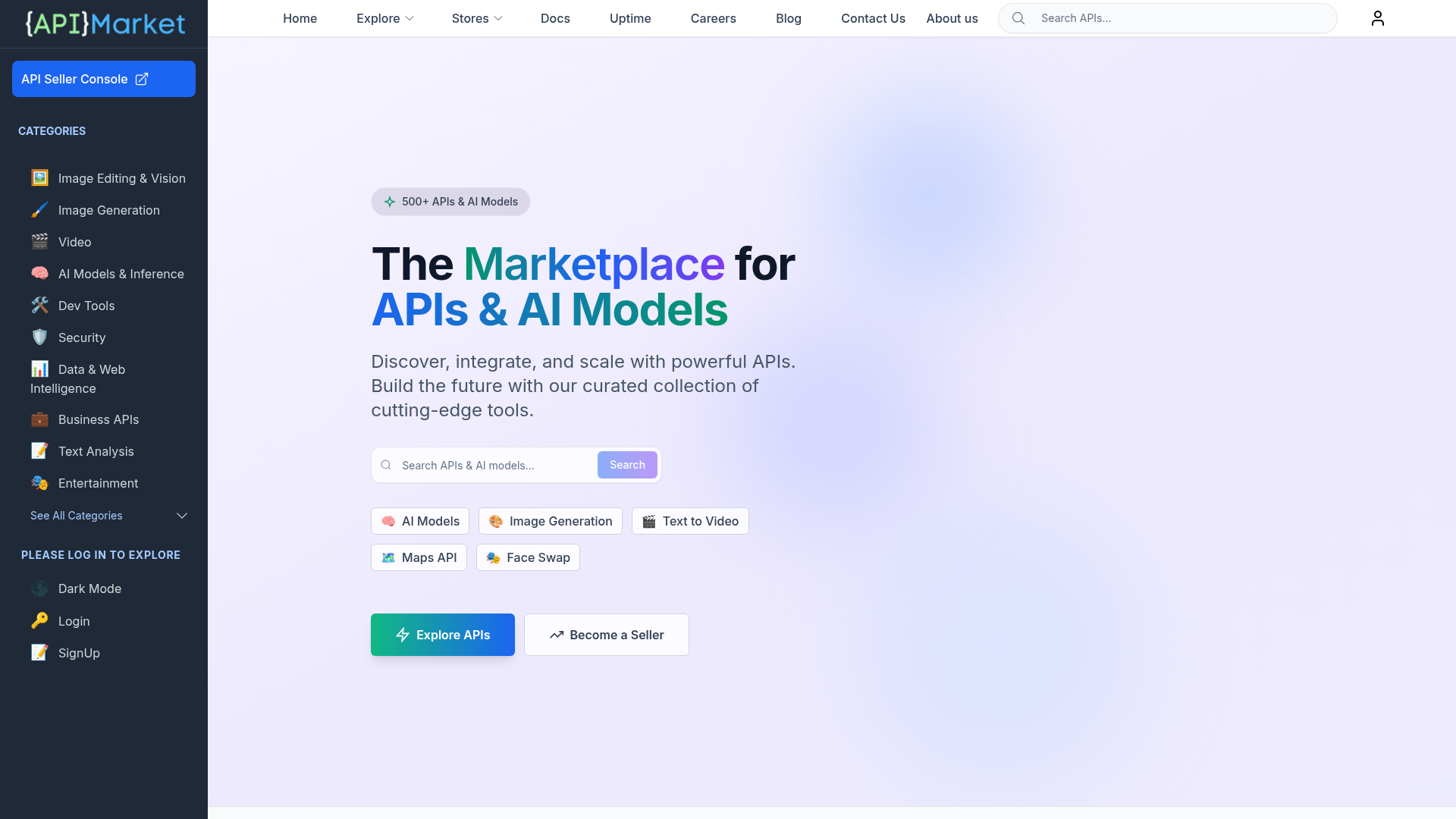
API.market is a newer marketplace oriented around AI models, data APIs, and MCP servers instead of general-purpose utility APIs, listing more than 500 APIs and AI models for its 13,000-plus registered developers. A prospective seller registers, completes a seller profile, and goes through a verification process before a listing goes live. The platform meters usage, handles billing, and manages distribution once an API is listed, similar to the older marketplaces but oriented toward the AI-tooling categories most in demand right now.
Key Features
- Categories lean toward AI and machine learning, image generation and editing, video, and data intelligence, alongside more familiar categories like maps and business APIs.
- A seller console separates listing management from the buyer-facing catalog.
- Usage metering and tracking come standard on every listed API, with no separate integration step for the provider.
Pros & Cons
PROS
CONS
Pricing
A provider sets the subscription price for their own listing. API.market does not publish a take-rate percentage; sellers go through a verification process, and revenue-share terms are confirmed at that stage.
AWS Marketplace
AWS Marketplace lets an independent software vendor, channel partner, or individual sell a SaaS product, a container, an Amazon Machine Image, or a data product to any AWS customer with a registered account. AWS collects payment from the buyer, meters usage where the pricing model calls for it, and disburses funds to the seller’s bank account, so no separate payment processor or invoicing system is required. Selling supports pay-as-you-go, annual and multi-year commitments, bring-your-own-license, and negotiated Private Offers with custom pricing and terms. A free-trial option exists specifically for usage-based SaaS listings, useful for a buyer evaluating an API before committing to a paid plan.
Key Features
- Standardized license terms speed up procurement for enterprise buyers already used to reviewing AWS contracts.
- Private Offers let a seller negotiate custom pricing, payment schedules, and contract length with a specific buyer.
- Disbursements go out monthly, once AWS has collected the buyer’s payment.
- A product can be listed for global availability or restricted to specific countries.
Pros & Cons
PROS
CONS
Pricing
AWS charges a listing fee only when a sale closes, calculated as a percentage of the deal’s total contract value; there is no upfront cost to list (effective January 5, 2024).
- SaaS or AWS Data Exchange public offers: 3%
- Server products (AMI, container, machine learning): 20%
- Private offers: 3% under $1 million in contract value, 2% from $1 million to $10 million, 1.5% at $10 million or more, and 1.5% on all renewals
Direct monetization and billing platforms
Zuplo
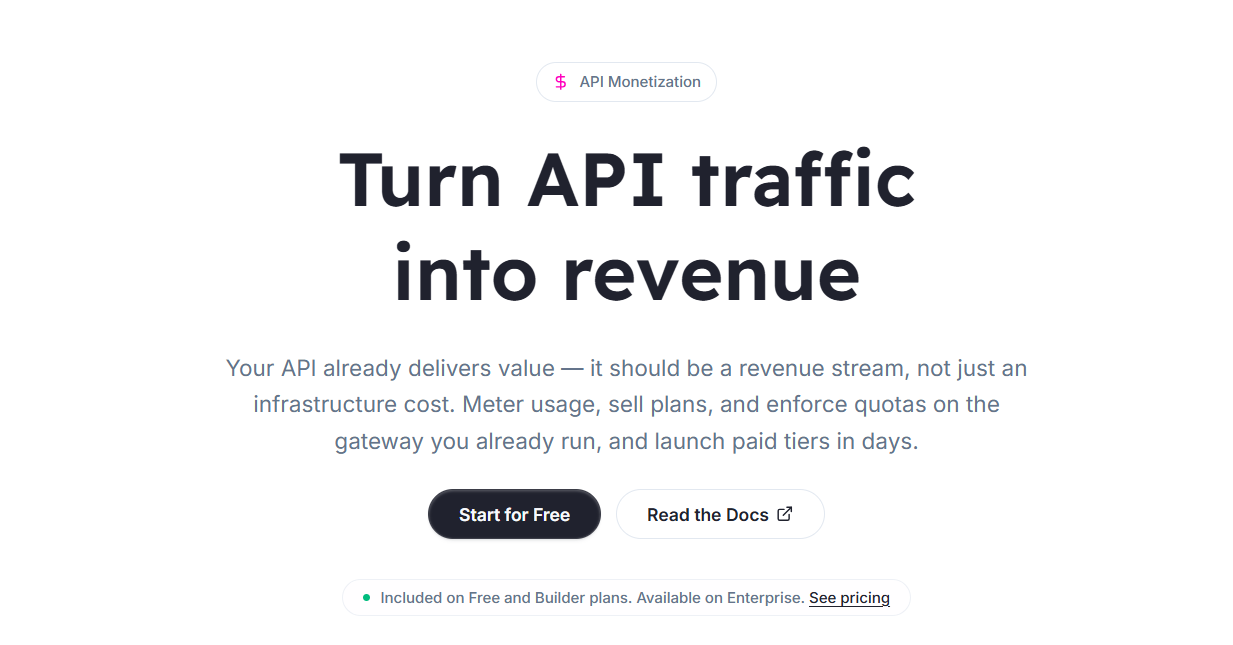
Zuplo is an API gateway with metering, quota enforcement, and Stripe-based billing placed directly in the same request path that routes your API’s traffic, so a customer hitting a limit gets blocked by the same system that handled the call. Pricing is defined through meters, features, and plans that a developer subscribes to through a hosted developer portal. The company also bundles an AI Gateway and an MCP Gateway on the same platform, aimed at teams exposing APIs to AI agents as well as human developers.
Key Features
- Meters, features, plans, and subscriptions form the pricing model, covering flat fees, usage-based billing, credit systems, and combinations of them.
- Quota enforcement happens inline with each request, with no separate metering service to sync or reconcile.
- The developer portal includes a pricing page, Stripe Checkout, and a real-time usage dashboard, on the same domain as the API’s documentation and key management.
- An AI Gateway and MCP Gateway ship on the same platform, for teams that also route to language models or expose tools to agents.
Pros & Cons
PROS
CONS
Pricing
Zuplo’s Free plan includes monetization at no cost, useful for testing a pricing model before committing to it.
- Free: 100,000 requests/month, monetization included for up to 100,000 metered events
- Builder: the same base, plus metered overage at $100 per 100,000 requests, capped at 2 custom domains and 1 million requests/month, aimed at solo builders, not teams
- Enterprise: starts at $1,000/month on an annual contract, with monetization available as an add-on
Kong
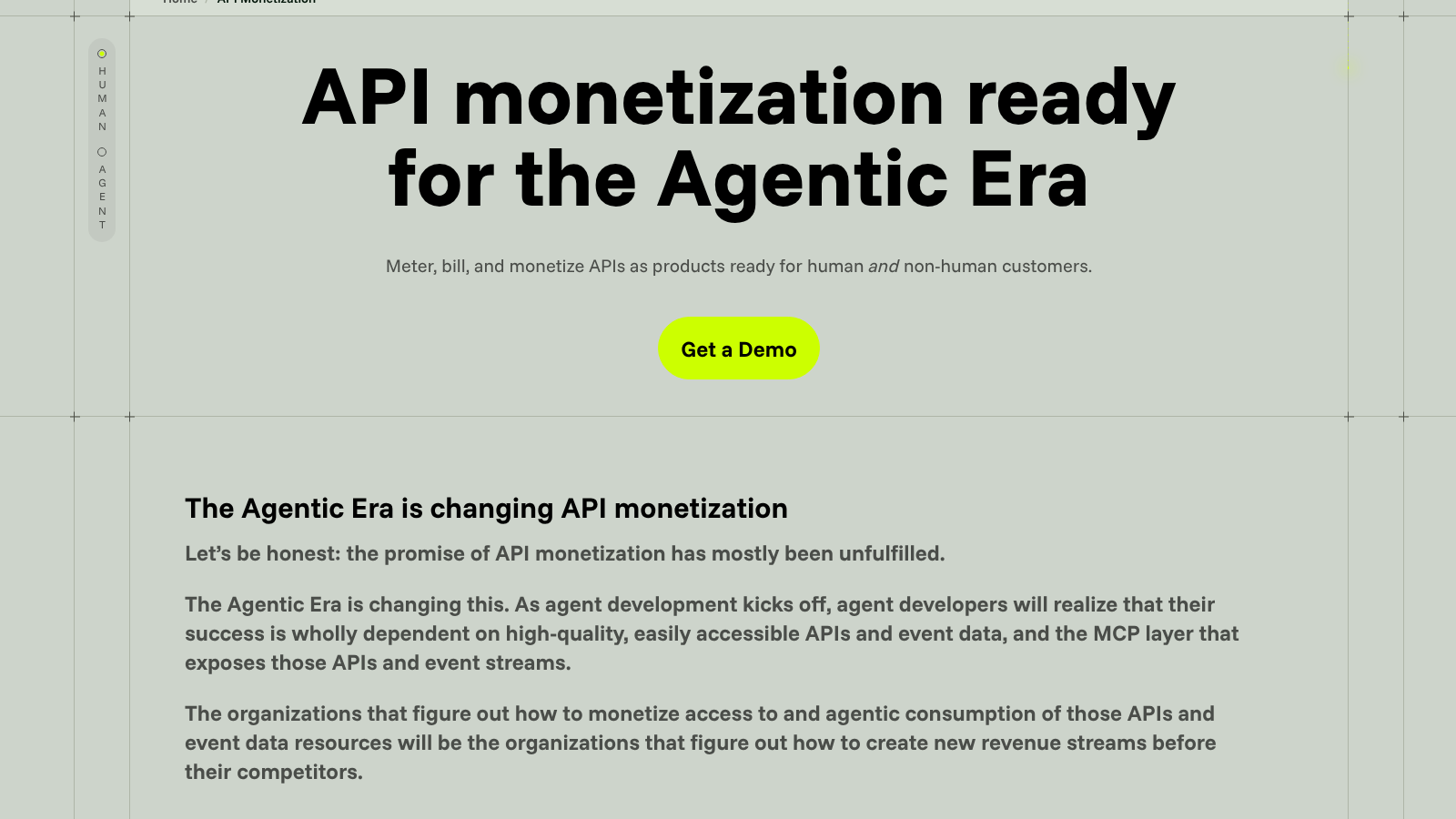
Kong is one of the most widely deployed API gateways, and in October 2025 it added native metering and billing directly into Kong Konnect, its unified platform, powered by OpenMeter, a usage-metering company Kong acquired the same year. The feature meters API and AI Gateway traffic inline, at the same point the gateway routes the request, an approach similar to Zuplo’s but inside a much larger, more established gateway. Rate cards support flat fees, usage-based pricing down to the token for AI and LLM traffic, prepaid credits, and negotiated enterprise terms, with invoices pushed automatically to Stripe or other payment and ERP systems.
Key Features
- Metering works natively on Kong API Gateway and AI Gateway traffic, and also accepts usage events from outside Kong through the open CNCF CloudEvents standard.
- AI and LLM traffic can be metered down to the token, per model, per customer, per request, not just per API call.
- A unified product catalog lets a team change pricing packages without writing code, then test and version the change before it goes live.
- Dashboards track revenue, churn, and forecasted revenue alongside the usage data the gateway already collects.
Pros & Cons
PROS
CONS
Pricing
Kong Konnect pricing does not list a separate charge for the metering and billing feature; it is a platform capability inside these tiers.
- Free trial: $0 for 30 days, no credit card required, full enterprise functionality
- Plus: self-serve, billed monthly per Gateway, exact rate shown at signup
- Enterprise: custom, billed annually
Moesif (WSO2)
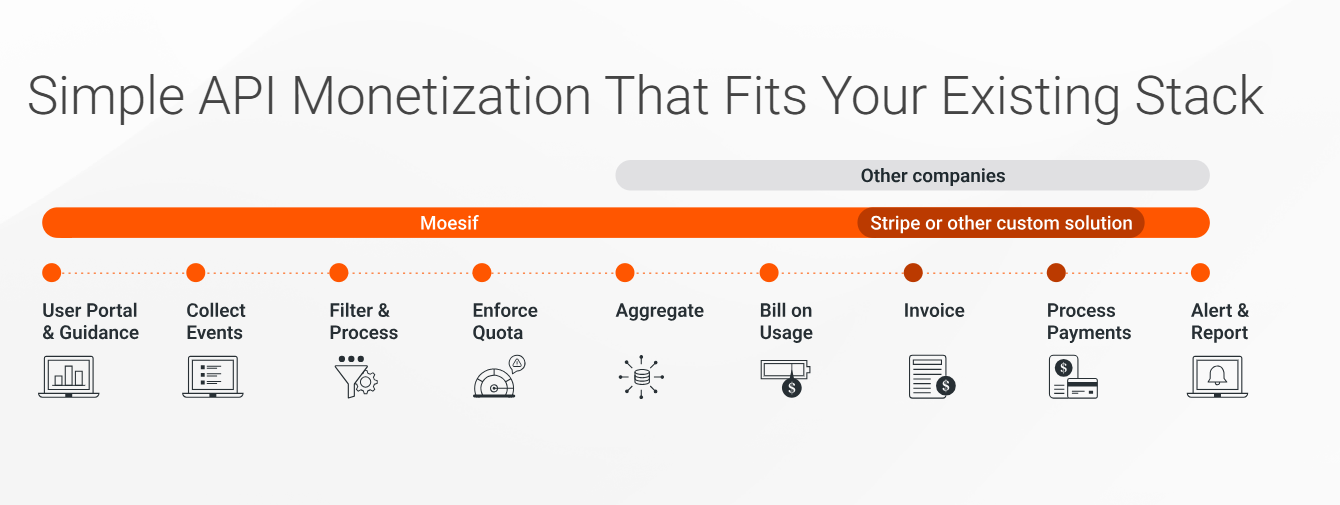
Moesif started as an API analytics platform and added usage-based billing on top of that core, tracking who calls an API, how often, and at what cost. WSO2 acquired Moesif in May 2025, and it now operates as an independent subsidiary within WSO2’s broader API management business. A provider instruments their API with Moesif’s SDK or a gateway plugin, and Moesif syncs the resulting usage data to Stripe, Recurly, Chargebee, or Zuora for actual invoicing and payment collection.
Key Features
- Governance rules enforce quotas and subscription terms, syncing usage-based limits back to the gateway.
- A product catalog defines metered plans, and prepaid credit or balance models are supported alongside standard subscriptions.
- Cohort analysis and funnel visualization break down usage by customer segment, going deeper than plan enforcement alone.
- A developer portal gives API consumers self-service access to their own usage and billing history.
Pros & Cons
PROS
CONS
Pricing
Moesif does not publish self-serve monetization pricing on its site; historically the product has been priced by usage tier, confirmed directly with the company. It connects to an existing Stripe, Recurly, Chargebee, or Zuora account for payment collection, and it does not charge its own percentage of revenue on top of that.
Lago
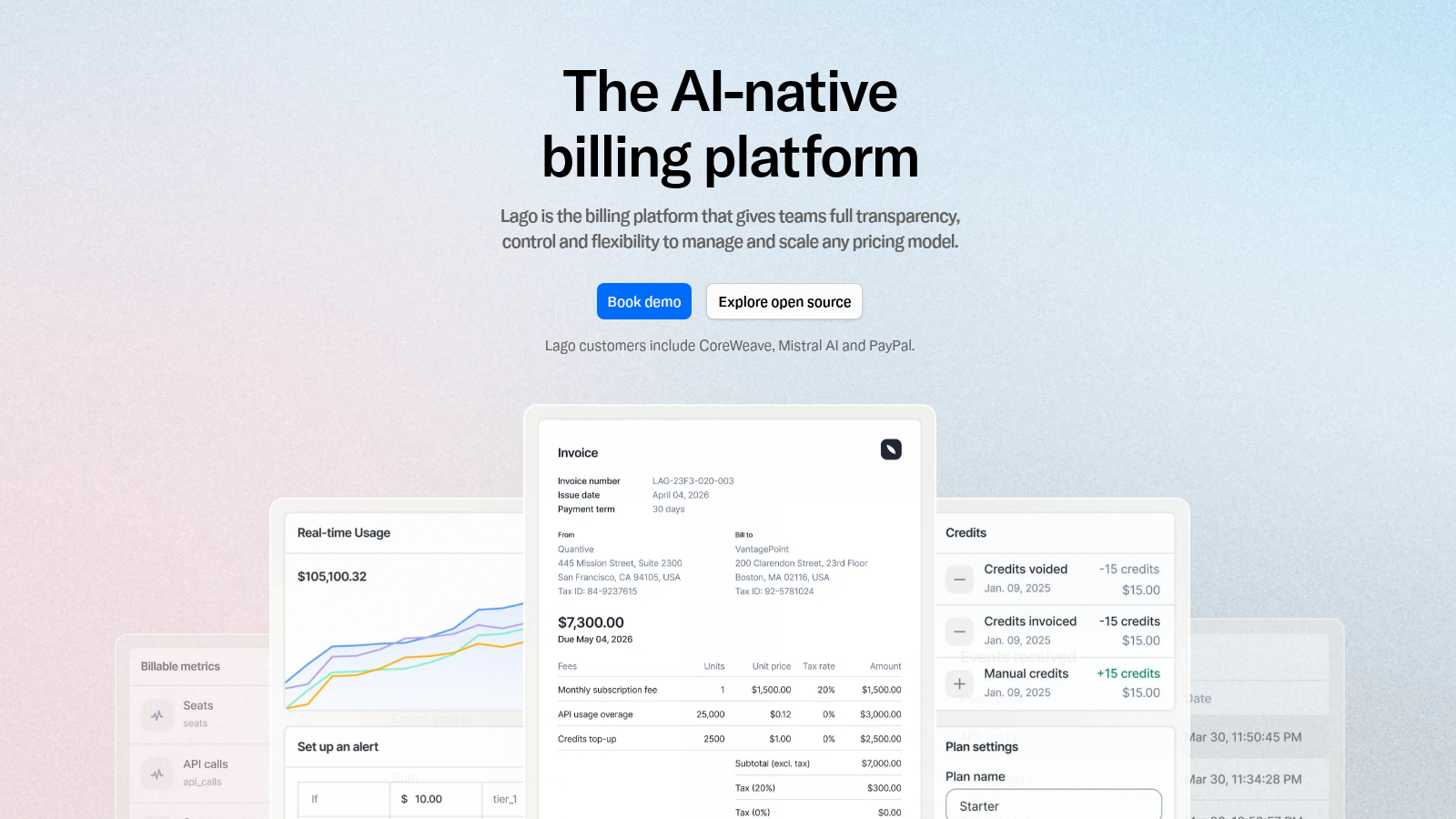
Lago is an open-source billing engine, licensed under AGPLv3, that a team can self-host or run as Lago’s managed cloud service. It covers usage metering, invoicing, dunning, and revenue analytics from one system, and connects to Stripe, Adyen, or GoCardless to actually collect the payment. CoreWeave, Mistral AI, and PayPal are named as production users. An included MCP server lets an AI agent query billing data directly, added to the product in 2026.
Key Features
- Hybrid plans combine a flat subscription fee with usage-based charges in the same billing cycle.
- Entitlements are tied directly to the billing plan, so a customer’s plan controls feature access instead of a separate permissions system.
- Revenue analytics track billing performance across every pricing model in one dashboard.
- Official SDKs cover JavaScript, Python, Ruby, and Go, generated from the same API contract as the documentation.
Pros & Cons
PROS
CONS
Pricing
The open-source version is free to self-host under AGPLv3.
- Self-hosted, open source: free, no platform fee
- Lago Premium (cloud or self-hosted): priced by quote, based on usage volume and deployment needs
Other platforms worth knowing
A few other platforms come up often in the same conversation and are worth naming even without a full entry.
Apiable connects to an existing gateway, Kong, AWS API Gateway, Apigee, or Azure API Management, and adds the billing and partner-onboarding layer those gateways do not include natively.
Gravitee is an open-source gateway with its own developer portal and subscription plans but no native billing, so it needs pairing with Stripe or a tool like Moesif to actually invoice anyone.
Amberflo focuses narrowly on real-time usage metering at high event volumes, syncing the resulting bill to Stripe without acting as a gateway itself.
MuleSoft’s Anypoint Platform includes API management inside a much larger enterprise integration product, priced for enterprise integration budgets that put it out of reach for most teams selling a single API.
Stripe Billing alone, with no gateway or metering layer around it, can also work for a team willing to build the usage tracking, quota enforcement, and developer portal themselves.
How to choose
Start with what you are optimizing for. If organic discovery matters more than keeping every dollar of revenue, a marketplace does real work for you: Rapid for the largest existing audience, APILayer if non-exclusive listing rights matter, AWS Marketplace if your buyer already procures through AWS, or API.market if the product is an AI model, a dataset, or an MCP server. If keeping the full margin and the direct customer relationship matters more, a monetization platform like Zuplo, Moesif, or Lago lets you sell from your own site instead of splitting revenue with anyone.
Then look at what each option actually requires from you. A marketplace listing needs almost no new infrastructure: submit the API, pass review, and the marketplace’s own gateway, docs, and billing take over. A monetization platform is a bigger commitment: Zuplo replaces your API gateway outright, Moesif needs an SDK or plugin instrumented into your API, and Lago needs a database, background workers, and a payment processor wired up if you self-host it.
None of this is exclusive. APILayer’s own terms explicitly allow listing the same API elsewhere, and nothing stops a provider from testing a marketplace listing on Rapid while also running Zuplo or Lago against direct customers on their own site. The fastest way to find out which combination works is to list on one marketplace and set up one direct-billing option in parallel, then compare where the paying customers actually come from.
Frequently Asked Questions
What happened to RapidAPI?
Nokia acquired RapidAPI’s technology and R&D team in November 2024. The public marketplace kept operating and is now called Rapid, or the Rapid API Hub, and it added Model Context Protocol support in 2026. Its marketplace fee changed to a flat 25% on every subscription and overage payment starting November 15, 2025.
Should I list on a marketplace or monetize my API directly?
It depends on what you are short of, buyers or margin. A marketplace like Rapid, APILayer, or API.market brings an existing audience in exchange for a revenue cut and less control over the customer relationship. A monetization platform like Zuplo, Moesif, or Lago keeps the full margin and the direct relationship but requires you to bring your own buyers.
How much revenue do these platforms take?
It varies by platform and is not always published. Rapid takes a flat 25% of every subscription and overage payment. AWS Marketplace charges 3% for a SaaS listing and 20% for a server-based product. APILayer and API.market let the provider set the price but do not publish a commission percentage. The monetization platforms, Zuplo, Kong, Moesif, and Lago, do not take a cut of revenue at all; you pay them a subscription or usage fee for the software instead, and keep everything customers pay you.
Can I use more than one of these platforms at the same time?
In most cases, yes. APILayer’s terms explicitly allow listing the same API on other marketplaces or selling it directly. Marketplaces generally do not require exclusivity, so a common pattern is listing on one marketplace for discovery while also running a direct monetization platform for customers who found the API another way. Check each platform’s current terms first, since exclusivity policies do change.
Do I need my own API gateway to use these platforms?
No, not for a marketplace listing. Rapid, APILayer, AWS Marketplace, and API.market all provide the gateway, authentication, and billing infrastructure themselves once your API is listed. Zuplo and Kong are the exceptions among the monetization platforms: adopting either one means routing your API’s traffic through its gateway, not just plugging in a billing add-on. Moesif and Lago work alongside whatever gateway and payment processor you already use.