



A company enrichment API turns a small piece of input, usually a website domain or a company name, into a structured record about the business behind it. A single call returns industry, employee count, headquarters, revenue band, and often the tech stack, funding history, and hiring trend. Apps use that to fill CRM records, qualify signups, route leads by company size, and feed data pipelines.
Most of the company enrichment APIs resell or index overlapping public web data, so the real differences are narrow: which identifiers the enrichment endpoint accepts; whether it offers a single lookup, a bulk call, and a search call, how fresh the data is, whether you can pay with a card or have to talk to sales, and the published US price per lookup. The APIs listed below are compared on exactly that.
What a company enrichment API returns
The core request is a domain in, a company record out. Many providers also accept a company name, a LinkedIn company URL, a work email, or a stock ticker as the match input and let you ask for the whole profile or only named fields.
The fields group into a few families.
- Firmographics describe the company itself: industry, size band, headquarters, founding year, legal type.
- Technographics list the software detected on a company’s website and job posts.
- Funding data covers rounds, investors, and valuation.
- Growth signals include headcount over time, hiring rate, and web-traffic trend.
- Contact data adds a company phone, social profiles, and sometimes named people with verified emails.
Endpoints come in three shapes. A single enrich call takes one identifier. A bulk enrich call takes a list. A search call returns companies that match filters such as industry plus country plus headcount. Not every provider offers all three.
Coverage and match rate are different numbers. Coverage is how many companies are in the database. Match rate is how often a lookup on your specific list comes back filled in. A provider can hold 70 million companies and still miss the five-person agencies on your list, so test with your own domains before you commit.
Company enrichment APIs compared
| API | Data focus | Match inputs | Free to start | Self-serve checkout | Published US price from |
|---|---|---|---|---|---|
| People Data Labs | Firmographics plus people, developer-first | Name, domain, social, ticker, location | 100 records/mo | Yes | About $100/mo |
| Coresignal | Multi-source firmographic, employee, and jobs data | Domain, company ID | 7-day trial, 2,000 credits | Yes | $49/mo |
| Apollo.io | Enrichment on a large B2B contact and company database | Domain, LinkedIn URL, website | Free plan, 900 credits/yr | Yes | $49/seat/mo, annual |
| Abstract API | One firmographic endpoint | Domain, work email | 100 requests | Yes | $12/mo, annual |
| The Companies API | Firmographic enrich plus attribute search | Domain, name | No standing free plan | Yes | $95/mo |
| Diffbot | Knowledge-graph entity data: firmographic, tech, news | Name, domain, partial identifiers | 10,000 credits/mo | Yes | $299/mo |
| Crustdata | Real-time signals: hiring, traffic, reviews, funding | Domain, name, ID, profile URL | Demo only | No | Quote |
| ZoomInfo | Enterprise firmographics, hierarchy, and intent | Domain, known company or contact | Demo only | No | Quote |
| Lusha | Contact plus company enrichment | Domain, email, company name | 40 credits/mo | Yes | $37.45/mo, annual |
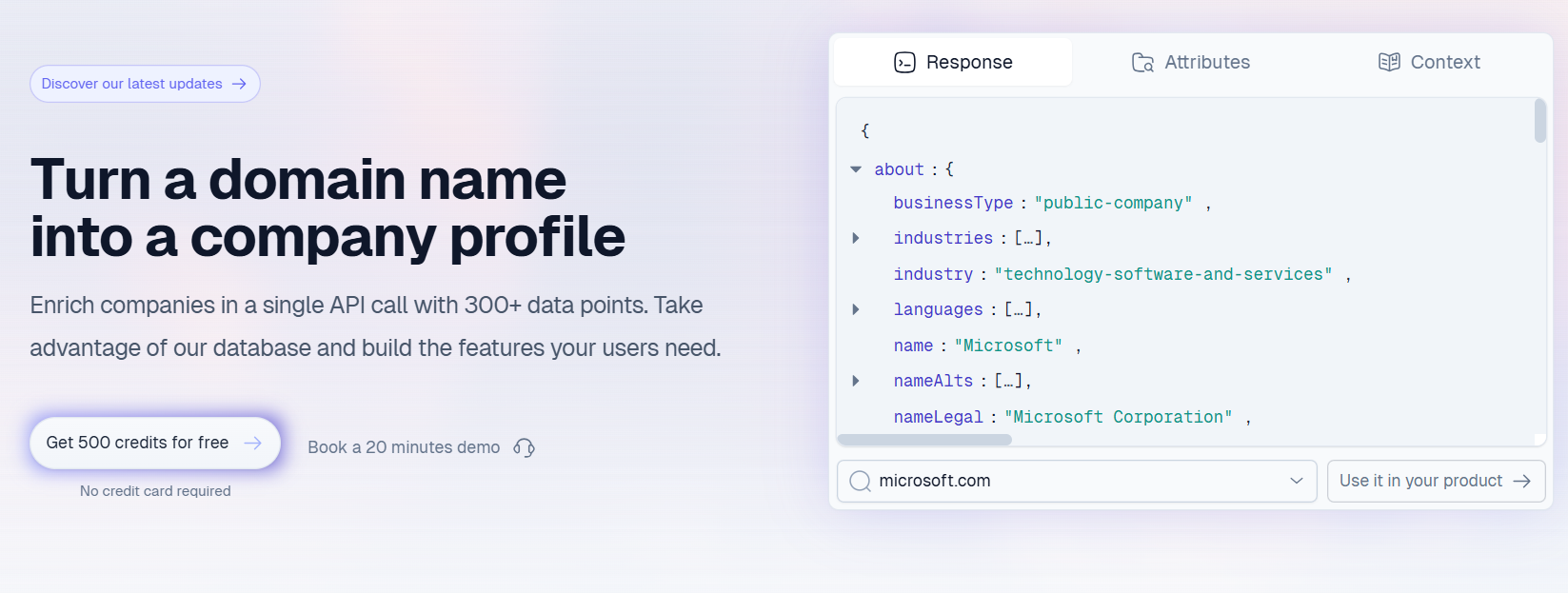
| CompanyEnrich | Low-cost firmographic enrich plus search | Domain, name | 500 credits | Yes | $49/mo |
People Data Labs
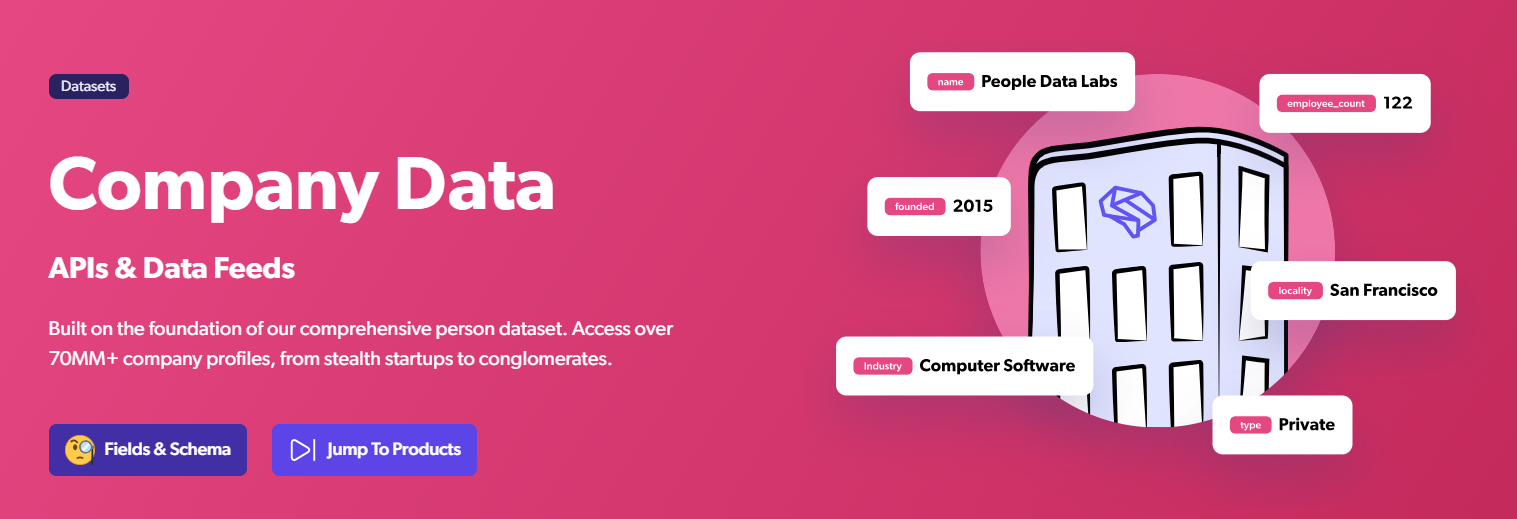
People Data Labs builds one dataset of people and layers company data on top, so a single account covers person enrichment, company enrichment, and IP-to-company lookups. The Company Enrichment API matches on a name, website, location, social profile, or stock ticker, and returns the full company record or only the fields you ask for. It suits teams building their own product or data pipeline who want SDKs and a self-serve dashboard. Named users on its site include S&P Global and Clay.
Key Features
- Roughly 70 million company profiles, each refreshed monthly.
- Match strictness is a request parameter, so you can require a website plus a country before a result counts as a hit.
- Billing is per successful match, and you can require specific fields to be present for the match to count.
- Company records come from the same graph as its person profiles, so joining a contact to an employer stays consistent.
- One key also reaches a Search API for firmographic list-building and an IP Enrichment API for de-anonymizing web traffic.
- Delivery is by API, flat-file license feed, or a Snowflake and Databricks share.
Pros & Cons
PROS
CONS
Pricing
A renewing free tier for testing, then one self-serve paid plan; bulk volume is a sales conversation.
- Free: up to 100 records per month, with contact fields obfuscated
- Pro: from about $100 per month, starts at 1,000 company records per month, monthly or annual (annual saves 20 percent)
- Enterprise: custom, adds data license feeds, SSO, and a success team
Coresignal
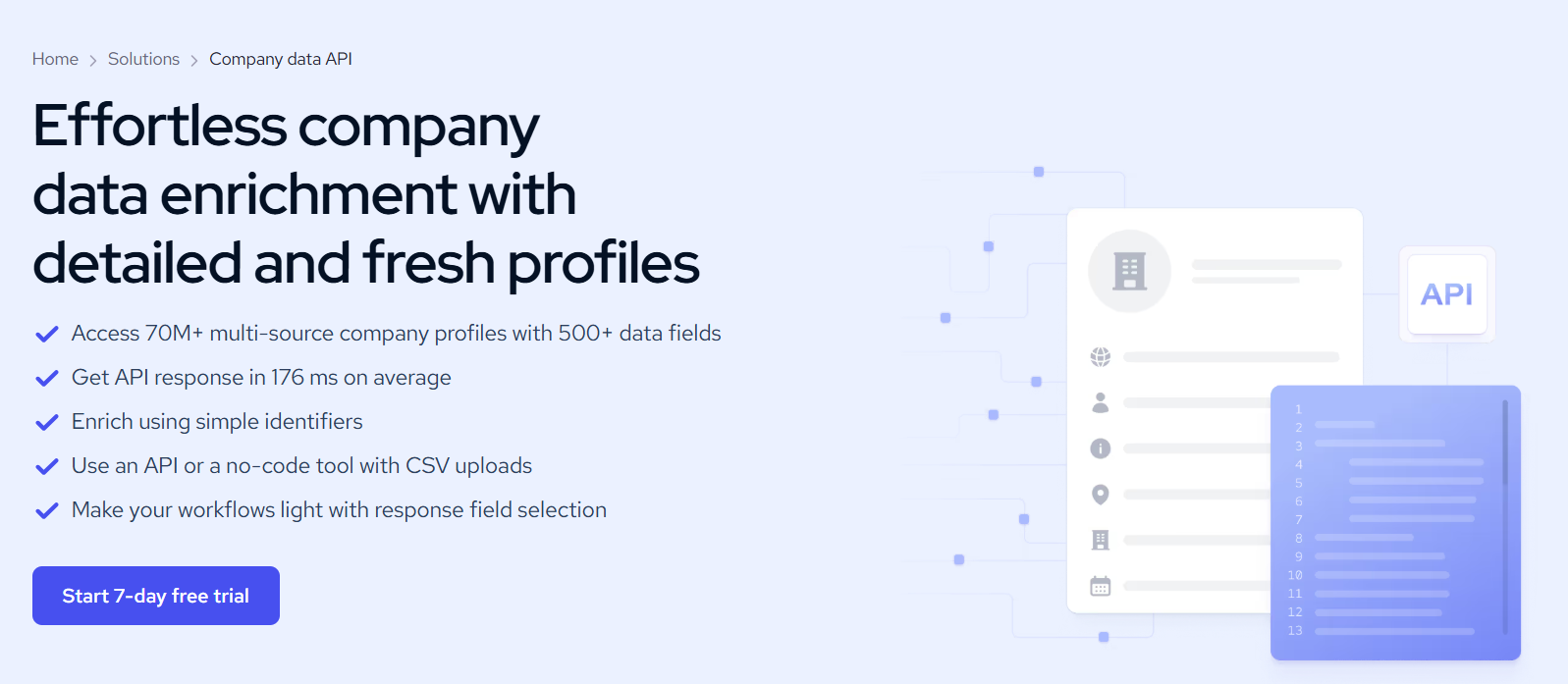
Coresignal resolves company records from more than 15 public web sources into one deduplicated schema of 500-plus fields, and returns them in about 176 milliseconds on average. You enrich by company domain or by a Coresignal profile ID, one at a time or in bulk, and you can name the exact fields you want back to keep responses small. It has sold web data since 2016 and is certified by the Ethical Web Data Collection Initiative.
Key Features
- A no-code Company Enricher takes a CSV of domains or emails and returns name, headquarters, size, industry, and a social link per row.
- The underlying database accepts Elasticsearch DSL queries when you need filters more complex than a lookup.
- Webhooks push record changes, so a synced dataset stays current without polling.
- Employee, Jobs, and Agentic Search APIs draw on the same credit balance.
Pros & Cons
PROS
CONS
Pricing
A 7-day trial, then self-serve credit plans from a low monthly price up to enterprise volume. Annual billing is about 10 percent off with credits granted upfront.
- Free trial: 2,000 credits for 7 days, no card
- Mini: $49 per month, 2,500 credits
- Growth: $1,000 per month, 150,000 credits, with 3-month credit rollover; lower plans do not roll credits over
- A company record costs 10 to 20 credits, for a single-source or multi-source profile
Apollo.io
Apollo.io pairs a large B2B contact and company database with an Organization Enrichment endpoint. It takes a domain, a LinkedIn company URL, or a website, and returns firmographics, department-level headcount, revenue, funding rounds and investors, tech stack, and 6-, 12-, and 24-month headcount growth. A bulk version enriches up to ten companies per call. Apollo fits teams that also want the outreach side, sequences, a dialer, and CRM sync, in one tool, since the API comes with the seat-based plans and is not sold on its own.
Key Features
- One organization enrichment costs one credit; email or phone reveals on the same record cost more.
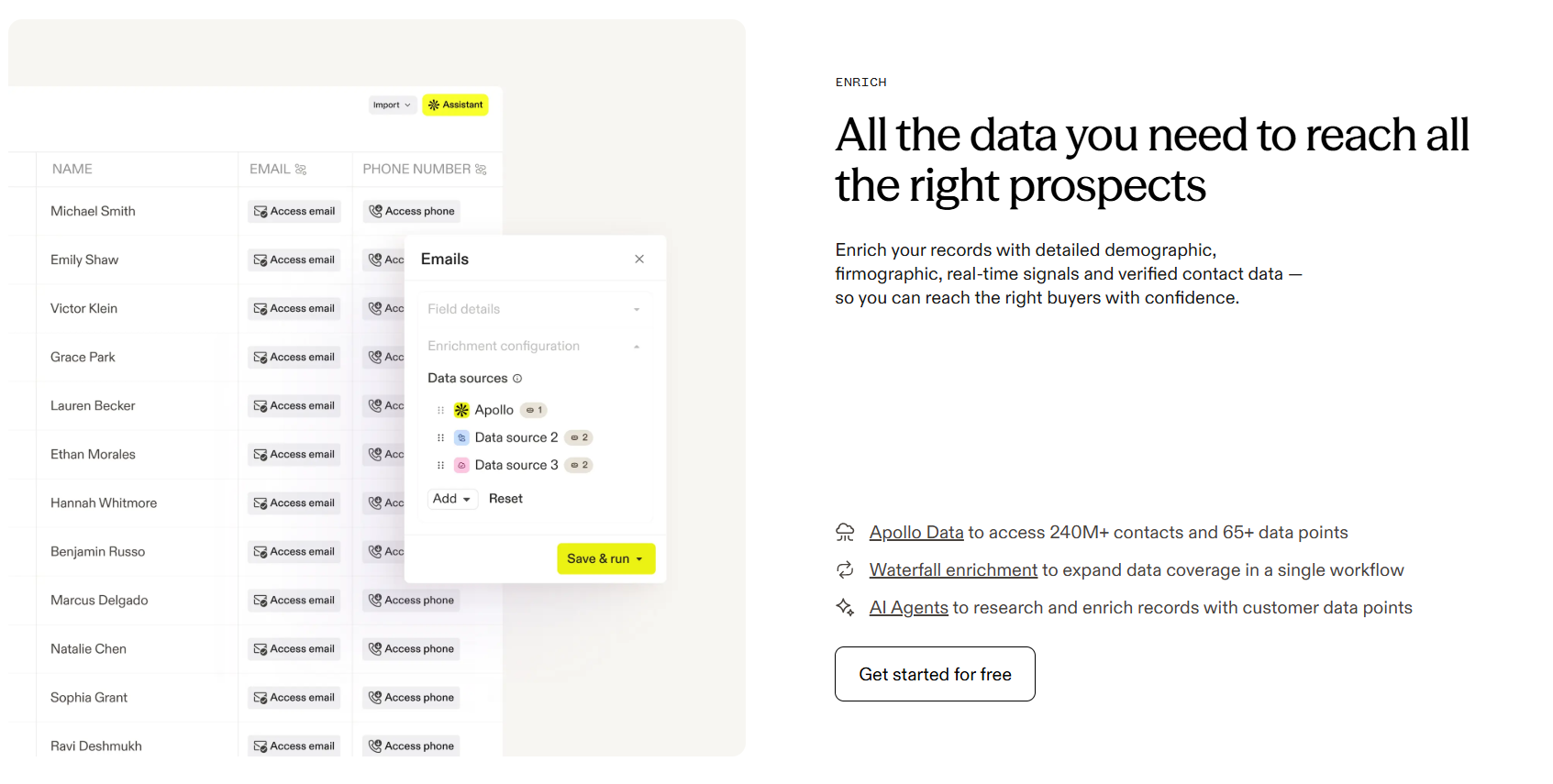
- Waterfall enrichment falls back through several data sources on a miss, on the paid plans.
- The database side is queryable, so you can search for accounts by filter and enrich the results in one flow.
- Native sync with Salesforce and HubSpot keeps enriched fields updated in the CRM.
Pros & Cons
PROS
CONS
Pricing
A free plan with a small credit grant, then per-seat plans billed annually with credits granted upfront.
- Free: $0, 900 credits per seat per year, CRM enrichment capped at 100 records per month
- Basic: $49 per seat per month billed annually, 30,000 credits per seat per year, adds API data enrichment
- Professional: $79 per seat per month billed annually, 48,000 credits per seat per year
- Organization: $119 per seat per month billed annually, three-seat minimum, adds SSO
Abstract API
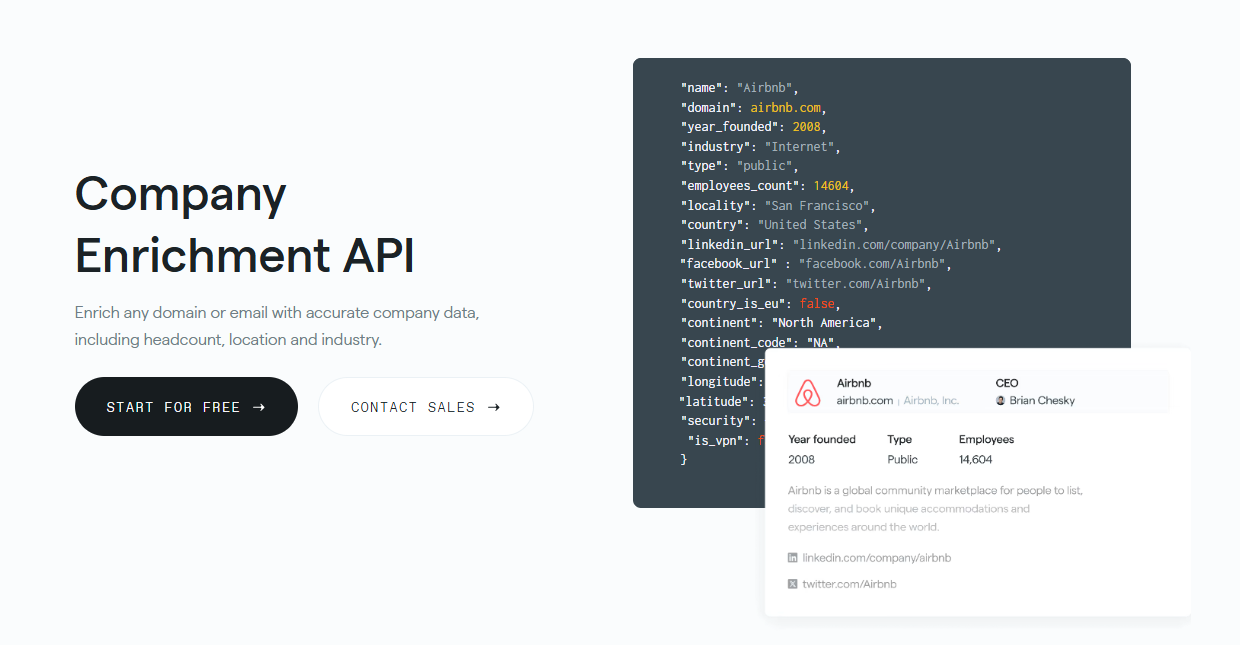
Abstract API’s Company Enrichment API does one thing. You send one GET request with a domain or a work email, and get one JSON object back: industry, SIC and NAICS codes, employee and revenue ranges, founding year, headquarters, social profiles, a ticker for listed companies, and a detected tech list. The dataset covers companies in more than 170 countries, drawn from LinkedIn, SEC EDGAR, and other public and private databases, and refreshed weekly. It suits a straightforward CRM or signup-form enrichment job where you do not need funding data or bulk search.
Key Features
- Passing an email returns the company behind the domain plus its public phone and social handles, which is handy for form enrichment.
- SIC and NAICS codes come standard, so routing leads by industry code needs no lookup table.
- The same account and response style cover Abstract’s IP, email, and phone validation APIs.
Pros & Cons
PROS
CONS
Pricing
A 100-request free tier, then one paid plan priced by request volume; annual billing roughly halves the monthly rate.
- Free: 100 requests total
- Standard: $19 per month for 1,000 requests per month, or $12 per month billed annually for 12,000 requests per year
- Enterprise: custom, adds an SLA, SSO, and a commercial license
The Companies API
The Companies API enriches a domain or company name against about 50 million companies, and when it has not seen a company before it analyzes the site on request instead of returning a miss. Alongside the enrich call, it offers attribute and natural-language search, so “SaaS companies in Germany with 50 to 200 staff” is a single query. Customers listed on its site include Palo Alto Networks and Crisp.
Key Features
- Every plan unlocks all API features and the full company set; plans differ only by monthly credits and request rate.
- Unfetched companies are analyzed live, which keeps coverage of newer and smaller businesses higher than a fixed snapshot.
- Saving the same company to a list twice does not spend a second credit.
Pros & Cons
PROS
CONS
Pricing
Credit plans billed monthly, with two months free on annual billing. There is no free tier.
- Startup: $95 per month, 50,000 credits, 50 requests per second
- Scaleup: $295 per month, 250,000 credits, 250 requests per second
- Enterprise: $595 per month, 500,000 credits, 1,000 requests per second
- Extra credits cost $1.50 to $2.50 per thousand, depending on plan
Diffbot
Diffbot maintains a Knowledge Graph, a database of linked entities assembled by crawling and parsing the public web. Its Enhance API takes a few identifiers about an organization, a name plus a domain, say, and returns everything the graph holds on it: firmographics, the tech stack behind a site, revenue and employee estimates, funding, and linked news articles and people. It fits a research tool or knowledge base more than a job that only appends a handful of CRM fields. The graph takes in roughly 30 million new organization records a month.
Key Features
- One Enhance call resolves partial or messy input to a single canonical entity, which helps with deduplication.
- The same credit balance covers article extraction, a natural-language API, and web search.
- Entities carry stable IDs and link to each other, so related companies and people resolve to the same records over time.
- Responses are structured JSON with a typed entity model you can map to your own schema.
Pros & Cons
PROS
CONS
Pricing
A permanent free tier, then flat monthly credit plans; cancel anytime.
- Free: 10,000 credits per month, all APIs, 5 requests per minute
- Startup: $299 per month, 250,000 credits per month
- Plus: $899 per month, 1,000,000 credits per month, three seats
- Enterprise: custom volume and rate limits
Crustdata
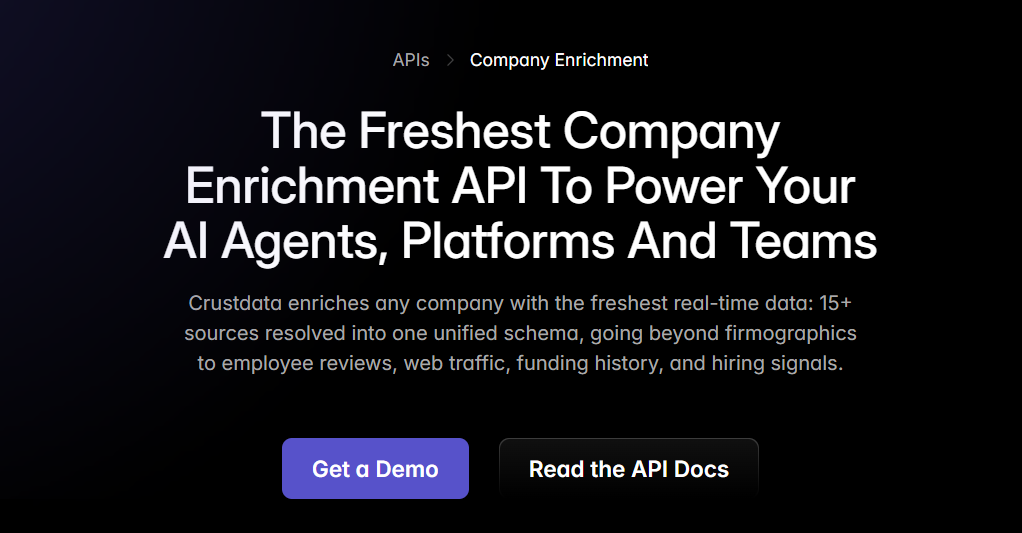
Crustdata indexes company data in real time from more than 15 sources. Its Company Enrichment API returns 250-plus fields that go past static firmographics into hiring rate, web-traffic trend, G2 and Glassdoor ratings, funding history, press mentions, and product launches. You send a domain, a company name, an ID, or a LinkedIn URL, and choose whether the answer comes live from the web or from a monthly-refreshed cache. Pair it with the Watcher API and a webhook fires when one of those signals changes.
Key Features
- Partial enrichment fetches only the fields your record is missing and leaves the rest untouched.
- Headcount comes back as a time series, current and historical, broken out by department.
- A bulk mode takes a list of domains as one batch job.
- An MCP server lets an assistant such as Claude call the enrichment in plain language.
Pros & Cons
PROS
CONS
Pricing
Credit-based API access or a monthly flat-file dataset. No public prices; pricing comes from a sales conversation.
- Real-time API: credit-based usage tiers, monthly or annual
- Flat-file dataset: full monthly refresh, unified from 11-plus sources, as CSV or JSON
- Both require contacting Crustdata for a quote
ZoomInfo
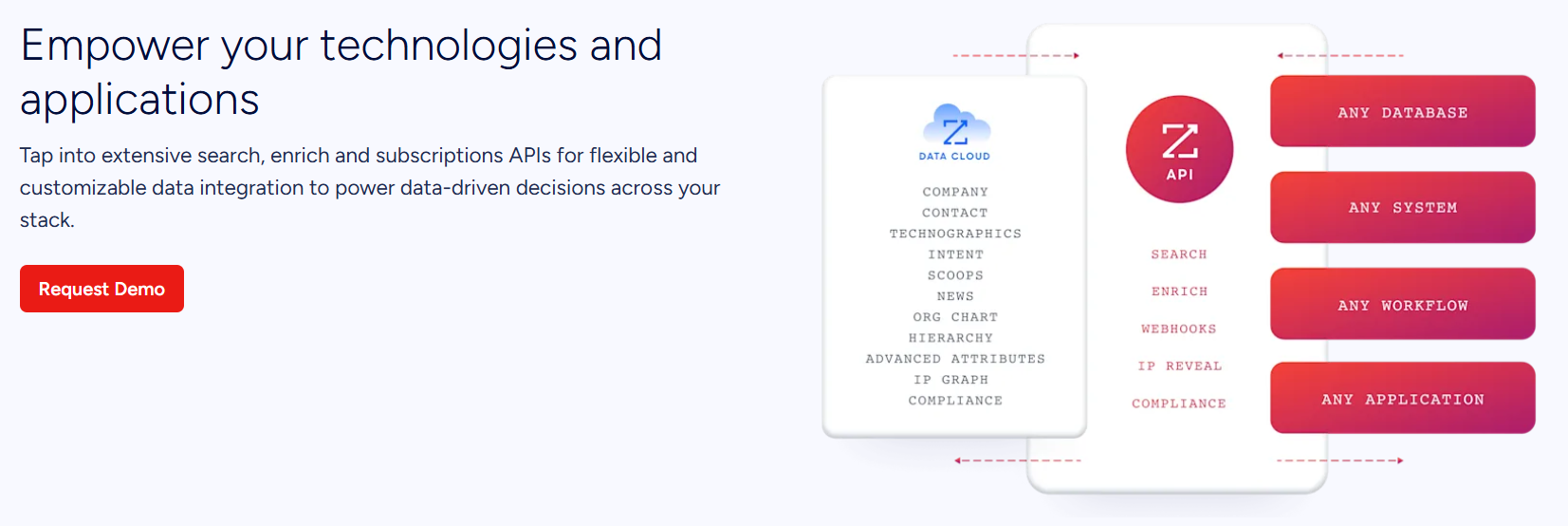
ZoomInfo‘s Enrich API matches a domain or a known record and returns the full ZoomInfo profile: company details, corporate hierarchy and org chart, tech stack, and buyer-intent signals. It sells only through the Enterprise API, as an annual contract after a demo, with no self-serve tier and no published price. It makes sense when you are already a ZoomInfo customer, or need the coverage, corporate hierarchy, and buyer-intent data that the mid-market APIs do not match.
Key Features
- A scaling API tier redeems and refreshes millions of records with daily change updates.
- Corporate hierarchy links every subsidiary to its ultimate parent.
- Separate APIs cover website-visitor identification and privacy or opt-out compliance.
Pros & Cons
PROS
CONS
Pricing
Enterprise API only, sold as an annual contract after a demo. ZoomInfo does not publish API pricing or offer a self-serve plan.
- Access: contact ZoomInfo sales for a quote
Lusha
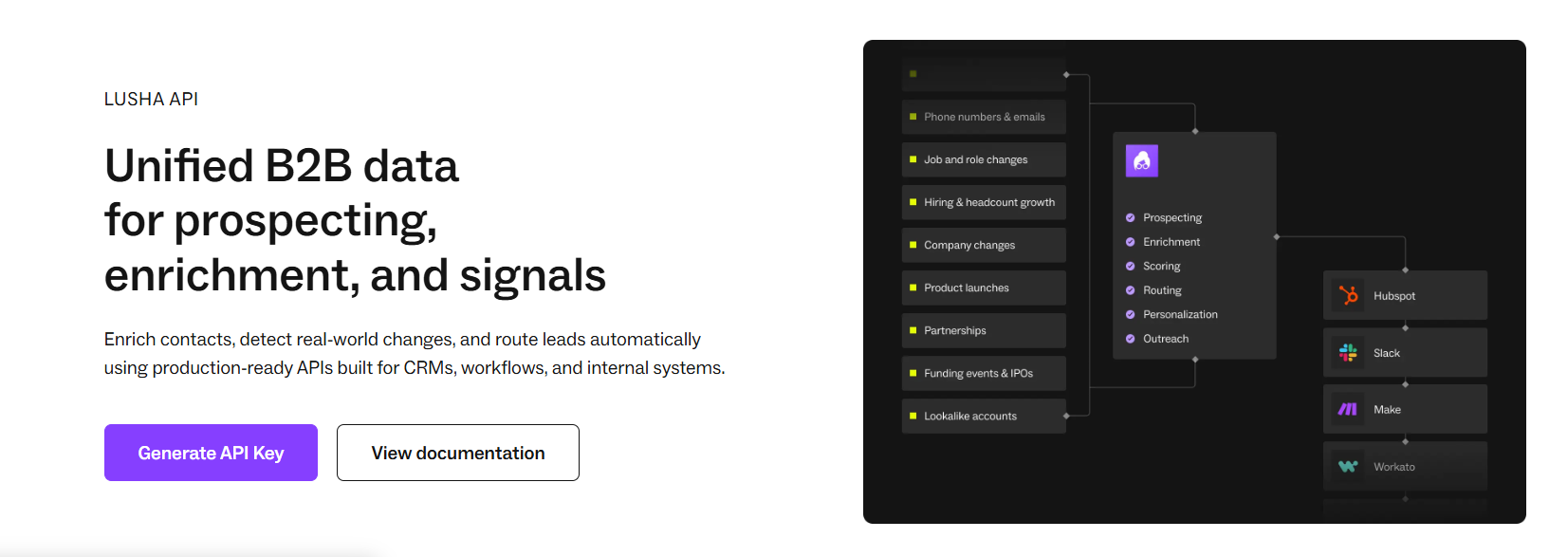
Lusha is a contact-data provider, and its API returns a company profile, industry, size, headquarters, and social links, next to verified work emails and phone numbers for people at that company. You enrich by domain, email, or company name, and one API call that returns up to 25 results costs a single credit. It fits a sales tool that needs both the account record and the people to reach inside it.
Key Features
- Bulk enrichment and CSV enrichment come in on the paid tiers.
- Contact and company lookalikes surface similar accounts or people from a seed record.
- Webhooks arrive on the Pro plan; an MCP server is documented separately.
Pros & Cons
PROS
CONS
Pricing
A 40-credit monthly free tier, then paid plans billed yearly; the API needs a paid tier. Credits: 1 per API call of up to 25 results, 1 per verified email, 5 per phone number.
- Free: 40 credits per month
- Starter: $37.45 per month billed yearly, 4,800 credits per year, with rate-limited API
- Pro: $52.45 per month billed yearly, 7,200 credits per year, adds webhooks and CSV enrichment
- Premium: $299.95 per month billed yearly, 40,800 credits per year, with a higher-rate API
CompanyEnrich
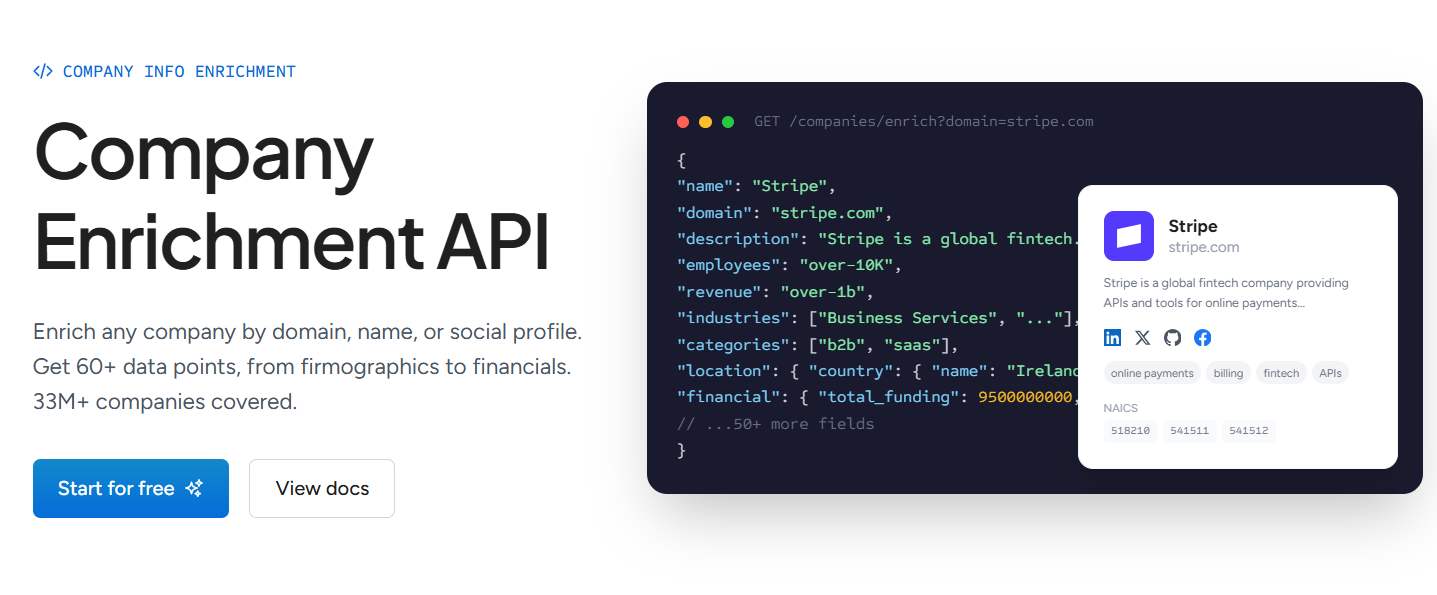
CompanyEnrich charges one credit per company enrichment, at roughly one cent, falling to a tenth of a cent at volume. It enriches by domain or name and returns firmographics, industry tags, department sizes, funding information, and a similar-companies list, with search, headcount, and funding endpoints alongside. Every plan includes full API access, and its Logo API and autocomplete calls cost nothing.
Key Features
- A free Preview API returns up to 25 search results without spending credits, for testing filters.
- Async and batch endpoints on the top plan handle large enrichment jobs.
- An MCP server exposes the data to AI assistants.
Pros & Cons
PROS
CONS
Pricing
A 500-credit free trial, then self-serve credit plans; every plan includes full API access. One company enrichment is one credit.
- Free trial: 500 credits
- Starter: $49 per month, 5,000 credits, about $0.0098 each
- Pro: $149 per month, 50,000 credits, about $0.003 each
- Scale: $549 per month, 500,000 credits, about $0.0011 each, adds batch and async endpoints
How to choose
For filling a few fields on CRM records or qualifying signups by company size and industry, a single-endpoint API like Abstract API is enough, and so is a one-credit lookup from CompanyEnrich or The Companies API.
To enrich at pipeline scale with field selection and a bulk call, Coresignal or People Data Labs are good fits, and both let you upload bulk data. When the enrichment is part of a product you ship to customers, check the license terms early: Apollo’s standard plans forbid external use, and several others gate it behind an agreement.
Weigh what the company record has to include. Funding rounds and investor data come standard with Apollo, Crustdata, and CompanyEnrich’s funding endpoint, and are absent from Abstract API and The Companies API. Corporate hierarchy, linking subsidiaries to a parent, is offered by ZoomInfo and Diffbot’s linked entities. If you mostly need the people to contact and not the company shape, Lusha returns both from one call.
Finally, match the buying model to your constraints. Abstract API, CompanyEnrich, Coresignal, The Companies API, Diffbot, People Data Labs, and Lusha all take a card and have a free tier or trial, so you can measure match rate on your own list before you pay. Apollo is self-serve but priced per seat as a full sales platform. ZoomInfo and Crustdata are demo-first with quoted pricing, which adds time but can be worth it for ZoomInfo’s coverage or Crustdata’s real-time signals. Whichever you shortlist, push 100 of your own domains through the free tier first, because published coverage numbers rarely predict the match rate on your specific list.
Frequently Asked Questions
Is there a free company enrichment API?
A few have a renewing free tier. Diffbot gives 10,000 credits a month and People Data Labs 100 records a month, both renewing, and Lusha’s free plan renews at 40 credits a month. Abstract API’s free tier is a one-time 100 requests, and Coresignal and CompanyEnrich give a short trial or a small credit grant. None of the free options is big enough for a production integration, but each is enough to test match rate on a sample list.
What happened to Clearbit’s API?
HubSpot acquired Clearbit in 2023 and turned it into Breeze Intelligence, a credit-based enrichment feature inside HubSpot. New customers cannot buy a standalone Clearbit API, the free Clearbit tools closed in April 2025, and the Logo API was retired in December 2025. Enrichment now lives inside HubSpot. For a standalone API, the providers in this article are the direct replacements.
What is the difference between firmographic and technographic data?
Firmographic data describes the company: industry, employee count, revenue band, headquarters, founding year, legal structure. Technographic data is the list of software a company uses, detected from its website and job posts, such as its CRM, analytics, or cloud provider. Most APIs here return firmographics; Diffbot, Apollo, Klazify, and Crustdata also return a tech stack.
How are these APIs priced?
Almost all price in credits. One company enrichment is usually one credit, but a multi-source record, a search result, or a knowledge-graph entity can cost more, up to 25 credits for a Diffbot entity. Plans bundle a monthly or annual credit pool; some pools roll over, most do not. A few providers, notably ZoomInfo and Crustdata, do not publish pricing and quote per contract.
How do I test match rate before committing?
Take a representative sample of your own domains, 100 or more, including the small and obscure ones, and push them through each provider’s free tier or trial. Count how many come back with the fields you actually need populated, not just how many return a record. Coverage claims are measured against a provider’s whole database; your match rate depends on how well that database overlaps your list.