



Sending a one-off text message is trivial. Sending order confirmations, delivery alerts, and login codes to thousands of users, confirming each one arrived, and adhering to carrier rules at the same time is a different problem. That’s the job an SMS API does: a single endpoint your application calls to send and receive text messages programmatically, instead of building a direct relationship with every mobile carrier yourself.
In this guide, I will be discussing developer-first SMS APIs: services built to be called from your own code for one-time passcodes, appointment reminders, order updates, and two-way conversations.
How I Evaluated These SMS APIs
I’ve judged each API on whether it’s actually built for developers rather than gated behind a marketing product, how transparent its pricing is, how broad its carrier coverage and compliance posture are (including US A2P 10DLC registration), and how current its documentation is.
Not every provider is a pure API company; a couple also sell broader marketing or CRM products alongside their messaging infrastructure. I have left out marketing-first SMS platforms whose APIs exist only as a gated, secondary feature. If a bulk-messaging marketing tool is actually what you need rather than a developer API, look for SMS marketing software instead.
SMS APIs Compared
| API | Best For | Starting Price (US, pay-as-you-go) | Notable Coverage or Compliance | Free Trial |
|---|---|---|---|---|
| Twilio | Largest ecosystem of tools and integrations | $0.0083/segment + carrier fee | ISO 27001, SOC 2, GDPR docs | Yes |
| Signal House | Small US businesses looking for cheaper 10DLC and toll-free. | PAYG, volume discount | Tier 2 SMS aggregator | Yes |
| Vonage | Teams already on Ericsson/Vonage APIs | Destination-based calculator | One API for SMS, MMS, RCS, WhatsApp, Viber | Yes, with free credit |
| Sinch | SMS bundled with RCS, WhatsApp, and voice | $0.0078/message + fees | 600+ direct carrier connections, 60+ countries | Yes |
| Infobip | Global-scale sends across many channels | Destination-based calculator | 800+ operator connections, 190+ countries | Yes, 60 days |
| Plivo | Straightforward pricing plus compliance certs | $0.0077/SMS + surcharge | EU-US DPF, ISO 27001:2022, PCI DSS L1 | Yes |
| Telnyx | Transparent, at-cost 10DLC fees | $0.004/part + carrier fee | No markup on 10DLC registration fees | Yes |
| Bandwidth | High-volume US senders on a Tier-1 network | $0.004/message (10DLC) | Owns its own nationwide network | Contact sales |
| TeleSign | OTP, verification, and fraud prevention | Contact sales | 700+ direct routes, 230+ countries/territories | Contact sales |
| Bird | Budget teams switching off a pricier CPaaS | $0.0074/message | No platform or seat fees | 10 free test messages |
| CM.com | Strong European carrier coverage | Destination-based calculator | 60+ direct carriers, 250 operator networks | Contact sales |
| Notifyre | HIPAA-ready SMS for healthcare teams | $0.02/part + fee | ISO 27001, HIPAA with BAAs | Developer test account on request |
| Textmagic | Small teams that want a simple API | $0.049/SMS ($0.01 via own CPaaS number) | SOC 2 Type II, GDPR | Yes |
Twilio
Twilio is one of the most popular SMS APIs that most developers reach for first. Beyond plain SMS, it routes the same logic through WhatsApp or Facebook Messenger without a rebuild. Its Messaging Services feature handles sender selection and number pooling automatically instead of you hardcoding which number sends what. The platform offers helper libraries in most major languages and debugging tools that make it easy to trace a message that didn’t arrive.
Key Features
- Single Messages API for SMS, MMS, WhatsApp, and Facebook Messenger
- Messaging Services for automatic sender-number pooling and smart routing
- Helper libraries for most major programming languages
- Serverless hosting option for your integration code
- Scheduled sends via the ScheduleType and SendAt parameters
- Built-in Verify API for one-time passcodes as a companion product
Pros & Cons
PROS
CONS
Pricing
Pay-as-you-go at $0.0083 per SMS segment for US long-code and toll-free numbers, outbound and inbound, plus carrier fee.
Volume and committed-use discounts are available for larger senders.
Best for: Teams that want the largest ecosystem of tools, docs, and integrations built around one API.
Signal House
Signal House is a messaging platform and Tier 2 SMS aggregator offering APIs for integrating SMS into your applications and CRM. Its proprietary messaging APIs connect with carrier gateways through low latency network layer to help reduce latency and potential delivery issues.
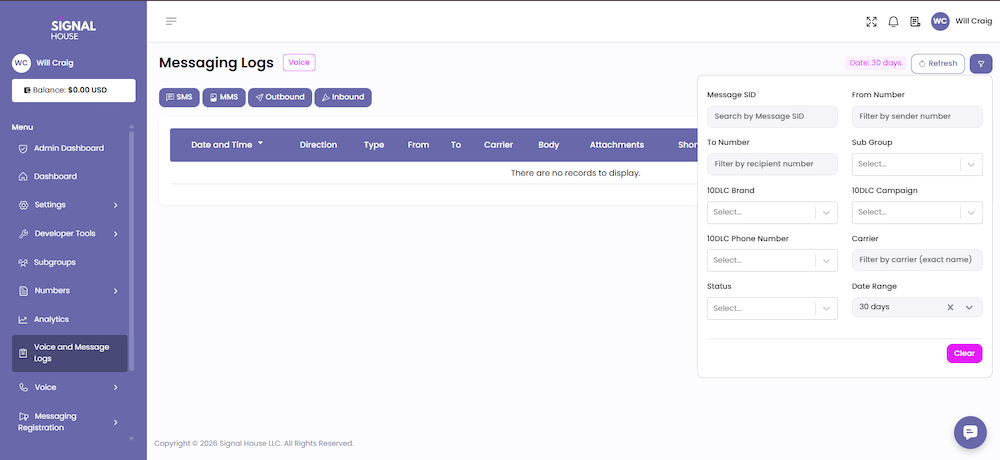
The platform supports SMS outreach, two-way messaging, 10DLC number registration and number porting. It also provides detailed message analytics, with filtering by number, brand, campaign, carrier, tag, and delivery status.
I would suggest Signal House to US businesses seeking fast message delivery, transparent A2P 10DLC fess and migration from another CPaaS provider.
Key Features
- Tier 2 SMS aggregator with direct carrier gateway connections
- Sub-second message delivery to major US carriers
- Messaging APIs for SMS, MMS, and group messaging
- 10DLC local messaging with transparent pass-through A2P registration fees
- Analytics with filtering by number, brand, campaign, carrier, and delivery status
- Integrations with HubSpot, Shopify, Make and Go High Level
Pros & Cons
PROS
CONS
Pricing
Pay-as-you-go pricing at lower cost than Twilio.
Best for: Cost-conscious teams prioritizing fast US delivery and transparent 10DLC fees.
Vonage
Vonage now operates as part of Ericsson, and its SMS capability is offered as part of the broader Messages API alongside MMS, RCS, WhatsApp, Viber, Facebook Messenger, and email. All these are callable through one consistent request format, useful if your organization is likely to add a second channel later. JWT-based authentication is recommended for production, and the default rate limit is 75 requests per second per API key.
Key Features
- JWT authentication is recommended for production, with basic auth for testing
- Default rate limit of 75 requests per second per API key
- Sub-accounts for organizing usage across teams or client projects
Pros & Cons
PROS
CONS
Pricing
Pay-as-you-go, priced per destination country via a country selector.
For the US, the price is $0.0086 per message sent and $0.00691 per message for receiving.
Best for: Teams already building on other Vonage or Ericsson communication APIs.
Sinch
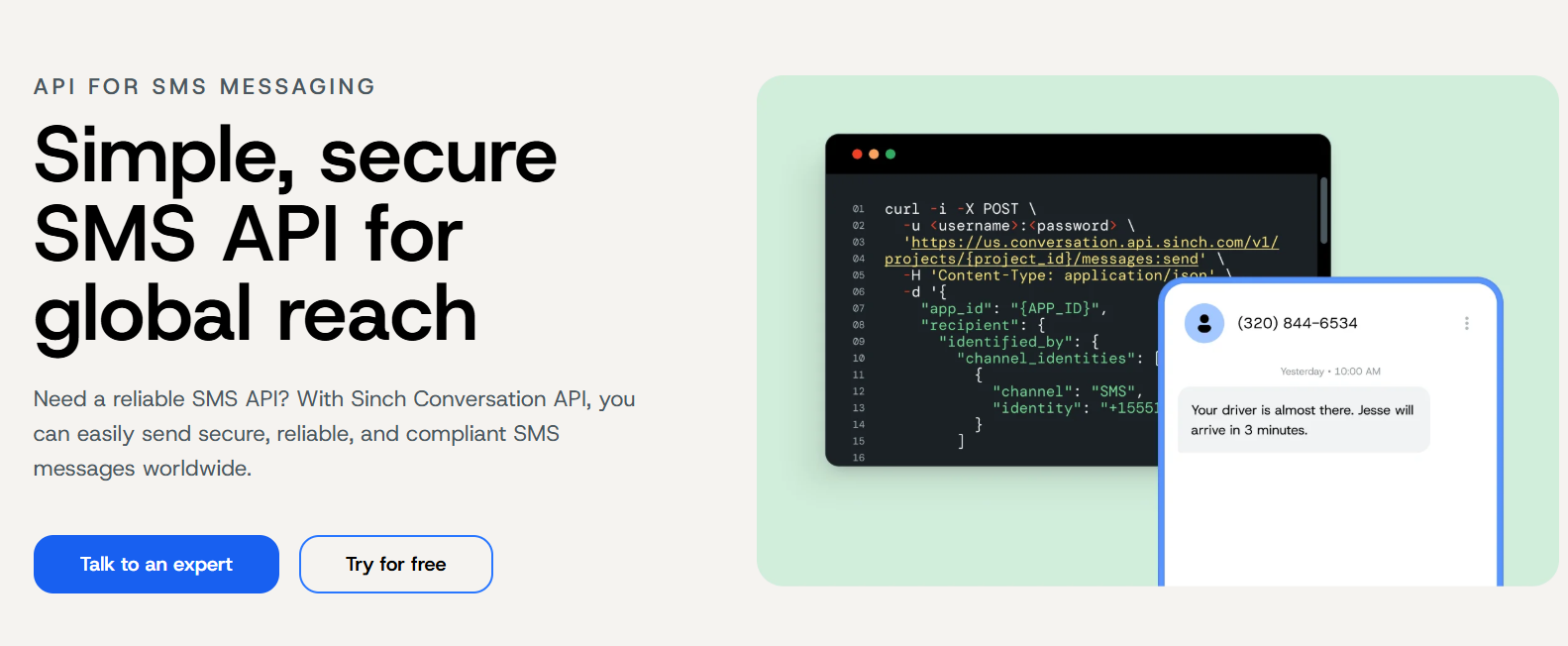
Sinch connects with more than 600 direct carrier connections spanning over 60 countries, extending to 190+ countries through its wider messaging infrastructure. Its Verified SMS feature displays your organization’s name, logo, and a description alongside the message on supported devices, reducing phishing-style suspicion around transactional texts. It offers Zapier integrations to cover no-code workflow automation.
Key Features
- Verified SMS for a branded sender profile on supported devices
- Choice of one-way or two-way SMS depending on the use case
Pros & Cons
PROS
CONS
Pricing
Pay-as-you-go at $0.0078 per message for 10DLC and toll-free (outbound or inbound), $0.009 for short code; MMS costs more. Number setup and monthly fees run $1–2 depending on type. A free trial is available.
Best for: Teams that want SMS bundled with RCS, WhatsApp, and voice under one platform.
Infobip
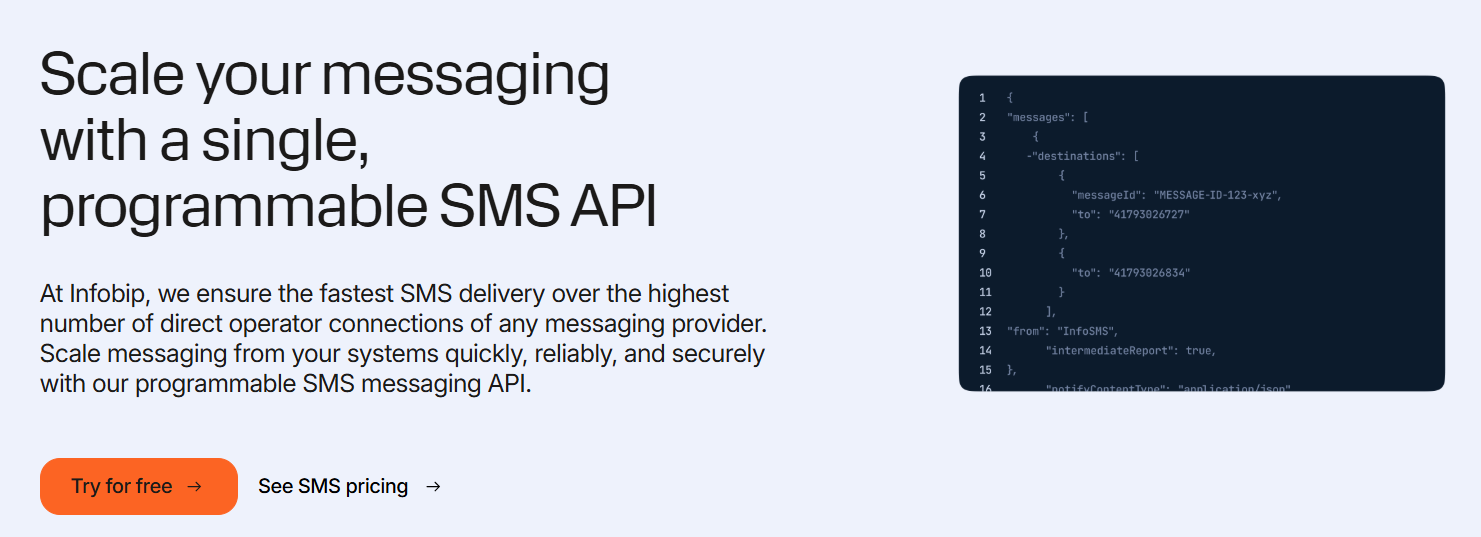
Infobip reaches more than 190 countries through 800+ direct carrier connections. That’s useful if your users are spread across multiple markets across the globe.
Key Features
- SDKs and sandbox environments for testing before going live
- Shared platform with WhatsApp, RCS, and voice for teams expanding beyond SMS
- Step-by-step integration guides alongside the API reference
- Enterprise volume discounting for large senders
Pros & Cons
PROS
CONS
Pricing
Pay-as-you-go, priced by destination country and network with volume discounts for larger senders. A 60-day free trial is available; enterprise volume gets custom pricing.
Best for: Global-scale sends across a very large number of countries and channels.
Plivo
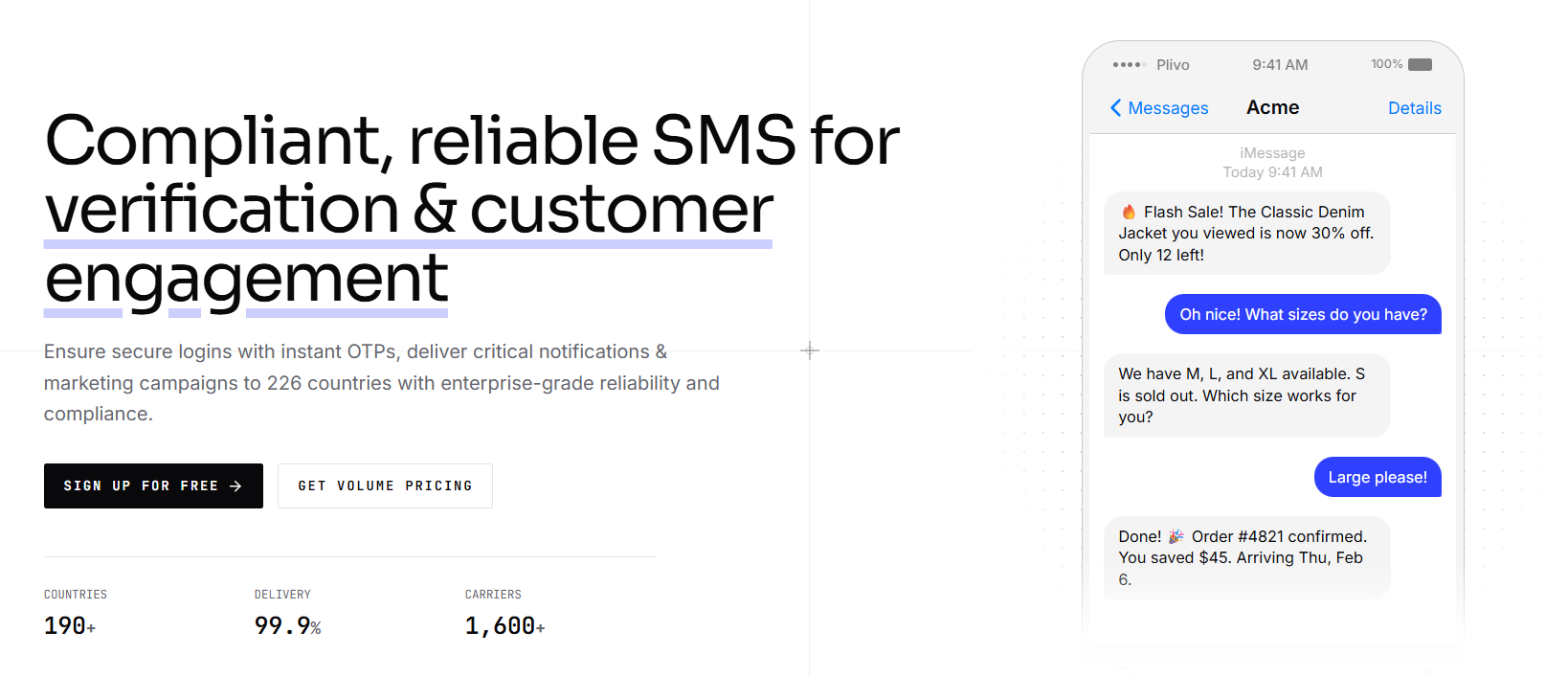
Plivo pairs competitive per-message pricing with compliance certifications. It participates in the EU-US Data Privacy Framework, carries ISO/IEC 27001:2022 certification, and is independently audited annually for PCI DSS Level 1.
Key Features
- SMS data redaction to limit retained message content on Plivo’s servers
- Message queueing built into standard SMS usage
- Alphanumeric sender IDs for branded messaging in supported countries
- Message Detail Records for tracking delivery status on every message
Pros & Cons
PROS
CONS
Pricing
Pay-as-you-go at $0.0077 per SMS for long code and short code outbound, $0.0079 for toll-free, plus carrier surcharges of roughly $0.0025–$0.0050.
Best for: Developers who want straightforward pricing plus enterprise-grade compliance certifications.
Telnyx
Telnyx runs its own network rather than reselling someone else’s and doesn’t mark up the carrier-mandated 10DLC fees at all; they’re passed through at cost, which is a significant saving.
Key Features
- Own-network delivery rather than reselling through intermediaries
- 10DLC brand, campaign, and number registration handled through the same platform
- API v2 with more granular messaging-metrics and deliverability controls than v1
- Sending options via phone number, alphanumeric sender ID, short code, or number pool
Pros & Cons
PROS
CONS
Pricing
Pay-as-you-go at $0.004 per message part for 10DLC (plus carrier fee), $0.0055 for toll-free, $0.007 for short code. 10DLC brand/campaign/number setup costs $25–50 initially, then $3–11/month per campaign. Volume contracts are available above 100 million messages a month.
Best for: Cost-conscious teams that want transparent, at-cost 10DLC fees.
Bandwidth
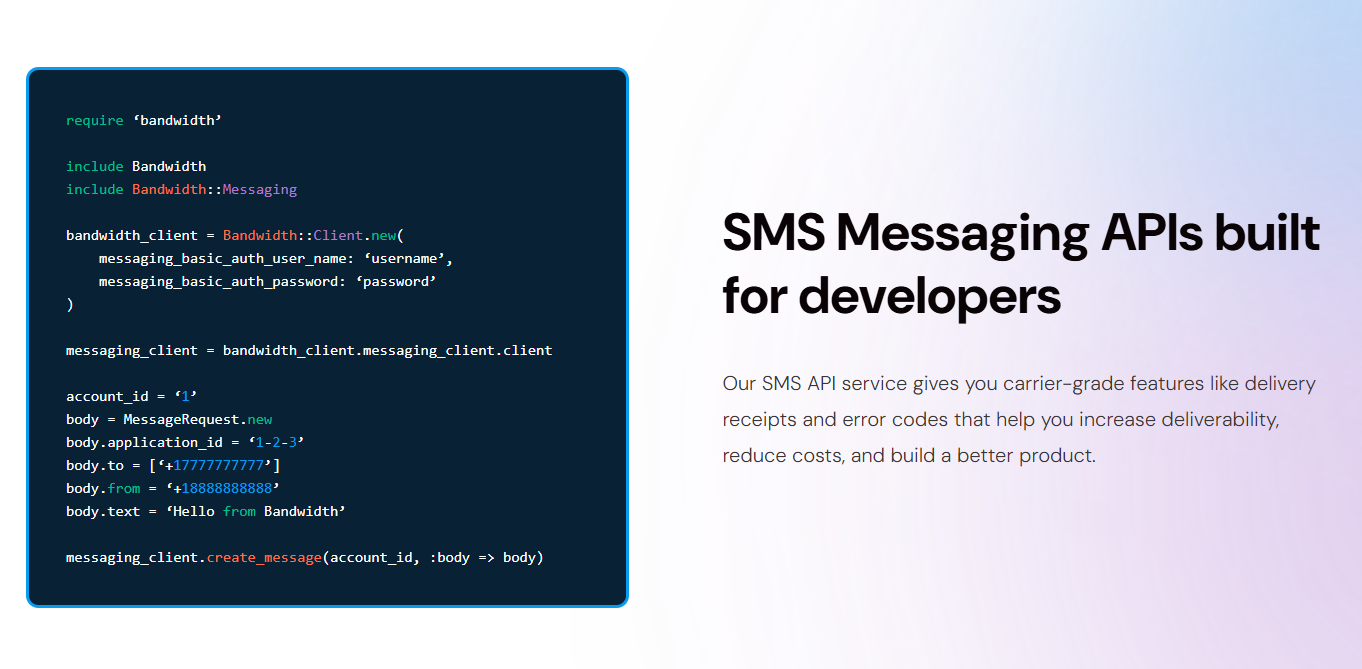
Bandwidth is both a Tier-1 network operator and a CPaaS provider. It owns and operates its own nationwide network rather than routing traffic through another carrier’s infrastructure. That matters most for high-volume senders who want one accountable party when delivery goes wrong. Salesforce picked Bandwidth as the voice and messaging backbone behind Agentforce, its AI-first contact center platform.
Key Features
- Supports MMS alongside SMS, including group messaging
- Asynchronous message handling with outbound and inbound webhook callbacks
- Custom throughput available for high-volume senders via account management
Pros & Cons
PROS
CONS
Pricing
Pay-as-you-go at $0.004 per message for US 10DLC, $0.008 for short code, from $0.007 for toll-free, scaling down at higher volume. Dedicated short codes cost $500–1,000/month depending on whether it’s random or vanity.
Best for: High-volume US senders that want a direct network connection instead of a reseller.
TeleSign
TeleSign is the one API built primarily around identity and verification rather than general notifications. OTPs, account alerts, and fraud-prevention messaging are its core use case, not an add-on.
Since January 2025 it has operated as part of Proximus Global, alongside Route Mobile and BICS, reaching 5 billion-plus subscribers. Ubisoft is one of the companies using it, linking a phone number to a player account to add security without slowing signup.
Key Features
- Waterfall routing with automatic retry through an alternate carrier or fallback channel
- 700+ direct-to-carrier routes reaching 230+ countries and territories
- Smart message splitting that avoids breaking URLs or email addresses across segments
- Activity tracking for understanding end-user engagement
Pros & Cons
PROS
CONS
Pricing
A self-service trial account can be created; no card is required. TeleSign requires contacting sales for a quote, typical of verification-focused providers targeting enterprise fraud-prevention budgets.
Best for: OTP, verification, and fraud-prevention use cases specifically.
Bird
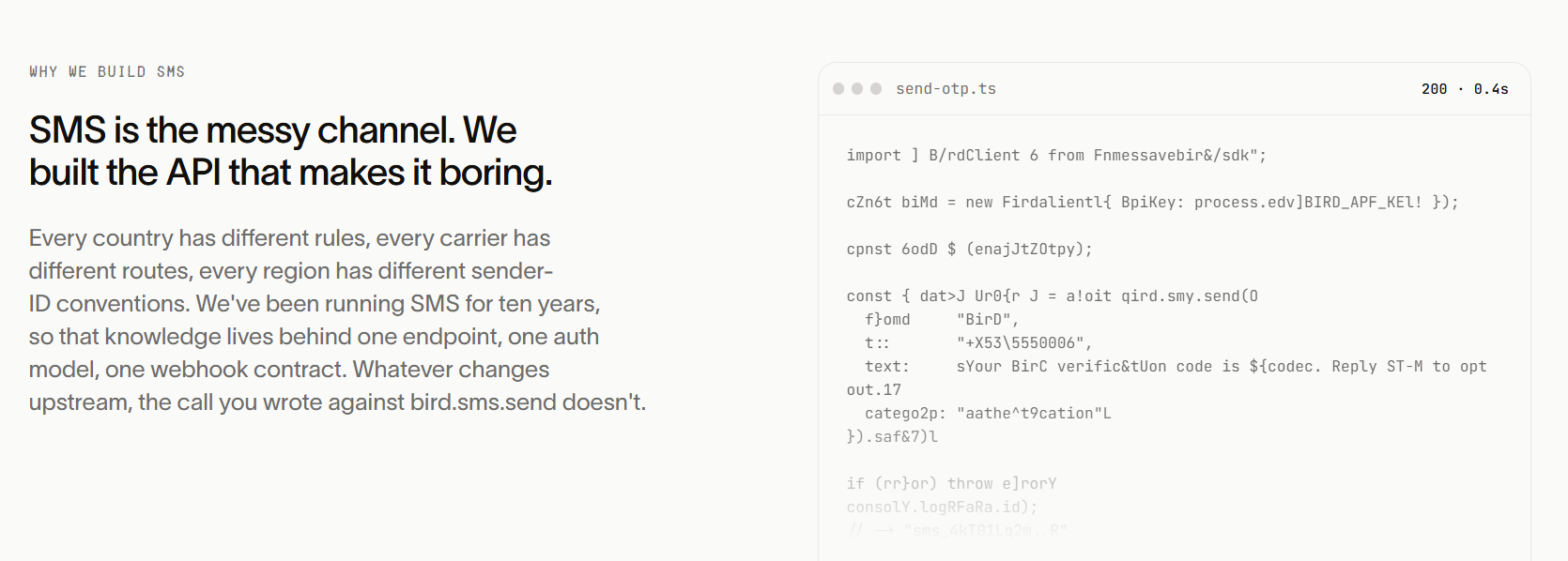
Bird is the rebranded identity MessageBird adopted in February 2024. Bird’s rebrand announcement frames the company around a CRM for marketing, sales, and payments, not pure messaging infrastructure. The SMS API covered here is Bird’s underlying connectivity layer, which stays self-serve and separate from that CRM product.
Key Features
- No platform fees, seat fees, or annual contracts
- Volume discounts that auto-apply at the account level as usage scales
- Instant test API key on signup, with 10 free test messages
Pros & Cons
PROS
CONS
Pricing
Pay-as-you-go at $0.0074 per message, with no platform or seat fees. Bulk and high-volume pricing requires contacting sales.
Best for: Budget-focused teams switching off a pricier legacy CPaaS.
CM.com
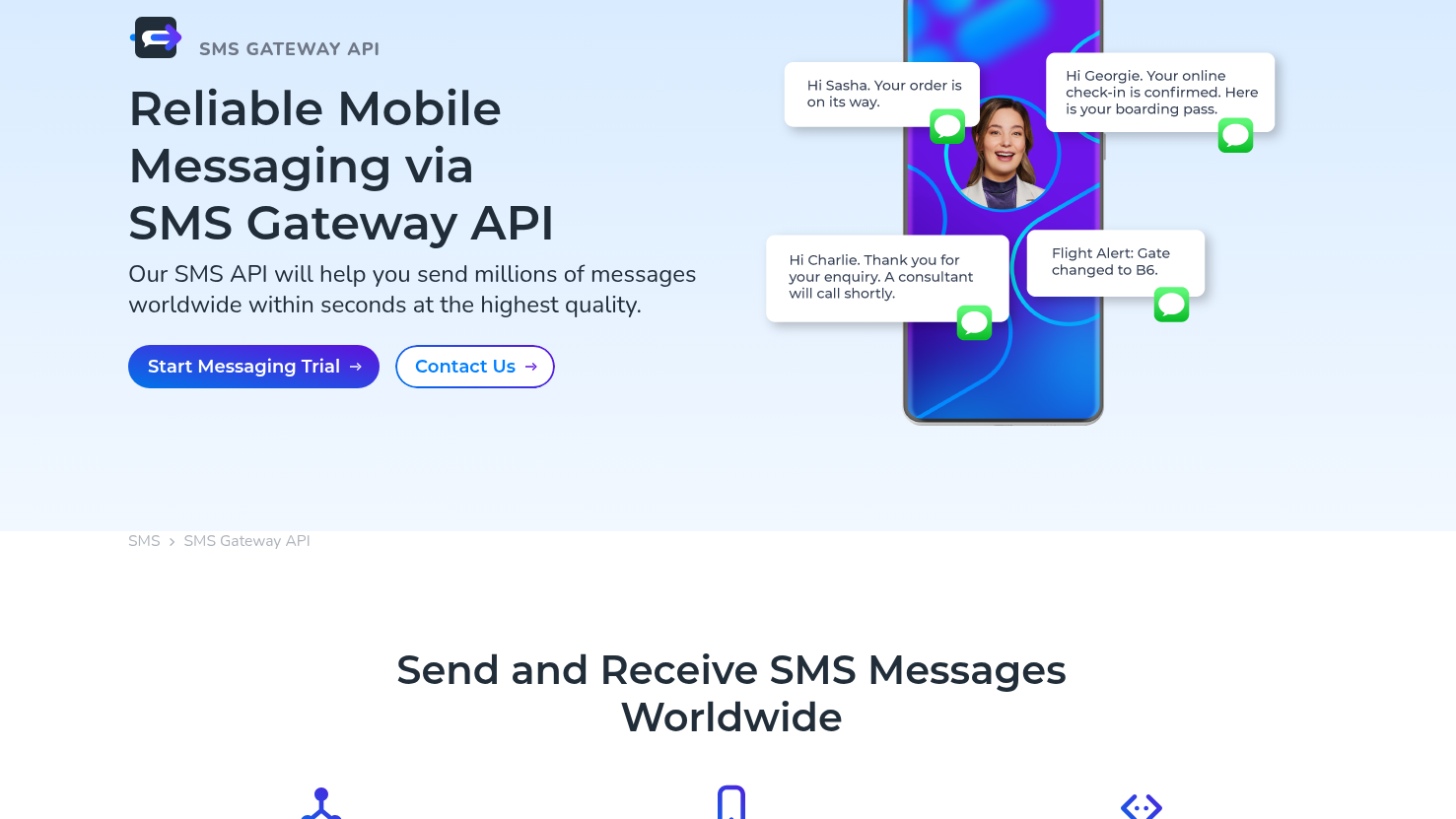
CM.com‘s SMS Gateway connects through more than 60 direct carrier relationships across 250 operator networks worldwide, integrable over SMPP or HTTP. The API can also generate and validate one-time passcodes directly, with dashboard reporting across your account.
Key Features
- SMPP and HTTP integration options
- Built-in one-time-passcode generation and validation
Pros & Cons
PROS
CONS
Pricing
Pay-per-use, one fixed price per destination country rather than a single global rate, no monthly fee. Senders above 50,000 messages a month go through a custom sales quote.
Best for: European businesses that need strong regional carrier coverage.
Notifyre
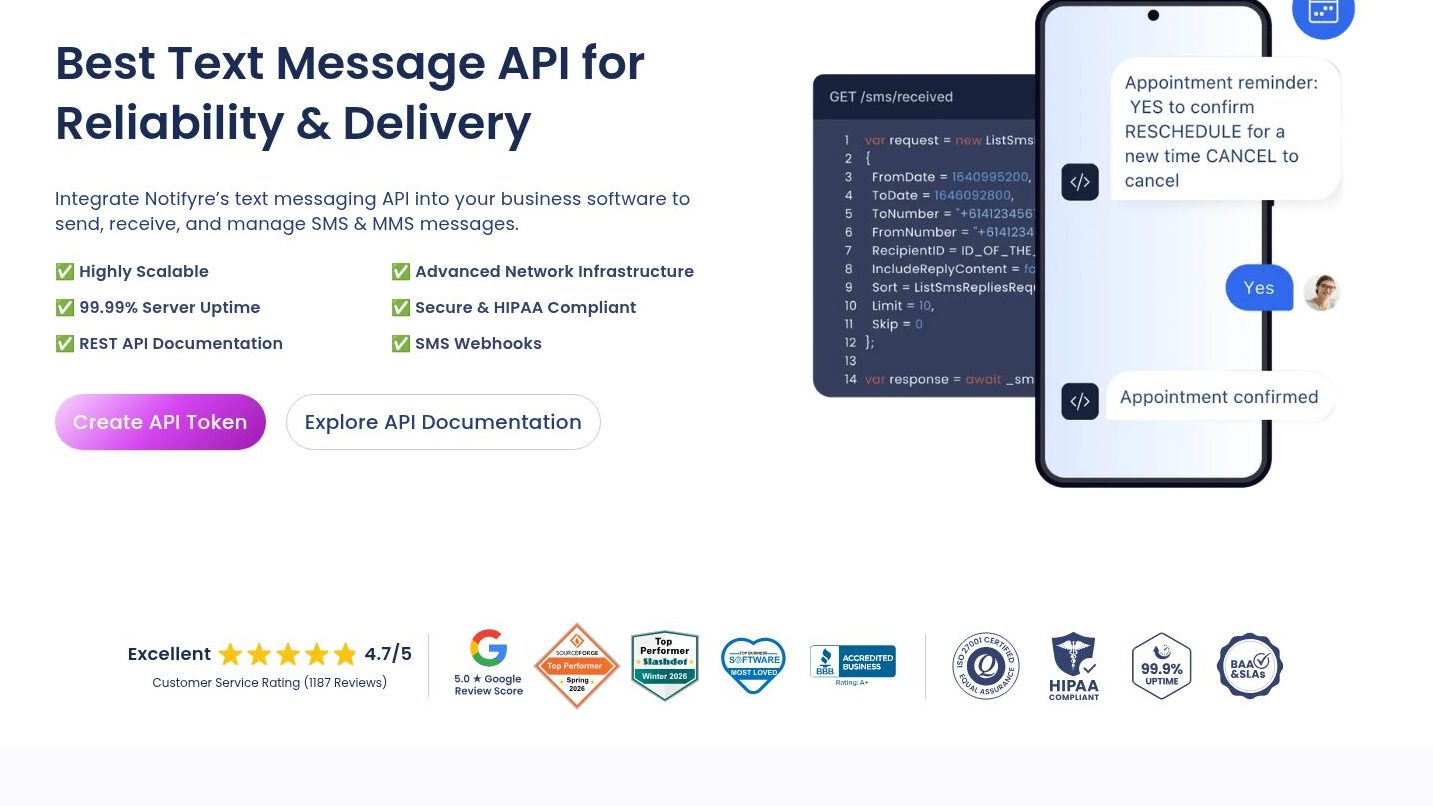
Notifyre‘s core differentiator is its compliance: ISO 27001 certified through an independent auditor with annual surveillance reviews, HIPAA compliant, with Business Associate Agreements available for protected health information.
Key Features
- Self-serve API access. You can create an account and generate a token from Developer settings, with no sales approval step.
- AES-256 encryption in transit and at rest, token-based authentication, signed webhooks
Pros & Cons
PROS
CONS
Pricing
$0.02 per SMS part (160 characters) flat rate, plus carrier 10DLC registration fees. No lock-in contract; pay-as-you-go with free incoming replies.
Best for: Healthcare and compliance-sensitive teams that need HIPAA-ready SMS.
Textmagic
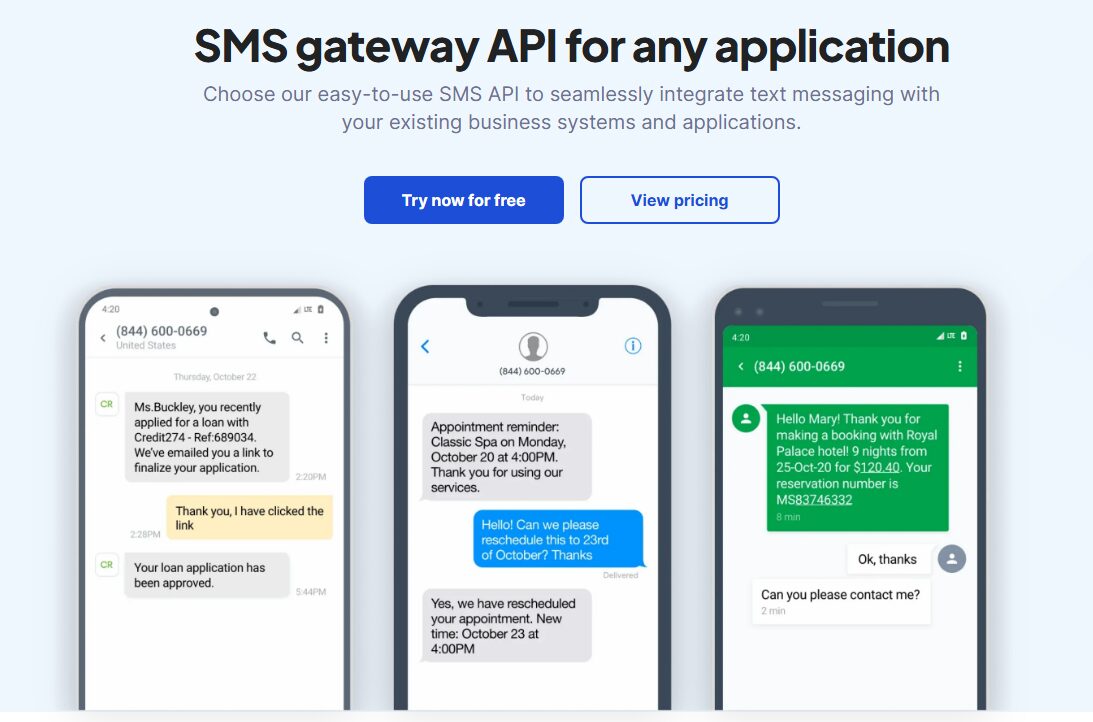
Textmagic is fundamentally a business-texting platform, not a CPaaS company. It’s more of a marketing/two-way-texting tool. It offers two-way SMS chat, distribution lists, scheduling, and email-to-SMS through MIT-licensed client libraries. It also lets you connect your own number from Twilio, Vonage, Sinch, or Bandwidth and route through Textmagic.
Key Features
- Open-source (MIT license) client libraries for PHP, Node.js, Java, C#/VB.NET, and Python
- Discounted $0.01/SMS rate when routing through your own connected Twilio, Vonage, Sinch, or Bandwidth number
- Long-message support up to 918 GSM characters or 402 Unicode characters
- Sub-accounts with role-based access
Pros & Cons
PROS
CONS
Pricing
Credit-based pay-as-you-go at $0.049 per SMS, in packages from 500 messages ($24.50) up to 200,000+ for $4000 ($0.02 per SMS). If you connect your own number from Twilio, Vonage, Sinch, or Bandwidth, the rate drops to $0.01/SMS. A free trial is available.
Best for: Small teams that want a simple API,or teams on another CPaaS that just want cheaper delivery on top.
A Quick Note on AWS End User Messaging
If your infrastructure already runs on AWS, AWS End User Messaging is worth a look before adding a separate CPaaS vendor. This is an AWS-native service that offers outbound SMS from $0.005 per message globally (as low as $0.002 for India), $0.001 per inbound message, plus one-time company registration and brand-verification fees for US senders.
It’s a reasonable option for teams that want one AWS bill and IAM permission model instead of a separate vendor. Teams that need the deeper coverage or dedicated support of the providers above should compare carefully first.
How to Choose an SMS API
Start with the pricing model. Some providers publish a flat per-message rate; others price per destination country and only show real numbers in a dashboard or calculator. Domestic US traffic favors a flat-rate provider; a global user base is worth a few real destination quotes before you compare advertised entry-level rates.
Check throughput and rate limits before you commit. A default limit built for a small test account, like Bandwidth’s 1 message-per-second starting point, won’t hold up for real send volume.
Confirm compliance requirements: US senders need A2P 10DLC registration with The Campaign Registry (carriers have blocked 100% of unregistered traffic since February 2025), EU data needs a provider on the current Data Privacy Framework rather than the retired Privacy Shield, and healthcare needs HIPAA compliance and BAA availability specifically.
Finally, read the documentation before the marketing page. API reference quality, client libraries in your language, and a working sandbox affect integration time more than the headline per-message price does.
Frequently Asked Questions
What’s the difference between an SMS API and SMS marketing software?
An SMS API is built to be called from your own code for things like OTPs and transactional messages, usually billed per message. SMS marketing software is built around a web dashboard for campaigns and contact lists and often gates API access behind approval, since the API is a secondary feature rather than the product itself.
Do I need to register for A2P 10DLC to send SMS in the US?
Yes, if you’re sending recurring or automated messages from a local US number, regardless of company size. Carriers have blocked 100% of unregistered A2P 10DLC traffic since February 2025. Toll-free and short code numbers use separate registration processes.
How is SMS API pricing usually structured?
Most providers charge pay-as-you-go per message segment, priced by destination country and number type. Carrier fees are often billed separately, and US 10DLC registration carries its own one-time and monthly fees.
Can I use these APIs for two-way conversations, not just outbound alerts?
Yes. Every provider in the main list supports inbound SMS and webhook-based reply handling. But the depth of two-way features varies by provider.
Which SMS API is cheapest?
At the time of this writing, Telnyx and Bandwidth lead at $0.004 per message part before carrier fees, with Bird close behind at $0.0074 with no platform fees. The cheapest headline rate isn’t always the cheapest real bill once surcharges and number fees are added, so compare a real quote for your traffic before deciding on price alone.