



Remember ARPANET (the early internet)? It was built for resilience and communication, and with openness and interoperability as priorities. That’s why security and privacy feel like an afterthought.
HTTP proxies, a crucial part of the modern internet, are a prime example. They are detectable.
To circumvent, you might want to use VPNs, but they can also be limiting in terms of speed due to encryption overhead.
So, what’s your choice?
I recommend SOCKS5 proxies, as they are known for their speed, versatility, and anonymity.
SOCKS5 proxies work differently from HTTP proxies by offering:
- Lower-level operation
- Protocol agnosticism (works across different apps and services)
- Relaying data without analyzing them
- Fast transmission, as it doesn’t alter data
All of these SOCKS5 characteristics make it ideal for various use cases, including:
- Web scraping (bypassing IP blocks and rate limits)
- Online gaming (reduced latency)
- Streaming geo-blocked media
- Secure file sharing via FTP
In this article, I’ll discuss the top SOCKS5 proxy providers. I’ll evaluate them across different criteria, including speed, anonymity, IP pool size, protocol support, and value.
What is a SOCKS5 Proxy?
SOCKS5 Proxy is a universal protocol that works with any online traffic. It is a general-purpose proxy with multiple benefits, including bypassing restrictions.
As a proxy acts as an intermediary, it can help bypass geo-restrictions and access blocked services.
To achieve the level of fast response and anonymity, SOCKS5 proxy servers create a UDP or TCP connection. They do so by using an arbitrary IP address (different from the user’s actual IP), fooling the destination servers.
On a fundamental level, it works differently from HTTP proxies.
HTTP proxies work by parsing headers, modifying the user agent, and performing related operations to transfer data and speak with services/apps. HTTP proxies can speak web traffic, which gives SOCKS5 an edge.
SOCKS5 proxies, on the other hand, work without the need to interact with or look into the transferred data. They simply forward TCP or UDP connection requests, ensuring less overhead.
In short, SOCKS5 proxies differ from HTTP proxies in the following ways:
- No header manipulation, as it doesn’t rewrite data packets.
- Protocol agnostic, as it works with both TCP and UDP
- Minimal overhead, as it doesn’t perform any encryption or carry out deep packet inspection
- Authentication support with basic username/password
It’s best to visualize SOCKS5 as a neutral tunnel, whereas an HTTP proxy acts as a translator.
How We Ranked SOCKS5 Proxies
To help give you a clear picture of what to expect from SOCKS5 proxies, we have evaluated each one of them based on the following five core criteria:
- Latency: Is the latency of the connection good? These include average response time, packet loss, and overall stability.
- Reliability: Does the provider offer high uptime (at least an industry standard of 99.9%) or does it falter?
- IP pool size: Is the pool size good enough to meet the demand? And is the IP pool properly geo-distributed to ensure accessibility?
- Geo coverage: Can the SOCKS5 proxy provider route traffic to specific cities and ASNs? This is important as it helps access geo-restricted content and enables precise location-based data collection.
- Pricing: Does the provider offer clear pricing with no hidden fees? Is it affordable?
Best SOCKS5 Proxies for 2026
Bright Data
Bright Data is a well-known leader in proxy infrastructure. Their SOCKS5 proxies offer high performance with 400M+ monthly SOCKS5 proxy IP availability.
It is developer-friendly, and one can start a 7-day free trial with no credit card requirement. Even non-tech people can use Bright Data’s proxy with the help of its built-in AI chat. It can assist with a question related to the platform. For example, I went ahead and asked about SOCKS5 proxies, and it gave a detailed reply on the topic.
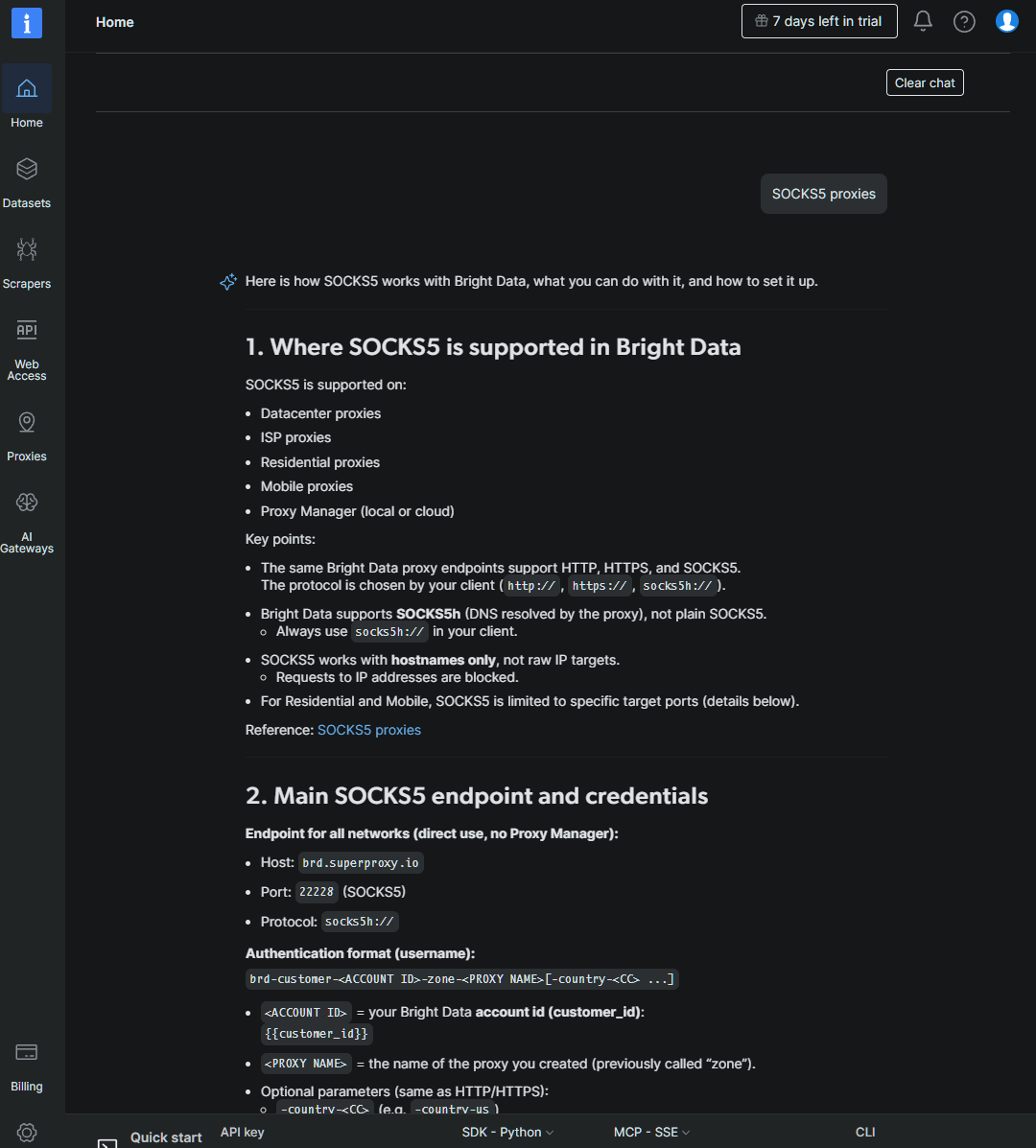
As for unique selling points, Bright Data’s biggest strengths include:
- 400 million proxies available across 195 countries (the largest rotating real-peer IP network)
- Supports residential, ISP, and datacenter proxies.
- Unlimited concurrent sessions
- Geo-location targeting.
Performance-wise, Bright Data excels. It has a 99.95% success rate with no limits on concurrent sessions.
All these make Bright Data’s SOCKS5 proxies an excellent pick for different use cases, including data scraping.
When it comes to our criteria, Bright Data’s SOCKS5 offering does well:
- Latency: Fast response time (between 50 ms and 450 ms for open targets) with unlimited concurrent sessions.
- Reliability: 99.99% network uptime for enterprise plans. Also offers real-time network status.
- IP pool size: 400 million IP addresses across residential, ISP, and datacenter (largest proxy pools)
- Geo coverage: Covers 195 countries with the ability to target by carrier, ASN, ZIP code, and city.
Bright Data Pros & Cons
PROS
CONS
Pricing
Bright Data offers competitive SOCKS5 pricing, starting at
- $4 per GB for residential proxies
- $1.8/IP for ISP proxies
- $1.40/IP for datacenter proxies.
Enterprise plans above 1 TB are available on custom pricing.
Use promocode GEEKFLARE50 to get $50 worth of free credits.
Oxylabs
Oxylabs is one of the best SOCKS5 proxy providers in the market. They offer the fastest proxies in the market with access to 175M+ ethically gathered proxies spread across the globe.
Oxylabs doesn’t offer any free trial (for proxies), but you can create an account to check their dashboard. It’s neat and provides access to most features.
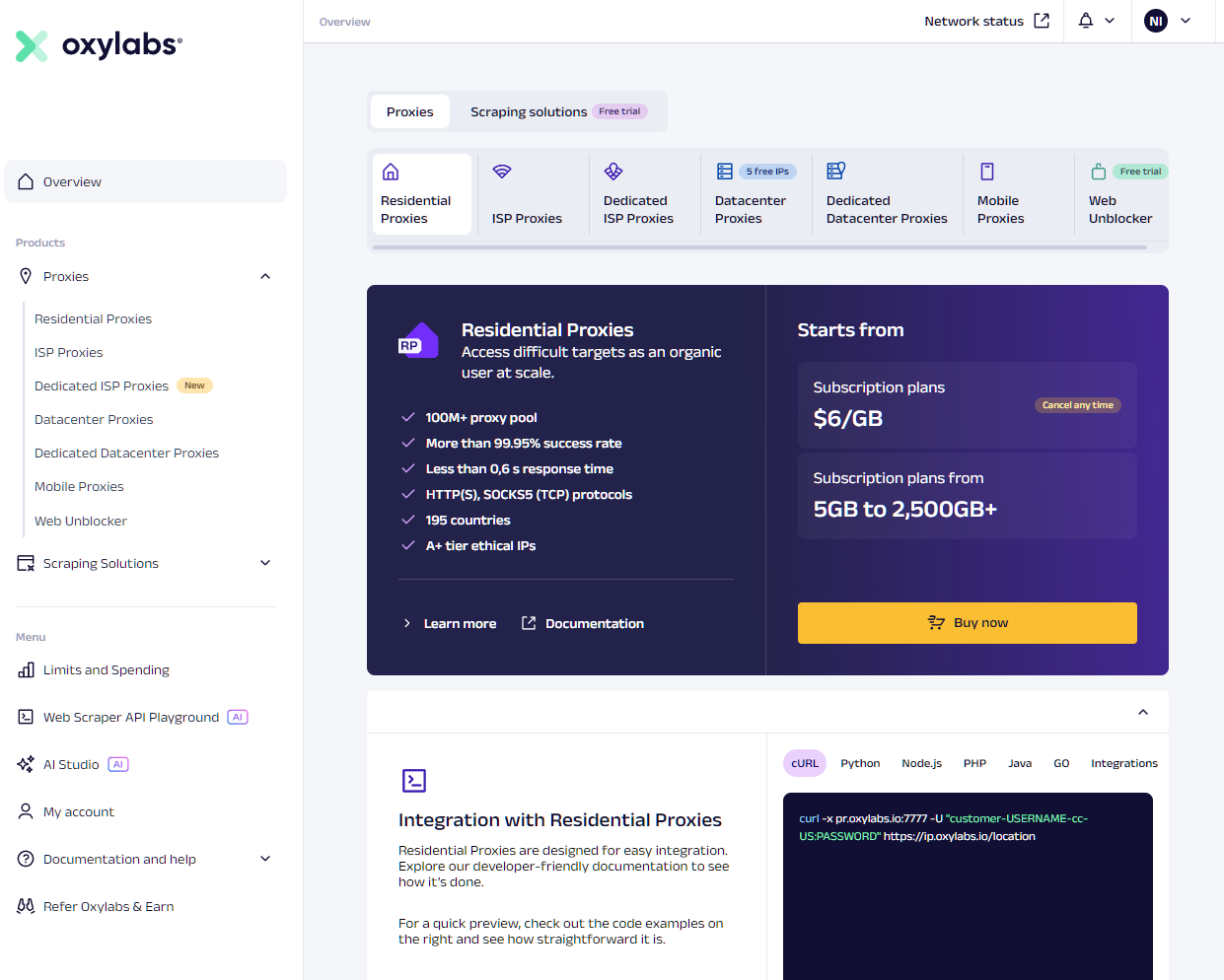
I also found Oxylabs to be an excellent choice for web scraping. It helps collect compliant data for data-driven projects using real profiles, and human-like residential proxies.
As for USP, Oxylabs has a lot to offer, including:
- Supports residential and dedicated data center proxies
- 175M+ proxy pool
- ISO/IEC 27001:2022 certified, making it secure for enterprise projects
When evaluated against the review criteria, we found the following:
- Latency: Average 0.6s response time for residential proxies with a mean response of 95.5ms across all checks.
- Reliability: Average 99.95% success rate for proxies with 99.9% uptime across the SOCKS5 proxy infrastructure
- IP pool size: 175+ million residential pool size, with a dedicated network that covers 2 million IPs.
- Geo coverage: Proxies available across 188 countries with free geo-targeting
Oxylabs Pros & Cons
PROS
CONS
Pricing
Oxylabs SOCKS5 starter plan costs $4.20/GB for for 5GB. Other plans are:
- Basic: $3.50/GB for 20GB
- Advanced: $2.85/GB for 125 GB
- Corporate: $1.75/GB for 1TB
Decodo
Decodo fits right on our list of best SOCKS5 proxies. That’s because it is fast, reliable (99.99% uptime), and has a vast network of 115M+ IPs across 195+ locations.
Decodo also offers a 3-day free trial that helps you understand what’s on offer. I quickly signed up for it and found the dashboard clean and clutter-free.
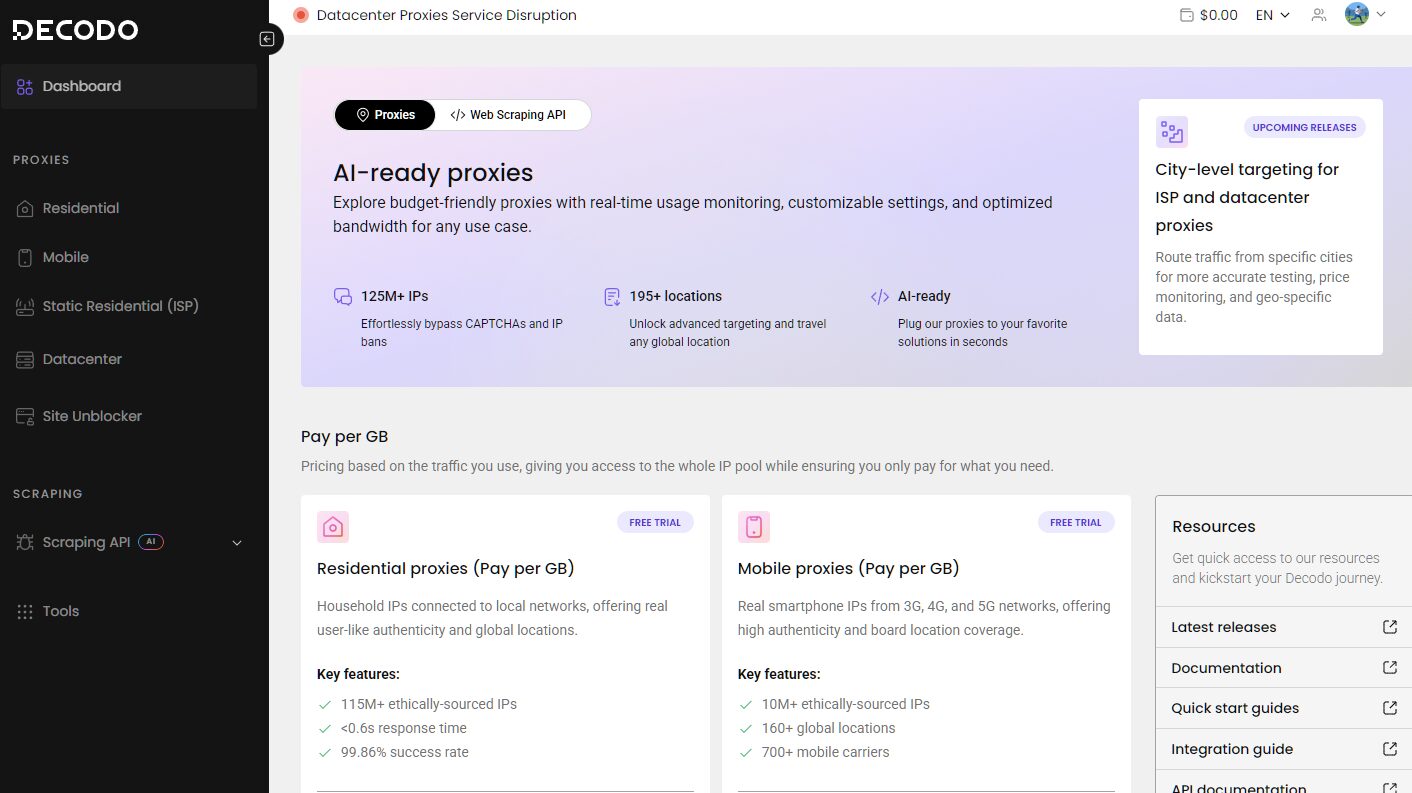
Coming to its USP, I found Decodo excels in its pricing. It’s affordable compared to the two big players, Oxylabs and Bright Data. Apart from that, other noteworthy Decodo features include:
- Support for TCP/UDP protocol
- A pool of 115 million IPs spanning over 195+ locations
As for performance, Residential proxies perform at less than 0.5s response time (as advertised) with a success rate of 99.68%. Impressive, indeed, especially for the price.
We found Decodo to pass our testing criteria with flying colors:
- Latency: less than 0.5 response time for residential, which can go as low as 0.3 seconds for datacenter and sub-0.2 for ISP proxies.
- Reliability: High residential proxy success rate at 99.68% with 99.99% uptime guarantee.
- IP pool size: 115+ million residential proxies, 10 million+ mobile proxies, and 500K+ datacenter proxies.
- Geo coverage: Offers coverage in 195 countries.
Decodo Pros & Cons
PROS
CONS
Pricing
Decodo pricing starts at $3.56/GB for regular plans and $2.38/GB for enterprise plans. They offer a 14-day money-back option.
Webshare
If you’re looking for the cheapest yet fast and high-performance SOCKS5 proxy provider, then Webshare is worth looking into. This makes it an ideal pick for small teams or individual developers.
With over 150+ countries covered, you get proper geo-coverage. According to the Webshare proxy location page, they have 27.8 million IPs available, with most IPs available in the United States, the United Kingdom, and Germany.
Webshare’s USP lies in affordability and also its free plan with access to 10 proxies. This free plan is good enough to test their service. Once signed up, you get a clean dashboard, the ability to buy proxies, guide setups, and an AI agent integration guide.
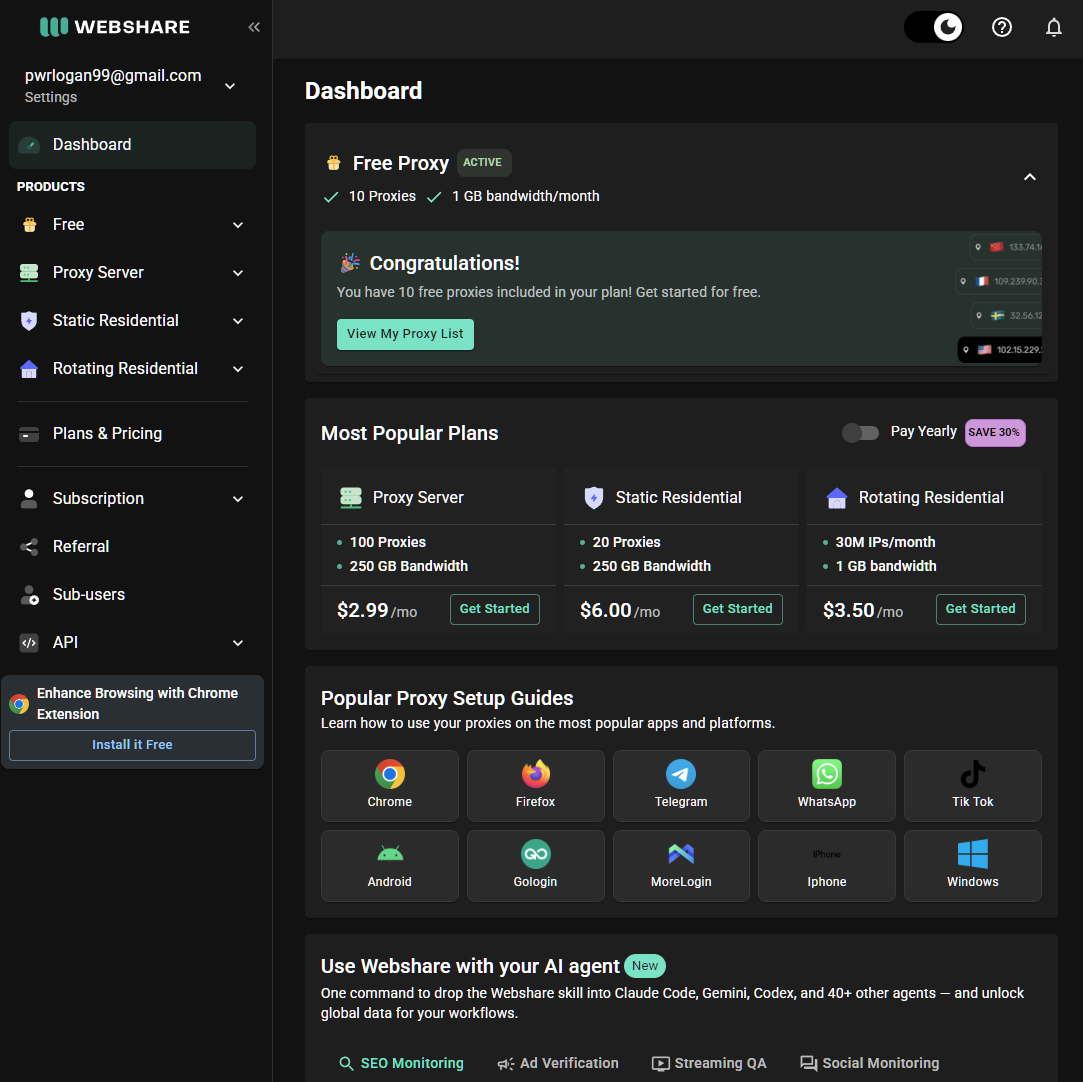
I also found its quick access guide to integrate it via different programming languages.
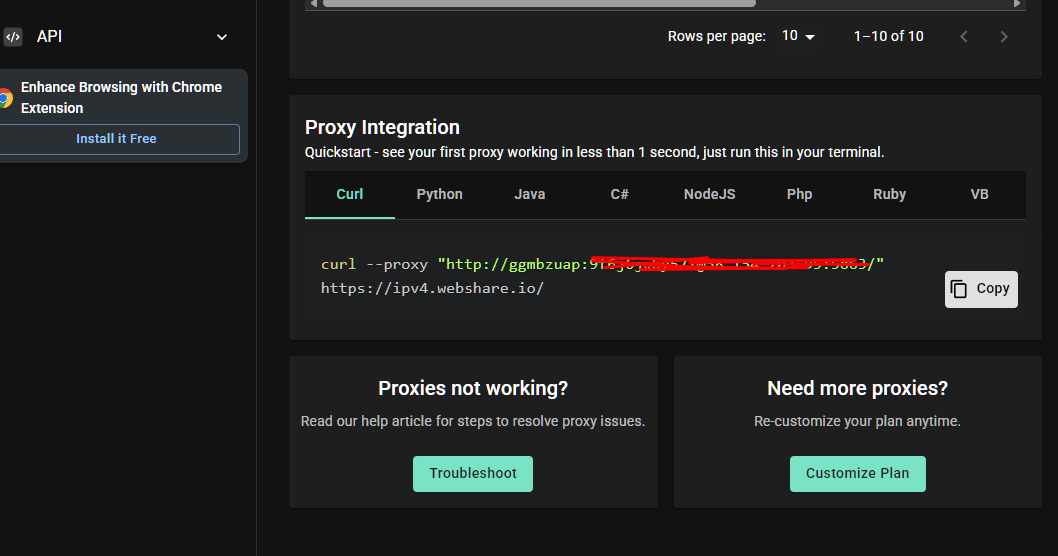
Under the hood, Webshare offers dual-protocol flexibility of choosing either SOCKS5 or HTTP proxies.
I found that Webshare decently scored on our parameters, as shown below.
- Latency: Fast proxies, but no public average response time information available.
- Reliability: Offers a solid 99.98% uptime.
- IP pool size: 27.8 million IPs
- Geo coverage: Offers proxies in 150+ countries
Webshare Pros & Cons
PROS
CONS
Pricing
Webshare SOCKS5 pricing starts at $0.0299 per proxy, giving you 100 proxies at $2.99 per month. The plans are subject to fair usage with bandwidth ranging from 250 GB to unlimited and threads from 500 to 3000.
IPRoyal
IPRoyal is a complete proxy provider with SOCKS5 support. It is a relatively new player in the market that offers solid proxy infrastructure with speed and scalability.
Its USP is its ability to feature non-expiring traffic, a feature most competitors don’t offer.
As for residential IPs, you get 64M+ IPs in 195+ countries. The performance is also excellent, with a close to 0.5s response time and 99.4% success rate.
You can sign up for a free account and check which plan suits you based on your needs. It’ll ask you 5 questions and target the address to check it.
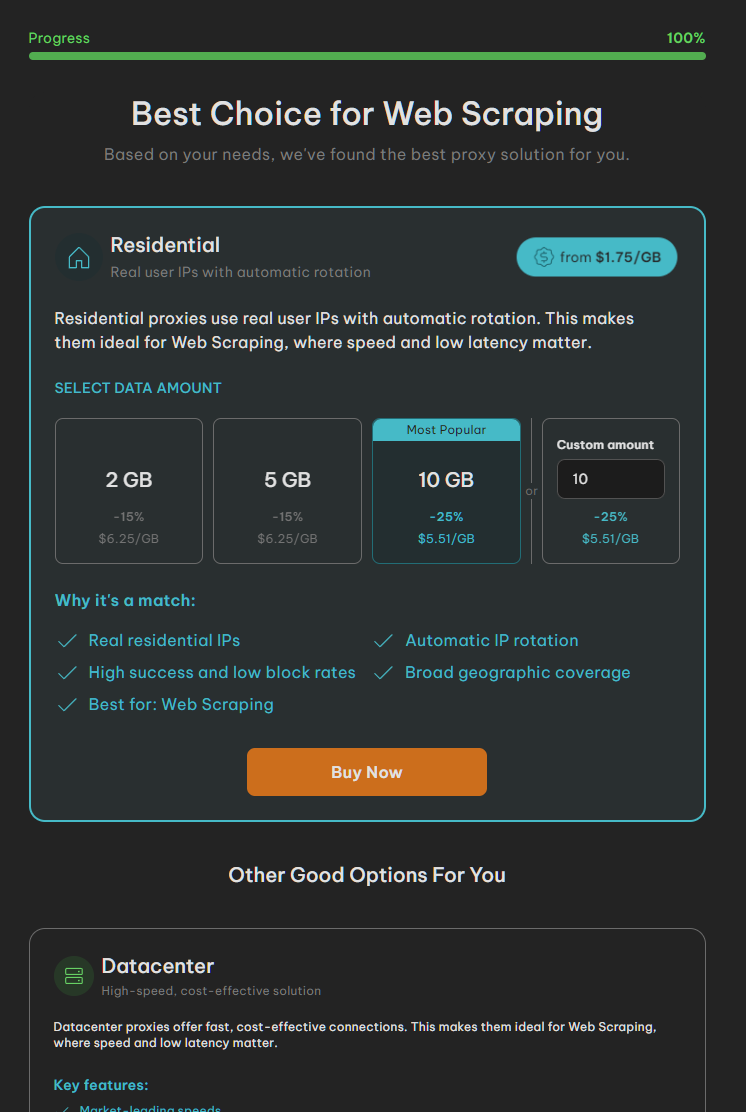
However, there is no free access or plan. If you don’t buy any of its plans, you won’t be able to access the dashboard.
As for our criteria, it passes them with strong numbers:
- Latency: average 0.5 seconds, average response time for residential proxies
- Reliability: 99.4% success rate
- IP pool size: 64 million+ residential IPs
- Geo coverage: available across 195+ countries
IPRoyal Pros & Cons
PROS
CONS
Pricing
IPRoyal SOCKS5 pricing starts as follows:
- $7.35/GB For residential IPs (PAYG plan)
- $2.40 per proxy for ISP (90 days plan)
- $1.39 per proxy for the datacenter (90 days plan)
- $117/month for mobile (90 days plan)
NodeMaven
NodeMaven is a highly rated SOCKS5 proxy provider with a focus on IP quality. It offers SOCKS5 support across residential, mobile, and ISP (static residential) proxies. Furthermore, it has dual support, which means HTTP/HTTPS support, offering flexible workflows.
Coverage-wise, you get 30M+ residential and 250K mobile IPs across 190+ countries. NodeMaven offers a 95% IP clean rate.
However, what separates them from the competition is their IP Quality Filter. It ensures low fraud score IPs get allocated. This helps reduce blocks and improve the success rate.
Additionally, you can rotate IPs per request, set custom intervals, or keep sticky sessions for up to 7 days.
Once I signed up, I got into their dashboard. It is intuitive, and you don’t have to leave the dashboard to buy proxies. It is also easy to use and includes features like traffic rollover and quality guarantee.
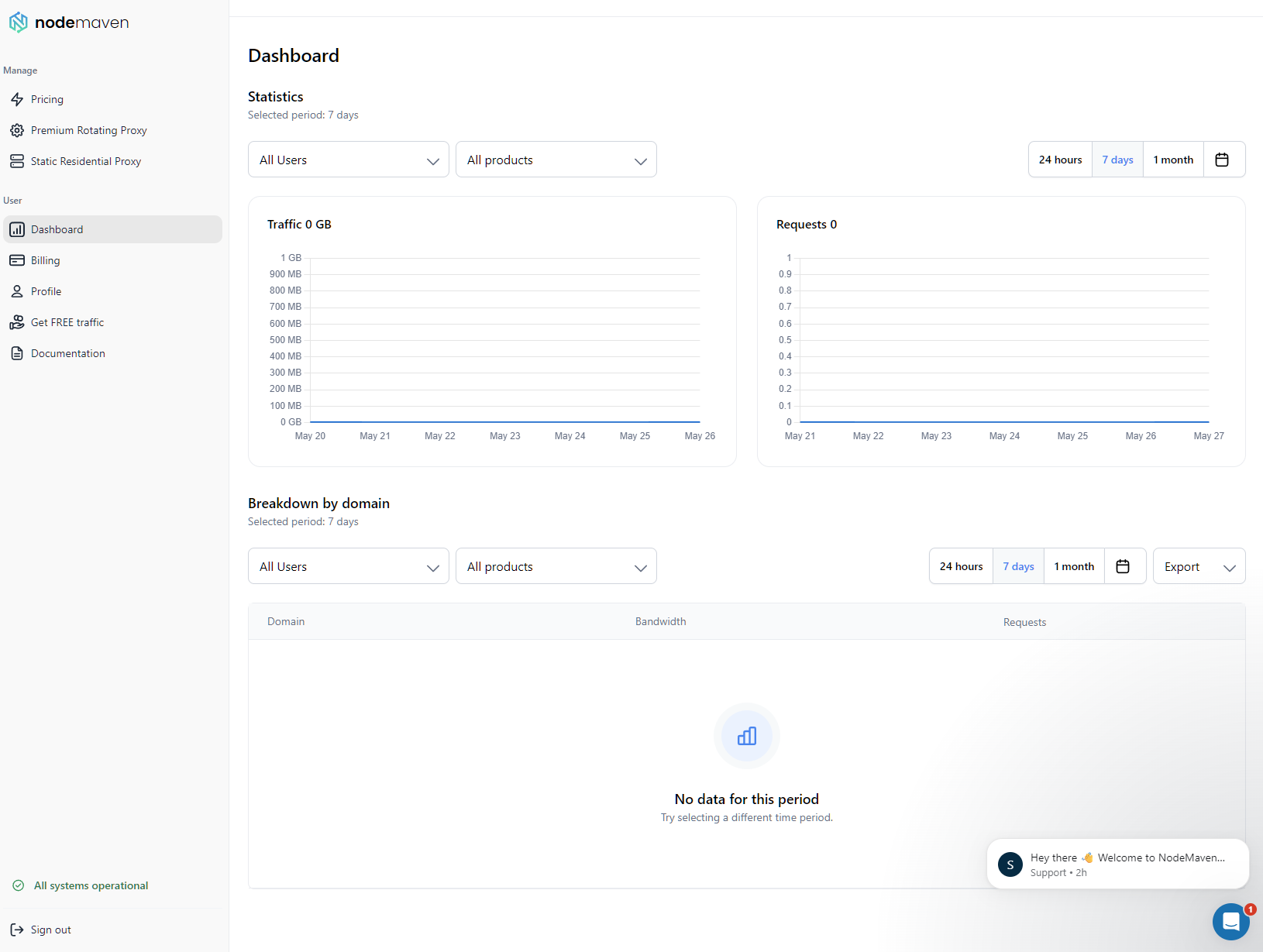
I found its 10% on used traffic as a cashback feature, which is unique in that you get a portion of your consumption back into your account every month.
As per our criteria, NodeMaven excels, as you can notice below:
- Latency: Low latency with no connection limits (no public average response time)
- Reliability: A high success rate of an average 99.54% success rate.
- IP pool size: 30M+ residential IPs with 250K+ mobile IPs.
- Geo coverage: 190+ countries coverage with the option to select locations with regions, ZIP code, city, and ISP-level targeting.
NodeMaven Pros & Cons
PROS
CONS
Pricing
NodeMaven pricing starts at just $5/GB (2 GB plan). You can try out NodeMaven with its $3.50 paid trial (gives you 750 MB).
Use promo code GEEK35 to get 35% off on all proxy types.
Proxy-Seller
Proxy-Seller offers private SOCKS5 proxies at an affordable rate. Its biggest advantage over its competitors is its “unlimited bandwidth up to 1 Gbps.”
Under the hood, it supports both HTTPS and SOCKS5 protocols. Moreover, it supports different types of proxies, including residential, ISP, and mobile. It also supports datacenter IPv4/IPv6.
As for geo coverage, it offers proxies across 220+ countries with a pool of 20M+ residential IPs, spread across 400 networks and 800 subnets.
Performance-wise, it does well with a 99.2% success rate. This makes it ideal for small- to medium-scale projects and is not recommended for high-volume scraping.
Proxy-Seller Pros & Cons
PROS
CONS
Pricing
Proxy-Seller prices are low, starting at $1.45 per GB (1000 GB plan). They have no free trial or plan.
DataImpulse
DataImpulse is a budget-friendly SOCKS5 proxy provider. It offers speed, anonymity, and accuracy while offering 90M+ IP addresses and guaranteed high uptime.
Furthermore, it has wide geo coverage with its proxies available in 195 countries. As for certification, it holds ISO 27001 certification.
The unique selling point of DataImpulse is its vast pool of residential IPs and geo coverage, while being affordable. It also has no traffic expiry date on proxies. So, once you buy them, you can use them without worrying about losing access.
DataImpulse offers a user-friendly dashboard and makes proxy management simple.
As for performance, DataImpulse residential proxies has 99.51% success rate and an average of 1 second response time.
DataImpulse Pros & Cons
PROS
CONS
Pricing
DataImpulse offers a basic Intro plan for $5 where you get 10 GB of data with the datacenter pool, 2.5 GB with the mobile pool, and 5 GB with the residential pool. The basic plan starts at $50.
Froxy
Froxy is a great pick if you’re looking for privacy and anonymity. They offer residential, mobile, and datacenter SOCKS5 proxies at decent pricing.
I found its rollover data useful as it helps you maximize your proxy usage without overpaying.
As for the proxy pool, they have 10 million IP addresses across 200 locations. These proxies are feature-rich as well, with features like advanced geo-targeting capabilities, high uptime (99.99%), and reliability.
Users will find it easy to use with its user-friendly dashboard.
Froxy Pros & Cons
PROS
CONS
Pricing
Froxy pricing starts at $5.50 per GB. You can also try its 3-day paid $1.99 trial with a 100 MB limit.

Soax

Proxysocks5
How to Choose the Right SOCKS5 Proxy
To choose the right SOCKS5 proxy, you need to ask these three questions.
- Which SOCKS5 proxy type do you need? Residential, Datacenter, or ISP proxies?
- Which proxy type should you add to the workload? Static or Rotating IPs?
- Should you use “free” SOCKS5 proxies?
Residential vs Datacenter vs ISP proxies: Which one do you actually need?
Each proxy type has its benefits and use cases.
For example, if you choose Residential proxies, then you get a real IP address capable of mimicking real users. This is ideal for sites that can detect bots and are only accessible to normal users. It stops triggering anti-bot systems.
If you opt for Datacenter proxies, you get cloud server IPs. These are faster and cheaper compared to residential. As for its use case, datacenter proxies are best suited for large-volume tasks such as uptime checks or price monitoring. However, these are relatively detectable compared to residential proxies.
Lastly, we have ISP proxies. These act as a middle ground between residential and datacenter proxies. Here, internet service providers assign IPs, giving them the realness of residential proxies and speed of datacenter proxies.
Basically, choose the proxy type based on your use case:
- Residential: scraping protected sites, account management, sneaker botting
- Datacenter: bulk data collection or sneaker botting (for speed-critical checkouts)
- ISP: for account management, streaming geo-blocked content
Static vs. Rotating IPs: Matching the proxy type to the workload.
Choosing between static and rotating IPs depends on your requirement.
If you need to constantly change the identity, then rotating IPs is the way to go. For tasks that require consistent identity, static IPs do great.
For example, you may want to use a static IP to manage accounts or sessions. In comparison, rotating IPs helps during web scraping activities by rotating IPs and acting as a completely new identity for the server.
In short, for data collection, use rotating IPs, and for managing accounts/services, use static IPs.
Why you should never use “free” SOCKS5 proxies.
It’s advisable not to use “free” SOCKS5 proxies as they can be unsafe. These free service proxies lack proper security implementation and can leak your data.
Most free SOCKS5 proxies log user activity and sell this data to third parties. Basically, they’re not giving you anything for free, but using your data as a means to provide free service.
Choosing any of the above-listed professional SOCKS5 providers can protect your data and privacy. The paid service providers have dedicated support, proper authentication, encryption, and SLA guarantees to ensure flawless service.
Top Use Cases for SOCKS5 Proxies
To truly understand SOCKS5 proxies, you need to look into their use cases. Below are the four popular use cases of SOCKS5 proxies.
1. Web Scraping & Data Extraction Without Triggering CAPTCHAs
One of the most common use cases of SOCKS5 proxies is web scraping and data extraction. Online platforms and services don’t like getting scraped. So, they employ strategies like CAPTCHA to catch unusual traffic patterns that resemble scraping.
To ensure that scraping doesn’t get affected, businesses can use SOCKS5 proxies to bypass these restrictions. It does it by working at a lower level, avoiding detection completely.
We suggest checking out Geekflare Web Scraping API, made specifically to handle CAPTCHA. It is a capable web scraping API with the ability to extract different data types. Apart from that, it includes rotating proxies and headless browsers.
2. Managing Multiple E-Commerce or Social Media Accounts
With SOCKS5, businesses can manage multiple e-commerce or social media accounts by maintaining consistent connections.
Most social media platforms have strict policies on account sharing or frequent operations. With SOCKS5 proxies, businesses can assign new IP addresses to each account, ensuring no bans or restrictions. This is especially true for agencies handling 50-500 social media accounts.
3. P2P Sharing & Gaming (UDP Support)
SOCKS5 is equally good at P2P sharing and gaming, as it supports UDP. Furthermore, its support for IPv4 and IPv6 addressing means that it can handle the full range of connection types, be it for VoIP, torrents, P2P, or gaming workflow.
4. Sneaker botting and limited-release purchasing
With SOCKS5 residential proxies, it is possible to optimize purchases of quick-to-sell items. This is possible by using varied IPs via botting software. This way, platforms such as Nike SNKRS, Adidas, etc., cannot detect the bot and help you lock the deal.
As SOCKS5 proxies are fast, you have a higher chance of buying. It’s best to go with a mix of residential proxies (for genuineness) and datacenter proxies (for raw speed).