



A timezone API is a web service that takes a location: coordinates, a street address, an IP address, or a named time zone, and sends back three things: the current local time there, the name of the time zone, and how many hours it’s offset from UTC. Ask it about Mumbai or a set of coordinates in Brazil, and it returns the answer already adjusted for daylight saving, so you’re not the one tracking which countries changed their clocks this year.
Some popular use cases for time zone APIs are as follows:
- Scheduling and calendar tools showing the same meeting as 3 PM to a New York attendee and 8 PM to one in London, from a single stored event time.
- Travel and booking platforms displaying check-in times, flight departures, and itineraries in the destination’s time zone, not the traveler’s home zone.
- E-commerce and logistics providers timestamping orders and estimating delivery windows correctly when the warehouse, carrier, and customer are located in three different countries.
- Financial and trading systems matching market open/close times and transaction logs to the exchange’s local time instead of the server’s.
- Customer support systems routing the process of sending a ticket to the agent whose local business hours match when it came in.
- IoT and embedded devices to get an accurate local time reference without adding a full, constantly updated time zone database on the device itself.
Below are the best timezone APIs ranging from free single-purpose services to enterprise data platforms.
Timezone APIs at a Glance
| API | Free tier | Paid pricing starts at | Data source | Best fit |
|---|---|---|---|---|
| TimeAPI.io | Unlimited, no cost | N/A; entirely free | IANA timezone database | Hobby projects and quick integrations |
| Abstract API | 5,000 requests/month | $12/month (annual billing) | Abstract’s own timezone dataset | Teams that want documented SLAs without enterprise sales calls |
| TimeZoneDB | 1 request/second, unlimited total | $5/month | 400+ time zones, 240+ countries | Budget-conscious apps needing steady, low-volume lookups |
| API Ninjas Timezone API | 3,000 requests/month (evaluation only) | $39/month | API Ninjas’ shared dataset | Teams using other API Ninjas endpoints |
| GeoNames Timezone Webservice | 1,000 credits/hour | Custom (commercial SLA tier) | GeoNames geographical database | Projects pulling place data from GeoNames |
| IPGeolocation.io | 1,000 credits/day | $19/month | Bundled with IP geolocation lookups | Apps that need timezone alongside IP-based location |
| Google Maps Platform Time Zone API | 10,000 calls/month | $5 per 1,000 calls after that | Google’s global timezone data | Products built on Google Maps Platform |
| Precisely Timezone API | Free trial, no card required | $50/month | Precisely Data Integrity Suite | Enterprise logistics, compliance, and customer-engagement systems |
TimeAPI.io
TimeAPI.io returns the current time for a timezone, coordinate set, or IANA zone name, and converts a given time between zones. There’s no signup wall and no pricing page to read before your first request. It’s the easiest platform on this list for a weekend project or a quick internal tool.
The service reports handling 2.5 billion requests a month with sub-millisecond response times and 99.99% uptime, so the free label doesn’t mean small-scale.
Pros & Cons
PROS
CONS
Pricing
Free for all use, with no paid tiers, request quotas, or credit card requirements.
Abstract API
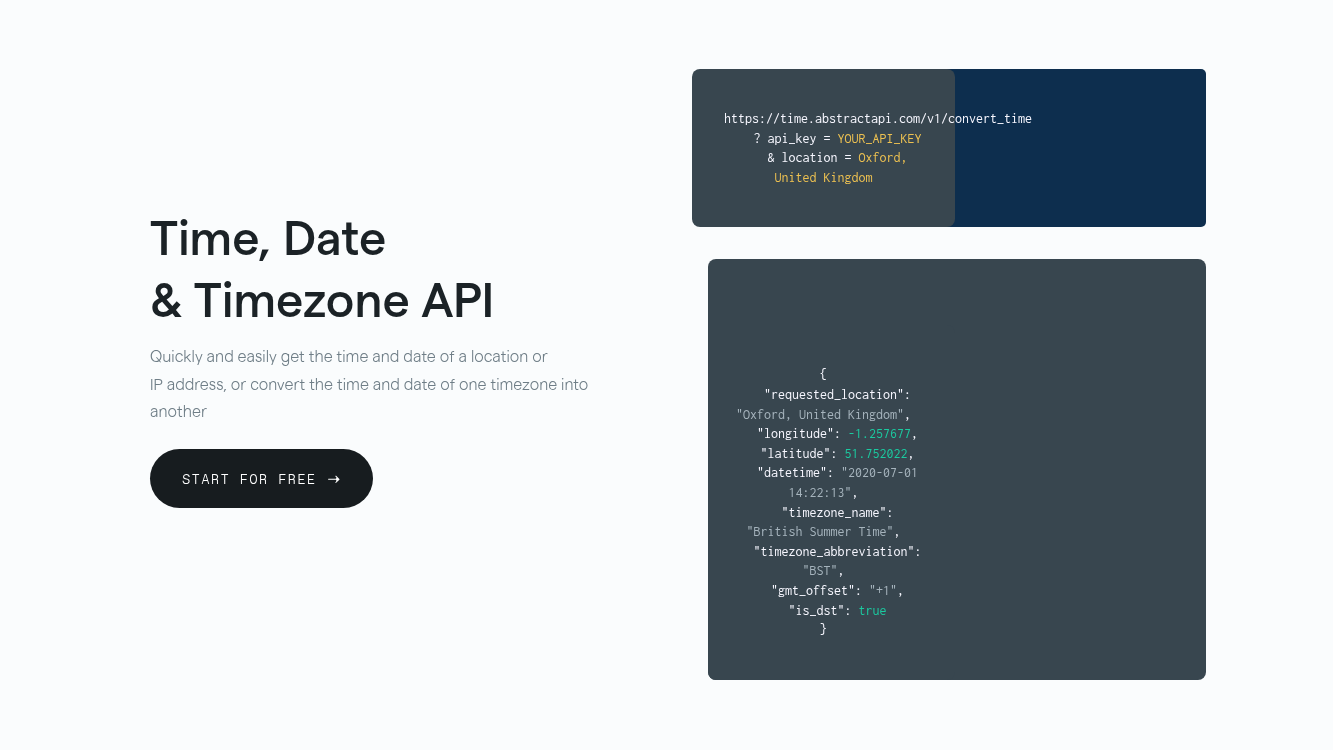
Abstract’s Time, Date & Timezone API covers the current time and timezone for a location or IP address, and converts a given time from one zone to another, down to millisecond precision. Abstract sells a list of separate APIs (email validation, IP geolocation, and others), and this one follows the same documented, self-serve pattern.
Key Features
- Daylight Saving Time and GMT offset included in every response
- All traffic required to run over TLS 1.2 or newer
- Multiple client libraries and a documented REST interface for faster integration
Pros & Cons
PROS
CONS
Pricing
Free: 5,000 requests/month, 1 request/second, no card required.
Standard: $12/month billed annually, 60,000 requests/year, 3 requests/second.
Enterprise: custom pricing with a 99.99% uptime SLA, SSO/SAML, and 24/7 support.
TimeZoneDB
TimeZoneDB has provided a straightforward, single-purpose timezone lookup service for years, covering more than 400 time zones across 240-plus countries. Query by coordinates or by zone name and get back the country, zone name, abbreviation, GMT offset, and DST status.
Pros & Cons
PROS
CONS
Pricing
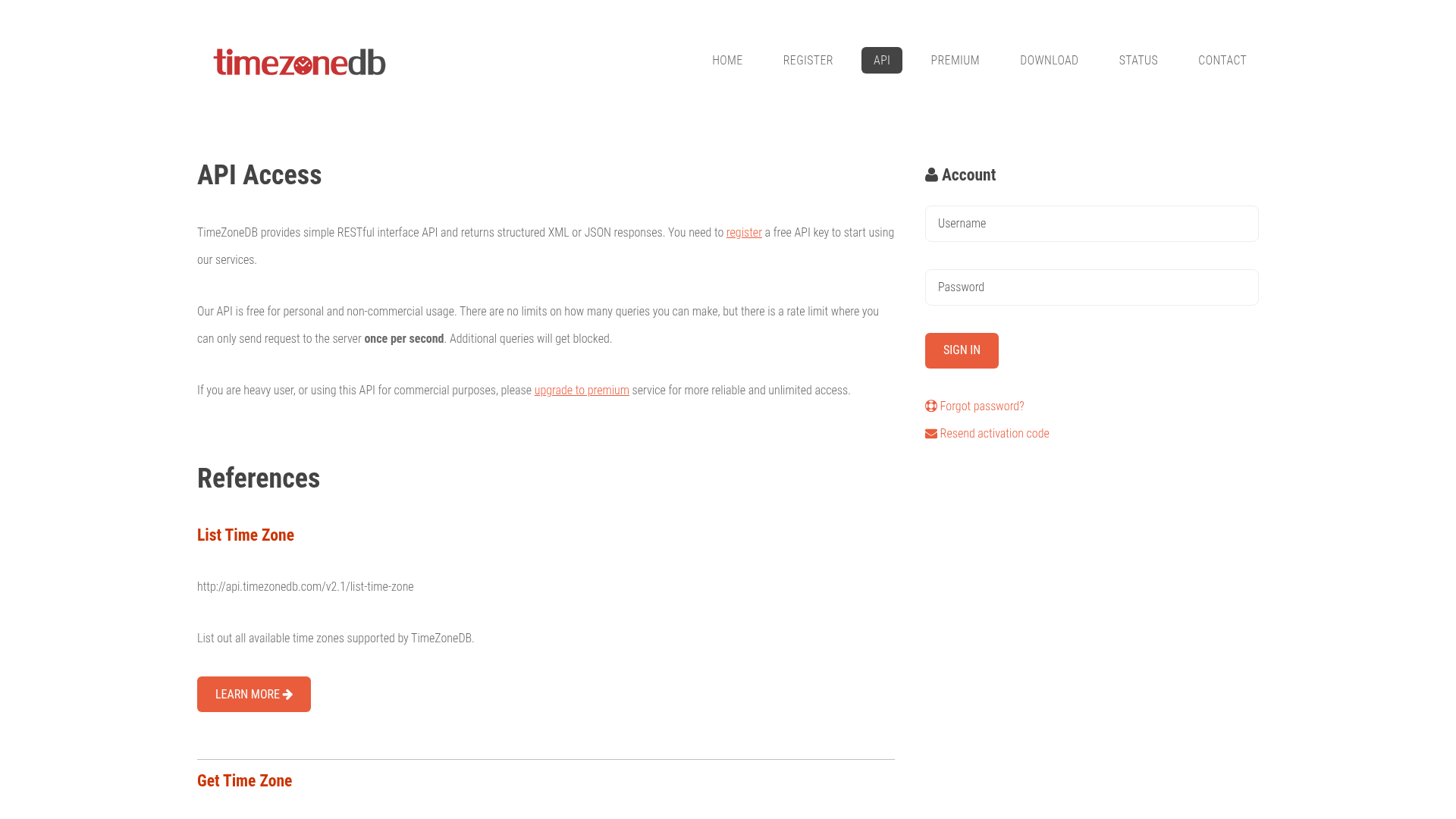
Free: requires a registered API key, capped at 1 request/second with no limit on total queries at that rate.
Paid: $5/month for more reliable, effectively unlimited access.
API Ninjas Timezone API
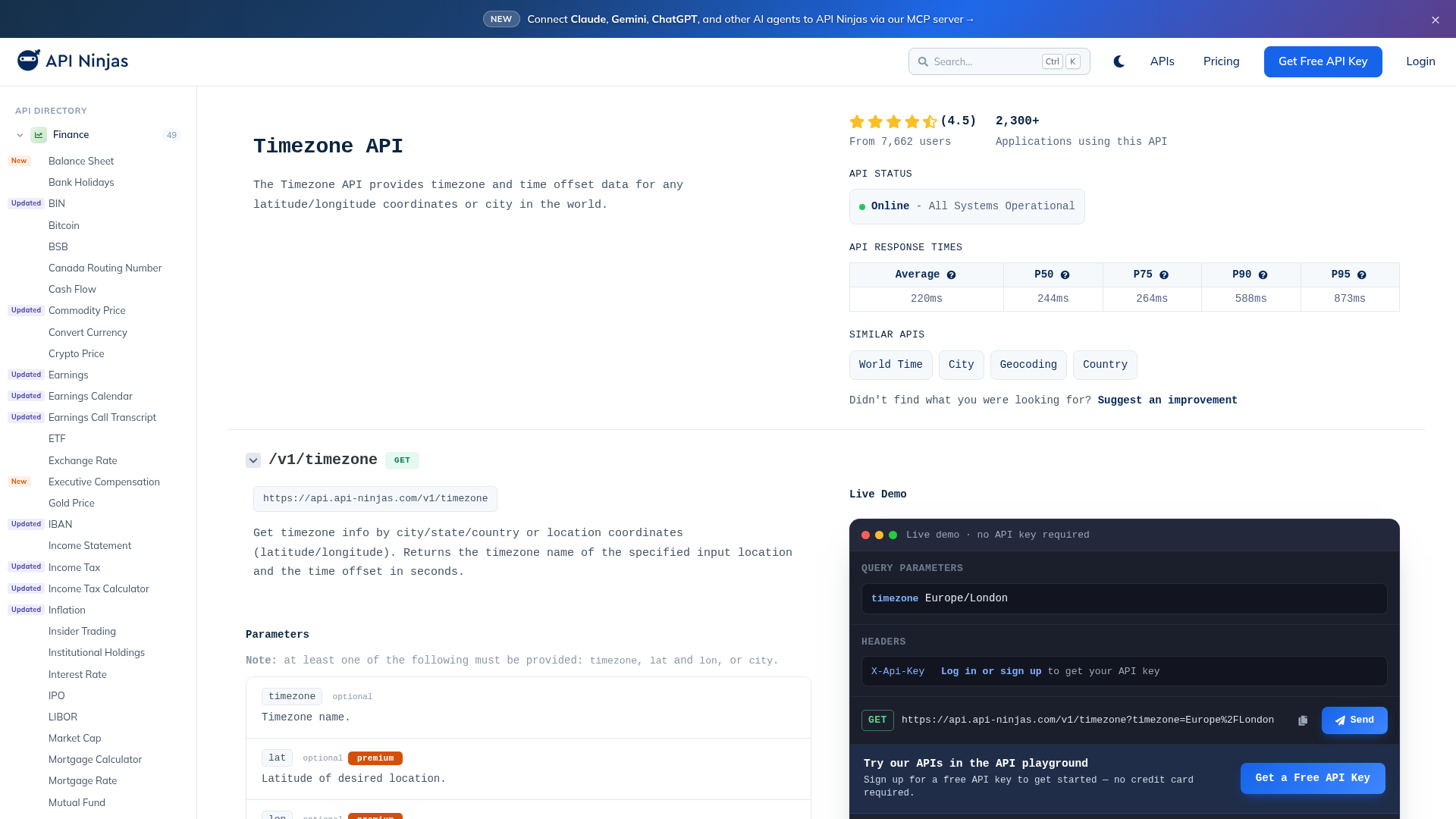
API Ninjas offers dozens of unrelated APIs (currency conversion, image processing, text analysis, and more) behind one key and one billing plan, and its Timezone API is one entry in that catalog. Query it by timezone name, city, country, or coordinates and get back the zone name, UTC offset in seconds, and local time.
The tradeoff is that timezone lookups aren’t the product’s focus: coordinate- and city-based queries are locked to paid plans, and only timezone-name lookups are available for free.
Pros & Cons
PROS
CONS
Pricing
Free: 3,000 requests/month, evaluation only, no card required.
Developer: $39/month for 100,000 requests.
Business: $99/month for 1,000,000 requests.
Professional: $199/month for 10,000,000 requests.
Enterprise: custom. A 34% discount applies on annual billing across paid plans.
GeoNames Timezone Webservice
GeoNames is best known as a free, community-maintained geographical database, and its timezone web service shares the same free account as its place-name and elevation lookups. Send a latitude and longitude and get back the time zone ID, GMT offset, and DST offset for that point.
You’ll need to register your own free username before making real requests; the shared demo account GeoNames publishes in its docs is explicitly not meant for production traffic and gets capped hard.
Pros & Cons
PROS
CONS
Pricing
Free: requires a registered username, capped at 1,000 credits per hour.
A separate commercial web-service tier with an SLA is available for higher-volume or guaranteed-uptime use.
IPGeolocation.io
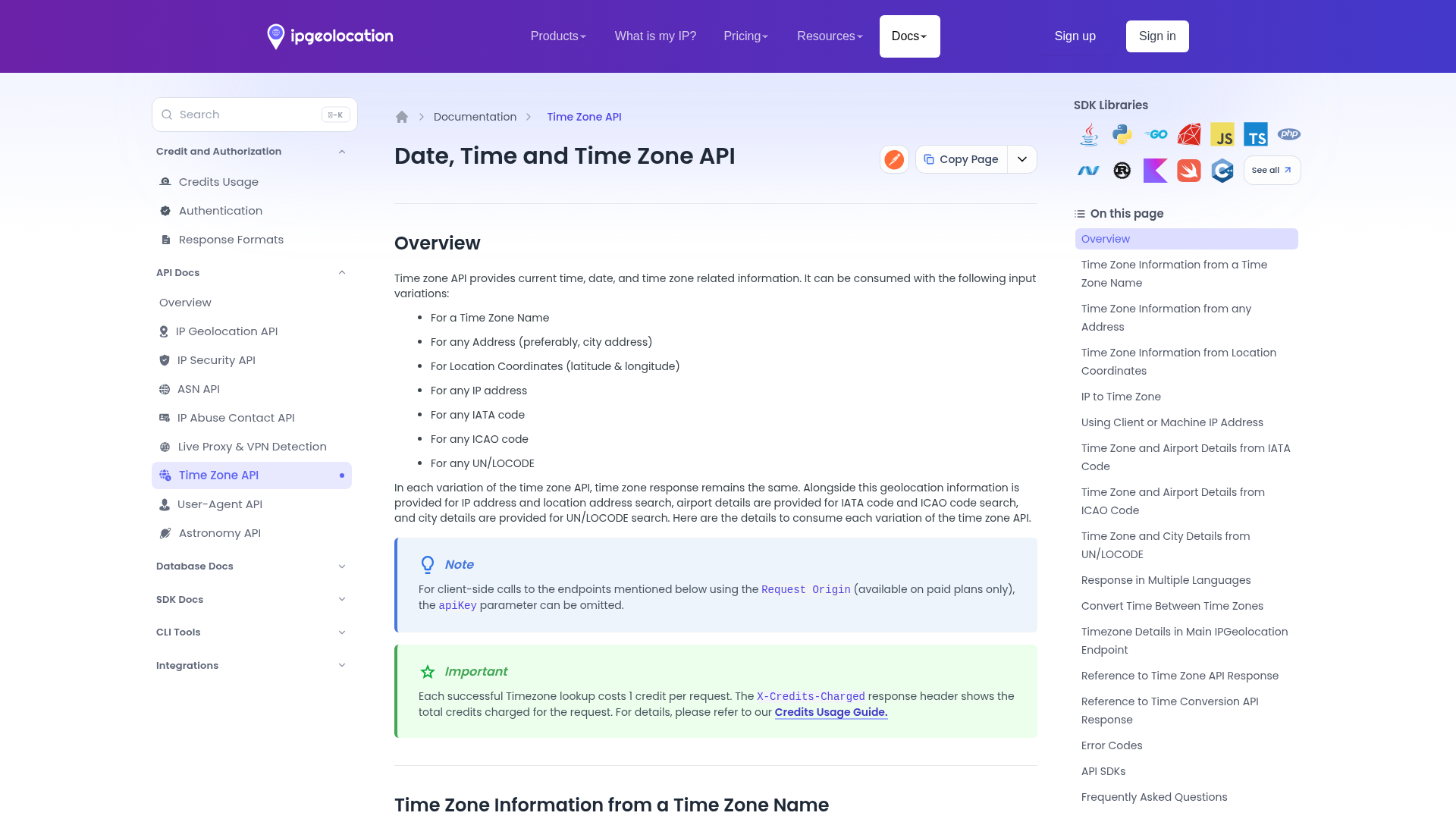
IPGeolocation.io provides IP-to-location lookups, and timezone data comes in the same response rather than being sold as a separate product. Send an IP address, coordinates, or a timezone name, and the API returns location details plus the matching timezone, current local time, and UTC offset in one call.
Pros & Cons
PROS
CONS
Pricing
Free: 1,000 credits/day, no card required.
Starter: $19/month, 150,000 credits.
Plus: $49/month, 500,000 credits.
Pro: $79/month, 1,000,000 credits.
Business: $129/month, 2,000,000 credits.
Premium: $249/month, 5,000,000 credits.
Google Maps Platform Time Zone API
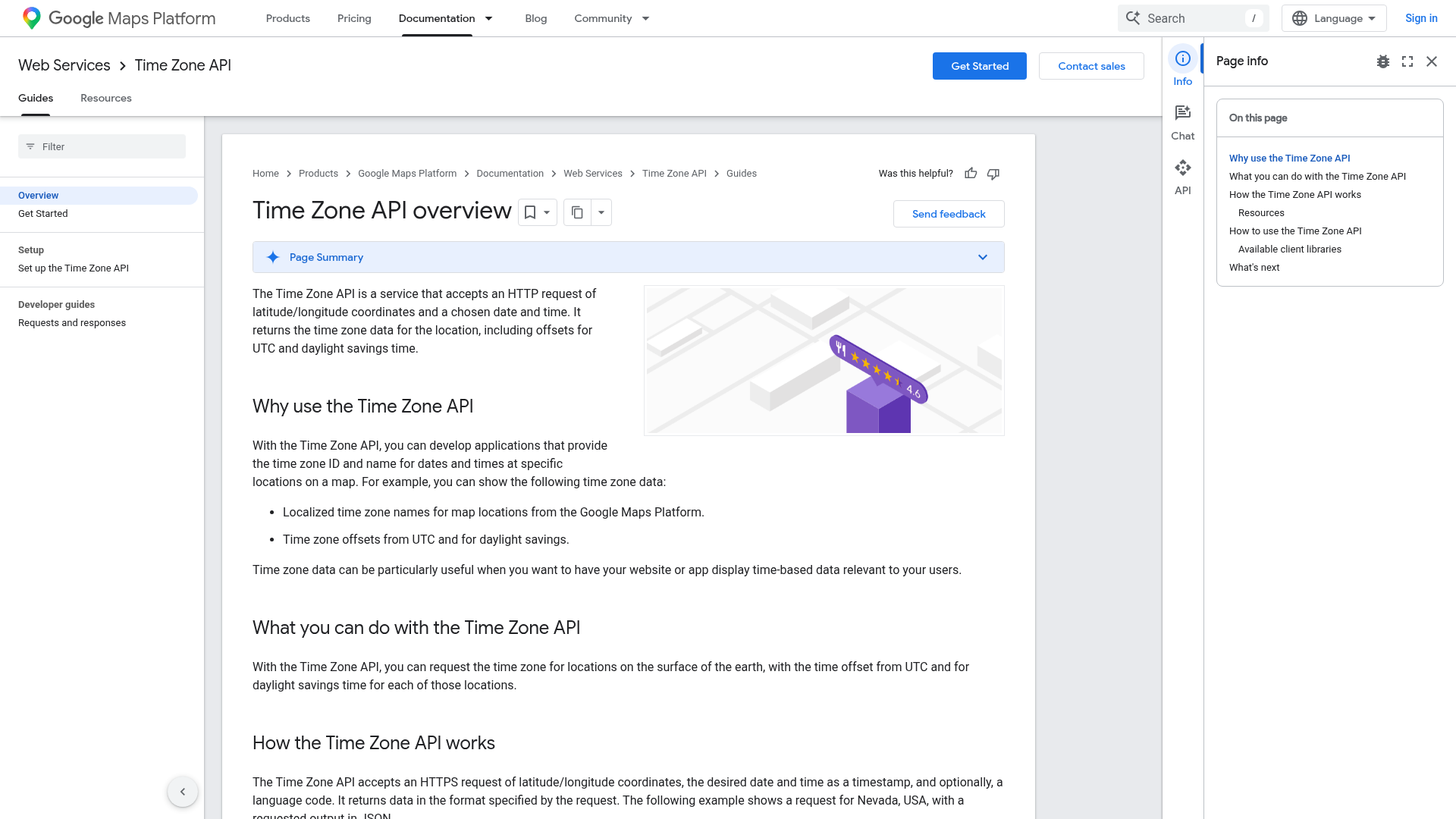
Google Maps Platform’s Time Zone API takes a latitude, longitude, and timestamp, and returns the timezone ID along with the UTC and DST offsets in effect at that moment. It’s built for pairing with other Maps Platform products a team is likely paying for, like Geocoding or Places, not as a standalone lookup.
Billing requires an active Google Cloud project with a billing account attached, even though the first 10,000 calls each month don’t cost anything. That setup is more complex than most other APIs on this list, and it’s worth factoring in before choosing Google just for its brand.
Key Features
- Accepts a specific past or future timestamp, so you can check what the offset was or will be, not only right now
- Supports up to 30,000 queries per minute once billing is enabled, well past what most apps need
- Response language can be set from a long list of supported locales
Pros & Cons
PROS
CONS
Pricing
10,000 calls/month are included free, then $5 per 1,000 calls at standard volume. Requires a Google Cloud project with billing enabled.
Precisely Timezone API
Precisely sells enterprise data-integrity software, and its Timezone API is one endpoint inside that broader suite. It resolves timezone by geographic coordinates or by street address, returning the zone name, timestamp, UTC offset, and Daylight Savings offset.
A free trial through the Developer Portal doesn’t require a credit card. Actual pricing is contract-based, built from licenses, integrations, and support level.
Pros & Cons
PROS
CONS
Pricing
Free trial available with 2,500 credits.
Paid plans are Basic for $50 and 5000 credits/month + overages and Professional for $900/month for 100,000 credits + overages.
Enterprise plans have custom pricing.
How to Choose a Timezone API
Start with volume and budget. A side project or internal tool has no reason to pay anything: TimeAPI.io covers current-time and conversion needs at zero cost, and GeoNames works well if the project touches GeoNames place-name data too. Once usage becomes commercial and predictable, TimeZoneDB and Abstract API both offer a documented, self-serve path with a real SLA on the paid tier.
Teams sending IP addresses through IPGeolocation.io, or coordinates through Google Maps Platform, gain the most by pulling timezone data from a call they’re making anyway, without adding another vendor. That single-call convenience is worth more than saving a few dollars on a standalone platform.
Address-based workflows in logistics or compliance fit Precisely’s model better than any of the coordinate-first APIs above. And a multi-API bundle like API Ninjas only makes sense once timezone data is one of several unrelated things the same account needs to fetch.
FAQs
Is there still a good free timezone API now that WorldTimeAPI is gone?
TimeAPI.io covers the same core need (current time by zone, plus conversion between zones) at no cost and with no published request cap, and its stated uptime and request volume suggest it’s built to handle production-scale free traffic, not just demos.
Do I need a dedicated timezone API if I already use Google Maps or an IP geolocation service?
Not necessarily. If your app calls the Google Maps Platform or an IP geolocation API like IPGeolocation.io, timezone data is available in or alongside those same responses. Adding a separate specialist API mostly duplicates a call the app is making.
Why is hardcoding timezone offsets a bad idea?
Governments change daylight saving and timezone rules more often than a static table gets updated, and a hardcoded list won’t reflect a rule change until someone notices the bug in production. A live API keeps that data current without a manual release.
What’s the difference between looking up a timezone by coordinates versus by IP address?
Coordinate-based lookup (used by TimeAPI.io, Google Maps Platform, GeoNames, and Precisely) needs a known latitude and longitude and returns an exact result for that point. IP-based lookup (IPGeolocation.io’s approach) estimates location from a user’s IP address first, which is convenient when you don’t have coordinates on hand, but is inherently less precise, particularly for mobile or VPN traffic.
Are any of these timezone APIs suitable for high-volume, mission-critical production use?
Abstract API’s Enterprise plan and Google Maps Platform both publish uptime commitments and support scaled volume once billing is set up. Precisely fits mission-critical use too, but only where its address-based, enterprise contract model matches how your organization buys software.