


If you want to purchase a translation API, you’ll need to make two decisions: which provider and which underlying technology. That second decision didn’t exist a few years ago.
NMT (neural machine translation) is a purpose-built technology with a model trained to do one job: turning text in one language into text in another.
On the other hand, large language models like GPT, Claude, and Gemini were trained on everything from code to conversation and image generation. Translation is just one of the things they turn out to be good at, often catching idioms and tone that a model built only to translate misses.
NMT engines from Google, Microsoft, and Amazon translate in under 100 milliseconds and charge roughly $10–20 per million characters. They are suited for live chat, bulk content creation, and anything where volume matters more than cultural nuance.
LLM-based translation, like DeepL’s newer model, Claude, GPT, Gemini, and dedicated tools like Lara, costs more and answers slower but reads context far better. This tech is more suitable for marketing copies, legal text, and culturally sensitive content. This guide covers both types of translation APIs, current pricing, and how to combine them.
Translation APIs at a Glance
| API | Type | Languages | Pricing | Best fit |
|---|---|---|---|---|
| Google Cloud Translation | NMT + LLM | 130+ | $20/M chars (NMT); $10/M in + $10/M out (LLM) | Broad-coverage default, either model |
| Azure Translator | NMT | 100+ | $10/M chars | Lowest-cost high-volume NMT |
| Amazon Translate | NMT | 75+ | $15/M chars ($60/M for Active Custom Translation) | AWS-native pipelines |
| DeepL API | NMT + LLM | 100+ (next-gen); 30+ (classic) | Free (1M chars); Growth $26/mo + $27.50/M | Quality-sensitive text, switchable per request |
| LibreTranslate | NMT (self-hosted) | ~50 | Free (self-hosted); hosted plans vary | Data sovereignty, no per-character billing |
| Lara (Translated) | Adaptive/LLM | 200+ | Free (10K chars/mo); $19.99–24.99/M | Context-aware, terminology-consistent documents |
| Gemini | LLM | 70+ (Live Translate); most languages (text) | Token-based; Live Translate ~$0.037/min | Real-time speech translation, prompt-based text |
| OpenAI | LLM | Most languages | Token-based; realtime translation ~$0.034/min | Prompt-based text and dedicated live speech |
| Claude | LLM | Most languages | $1–$5 input / $5–$25 output per M tokens | Tone, register, and instruction-heavy translation |
| DeepSeek | LLM | Most languages | $0.14–$0.435 input / $0.28–$0.87 output per M tokens | Budget prompt-based translation |
Traditional NMT APIs
Google Cloud Translation API
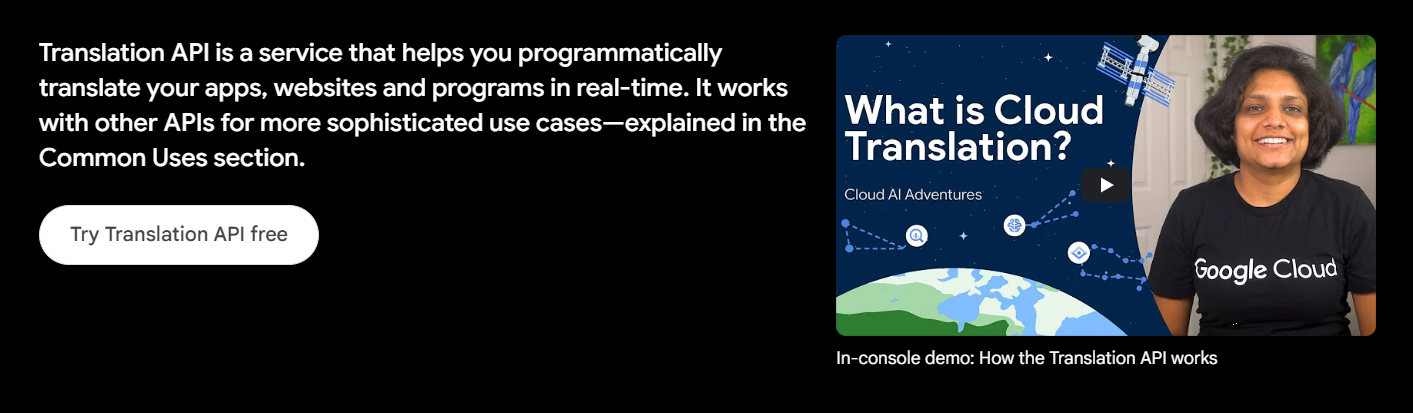
Google Cloud Translation is the only major NMT vendor that also sells a specialized translation LLM from the same endpoint, switchable per request without moving to a different provider. It also covers the widest language list. Its Advanced edition (v3) layers on glossaries, batch operations, and AutoML custom models beyond what the Basic edition (v2) offers.
Key Features
- Automatic source-language detection at no extra charge
- A dedicated translation LLM, billed separately from the classic NMT model but priced to cost the same for standard text translation
- Adaptive Translation, which fine-tunes output using your own reference translations
- AutoML custom models for domain-specific terminology (Advanced edition only)
- Batch translation for text and documents, alongside single-request calls
Pros & Cons
PROS
CONS
Pricing
Basic/Advanced NMT: first 2M characters/month free, then $20 per million.
Standard LLM text translation: $10 per million input characters plus $10 per million output characters.
Adaptive Translation (LLM): $25 per million input plus $25 per million output.
Custom AutoML models start at $40 per million characters and scale down with volume.
Azure Translator
Azure Translator is the most straightforward translation option if your team is already using the Microsoft stack. It’s available directly in Azure AI Foundry Tools alongside the rest of what you are already paying for. It’s also the cheapest of the three major cloud NMT providers on a per-character basis.
Key Features
- Transliteration and a bilingual dictionary lookup alongside standard translation
- Document translation that preserves the original layout
- Custom translation for training domain-specific models, with training costs capped at $300 per job
- Reaches over 95% of world GDP in language coverage, as per Microsoft
Pros & Cons
PROS
CONS
Pricing
Standard text translation: $10 per million characters, with 2 million characters/month free.
Custom translation text: $40 per million characters.
Document translation: $15 per million characters (or $8 per thousand images for scanned documents).
Amazon Translate
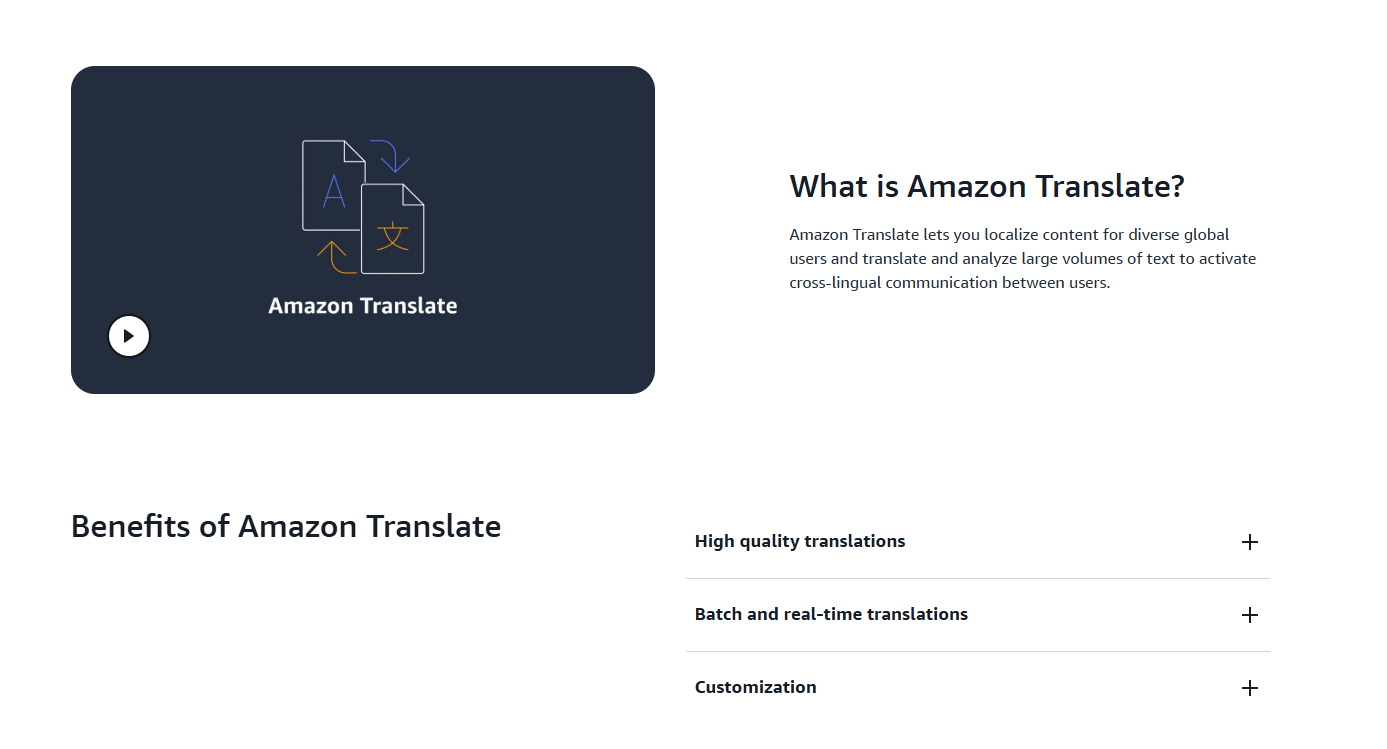
Amazon Translate is the best option if you’re already using AWS. It is available alongside services such as S3, Lambda, and Transcribe, so translation can be processed in the same workflow without adding another vendor. It supports both real-time and batch translation, which makes it suitable for everything from app content to large document-processing jobs.
Key Features
- Active Custom Translation (ACT), which customizes output using your own parallel-text examples without needing to train separate model
- Automatic language detection
- Real-time and asynchronous batch translation, including HTML and DOCX documents
- Native hooks into S3, Lambda, Transcribe, Redshift, and DynamoDB
Pros & Cons
PROS
CONS
Pricing
Standard translation: $15 per million characters, with 2 million characters/month free for the first 12 months. Active Custom Translation: $60 per million characters, with a smaller free allowance for the first two months. Real-time DOCX translation is priced at $30 per million characters.
DeepL API
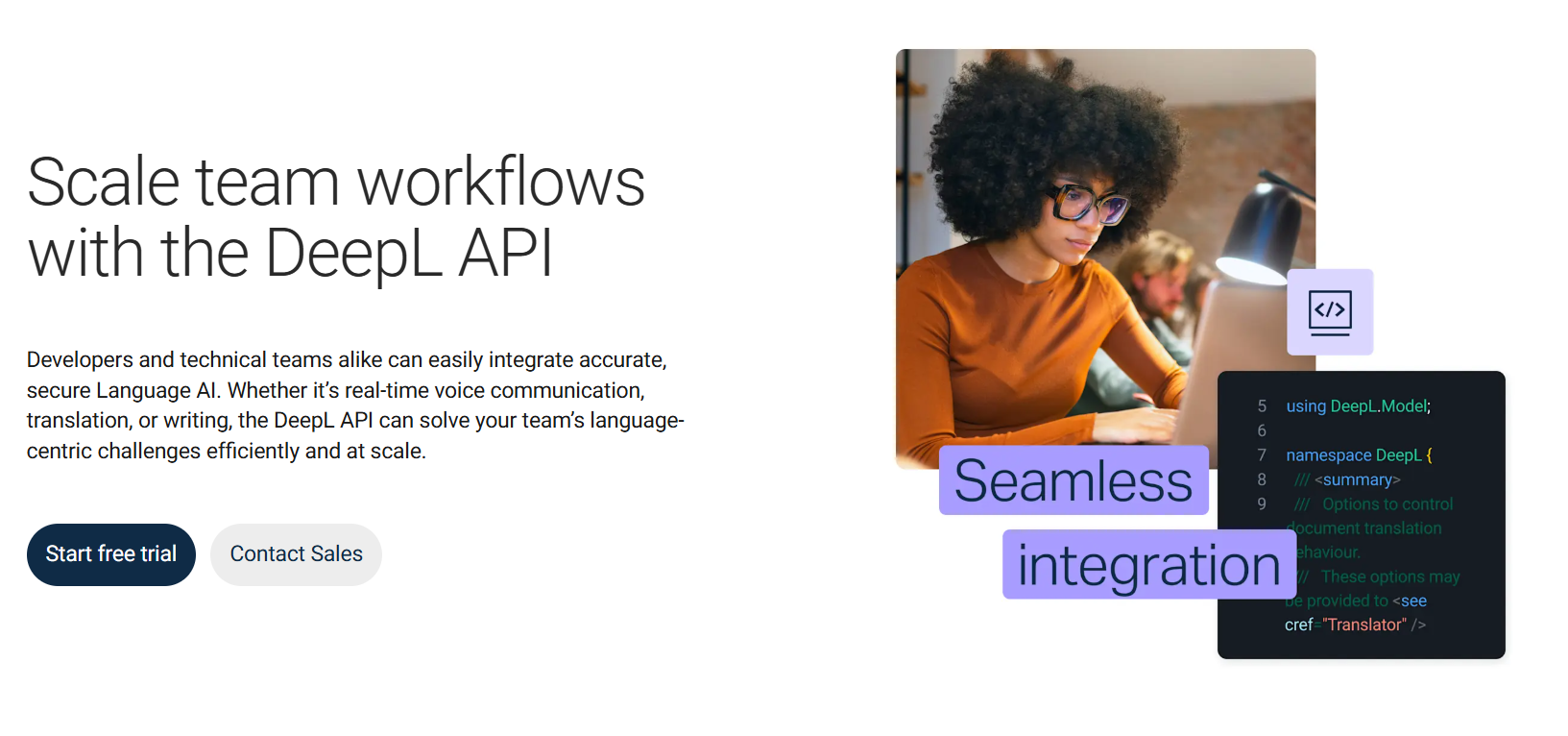
One parameter is what separates DeepL from every other NMT vendor here: model_type switches between its fast classic model and its newer translation-specific LLM in the same API call.
Its plan structure changed too, from a flat free-plus-pay-as-you-go setup to a tiered system. It’s worth checking closely if you’re upgrading an older integration.
Key Features
- A
model_typerequest parameter (quality_optimized,latency_optimized, or a hybrid preference) that picks the model per call - A purpose-built translation LLM, now covering 100+ languages after launching with Japanese, German, and Simplified Chinese
- No use of customer content for model training
- A companion Voice API for speech-to-text and speech-to-speech translation
Pros & Cons
PROS
CONS
Pricing
Free: One-time 1 million-character credit, one API key.
Growth: $26/month billed annually, 12 million characters/year included, then $27.50 per additional million characters. Also includes DeepL Voice hours.
Enterprise API: Custom volume pricing with no monthly cap.
LibreTranslate
LibreTranslate can be self-hosted on your own server, with no per-character bill and no text leaving your infrastructure. None of the paid APIs offer that option. That makes LibreTranslate worth considering when data needs to stay in-house or per-character pricing becomes too expensive.
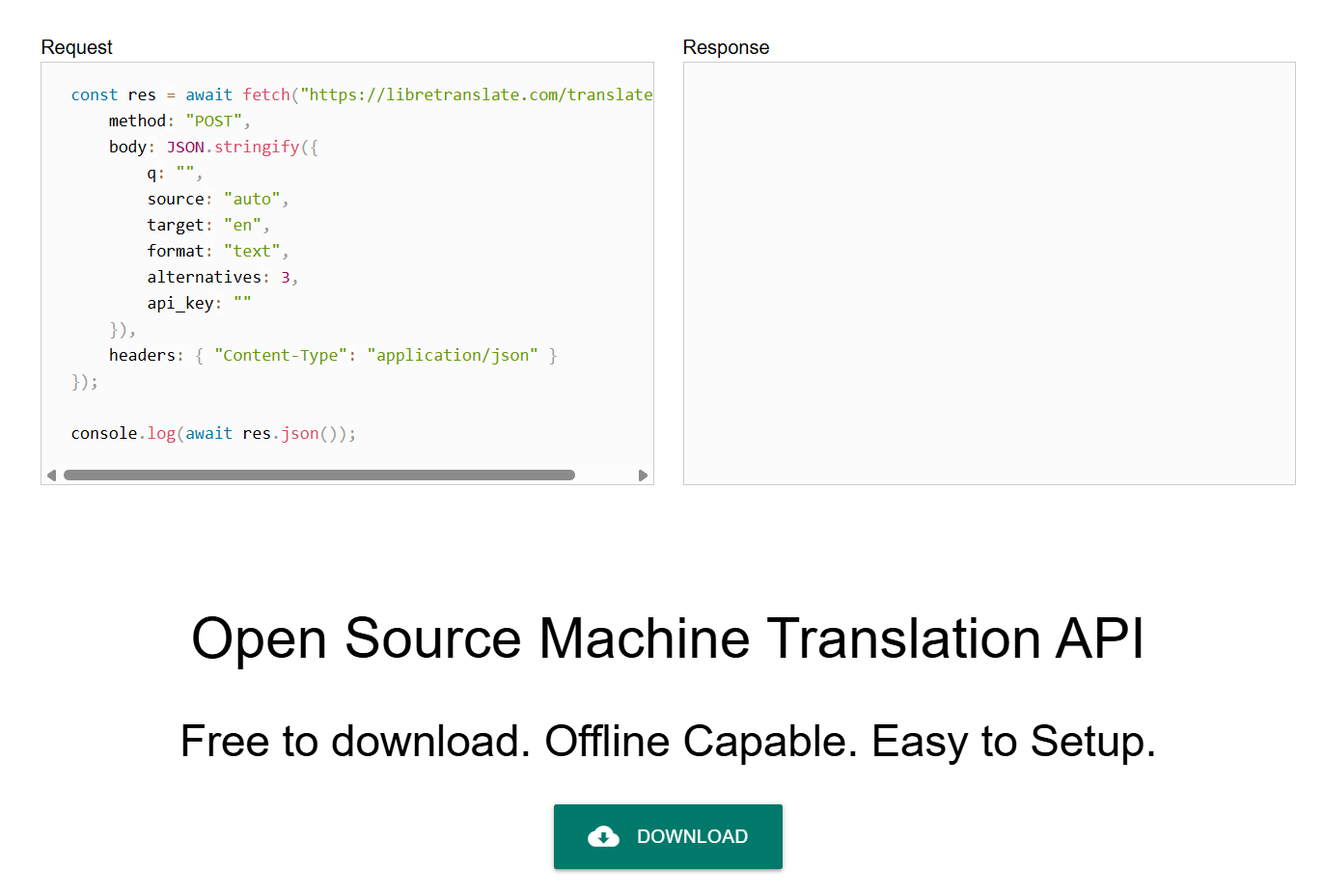
It covers roughly 50 languages now, using the open-source Argos Translate engine underneath, and it can operate fully offline once language models are downloaded. It’s AGPLv3-licensed and deployable via Docker in minutes, but it won’t match a commercial NMT engine’s translation quality across the board, and there’s no LLM tier to fall back on if you need one.
Pricing
Free and unlimited when self-hosted on your own infrastructure. LibreTranslate.com’s hosted API is also available with a paid API key for teams that don’t want to maintain their own instance.
LLM-Based and Context-Aware Translation APIs
According to Intento’s State of Translation Automation 2025 report, LLM-based systems accounted for 89% of top-performing solutions across evaluated language pairs, up from 55% the year before. A few of the entries below are dedicated translation products; the rest are general-purpose LLMs that developers now reach for through ordinary prompting.
Lara (by Translated)
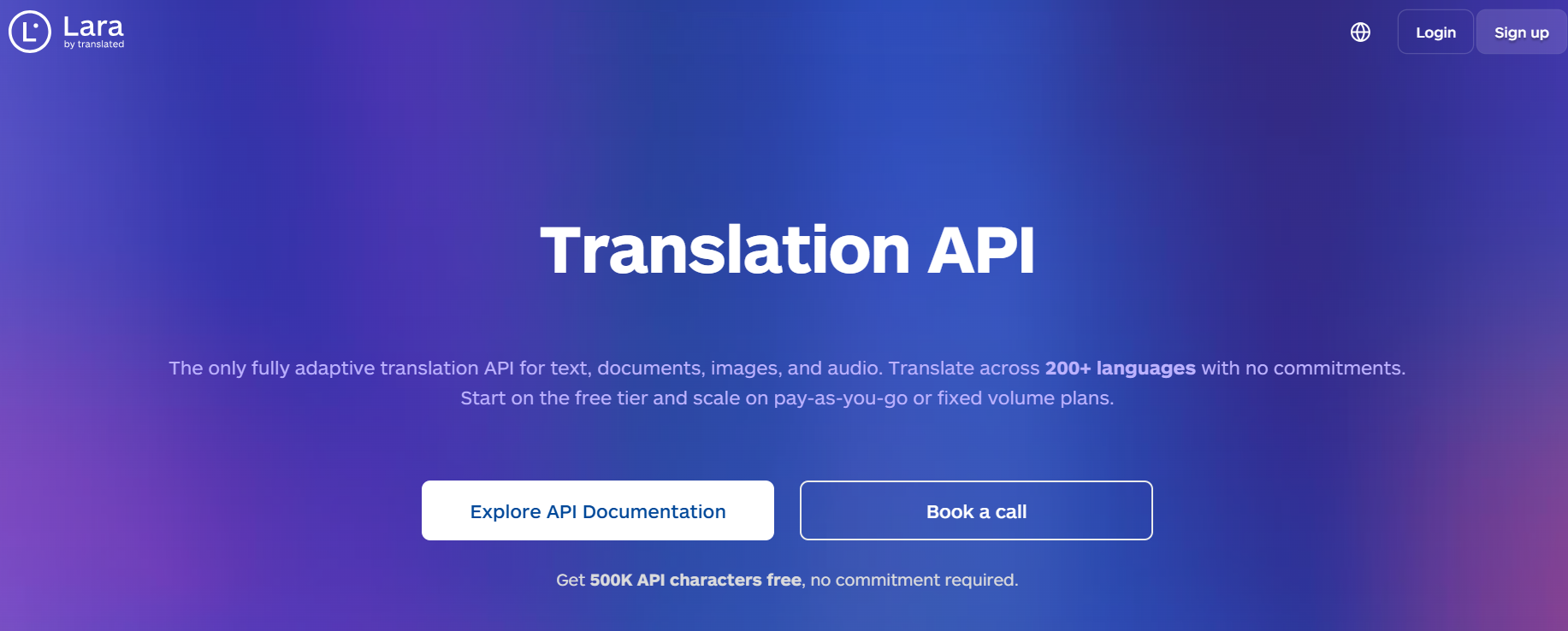
When you translate the first page of a document with Lara, it remembers its terminology choices, ensuring page 40 remains consistent with page 1 without you building or maintaining a glossary yourself. It checks what’s already been translated in a document, or any context you feed it, before translating the next chunk; it won’t treat every string as a blank slate. Long documents and ongoing projects where consistency across hundreds of pages matter more than any single sentence are where that pays off.
Key Features
- Doesn’t bill separately for the prior context or translation history it uses to adapt output
- Two selectable models: Lara Base for everyday speed and cost, Lara Think for deeper multi-step analysis on complex documents
- Covers text, documents, images, and audio across 200+ languages and 70+ file formats with layout preservation
- Ships as an MCP server, plugging directly into agent and LLM tool-use workflows
Pros & Cons
PROS
CONS
Pricing
Free API: up to 10,000 characters/month.
Pro: $9.99/month plus $24.99 per million characters of API usage.
Team: $29.99/month plus $19.99 per million characters.
Enterprise: custom.
Google Gemini
Gemini Live Translate processes spoken conversation end-to-end in a single model audio in, audio out format. There’s no need to process speech-to-text, translation, and text-to-speech separately. This lets it preserve a speaker’s tone and pacing in real time, across 70+ languages. For text, Gemini translates the same way any general-purpose LLM does: through a prompt, with quality depending on which model and instructions you use.
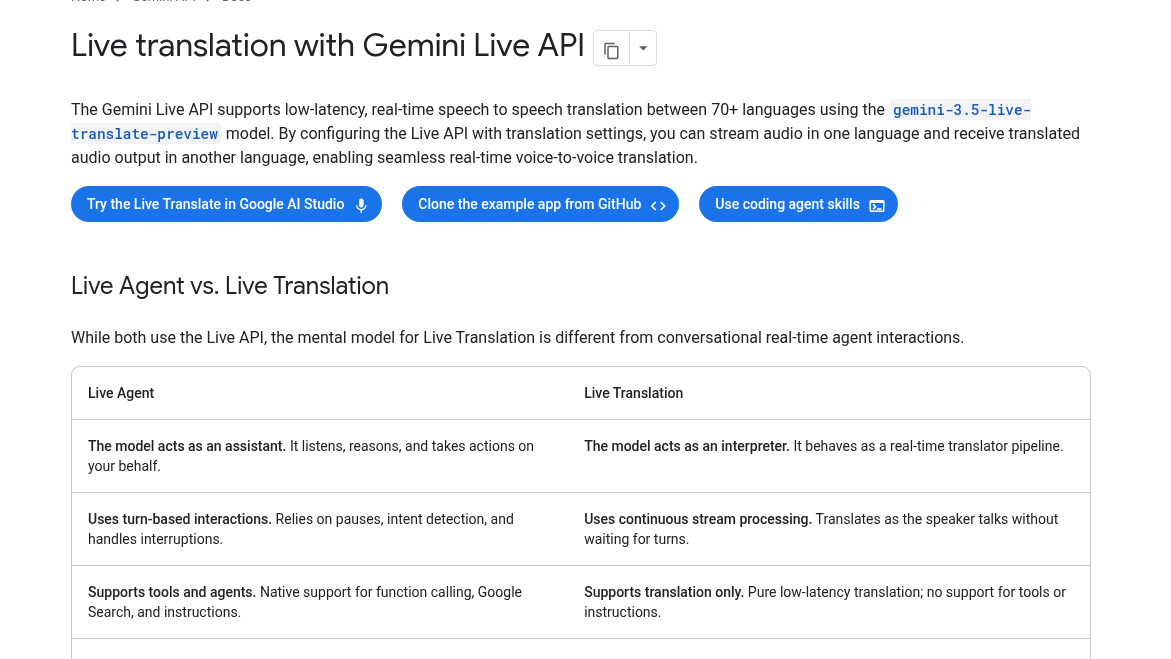
It streams over the Gemini Live API, with a free path through Google AI Studio for prototyping without a paid subscription.
Pricing
Gemini Live Translate is billed by audio token consumption, working out to roughly $0.037 per minute.
Text translation through general Gemini models is billed per token.
For example, Gemini 3.1 Pro Preview costs $2 per million input tokens and $12 per million output tokens for shorter contexts.
OpenAI
OpenAI ships a dedicated real-time speech translation model, gpt-realtime-translate, separate from the ordinary prompt-based translation available through its general chat models. For text, you will need to pick from the GPT-5.6 family based on how much quality you need per dollar, from the budget Luna tier up to the flagship Sol.
Pricing
Gpt-realtime-translate costs about $0.034 per minute for live speech translation.
Text translation through general models varies by tier. The current flagship family spans roughly $0.20/$1.20 (smallest) to $5/$30 (largest) per million input/output tokens, so cost depends heavily on which model you prompt.
Anthropic Claude
Claude has no dedicated translation endpoint. You translate by prompting the same Messages API used for everything else. It follows detailed instructions about tone, register, and terminology well enough to work as a stand-in for a glossary feature, which suits marketing copy, legal text, or anything else where brand voice matters as much as accuracy.
Pricing
Token-based, varying by model: Haiku 4.5 at $1/$5 per million input/output tokens, Sonnet 5 at $2/$10, and Opus 5 at $5/$25.
DeepSeek
DeepSeek has no dedicated translation product. It offers just prompt-based translation priced well below what OpenAI, Anthropic, or Google charge per token. Its API is compatible with both the OpenAI and Anthropic request formats, so it’s a quick drop-in test when the pricing above doesn’t work for your volume.
Pricing
V4-Flash: $0.14 per million input tokens (cache miss) and $0.28 per million output tokens.
V4-Pro: $0.435 input and $0.87 output per million tokens.
Please note that DeepSeek’s plans are time-sensitive.
Other Translation APIs Worth Knowing
SYSTRAN Translate covers 55 languages with a 14-day, 500,000-character free trial, then €14.99/month for 1 million characters. It also offers an on-premise enterprise deployment for organizations that can’t send text to a third-party cloud. This makes it relevant for government and large-corporate use.
Translate.com pairs machine translation (5,900+ language pairs) with an optional human-translation layer (110+ language pairs, proofread, roughly 1.5-hour turnaround). Pricing is $0.05 per word on subscription or $0.09 per word (not character) pay-as-you-go.
Yandex Translate API covers 90+ languages with a free testing playground. But international payment and compliance friction tied to broader sanctions on Yandex’s other business units is worth checking before committing to it for a production account outside Russia.
Building a Hybrid NMT + LLM Translation Strategy
Most teams don’t end up choosing one category over the other. They route different content to each one. A support chat widget or a bulk product-catalog import goes to an NMT engine for speed and cost. A marketing landing page, a legal disclaimer, or anything culturally sensitive goes to an LLM, or to DeepL’s quality_optimized mode, because the extra latency and cost are worth it for the better output.
A simplified version of that routing logic looks like this:
function translate(text, targetLang, options) {
  if (options.qualityCritical) {
    const result = llmTranslate(text, targetLang, { context: options.context });
    return result.confidence >= MIN_CONFIDENCE
      ? result
      : flagForHumanReview(result);
  }
  // Default: fast, cheap NMT for bulk or real-time content
  return nmtTranslate(text, targetLang);
}
The fallback direction matters as much as the routing rule. If an LLM call times out or returns a low-confidence result, falling back to NMT keeps the request from failing outright, even though the output quality drops for that one string.
Teams building this into an agent or automation workflow will prefer a translation layer with native MCP support, like Lara.
How to Choose a Translation API
For live chat, support widgets, or anything where a user is waiting on the response, NMT wins on latency alone. Google, Azure, and Amazon all translate well under the time it takes an LLM to generate a first token. Bulk content generation and large product catalogs land in the same place, mostly because per-character NMT pricing stays predictable at volume in a way token-based LLM pricing doesn’t.
Marketing copy, legal text, and anything where tone or cultural nuance matters is where LLM-based translation earns its higher cost. DeepL’s next-gen model, Claude, and GPT all handle idiom and register better than a classic NMT model, and Claude in particular rewards detailed prompting about style constraints. Long-form documents or ongoing projects that need consistent terminology across many pages fit Lara’s adaptive approach better than a stateless call to any of the above.
Self-hosted deployments narrow the field to LibreTranslate, since it’s the only option here that doesn’t require sending text to a third party at all.
Real-time spoken translation for calls, meetings, or live video now has two purpose-built options worth comparing directly: Gemini Live Translate and OpenAI’s gpt-realtime-translate, rather than chaining a speech-to-text and translation API together yourself.
FAQs
Do I need an LLM translation API, or is NMT enough?
If your content is short, structured, and high-volume, like UI strings, chat messages, or product listings, a classic NMT engine covers it, and switching to an LLM mostly adds cost and latency without a reader-noticeable quality gain. The equation flips for long-form, culturally sensitive, or brand-voice-dependent text.
Can I get NMT speed and LLM quality from the same API?
DeepL comes closest: its model_type parameter switches between a fast classic model and its LLM-based model in the same request, so you don’t need two separate integrations. Google offers something similar by exposing NMT and LLM translation as separate priced options within one API.
Which option is cheapest for high-volume text translation?
Azure’s $10 per million characters is the lowest standard NMT rate among the major cloud providers. On the LLM side, DeepSeek’s per-token pricing is cheaper by a wide margin, though its provider has flagged a near-term price increase.
Is there a way to translate without sending data to a third party?
LibreTranslate is the best option here. It’s open-source and can operate entirely on infrastructure you control, with no per-character billing once it’s set up.
How does real-time speech translation differ from text translation APIs?
Dedicated models like Gemini Live Translate and OpenAI’s gpt-realtime-translate process audio end-to-end. That’s what lets them preserve a speaker’s tone and pacing while keeping latency low enough for a live conversation.