



A voice call API lets your own code make and control phone calls. Dial a number from a webhook. Drop a caller into an IVR menu you built yourself. Record the conversation and stream the audio to a transcription engine while the call is still happening. A call center seat license doesn’t give you any of that, and neither does a plain phone line.
In this guide, I have compared the best programmable voice APIs you can sign up for today and start dialing with an API key. I have also included a section on AI voice agent platforms for teams whose goal is a conversation the AI runs itself, not just a connected call.
Voice call APIs compared
| Provider | Known for | Notable feature | Starting price |
|---|---|---|---|
| Twilio Voice | Deepest docs and ecosystem | Voice Intelligence, Branded Calling | $0.014/min outbound (US) |
| Vonage Voice API | Ericsson-backed global network | Fraud Defender, AI Hub voice connectors | Pay-per-second, varies by country |
| Bandwidth | Owns its US carrier network | Bring Your Own AI | $0.0055-0.0100/min (US) |
| Telnyx | Lowest base per-minute rate here | Swappable STT/TTS engine marketplace | $0.002/min (US) |
| Plivo | Classic API plus first-party AI agents | Dynamic Caller ID | From $0.0010/min outbound |
| Sinch | Voice bundled with SMS, WhatsApp, email | TTS and IVR included free | Per call leg, varies by country |
| Infobip | Widest channel and country reach | Click-to-Call | Contact-based, per-country average |
| Agora | Ultra-low-latency in-app audio | AI noise suppression, spatial audio | 10,000 free min/mo, then $0.99/1,000 min |
| SignalWire | Bundled AI Agent Runtime pricing | SWML call flow as JSON | $0.16/min AI runtime plus transport |
| RingCentral | API on top of a full UC platform | Presence and Call Log API | Bundled with RingEX/RingCX plans |
| Telesign | Fraud-hardened voice OTP | IRSF traffic monitoring | Contact sales |
| Sendbird | Voice add-on to a chat platform | Peer-to-peer or relayed calling | $0.0010-0.0015/min |
| EnableX | On-premise deployment option | Voice Streaming API to WebSocket | Per call leg, varies by country |
| ZegoCloud | Social audio at scale | Up to 10,000 call participants | 10,000 free min, then $0.99/1,000 min |
Twilio Voice
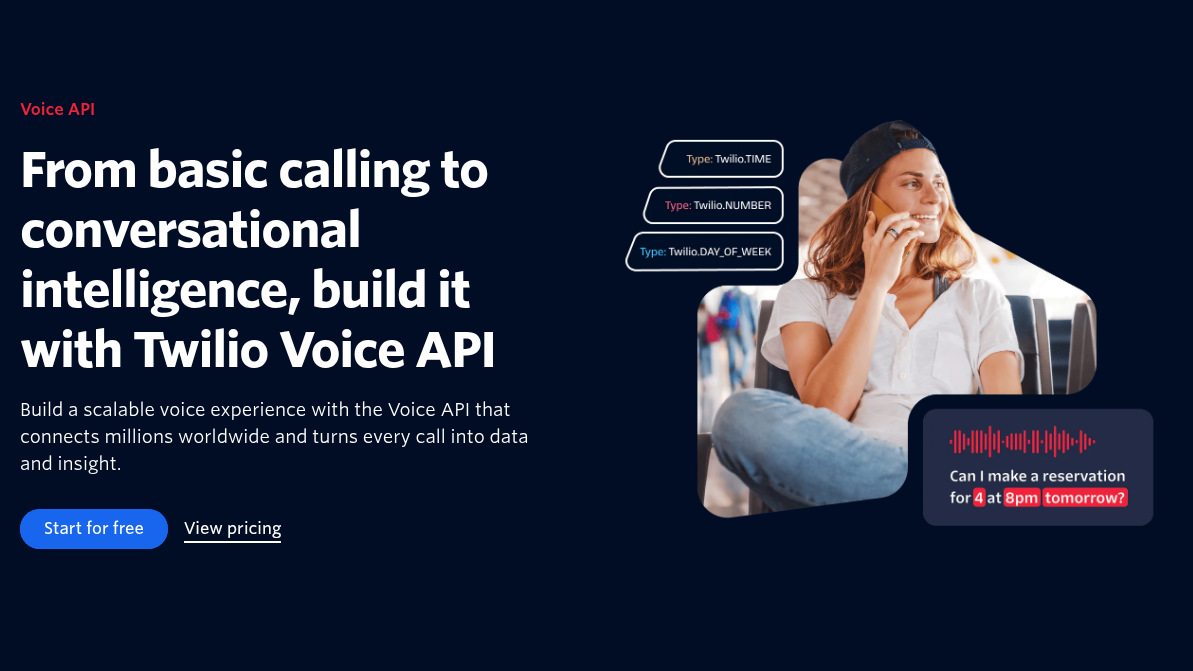
Twilio Voice is the default most developers consider first and a sort of industry benchmark. It places and receives PSTN calls, handles WebRTC calls inside a browser, and connects to SIP trunks, all through one set of endpoints. It includes call recording, conferencing, and a machine-learning layer that turns recorded calls into structured data.
Key Features
- Voice Intelligence turns recorded calls into searchable transcripts and structured data for analytics
- Branded Calling shows a verified business name on the recipient’s phone before they answer
- Global conferencing supports large multi-party calls with per-participant controls
- TwiML and Voice SDKs cover both server-side call control and in-app or browser calling
- SIP trunking lets an existing PBX route calls through Twilio’s carrier network
Pros & Cons
PROS
CONS
Pricing
Twilio bills $0.014 per minute for US outbound calls and $0.0085 per minute for inbound.
Intra-Twilio call legs, conferencing, or transfers between Twilio numbers cost $0.002 per minute.
New accounts start with a free trial that doesn’t need a credit card.
Vonage Voice API
Ericsson owns Vonage now. Its Voice API is built around WebRTC and PSTN calling with per-second billing, and it leans on the data your app already has to personalize a call before it connects.
Key Features
- Voice Connectors route calls directly into Vonage AI Hub for conversational flows; no separate telephony integration is required
- Fraud Defender flags SIM-swap and number-porting risk before a call or SMS OTP goes out
- WebSocket audio streaming exposes live call audio for real-time processing
- Number Insight looks up a phone number’s type, carrier, and reachability before dialing
Pros & Cons
PROS
CONS
Pricing
Vonage bills per-second usage. Rates vary by destination country and network type. Outbound and inbound rates for US mobile and landline numbers, plus the full country pricing sheet, show up after signing up for a free trial account. No credit card needed.
Bandwidth
Bandwidth owns its US carrier network outright. It doesn’t resell someone else’s capacity. The Voice API covers inbound and outbound calling, call control, and AI-agent integration on a single all-IP network.
Key Features
- Bring Your Own AI lets you add an existing conversational AI stack into Bandwidth’s call infrastructure without a platform switch
- Real-time transcription and standard or enhanced text-to-speech run directly through the Voice API
- Answering Machine Detection and bidirectional media streaming support automated outbound campaigns
- Direct carrier relationships mean fewer hops between a call and the network underneath it
Pros & Cons
PROS
CONS
Pricing
US local outbound calls cost $0.0100 per minute and inbound $0.0055 per minute, billed in 6-second increments. Add-ons are priced separately: standard text-to-speech at $0.0007 per 100 characters, standard transcription at $0.0450 per minute, call recording at $0.0020 per minute, and answering machine detection at $0.0060 per call.
Telnyx
Telnyx has points of presence in 130+ countries and prices its Voice API below Twilio and Vonage for comparable US calling. The API covers call control, browser and app calling over WebRTC. It offers a marketplace of interchangeable speech-to-text and text-to-speech engines, not a single built-in option.
Key Features
- A single API swaps a call’s speech engine between Deepgram, Whisper, Google, Azure, or Telnyx’s own options without touching the integration code
- AI Gather and AI Assistant commands chain speech-to-text, a language model, and text-to-speech onto a live call in a few lines
- Real-time bidirectional media streaming runs over secure WebSockets for custom audio processing
- Round-trip time stays under 200 ms because AI and telephony infrastructure share the same private backbone
Pros & Cons
PROS
CONS
Pricing
Outbound and inbound US calls cost $0.002 per minute, plus the applicable SIP trunking fee. Optional features are billed separately by engine choice: Telnyx’s own text-to-speech costs $0.000003 per character. Premium options like ElevenLabs bill at cost through a bring-your-own-API-key model.
Plivo
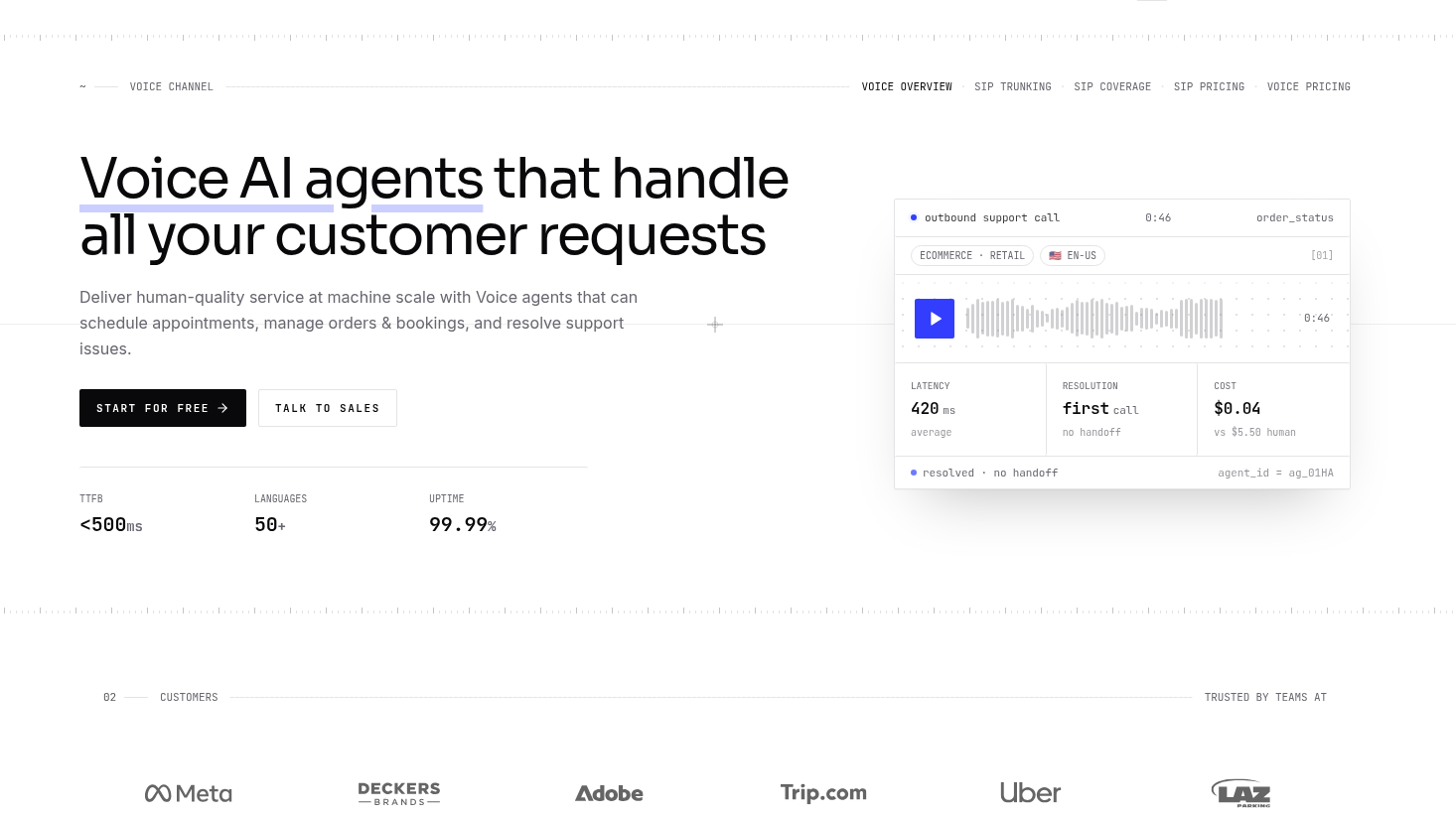
Plivo now offers Voice AI Agents. Underneath that, the classic programmable Voice API developers have used for over a decade is still live: outbound and inbound calling to PSTN and SIP endpoints, up to 1,000 destinations per bulk request, with call recording, transfer, and machine detection built in.
Key Features
- Voicemail and call transcription convert recorded audio into text with no separate integration
- Dynamic Caller ID sets the outbound number per call; it isn’t fixed account-wide
- A dedicated Voice AI Agents product along with the classic API for teams that want a conversational agent, not raw call control
Pros & Cons
PROS
CONS
Pricing
Pay-as-you-go telephony starts at $0.0010 per minute for outbound calls and $0.0028 per minute for inbound, over SIP trunking or audio streaming. The separate Voice AI Agents product bills a flat $0.04 per minute that bundles telephony, the language model, and transcription into one rate.
Sinch
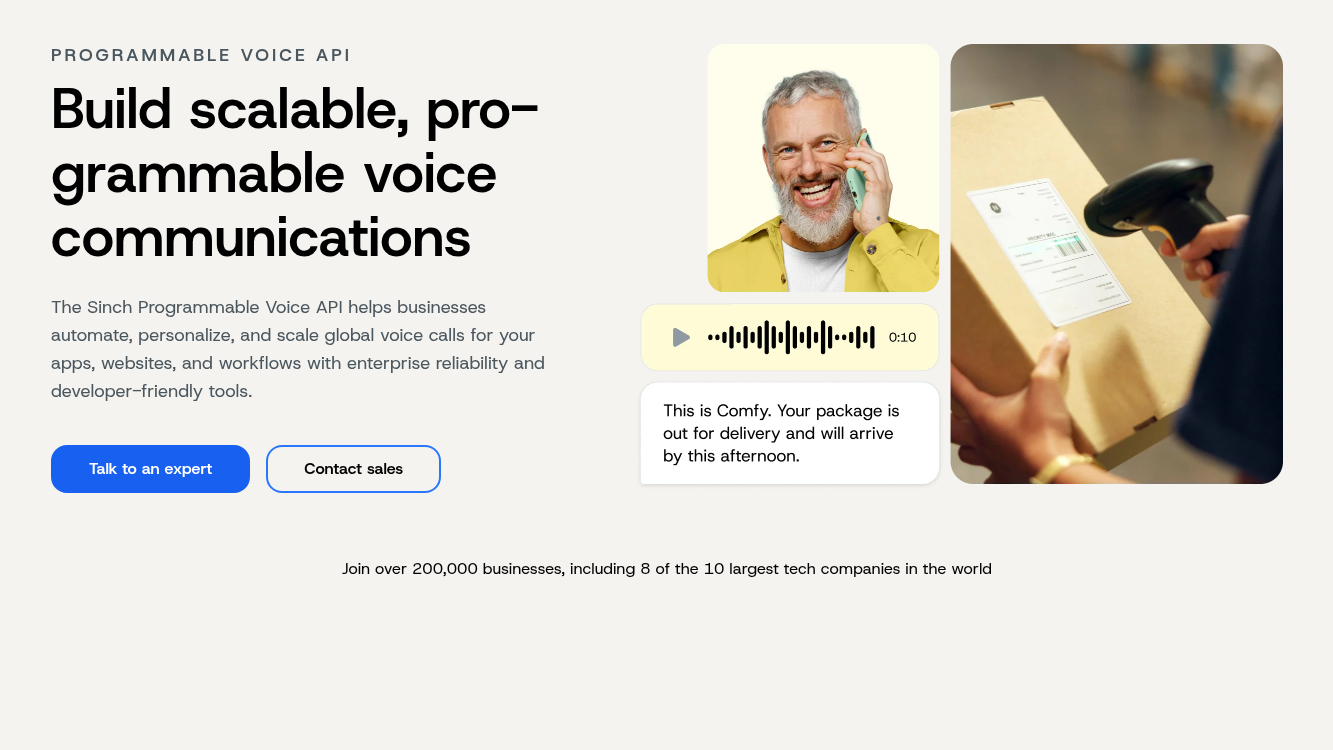
Sinch treats voice as one channel among several. Its Voice API is available on the same platform as SMS, WhatsApp, and email. That suits a team that wants one vendor relationship, not a voice specialist.
Key Features
- Number masking connects two parties without exposing either party’s real phone number, common in ride-hailing and delivery apps
- Voice-based IVR and recorded prompts bill per interaction, not folded into an opaque platform fee
- Secure Telephone Identity Revisited support helps calls avoid getting flagged as spam by carriers
Pros & Cons
PROS
CONS
Pricing
Sinch charges pay-as-you-go rates per call leg. No setup fee, no monthly number fee. The exact rate depends on the destination country, viewable through Sinch’s online pricing calculator after selecting a region.
Infobip
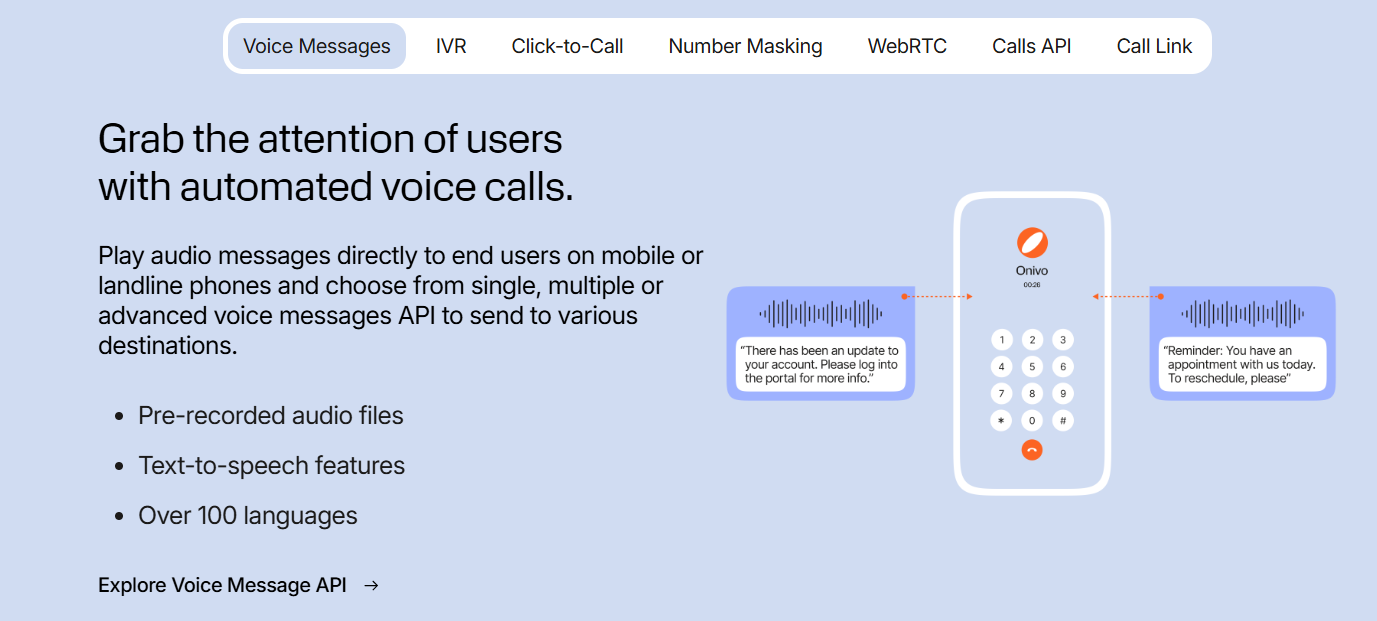
Infobip offers more than 60 APIs on one communications platform, and Voice is one of them. SMS, WhatsApp, email, and chat apps are part of the same platform. Network coverage reaches 195 countries, in 100+ languages.
Key Features
- Click-to-Call connects two outbound legs through a single API call, useful for connecting a website visitor to a sales rep
- Pre-recorded audio and text-to-speech voice messages support over 100 languages
- FCC STIR/SHAKEN and GDPR compliance apply automatically at the network level
- Detailed call reporting and roughly 50 webhook event types show call outcomes without custom logging
Pros & Cons
PROS
CONS
Pricing
Infobip doesn’t publish flat per-minute voice rates. They only show average prices across supported networks per country, with exact per-network pricing visible after signup. There’s no platform fee for API-only access. A 60-day free trial covers a limited number of test calls.
Agora
Agora specializes in ultra-low-latency real-time audio and video, not traditional PSTN telephony. It fits in-app voice calling, social audio rooms, and gaming voice chat best. It doesn’t dial real phone numbers.
Key Features
- AI noise suppression and 3D spatial audio make in-app calling sound more immersive than plain VoIP
- Real-time transcription generates live captions during a call
- The SDK spans Windows, macOS, Android, Web, Flutter, and Electron from one integration
- An Extensions Marketplace adds AI-powered noise cancellation and effects with no custom development
Pros & Cons
PROS
CONS
Pricing
Agora includes 10,000 free Standard voice minutes every month. Pay-as-you-go usage beyond that costs $0.99 per 1,000 minutes. Six subscription tiers run from $45.99 to $1,217.99 a month for higher committed volume.
SignalWire
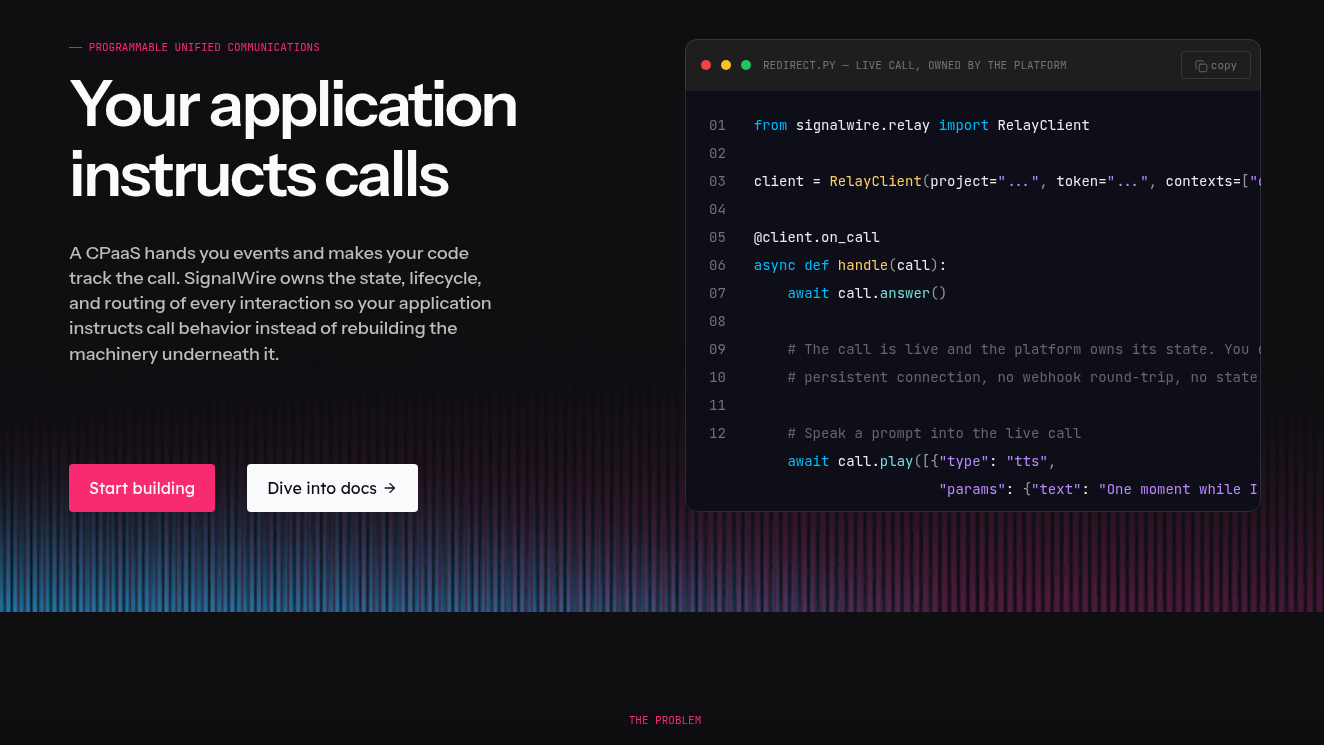
SignalWire builds on FreeSWITCH, the open-source telephony engine its own founders originally created in 2006. The same engine is available through a Relay API and SWML, SignalWire Markup Language, for writing call flows in code.
Key Features
- SWML describes a full call flow, AI voice agent logic included, as one JSON document; no chain of webhook calls needed
- A bundled AI Agent Runtime combines the language model, speech-to-text, and text-to-speech into one flat per-minute rate
- A Compatibility API mirrors Twilio’s TwiML syntax closely enough to ease a migration
Pros & Cons
PROS
CONS
Pricing
SignalWire’s AI Agent Runtime costs a flat $0.16 per minute, inclusive of the language model, speech-to-text, and text-to-speech.
Separately, SIP/WebRTC transport costs $0.0030 per minute, PSTN inbound $0.0066 per minute, and PSTN outbound $0.0080 per minute.
RingCentral
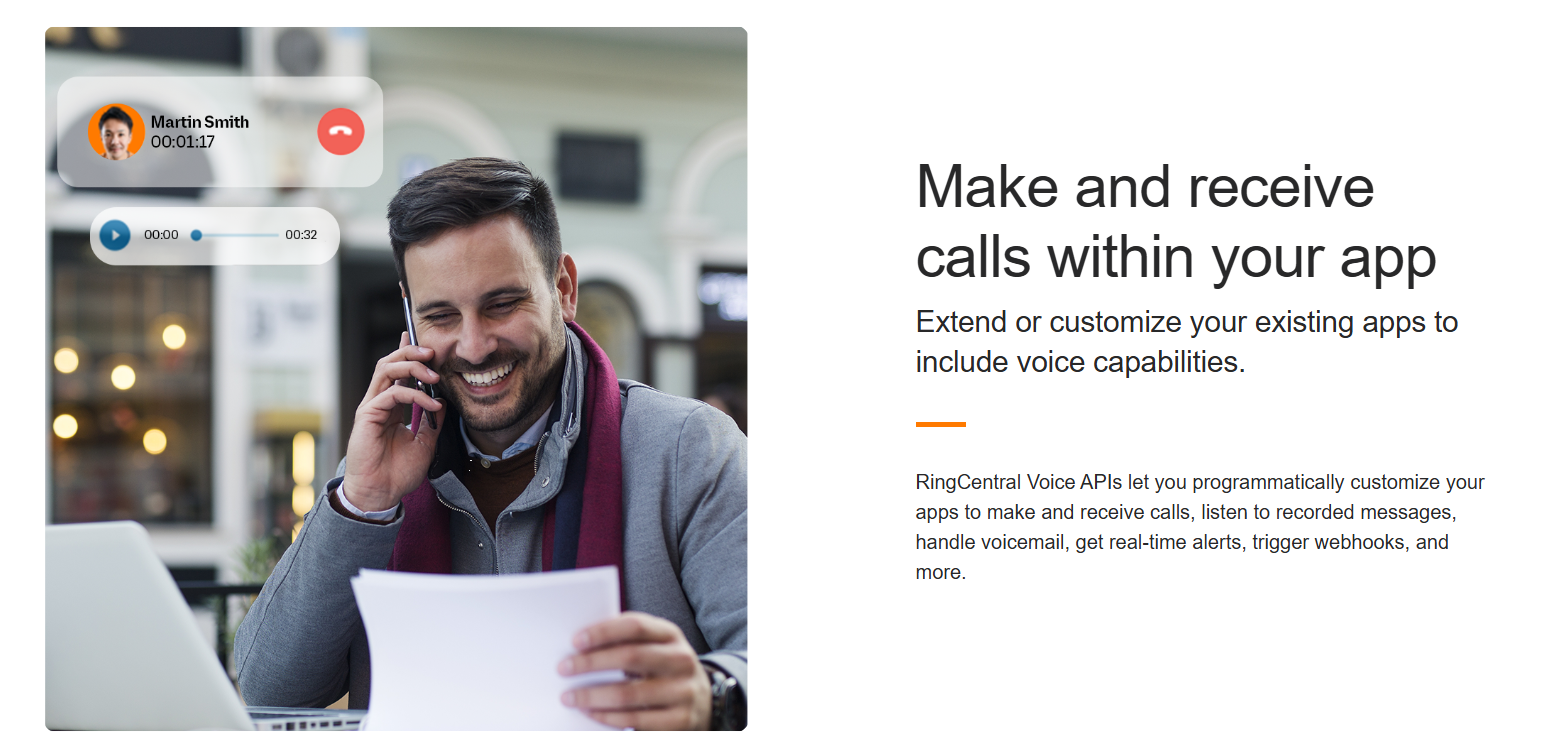
RingCentral‘s Voice API is one piece of a much bigger unified communications business. Developers get programmatic access to the same call routing, voicemail, and webhook events that power RingCentral’s own phone system product.
Key Features
- Presence monitoring reports whether a user is on a call, in a meeting, or set to Do Not Disturb
- The Call Log API exposes participant details, timing, and outcome for every call, alongside downloadable recordings
- Active calls can be recorded, muted, held, transferred, or parked programmatically; control isn’t limited to the start of a call
Pros & Cons
PROS
CONS
Pricing
RingCentral doesn’t publish standalone per-minute Voice API pricing. Access comes bundled with RingEX or RingCX plans. Current rates require talking to sales or checking an existing account’s plan details.
Telesign
Telesign made its name in phone number verification and fraud prevention. Its Voice API extends that same infrastructure to two-way calling: a one-time passcode delivered by voice or a support line that screens for International Revenue Share Fraud before connecting a call.
Key Features
- Automated traffic-pattern monitoring flags suspicious calling activity that could signal fraud
- Text-to-speech covers 26 languages and dialects for voice-delivered messages
- Phone number reformatting improves call deliverability across the 230-plus countries and territories Telesign supports
Pros & Cons
PROS
CONS
Pricing
Telesign doesn’t publish Voice API pricing. Its sales team quotes rates based on call volume, destination countries, and which features (recording, TTS, traffic monitoring) are included.
Sendbird
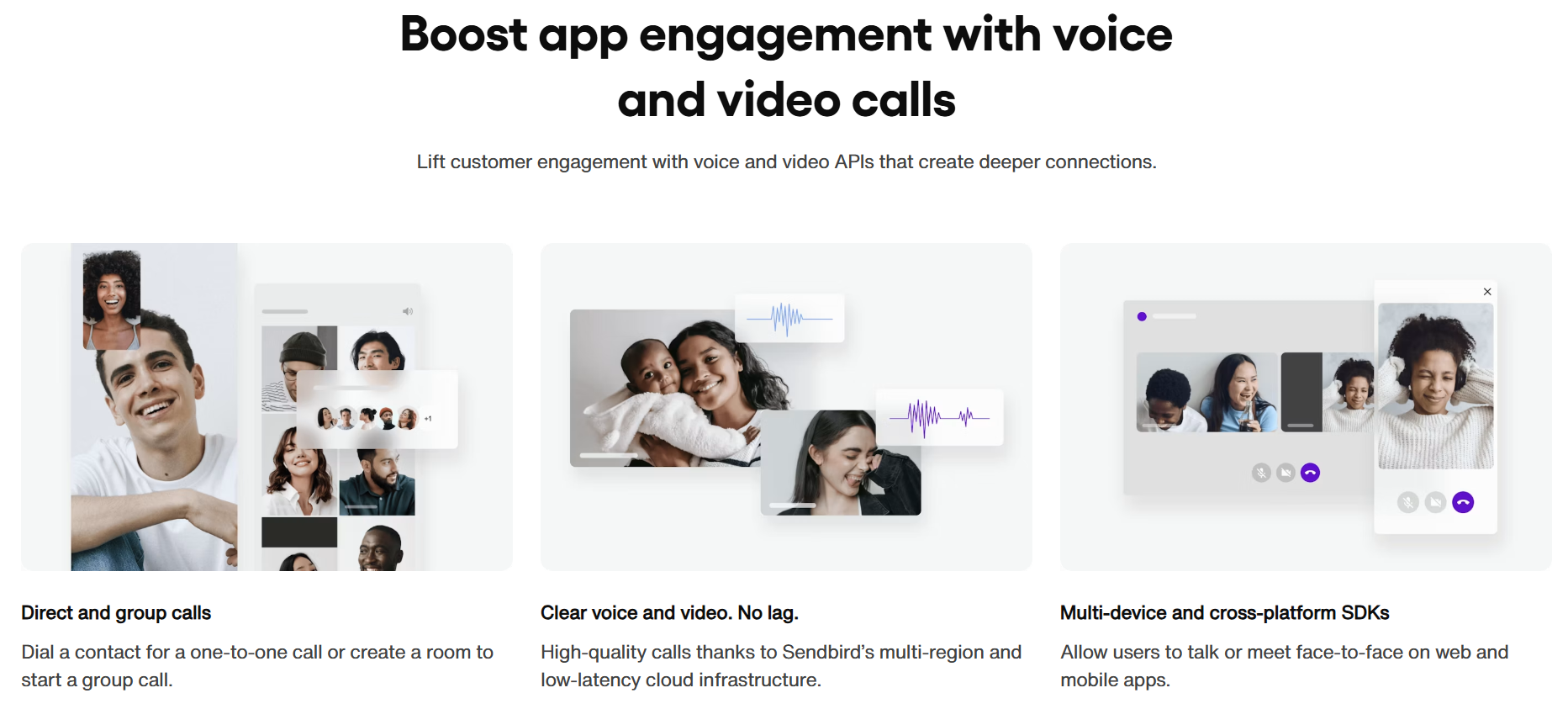
Chat made Sendbird‘s name, and more recently AI customer-support agents have too. Its Calls product is a real voice and video API with SDKs for iOS, Android, JavaScript, Unity, and React Native at the same scale as its messaging platform.
Key Features
- Server-side call analytics, call logs, metadata, and automated billing run through a separate platform API from the client SDKs
- Peer-to-peer and server-relayed connection modes trade cost against reliability on unstable networks
- HIPAA compliance is available as a paid add-on for healthcare use cases
Pros & Cons
PROS
CONS
Pricing
Peer-to-peer voice calls cost $0.0010 per minute per user, server-relayed calls $0.0015 per minute per user, and cloud recording $0.0014 per minute. Billing draws against a prepaid credit balance, with volume discounts applied automatically.
EnableX
EnableX serves banks, healthcare providers, logistics companies, and other regulated businesses that need strict control over where call data lives. It offers an on-premise deployment option most competitors here don’t.
Key Features
- On-premise deployment puts the entire voice stack, SIP trunking, and recording included, inside a customer’s own data center
- AI text-to-speech in 75-plus languages and number-to-word conversion for amounts and dates
- A Voice Streaming API forks live call audio to a WebSocket endpoint for real-time transcription or AI voice agents
Pros & Cons
PROS
CONS
Pricing
EnableX bills per minute per call leg, with inbound and outbound rates set separately for each destination country through its online pricing calculator. Virtual number rental is billed monthly and also varies by country. There are no setup fees and no minimum monthly commitment, and volume discounts apply once an account crosses 100,000 minutes a month.
ZegoCloud
Real-time engagement is ZegoCloud‘s focus, not telephony specifically. Its Voice Call API reflects that: social audio rooms, in-game voice chat, and audio conferencing for up to 10,000 participants. It doesn’t connect calls to the public phone network.
Key Features
- Prebuilt UIKits get a working voice-calling screen into an app in under 10 lines of code; lower-level SDKs handle full custom UI
- AI noise reduction isolates human speech from background noise automatically
- Support spans over 15,000 device models across Android, iOS, Web, React Native, and Flutter
Pros & Cons
PROS
CONS
Pricing
Voice calls cost $0.99 per 1,000 participant minutes after the first 10,000 free minutes on signup. Related services price separately: cloud recording at $0.59 per 1,000 minutes and live streaming at $0.39 per 1,000 minutes.
AI voice agent APIs
Everything above connects a call. A newer category of platform runs the conversation itself: an AI voice agent that understands what a caller says, decides how to respond, and speaks back, with no human and no scripted IVR tree in the loop. Several CPaaS providers above, Plivo, SignalWire, Telnyx, and Bandwidth among them, have added their own AI agent products, covered in their sections already. These four platforms build voice agents as their core product, not as an add-on:
- Vapi: a developer-first platform for building voice AI agents, letting teams pick their own language model, speech-to-text, and text-to-speech provider. Enterprise customers include Amazon Ring, Intuit, and ServiceTitan.
- Retell AI: charges nothing until a call happens, with pay-as-you-go pricing from $0.07 to $0.31 per minute depending on the language model and voice selected, and no annual contract.
- Bland AI: The language model, speech-to-text, and text-to-speech are available in one flat per-minute rate starting at $0.14.
- ElevenLabs (Eleven Agents): known for realistic text-to-speech, and extends that technology into full conversational agents that can work over a phone call or an in-app chat.
How to Choose a Voice Call API?
Start with what the call needs to reach. A real phone number, a customer’s mobile line or a landline, means you need a PSTN-capable provider: Twilio, Vonage, Bandwidth, Telnyx, Plivo, Sinch, Infobip, SignalWire, RingCentral, Telesign, and EnableX all connect to the public phone network.
Agora and ZegoCloud connect app users to each other over the internet instead. That suits social audio, in-game voice, and internal team calling. It doesn’t dial an outside phone number.
Coverage and compliance narrow the list further. A regulated healthcare or financial product needs a confirmed HIPAA, SOC 2, or on-premise deployment. That rules out providers where compliance is not a current feature. EnableX’s on-premise option and Bandwidth’s carrier-owned network can be considered for these use cases.
Pricing model matters as much as the headline rate. Twilio, Bandwidth, and Telnyx publish a flat per-minute rate. Vonage, Sinch, and Infobip need a country picked in an interactive tool or an account created before a real number appears. That’s fine for evaluation but can require extra time during a proof of concept. Telesign and RingCentral don’t publish rates at all.
If you also require a conversational agent, you can consider Vapi and Retell AI. They suit teams that want to choose their own AI models and see costs broken down by component. Bland AI’s bundled per-minute rate trades that flexibility for predictability. Several CPaaS providers above, Plivo, SignalWire, Telnyx, and Bandwidth especially, now sell a first-party AI agent option where you can use the same account and phone numbers as the core Voice API. Worth checking before adding a second vendor just for that.
Frequently Asked Questions
What’s the difference between a voice API and a call center platform?
A voice API is a building block: code that makes, receives, and controls phone calls. A call center platform, RingCentral’s RingEX or Genesys for example, is a finished product for agents to use directly: dashboard, queues, and reporting already built. Several providers here, RingCentral included, sell both. The Voice API is the piece a developer uses to extend or automate what the finished product already does.
Do I need new phone numbers, or can I keep my existing number?
Most providers port an existing number in. Several, Bandwidth, Telnyx, and SignalWire among them, also support SIP trunking. That connects the API to numbers still hosted on another carrier or an on-premise PBX, no full port required. Number-porting timelines vary by country and carrier, generally a few days to a few weeks for US numbers.
Why do some of these providers not publish per-minute pricing?
Infobip, RingCentral, and Telesign price by contract, not a public rate card. Their rates usually depend on call volume, destination mix, or which bundled features (compliance or dedicated support) an account needs. That doesn’t necessarily make them more expensive than the providers with flat published rates. It just makes them less transparent before signing up.
Can I switch voice API providers later without rewriting my whole call flow?
Partially. Core actions like dialing, hanging up, and playing audio map fairly directly between providers. But each one speaks its own call-flow language: TwiML for Twilio, SWML for SignalWire, XML for Plivo. SignalWire’s Compatibility API specifically targets teams migrating off Twilio, accepting TwiML-like syntax. That’s the smoothest path among the providers here if a future switch is a real concern.
Are AI voice agents going to replace CPaaS voice APIs?
Not really. They depend on them. Every AI voice agent still needs a way to actually place and receive the call, and that’s the CPaaS layer underneath. Bland AI, for instance, connects through a customer’s own Twilio account or SIP trunk. The real question when choosing is whether the project needs raw call control to build custom logic, or a pre-built layer that decides what to say next and speaks the reply itself.