


A cryptocurrency API delivers structured data or trading access to your code instead of you scraping an exchange’s website or running your own blockchain node. Depending on what you’re building, that might mean a live price feed, years of historical OHLCV data, a direct order-execution endpoint on an exchange, or decoded on-chain activity like wallet balances and DEX trades.
Those are three different jobs, and mixing them up is the easiest way to pick the wrong API.
- Market-data APIs such as CoinGecko or CoinMarketCap answer “what is this coin worth.”
- Exchange APIs such as Binance, Coinbase, or Kraken answer “place this trade.”
- On-chain APIs such as Moralis, Etherscan, or Bitquery answer “what actually happened on this blockchain.”
In this guide, I have discussed four options in each category.
Every API below has public documentation and a self-serve way to get a key today.
Cryptocurrency APIs at a Glance
| API | Category | Free tier | Paid from | Best fit |
|---|---|---|---|---|
| CoinGecko | Market data | 10k calls/day, attribution required | $35/mo | Independent price data with on-chain DEX coverage |
| CoinMarketCap | Market data | 15,000 credits/mo, commercial use allowed | $29/mo | Free tier you can actually ship in a commercial product |
| Coinpaprika | Market data | 20,000 calls/mo, personal use only | $99/mo | Budget historical data for non-commercial projects |
| CoinAPI.io | Market data | $25 in free credits | $79/mo | Institutional and quant-grade tick data |
| Coinbase Advanced Trade | Exchange trading | Free with an account | Trading fees only | Building on a regulated US exchange |
| Binance API | Exchange trading | Free with an account | Trading fees only | Highest-volume global exchange |
| Kraken API | Exchange trading | Free with an account | Trading fees only | Spot, derivatives, and institutional OTC/custody |
| KuCoin API | Exchange trading | Free with an account | Trading fees only | Broad pair coverage with VIP-tiered limits |
| Moralis | On-chain data | None | $149/mo | Wallet, token, NFT, and DeFi data in one API |
| Etherscan API | On-chain data | 100k calls/day, ~90% chain coverage | $49/mo | Familiar block-explorer data across 60+ chains |
| Bitquery | On-chain data | 7-day trial with live streaming | $39/mo | One GraphQL schema across 40+ chains |
| NOWNodes | On-chain data | 100,000 requests, one-month trial | Custom, by volume | Shared or dedicated RPC nodes across 120+ chains |
In the sections below, I have covered each API’s data or execution scope, how you access it, and current pricing.
CoinGecko
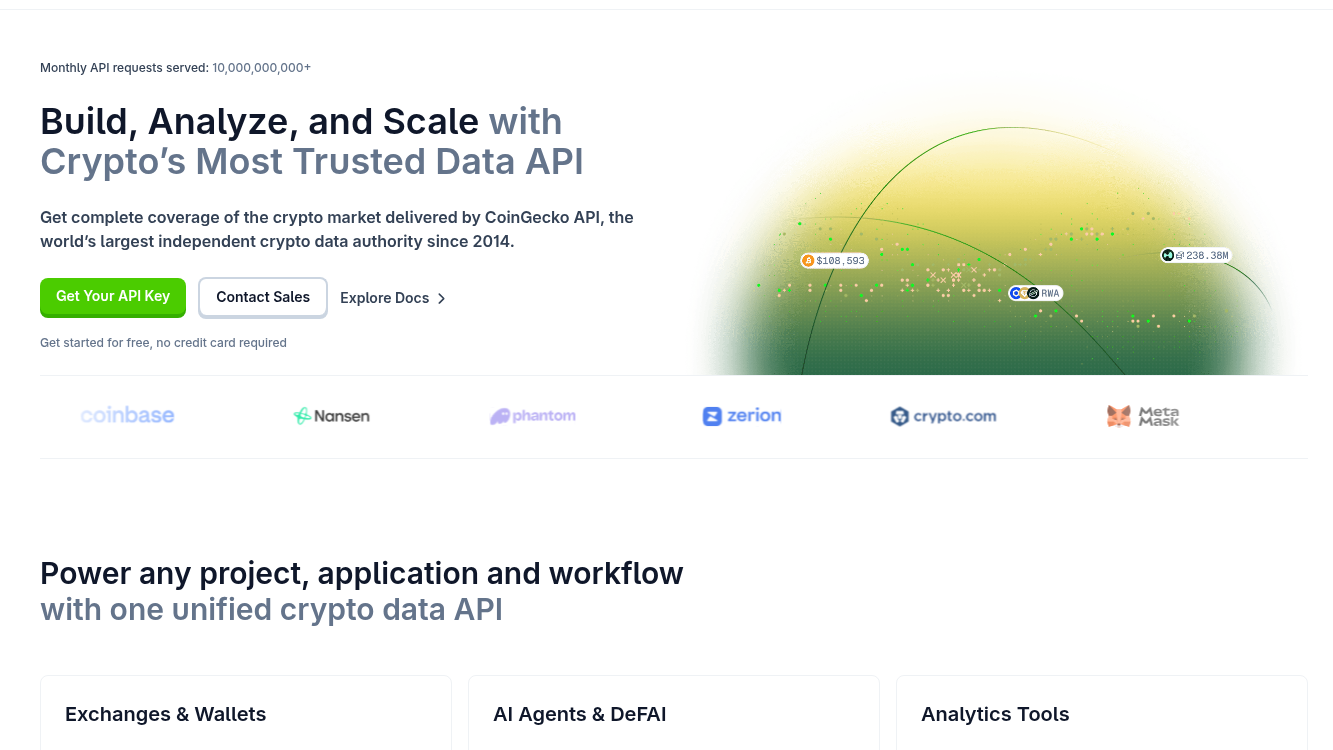
CoinGecko tracks more than 21,000 coins across upward of 1,400 exchanges without being owned by any exchange itself, which keeps its incentives on data accuracy rather than trade volume. It’s used at production scale by Consensys, Chainlink, Coinbase, Ledger, and Etherscan, among others.
Pricing follows a flat credit model: one API call always costs one credit, regardless of how much data comes back.
Key Features
- On-chain DEX data across 220-plus blockchain networks and 1,000-plus decentralized exchanges via Gecko Terminal
- Up to 12 years of historical daily and hourly price, market cap, and volume data
- WebSocket streaming for low-latency real-time price updates
- Security signals per token, including holder distribution and mint/freeze authority
- Community and development-activity metrics beyond raw price and volume
Pros & Cons
PROS
CONS
Pricing
Demo: free, 10,000 calls/month, 100 calls/minute, attribution required.
Basic: $35/mo ($29/mo billed annually), 100k calls/month, commercial use.
Analyst: $129/mo ($103.2/mo annually), 500k calls/month, 10-year history.
Lite: $499/mo ($399.2/mo annually), 2M calls/month.
Enterprise: custom pricing and limits.
CoinMarketCap
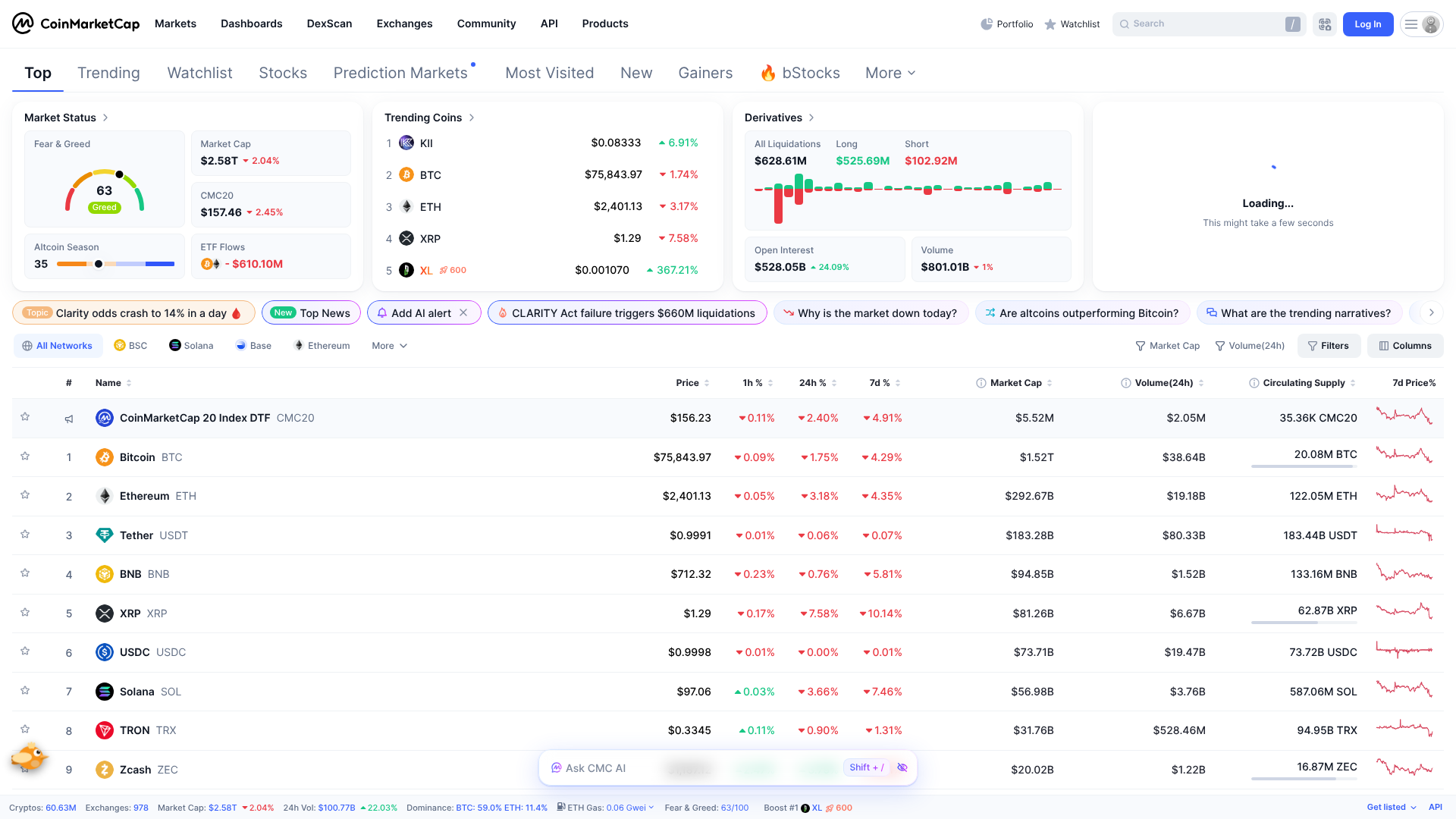
CoinMarketCap, owned by Binance, is one of the most widely recognized crypto price trackers, and its free Basic API tier explicitly permits commercial use, unlike most free tiers in this list that only cover personal or evaluation use.
Along with the standard exchange-reported market data, CoinMarketCap maintains a separate DEX API for on-chain token and liquidity-pool data. A keyless public endpoint also needs no signup for a curated set of requests.
Key Features
- Keyless public API subset requiring no signup for basic quote and listing data
- Separate DEX API for on-chain pool, liquidity, and token-security data
- ISO/IEC 27001 and 27701 certified infrastructure across every plan, not just Enterprise
- Global metrics endpoints, including the CMC Fear and Greed Index and Altcoin Season Index
- x402-enabled endpoints charge 0.01 USDC per call for AI-agent access; no subscription required
Pros & Cons
PROS
CONS
Pricing
Basic: free, 15,000 credits/month, 50 requests/minute, commercial use allowed.
Builder: $29/mo.
Startup: $79/mo.
Growth: $299/mo.
Professional: $699/mo.
Enterprise: custom limits and license terms.
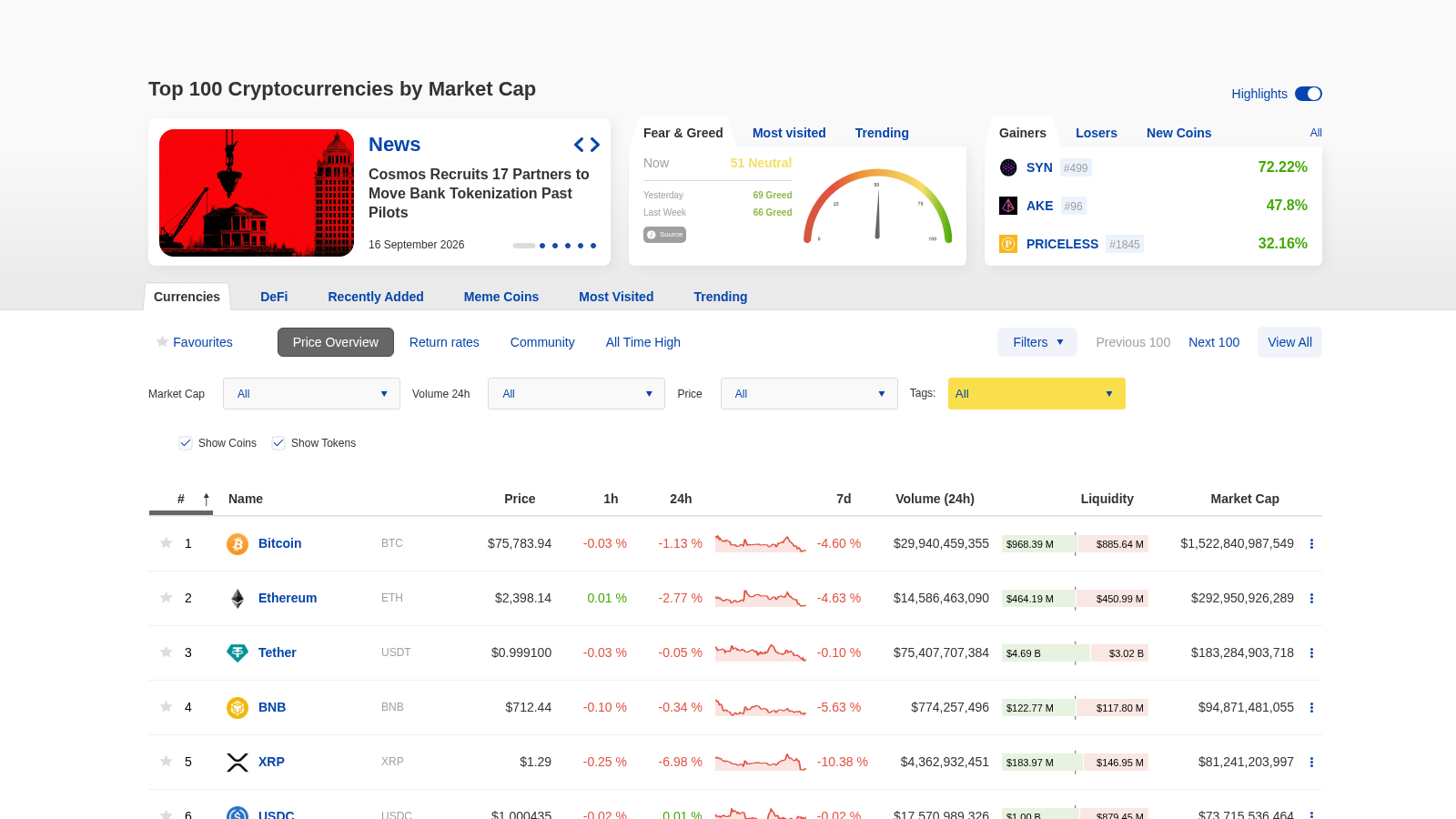
Coinpaprika
Coinpaprika covers 2,000 assets on its free tier, scaling to full market coverage on paid plans, and positions itself as a direct alternative for teams comparing it against CoinMarketCap.
Its free access is capped at personal, non-commercial projects; anything shipped commercially needs at least the Starter paid plan.
Key Features
- API-mappings endpoint that translates IDs from other providers, such as CoinGecko or CoinMarketCap, into Coinpaprika’s own IDs
- Hourly and 5-minute historical granularity on the higher paid tiers
- Crypto payment accepted on annual Business plans and above
- WebSocket streaming, reserved for the Enterprise plan
Pros & Cons
PROS
CONS
Pricing
Free: $0, 20,000 calls/month, personal and non-commercial use only.
Starter: $99/mo, 400k calls/month, 5-year daily history, commercial use.
Pro: $199/mo, 1M calls/month, full history.
Business: $799/mo, 5M calls/month.
Ultimate: $1,499/mo, 10M calls/month.
Enterprise: custom, includes SLA and redistribution rights.
CoinAPI.io
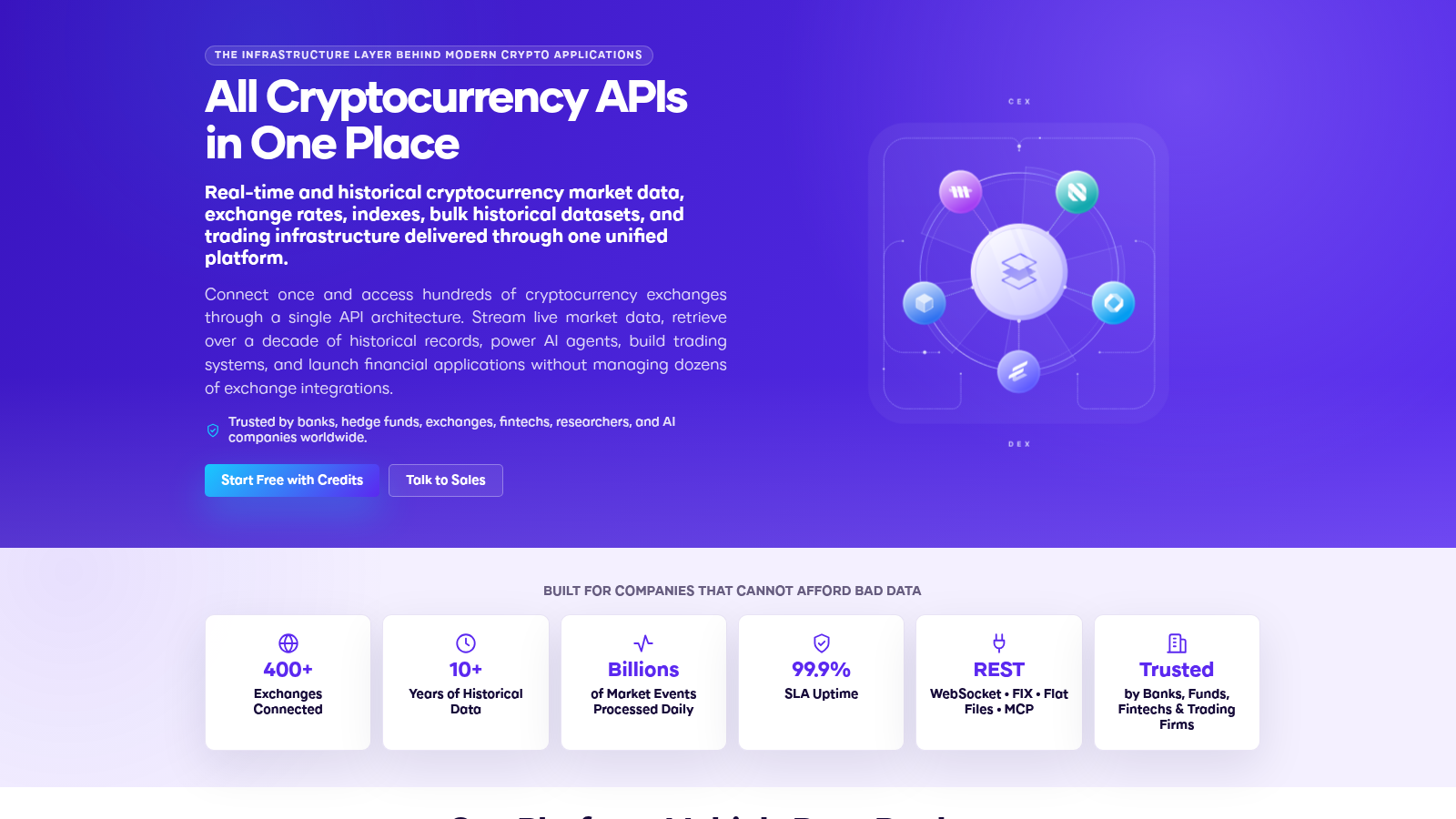
CoinAPI.io is built for institutional and quant use, connecting to more than 400 exchanges with over a decade of tick-level historical data. It’s marketed directly at banks, hedge funds, and trading firms, not hobbyist projects.
Billing works by metered usage: the per-credit rate drops automatically as daily volume climbs, so there is no single flat monthly quota to plan around.
Key Features
- FIX protocol access from the Pro plan up, unusual among developer-oriented crypto data APIs
- Separate Indexes API and downloadable flat files for bulk historical backfills
- An MCP server for AI-agent access to market data
- REST, WebSocket, and JSON-RPC protocols are available depending on the plan
Pros & Cons
PROS
CONS
Pricing
Pay As You Go: free $25 in credits, then metered from $5.26 down to $0.03 per 1,000 credits/day by volume.
Startup: $79/mo, 1,000 REST credits/day.
Streamer: $249/mo, 10,000 credits/day.
Pro: $599/mo, 100,000 credits/day, FIX API.
Enterprise: custom.
Coinbase Advanced Trade API
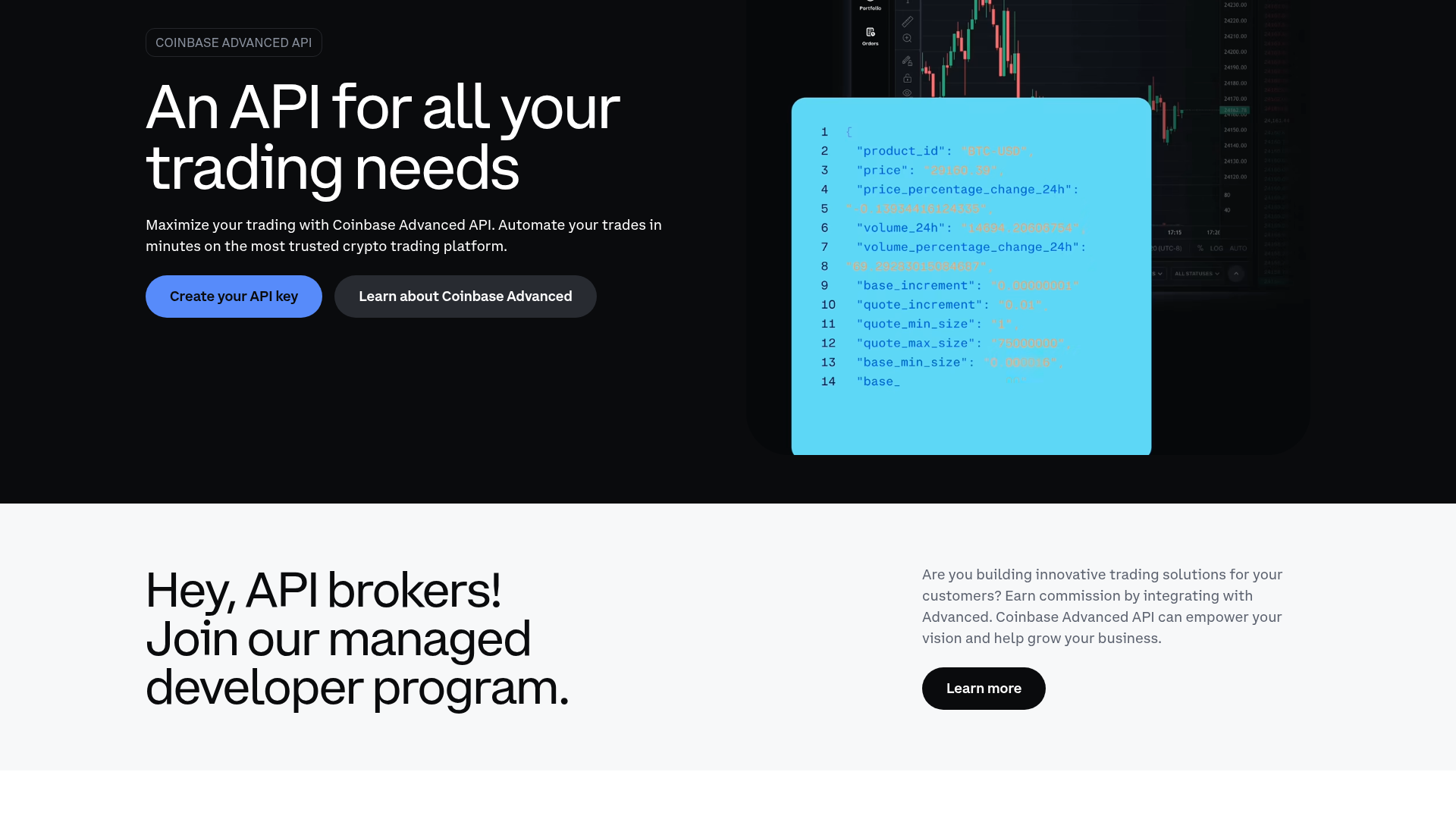
The Coinbase Advanced Trade API is Coinbase’s current programmatic trading interface, replacing Coinbase Pro, which was retired in 2022. It gives direct order placement and account management against one of the more heavily regulated US exchanges.
It’s part of the wider Coinbase Developer Platform, which shares the same API-key infrastructure with Coinbase’s wallet and onchain tooling.
Key Features
- REST API for order placement, cancellation, and account or portfolio management
- WebSocket feed for live market data and order-status updates
- Shares infrastructure with the broader Coinbase Developer Platform, including wallet and on-chain products
Pros & Cons
PROS
CONS
Pricing
No subscription; API access (REST and WebSocket) is free with any Coinbase account.
Coinbase charges standard maker/taker trading fees on executed orders, tiered by 30-day trading volume per its published fee schedule.
Binance API
Binance operates the highest-volume centralized exchange globally, and its API gives direct access to spot, margin, and futures trading alongside live market data, at no separate subscription cost. Rate limiting is IP-based and weight-driven: the shared limit across all endpoints was raised from 1,200 to 6,000 request-weight per minute in 2023.
Key Features
- Separate REST APIs for spot, margin, futures, and wallet operations
- WebSocket streams for order books, trades, and account updates
- Official SDKs maintained across multiple languages through the Binance Developer Center
Pros & Cons
PROS
CONS
Pricing
No subscription; the API is free with an account.
Costs come from standard spot and futures trading fees, tiered by 30-day trading volume and VIP level per Binance’s published fee schedule.
Kraken API
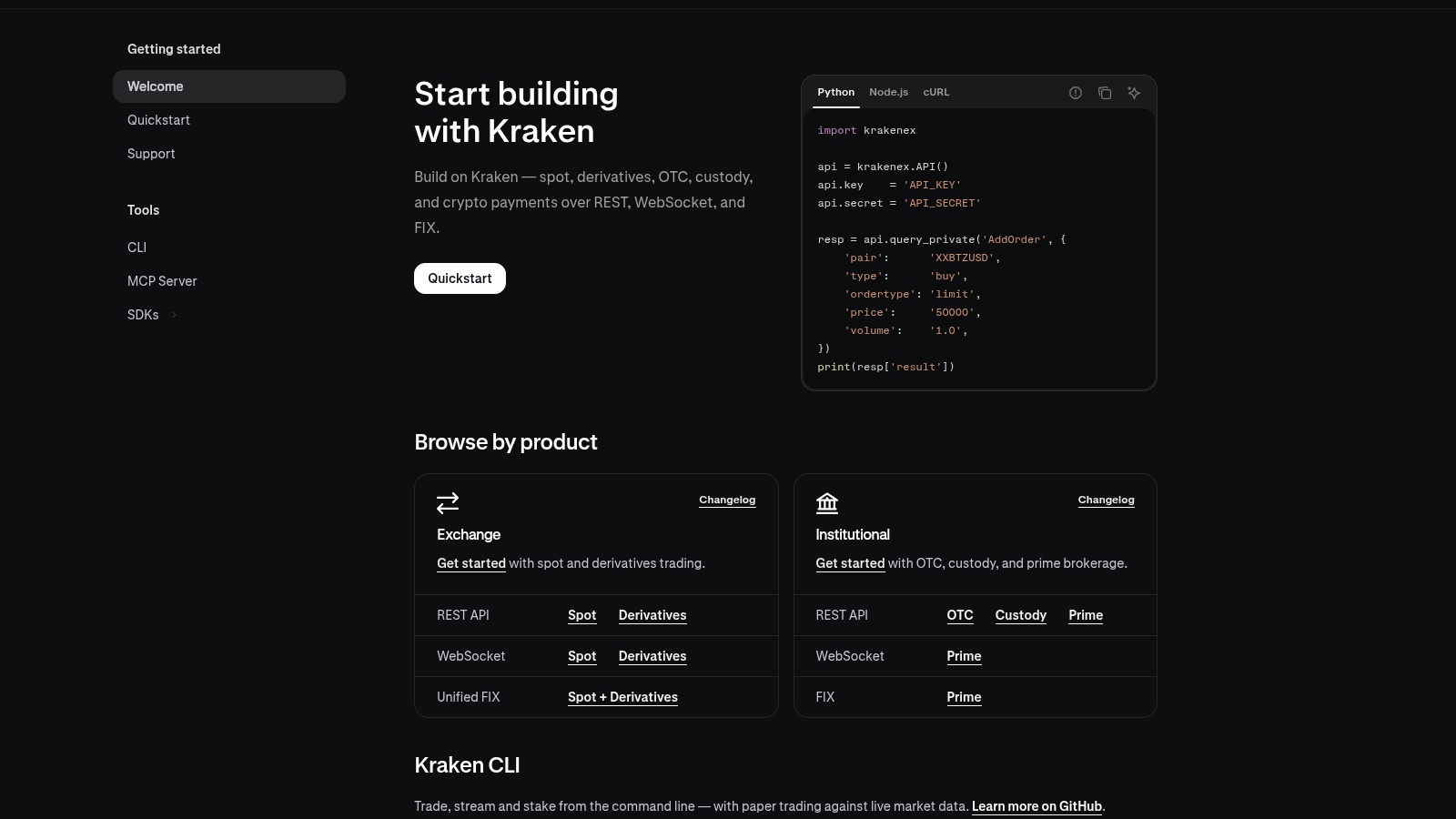
The Kraken API covers spot and derivatives trading over REST, WebSocket, and FIX, plus a separate institutional line for OTC, custody, and prime brokerage on larger accounts.
Rate limits scale with account verification tier, not a paid subscription tier, and Kraken renamed its tiers in December 2025: Intermediate and Pro are now called Standard verification and Verified with higher limits.
Key Features
- Separate Exchange (spot plus derivatives) and Institutional (OTC, custody, prime brokerage) API lines
- Official Kraken CLI for trading, streaming, and staking from the command line
- Paper trading against live market data, usable through the CLI before risking funds
Pros & Cons
PROS
CONS
Pricing
No subscription; the API is free with an account.
Rate limits scale with verification tier (Starter, Standard verification, or Verified with higher limits), not a paid plan.
Trading fees follow Kraken’s standard maker/taker schedule.
KuCoin API
The KuCoin API mirrors the breadth of one of the larger global exchanges by listed pairs, covering spot, margin, and futures trading plus market data, with rate limits that scale by account VIP level. On August 27, 2026, KuCoin overhauled its Management API rate limits, replacing per-UID limits with a unified master-sub account model.
Key Features
- REST and WebSocket access across spot, margin, and futures markets
- Official SDKs in multiple languages through KuCoin’s developer documentation
- Unified master-sub account rate-limit model as of the August 2026 update
Pros & Cons
PROS
CONS
Pricing
No subscription; the API is free with an account.
REST and WebSocket rate limits scale with VIP level.
New sub-accounts default to 10 requests/second under the unified master-account rate-limit model introduced in August 2026.
Moralis
Moralis packages wallet, token, NFT, price, and DeFi data behind one API and one Compute-Unit billing model, across 20-plus chains including Ethereum, Solana, Base, and Bitcoin.
Moralis says its Wallet API needs fewer calls than general-purpose node providers to build the same portfolio view, since it’s built specifically around common wallet queries, not raw RPC calls.
Key Features
- Wallet, Token, NFT, Price, DeFi, and Blockchain APIs under one key
- Streams product pushes real-time on-chain events for a wallet, contract, or address as they happen
- SOC 2 Type II certified
- RPC node access is included at every paid tier, not sold separately
Pros & Cons
PROS
CONS
Pricing
Starter: $149/mo billed annually, 2M compute units/month, 40 requests/second.
Pro: $249/mo billed annually, 100M CU/month, 80 req/sec, premium endpoints.
Business: $749/mo billed annually, 500M CU/month, 200 req/sec.
Enterprise: custom limits and SLA.
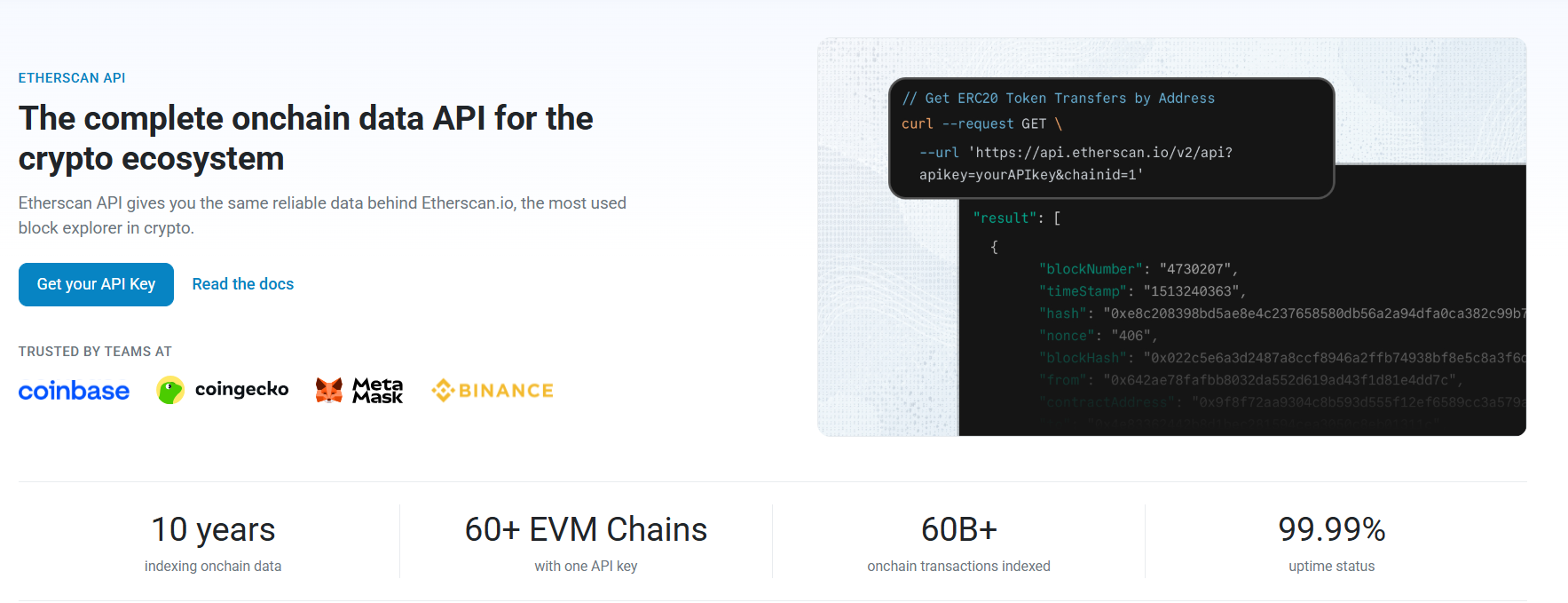
Etherscan API
The Etherscan API positions itself as one API for 60-plus blockchains, not just Ethereum, putting the same block-explorer data developers already recognize behind a tiered subscription; longtime users may remember it as mostly free.
The free tier is still usable, covering roughly 90 percent of supported chain IDs, but the additional API Pro analytics endpoints are reserved for paid plans.
Key Features
- Transaction, balance, contract, and log data across 60-plus chains under one key
- API Pro endpoints add address metadata and analytics access from the Standard plan up
- Free tier covers roughly 90 percent of supported chain IDs
Pros & Cons
PROS
CONS
Pricing
Free: $0, 3 calls/sec, 100,000 calls/day, ~90% chain coverage.
Lite: $49/mo, 5 calls/sec, all chains.
Standard: $199/mo, 10 calls/sec, API Pro endpoints.
Professional: $399/mo, 30 calls/sec, 1M calls/day.
Higher tiers (Advanced, Pro Plus, Metadata Enterprise, Dedicated) scale further on request.
Bitquery
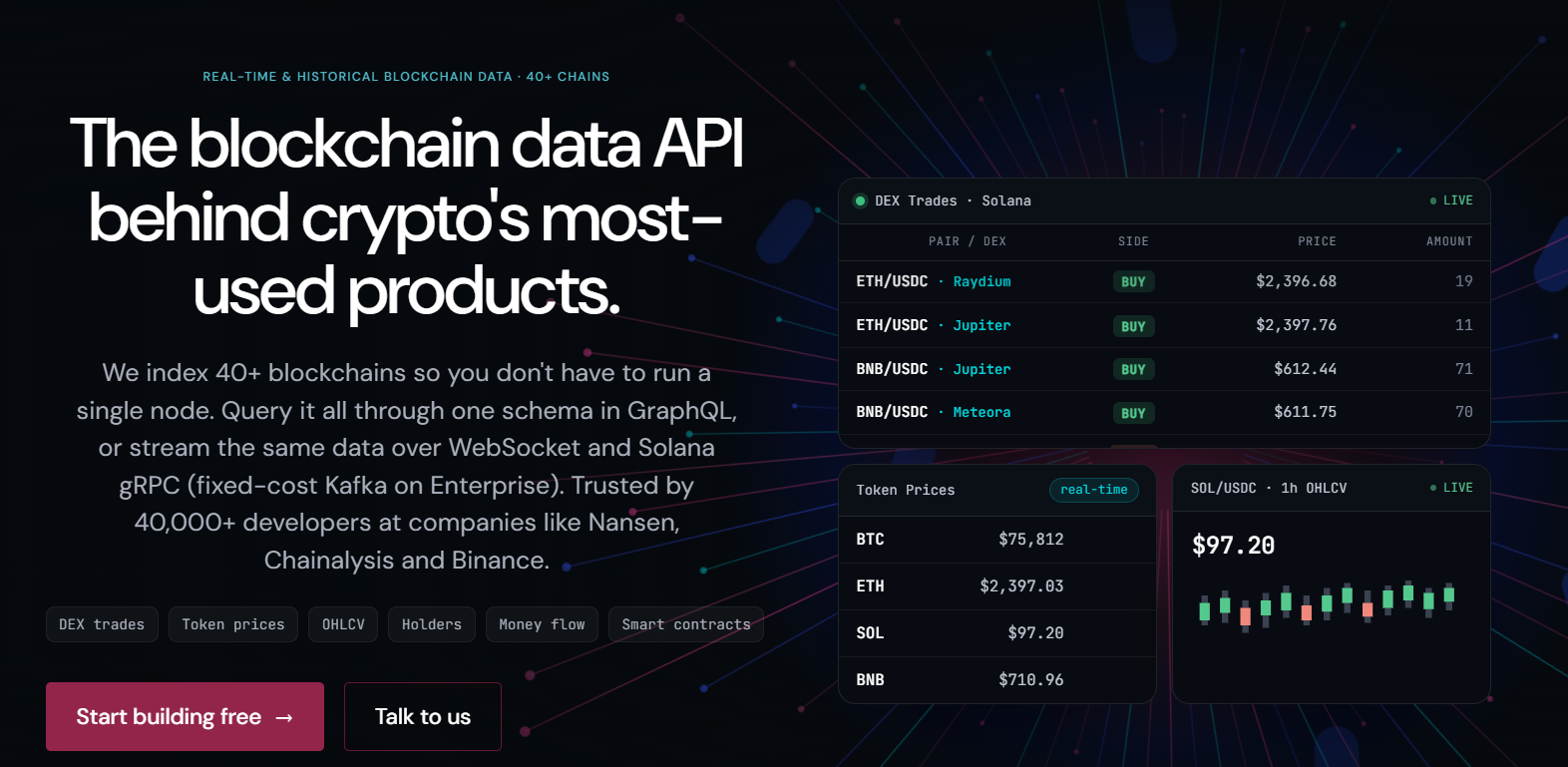
Bitquery indexes more than 40 blockchains into one GraphQL schema, decoding trades, transfers, and contract events so you query structured data instead of parsing raw blocks yourself.
Every self-service plan also decodes Polymarket, Hyperliquid, and Phoenix activity, covering prediction market perpetuals and standard chain data.
Key Features
- One GraphQL schema spans EVM chains, Solana, Tron, and more, so query shape stays the same across chains
- Live WebSocket streaming for trades, mempool activity, and DEX events on Pro and above
- Coinpath money-flow tracing and address-label data for compliance and investigation use cases
- An MCP server that lets AI agents query on-chain data in plain English
Pros & Cons
PROS
CONS
Pricing
Personal: $39/mo billed annually, 100k points (~20k calls)/month, no streaming, personal use only.
Pro: $79/mo billed annually, 1M points, streaming on 10 core chains, commercial use.
Scale: $239/mo billed annually, 5M points.
Enterprise: custom, unlimited streaming.
Historical/archive data is a separate add-on from $70-150/mo per chain on every plan.
NOWNodes
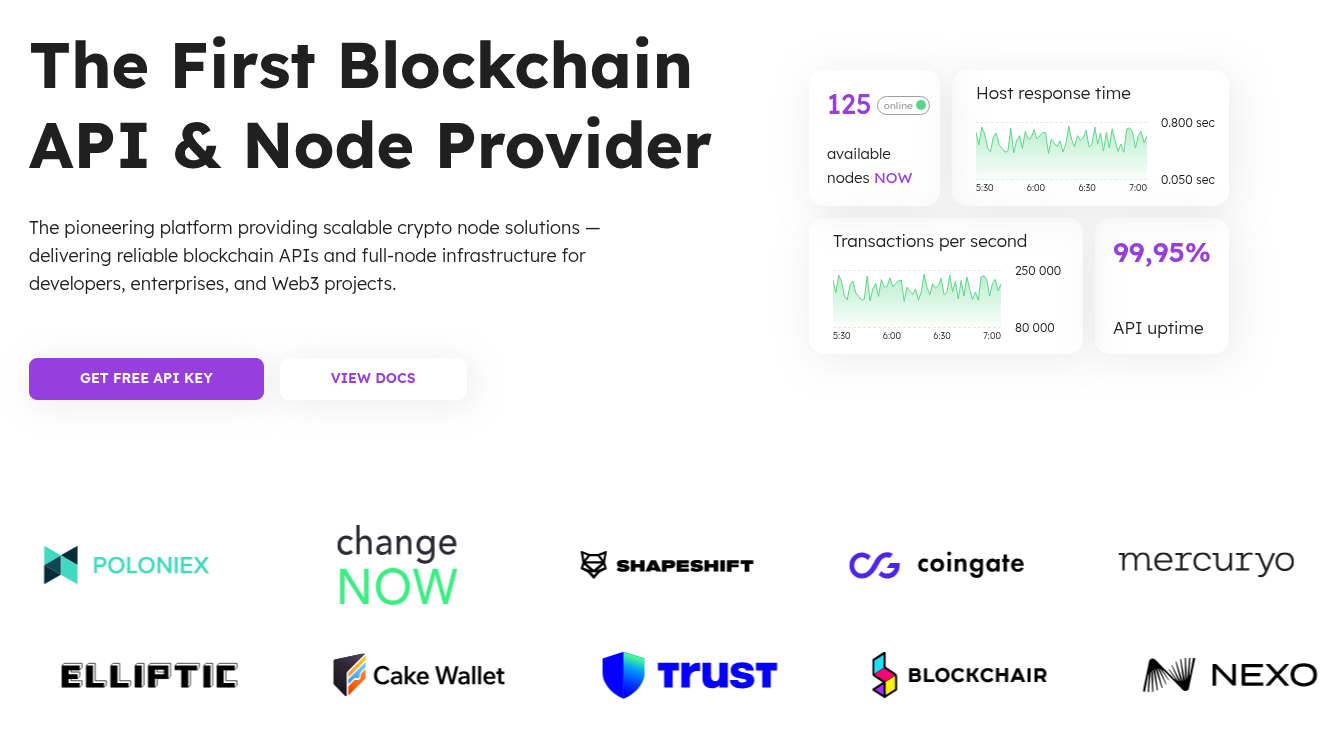
NOWNodes gives shared or dedicated RPC node access across more than 120 blockchain networks, for teams that want node infrastructure without running and maintaining their own. Its infrastructure is GEO-balanced to keep response times low across the US and Europe. Block explorers and a market-data add-on are sold under the same key.
Key Features
- Shared and dedicated node tiers, plus block explorers and a market-data add-on under one key
- gRPC and MCP server access with standard JSON-RPC and WebSocket
- GEO-balanced infrastructure targeting low latency in the US and Europe
Pros & Cons
PROS
CONS
Pricing
Start: free trial, 100,000 requests for one month.
Paid tiers (Pro through Enterprise) scale from 1,000,000 up to 100,000,000 requests/month.
Overage above Pro Plus runs roughly €0.50 to €5 per 100,000 extra requests depending on tier; check NOWNodes’ pricing page for current per-tier subscription cost.
How to Choose a Cryptocurrency API
Start by naming the job, not the coin. If the product needs to show a price, a market cap, or a portfolio value, CoinGecko or CoinMarketCap cover most projects, and CoinAPI.io is the better fit once you need institutional-grade tick data or FIX connectivity.
If the product needs to place or manage a trade, you want an exchange API directly, since Binance, Coinbase, and Kraken all expose trading through their own developer portals, not a third-party data reseller.
If the product needs to read what actually happened on a chain, such as wallet balances, NFT ownership, or DeFi positions, that’s on-chain data, and Moralis or Etherscan will get you there faster than running your own node.
CoinMarketCap’s Basic plan explicitly allows commercial use at no cost, which is unusual. CoinGecko’s free Demo plan requires visible attribution. Coinpaprika’s free tier is personal and non-commercial only, so a paid Starter plan is the real starting point for anything you plan to ship. Read the license terms on the pricing page, not only the rate limit, before building a business on a free key.
The four on-chain options here solve the same broad problem in different ways. Moralis and Bitquery abstract the blockchain into a higher-level API or schema, so you never touch raw RPC calls. Etherscan exposes the same explorer data millions of developers already know, now sold across 60-plus chains instead of just Ethereum. NOWNodes operates one layer lower, giving you the node itself, not a processed API layered on top, which matters if your application needs raw RPC access, not pre-decoded events.
None of the four exchange APIs charge a subscription fee. Binance, Coinbase, Kraken, and KuCoin all make their API free with an account. The real cost is the trading fee on whatever you execute, and for higher throughput, completing that exchange’s account verification rather than upgrading a plan.
FAQs
What’s the difference between a market-data API, an exchange API, and an on-chain API?
A market-data API such as CoinGecko or CoinMarketCap reports prices, volume, and market cap aggregated from exchanges. An exchange API such as Binance, Coinbase, or Kraken lets you place and manage trades directly on that exchange. An on-chain API such as Moralis, Etherscan, or Bitquery reads data recorded on the blockchain itself, wallet balances, NFT ownership, DeFi positions, and transaction history, independent of any single exchange.
Can I use a free cryptocurrency API tier in a commercial product?
It depends on the provider. CoinMarketCap’s free Basic tier explicitly allows commercial use. CoinGecko’s free Demo tier is usable commercially but requires visible attribution. Coinpaprika’s free tier is personal and non-commercial only, so a paid plan is required before shipping. Check the license terms on the provider’s own pricing page, not only the rate limit, before building a commercial product on a free key.
What happened to Nomics and Cryptowatch?
Nomics shut down its cryptocurrency market-data API on April 4, 2023, and the service never returned. Cryptowatch, owned by Kraken, was discontinued as a standalone product, with its charting and market-data features folded into Kraken Pro. Neither is a working option today; CoinGecko, CoinMarketCap, or Coinpaprika are the closest current replacements for market data, and Kraken Pro itself for charting.
Do exchange APIs like Binance or Coinbase charge for API access?
No. Binance, Coinbase Advanced Trade, Kraken, and KuCoin all provide API access free with a standard account. The cost comes from the exchange’s own trading fees on whatever orders you execute, not from a separate API subscription, and higher rate limits typically come from completing the exchange’s account verification, not from paying for a plan.
Is there a free way to get real-time cryptocurrency data?
Yes, in a few forms. CoinMarketCap’s free Basic plan updates every 60 seconds and allows commercial use. Bitquery’s 7-day trial includes full live WebSocket streaming across 40-plus chains. And every exchange API here, Binance, Coinbase, Kraken, and KuCoin, provides real-time market data over WebSocket at no cost, since that access comes with the account, not a separate paid data plan.