



A news API delivers news as structured JSON, not a web page. You send a request that describes what you want: a keyword, a topic, a named source, a language, a country, a date range. The response is a list of articles, each carrying a headline, a summary or the full text, a publication date, the source name, an author, a link, and usually an image.
That output feeds on a lot of different products.
- A media-monitoring dashboard watches for every mention of a brand across thousands of outlets.
- A finance app shows the day’s headlines next to a stock chart.
- An AI assistant pulls in the morning’s news before answering, so its replies aren’t stuck at the training cutoff.
- A research team measures how an election was covered across 40 countries.
None of these read newspapers; they just call a news API on a schedule.
If you wish to build these tools yourself, you’ll have to crawl tens of thousands of sites, parse each layout, remove duplicates, tag entities and sentiment, translate from multiple languages, and keep all of it live around the clock. It is a permanent engineering cost and effort. A subscription, or in several cases a free tier, gives you the same feed through one news API key.
This guide compares the best news APIs, from keyless research databases to enterprise monitoring feeds, on coverage, enrichment, historical depth, and current pricing.
News APIs compared
| Provider | Best for | Notable feature | Starting price |
|---|---|---|---|
| NewsAPI.org | Simple general-news integration | Two endpoints, large client-library ecosystem | Free (dev only), paid from $449/mo |
| NewsData.io | A free tier you can prototype on | 200 free credits a day, 206 countries | Free, paid from $199.99/mo |
| GNews API | Google News-style aggregation | Own low-latency index, MCP server | Free (non-commercial), paid from EUR 49.99/mo |
| Mediastack | Cheapest self-serve entry | Commercial use from the first paid tier | Free, paid from $24.99/mo |
| Event Registry | Event detection and NLP enrichment | Groups articles into real-world events | Free (2,000 tokens), paid from $90/mo |
| Webz.io | Widest source coverage and RAG | Semantic search returns ready-to-prompt passages | Free ($5 credits/mo), then pay-as-you-go |
| NewsCatcher | Enterprise risk and compliance monitoring | Entity resolution to the exact company | Contact sales (7-day trial) |
| Perigon | AI agents and real-time apps | Official MCP server, story clustering | Free (150 req/mo), commercial from $24k/yr |
| GDELT Project | Free global research firehose | 100+ languages, archive to 1979, no key | Free and open |
| The Guardian | One trusted publisher, full text free | Full article body on the free tier | Free (non-commercial), commercial on usage |
| New York Times | Historical news research | Article archive back to 1851 | Free (non-commercial) |
| Contify | Business and competitive intelligence | Noise-filtered, business-event tagged | Contact sales (7-day trial) |
NewsAPI.org
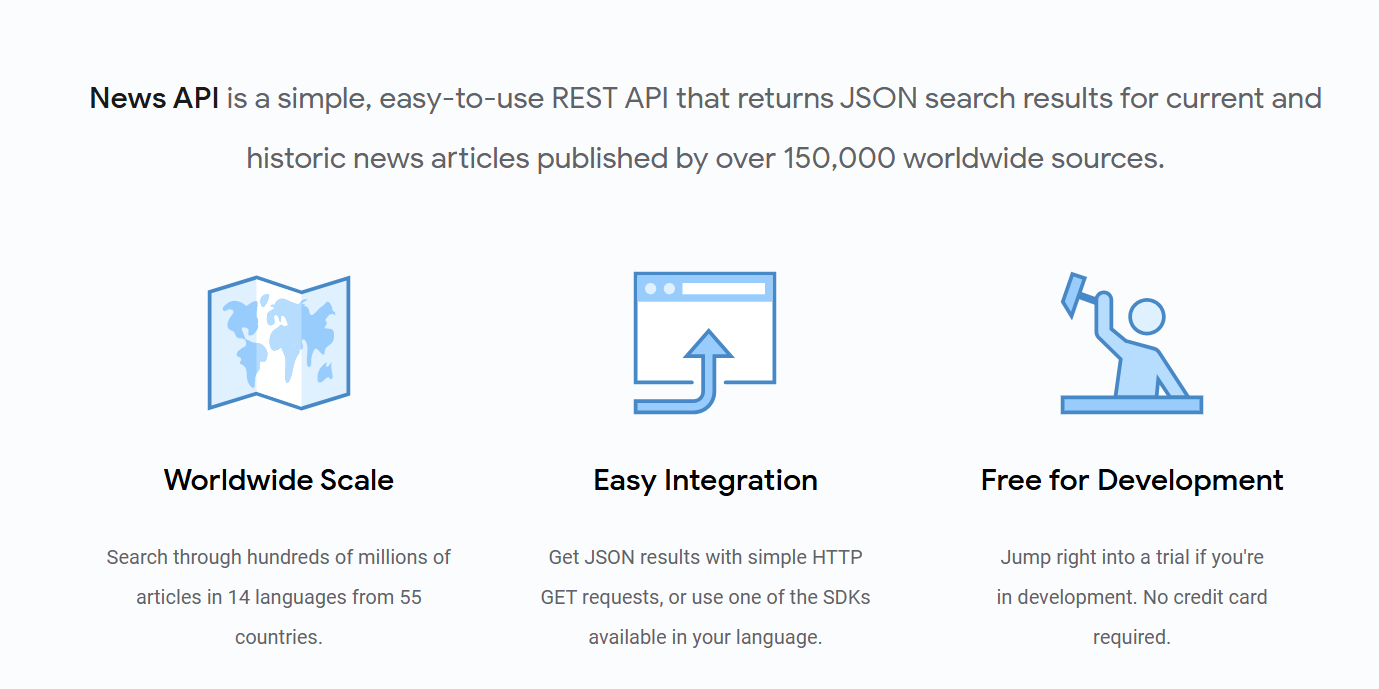
NewsAPI.org is one of the oldest general news APIs and still one of the most widely used. It exposes two endpoints: one searches the full article index, the other returns breaking headlines. Responses are clean JSON, and the client-library and tutorial ecosystem around it is large.
Key Features
- The
/v2/everythingendpoint searches roughly 150,000 sources by keyword, phrase, source, domain, language or date. Boolean AND, OR and NOT are supported. - The
/v2/top-headlinesendpoint filters live headlines by country, category or a named source set. - Each result carries the source, author, title, description, published date, URL and image URL.
- Official client libraries cover Node.js, Python, Ruby, PHP, Java and C#.
Pros & Cons
PROS
CONS
Pricing
Annual billing takes 20 percent off the figures below.
- Developer: $0, 100 requests/day, articles on a 24-hour delay, last-month search window, for development and testing only
- Business: $449/month, 250,000 requests/month, real-time articles, 5-year search
- Advanced: $1,749/month, 2,000,000 requests/month, 99.95 percent uptime SLA
- Enterprise: custom quote, adds article enrichment, story clustering, and on-premise deployment
NewsData.io
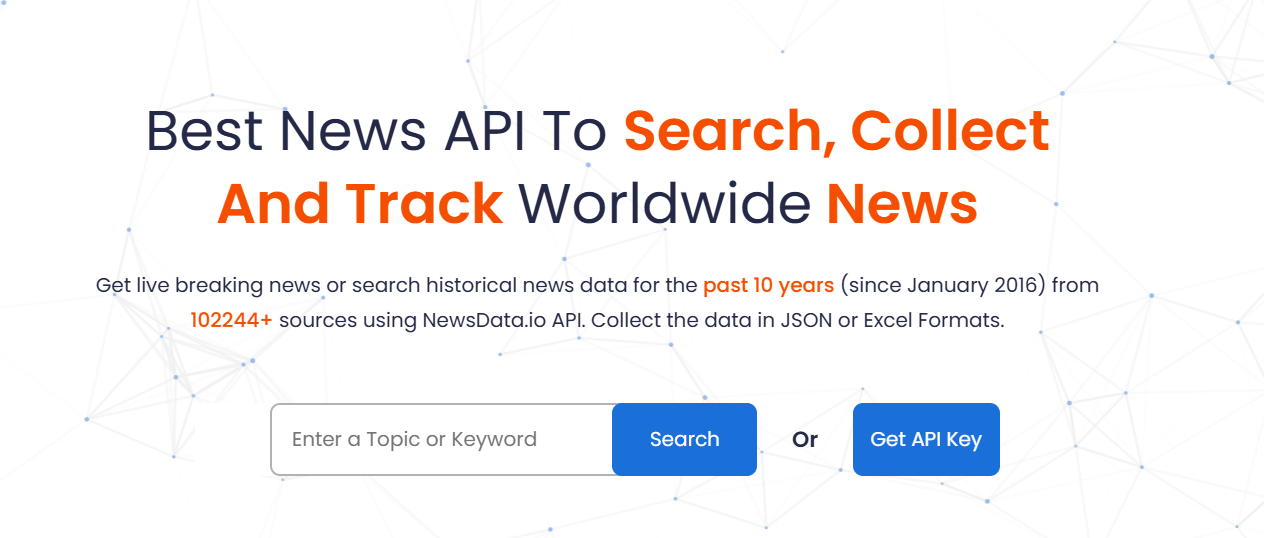
NewsData.io offers a very large source and a free tier you can actually build a prototype against. It pulls from a base of 102,000 sources across 206 countries and 89 languages, with separate endpoints for latest news, an archive, crypto and market news, and a streaming feed.
Key Features
- The News Archive endpoint covers 2016 onward.
- AI-generated tags and an article sentiment field are available on the higher plans.
- A News Count endpoint returns volume trends over time without pulling every matching article.
- An official MCP server lets an AI agent call the API as a tool.
- Each archive call costs 5 credits regardless of how many articles it returns.
Pros & Cons
PROS
CONS
Pricing
Yearly billing takes 20 percent off.
- Free: 200 API credits/day, 12-hour delay, no archive, truncated text
- Basic: $199.99/month, 20,000 credits/month, 6 months history, full content, AI summaries
- Professional: $349.99/month, 50,000 credits/month, 2 years history, AI tags and sentiment
- Corporate: $1,299.99/month, 1,000,000 credits/month, 10 years history, 99.95 percent SLA
GNews API
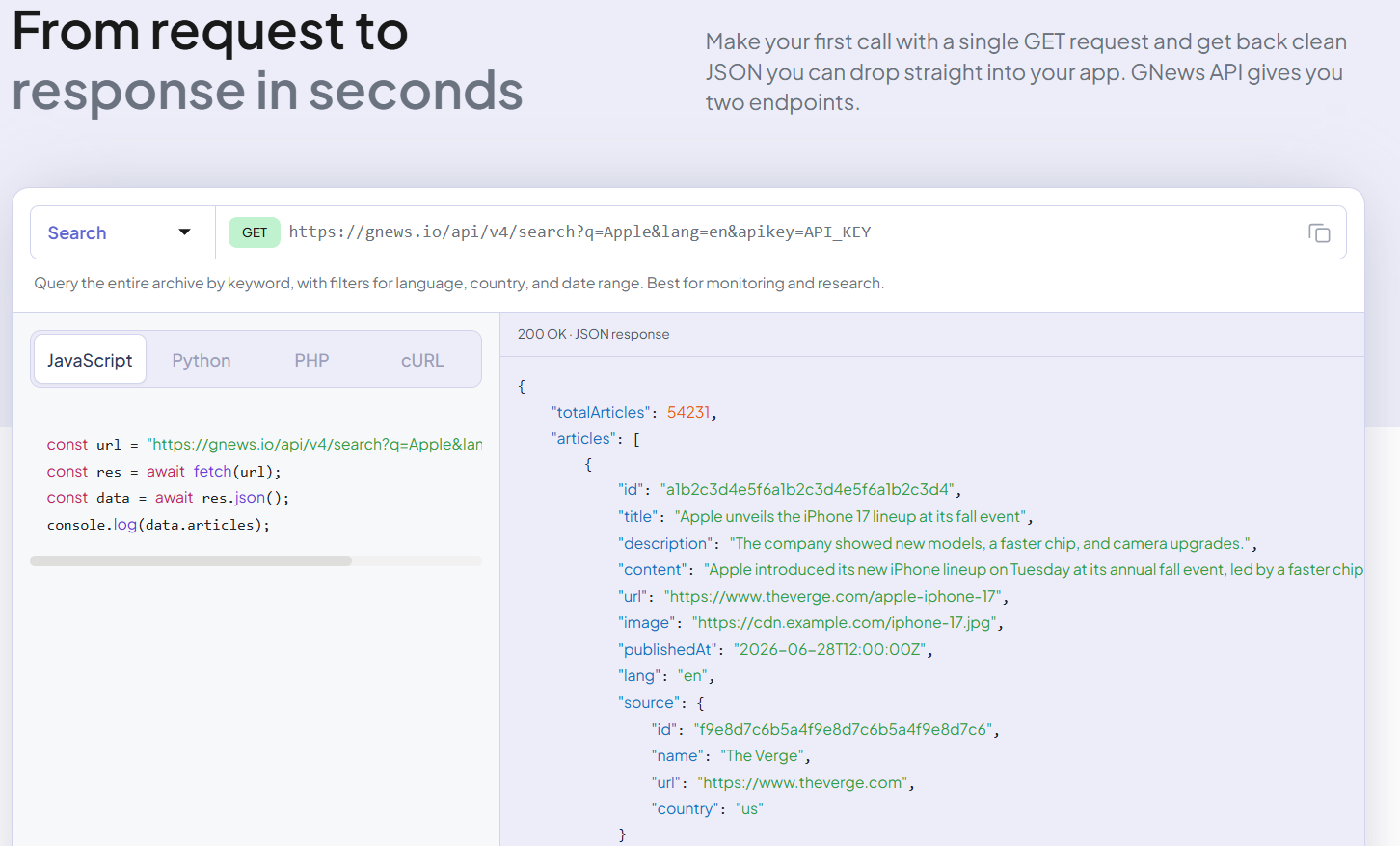
GNews API keeps its surface small: one endpoint for search, one for top headlines ranked the way Google News ranks them. It indexes over 100 million articles from 80,000 sources across 41 languages and 71 countries into its own database, so queries faster than when being scraped on demand. Its user base passes 150,000 developers, and its trusted-by list includes universities such as ETH Zurich and Harvard.
Key Features
- Full article text is included on every paid plan, not held back for a higher tier.
- Search accepts Boolean operators for combining and excluding terms.
- Official SDKs cover JavaScript, TypeScript and PHP, alongside an MCP server for AI agents.
- A separate free academic program grants API access for student projects and theses.
Pros & Cons
PROS
CONS
Pricing
Prices are in euros; annual billing takes about 20 percent off. A 10-day trial covers the paid features.
- Free: EUR 0, 100 requests/day, 12-hour delay, non-commercial only
- Essential: EUR 49.99/month, 1,000 requests/day, real-time, full content
- Business: EUR 99.99/month, 5,000 requests/day
- Enterprise: EUR 249.99/month, 25,000 requests/day, premium support
Mediastack
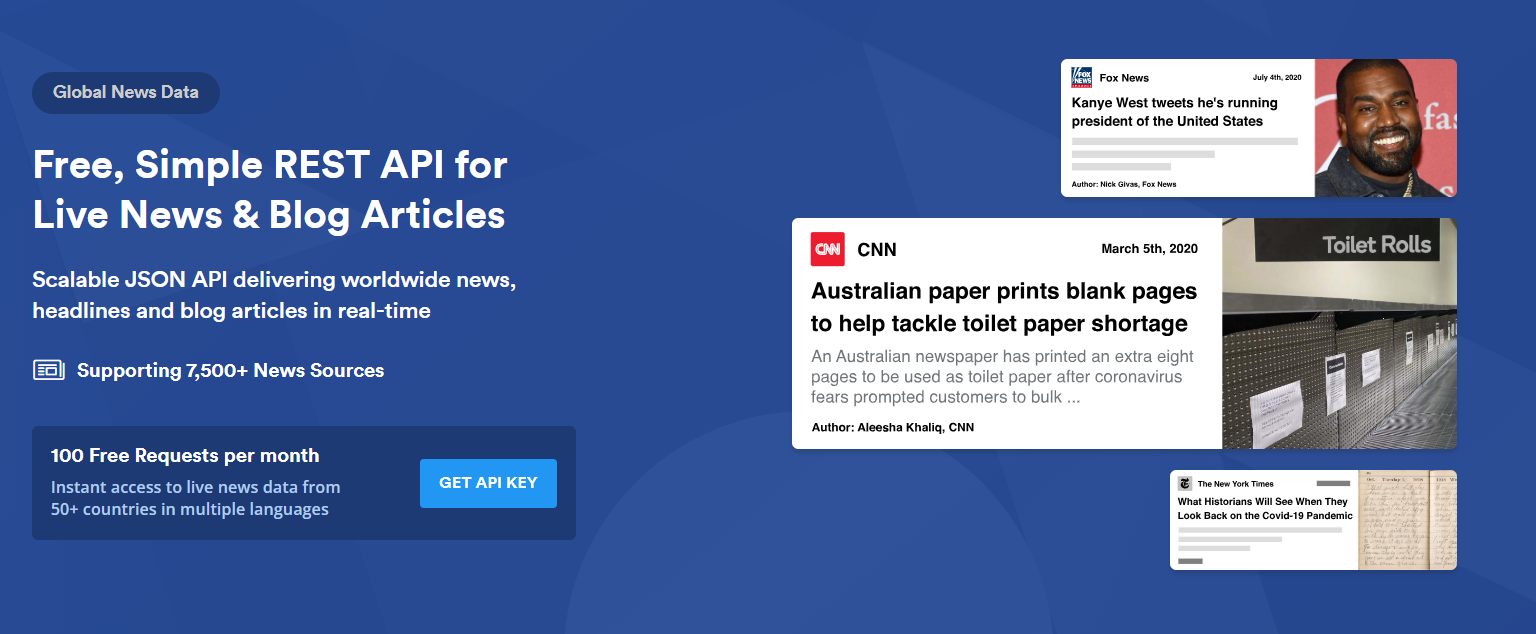
Mediastack is the cheapest self-serve way into this category. It is an apilayer product covering roughly 7,500 sources across 50+ countries in 13 languages, and a single REST endpoint returns live or historical news as JSON.
Key Features
- Commercial use and historical data are both available from the entry-level paid plan, not reserved for a higher tier.
- A public status page tracks real uptime, not a target number.
- Usage past the plan limit is billed per extra call instead of cutting the API off.
Pros & Cons
PROS
CONS
Pricing
Annual billing is up to about 15 percent cheaper.
- Free: $0, 100 calls/month, delayed data, no commercial use
- Standard: $24.99/month, 10,000 calls/month, live data
- Professional: $99.99/month, 50,000 calls/month
- Business: $249.99/month, 250,000 calls/month
- Enterprise: custom quote
Event Registry (NewsAPI.ai)
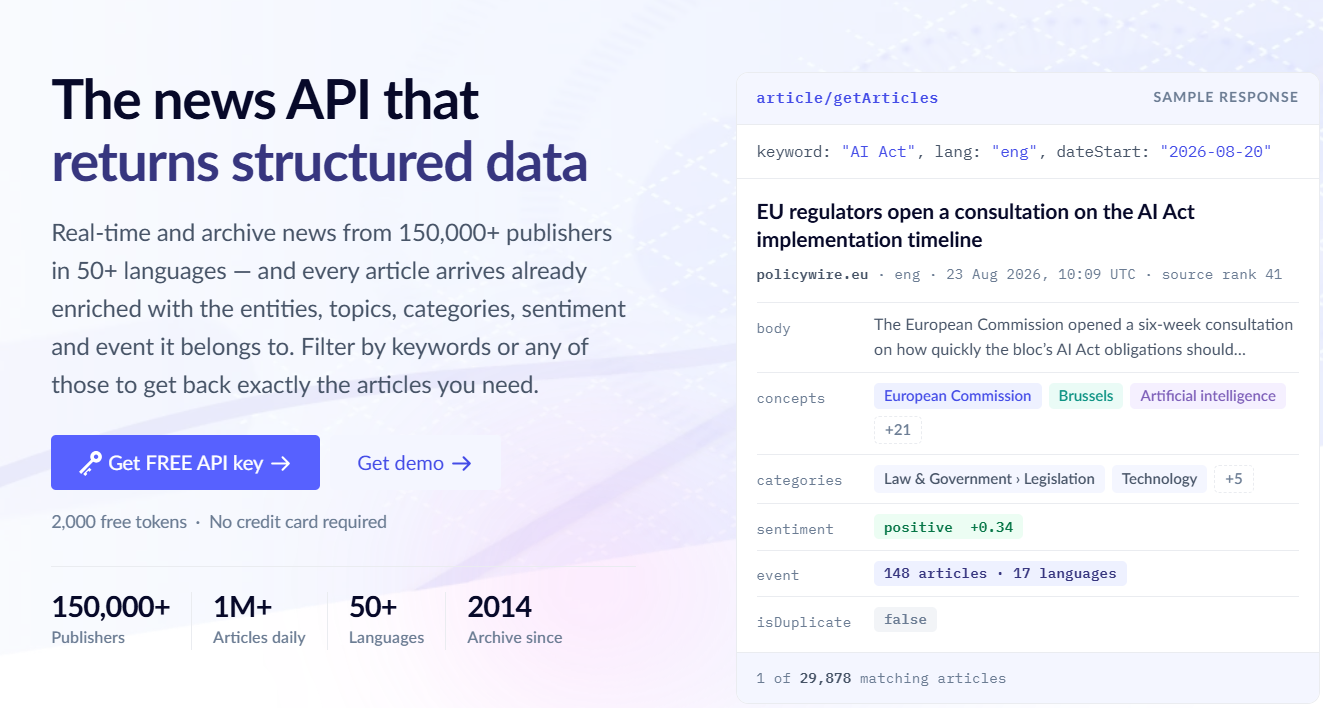
Event Registry goes past article retrieval into event detection. It groups every article reporting the same real-world development into one Event object, and tags each article with disambiguated entities, categories, and sentiment. Coverage spans 150,000 news outlets in more than 50 languages, on an index that starts in 2014. Bloomberg, IBM and the World Bank are listed as customers.
Key Features
- Search by concept, not a keyword string, so the company Apple is separated from the fruit.
- A separate Text Analytics API applies the same NLP to text you supply.
- Access is by REST, a Python SDK, or a Node.js SDK, and an interactive sandbox generates working query code.
Pros & Cons
PROS
CONS
Pricing
A recent article search costs one token; archive searches cost five tokens per year covered. Extra tokens past the cap are $0.015 each.
- Free: 2,000 tokens, one-off, no card
- Paid: from $90/month for 5,000 tokens, with larger token bundles above that
- Enterprise: custom quote for volume pricing and dedicated support
Webz.io
Webz.io comes from the enterprise web-data world. Its news feeds cover 3.5 million articles a day from 300,000 sites in over 170 languages, and its archive starts in 2008. It offers two APIs: a structured News API for filtering and monitoring and a News Search API that answers a plain-language query for retrieval pipelines. Media-monitoring platform Mention is named as a customer.

Key Features
- Sibling endpoints extend coverage to blogs, forums, and reviews; a separate product covers dark-web sources.
- Enrichment includes entity-level sentiment, fake-news and satire flags, and source-credibility signals.
- Output is available as JSON or XML, with large-scale pagination for bulk pulls.
Pros & Cons
PROS
CONS
Pricing
The free tier needs no card. Scale is pay-as-you-go with no minimum spend.
- Free: $5 worth of usage credits each month
- Scale: news feed calls $0.01 each plus $0.005 per returned article; the semantic Search API $0.001 per call plus $0.0005 per result
- High Volume: custom contract with bulk discounts and custom sources
NewsCatcher
NewsCatcher is aimed at risk, compliance, and market intelligence teams that need clean company and topic coverage, not a raw firehose. Its News API delivers structured, enriched articles from 140,000 sources, with over seven years of history and full article text. Onboarding is sales-led: every plan starts with a demo.
Key Features
- Entity resolution ties each article to the exact company or person you track, not a bare name match.
- A localized-news layer surfaces city- and region-level coverage.
- A companion Watchlist and Monitors add-on checks scheduled queries automatically.
- SOC 2 Type II, ISO, and GDPR compliance are in place for enterprise procurement.
Pros & Cons
PROS
CONS
Pricing
The News API is quote-only, with a 7-day free trial on every plan and production access on the Enterprise tier.
NewsCatcher’s Catch All web-search API starts at $50/month if you only need on-demand web search, not a structured news feed.
Perigon
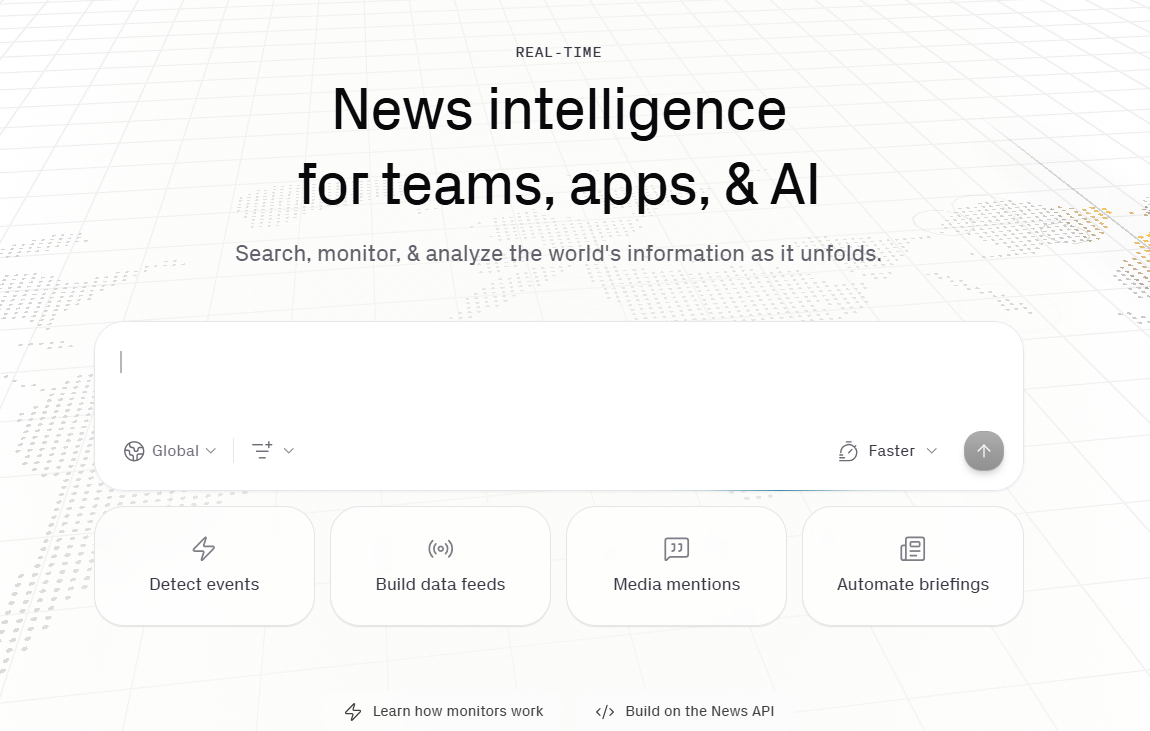
Perigon focuses on developers and AI agents. It monitors 230,000 sources, clusters articles into stories, and resolves the companies, people, and journalists each article names. The average gap from publication to API availability is about six minutes.
Key Features
- An official MCP server lets you use the API via Claude, Cursor, or any MCP client with no SDK.
- Vector search matches articles by meaning, not by exact keywords.
- Dedicated endpoints cover companies, people, sources, and journalists.
- Free tools build and classify Boolean queries before you write code.
Pros & Cons
PROS
CONS
Pricing
Annual billing saves 10 percent.
- Free: $0, 150 requests/month, personal use, all endpoints
- Basic: $250/month, 10,000 requests/month, priced for eligible startups
- Plus: $550/month, 50,000 requests/month, priced for eligible startups
- Commercial: custom, from about $24,000/year, full commercial license, over ten years of history and an SLA
GDELT Project
GDELT is not a commercial product. It monitors news in over 100 languages from every country, updates every 15 minutes, and makes the entire database free and open. Its archive of coded events starts on 1 January 1979.
Key Features
- The keyless DOC 2.0 API searches the full text of a rolling window of global coverage and returns article lists, timelines, and tone charts as JSON.
- The full dataset is queryable in Google BigQuery with standard SQL.
- Real-time machine translation covers 65 languages into English.
- The Global Knowledge Graph tags people, organizations, themes, and more than 2,200 emotions per article.
Pros & Cons
PROS
CONS
Pricing
Free and open, with no account required.
- Access the raw data files directly, the keyless DOC 2.0 API, the browser-based GDELT Analysis Service, or the full dataset in Google BigQuery
- BigQuery query costs are billed by Google, not by GDELT
The Guardian Open Platform
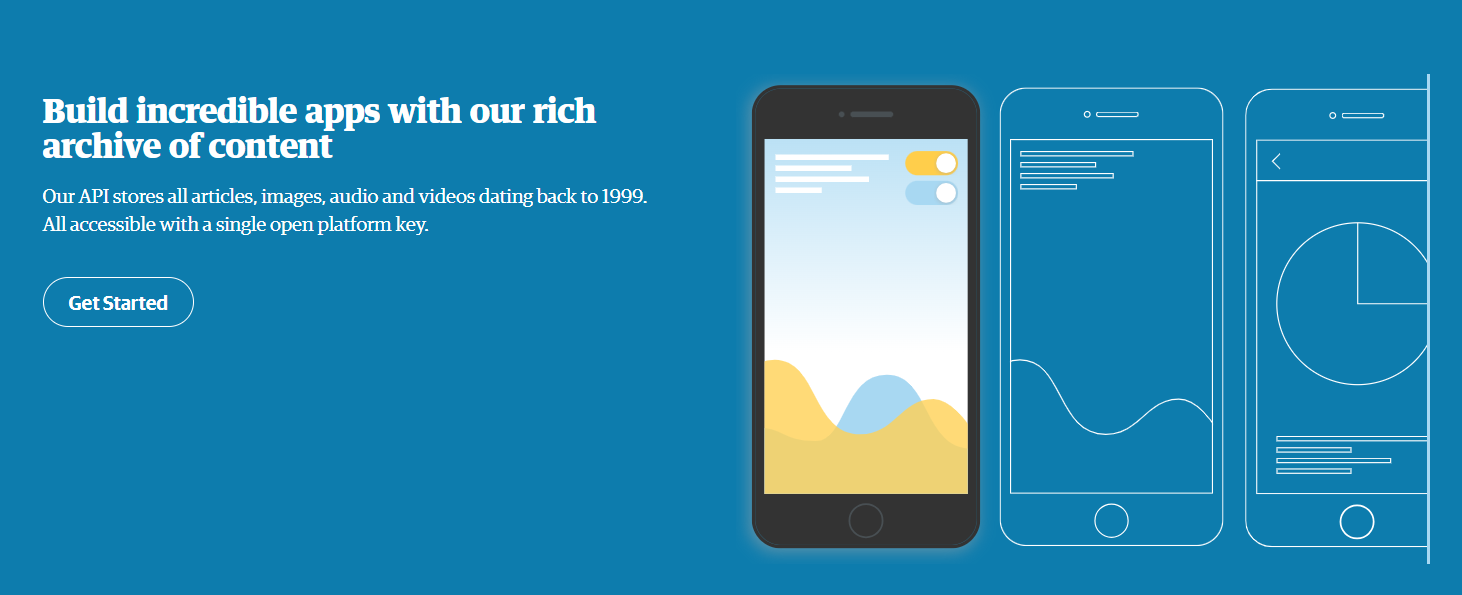
The Guardian Open Platform gives programmatic access to everything the paper has published since 1999, more than 1.9 million pieces, filed by section and topic. A free developer key covers non-commercial use; commercial use is priced on how much you consume.
Key Features
- Content is filed against a large tag taxonomy, so filtering to one topic or news desk is precise.
- An in-browser query builder previews requests and responses before you write code.
Pros & Cons
PROS
CONS
Pricing
Commercial licensing terms are negotiated case by case.
- Developer key: free for non-commercial use, up to 500 calls/day and 1 call/second
- Commercial key: custom throttle and quota priced on usage, adds images, audio, video and rights for republishing and AI training
The New York Times APIs
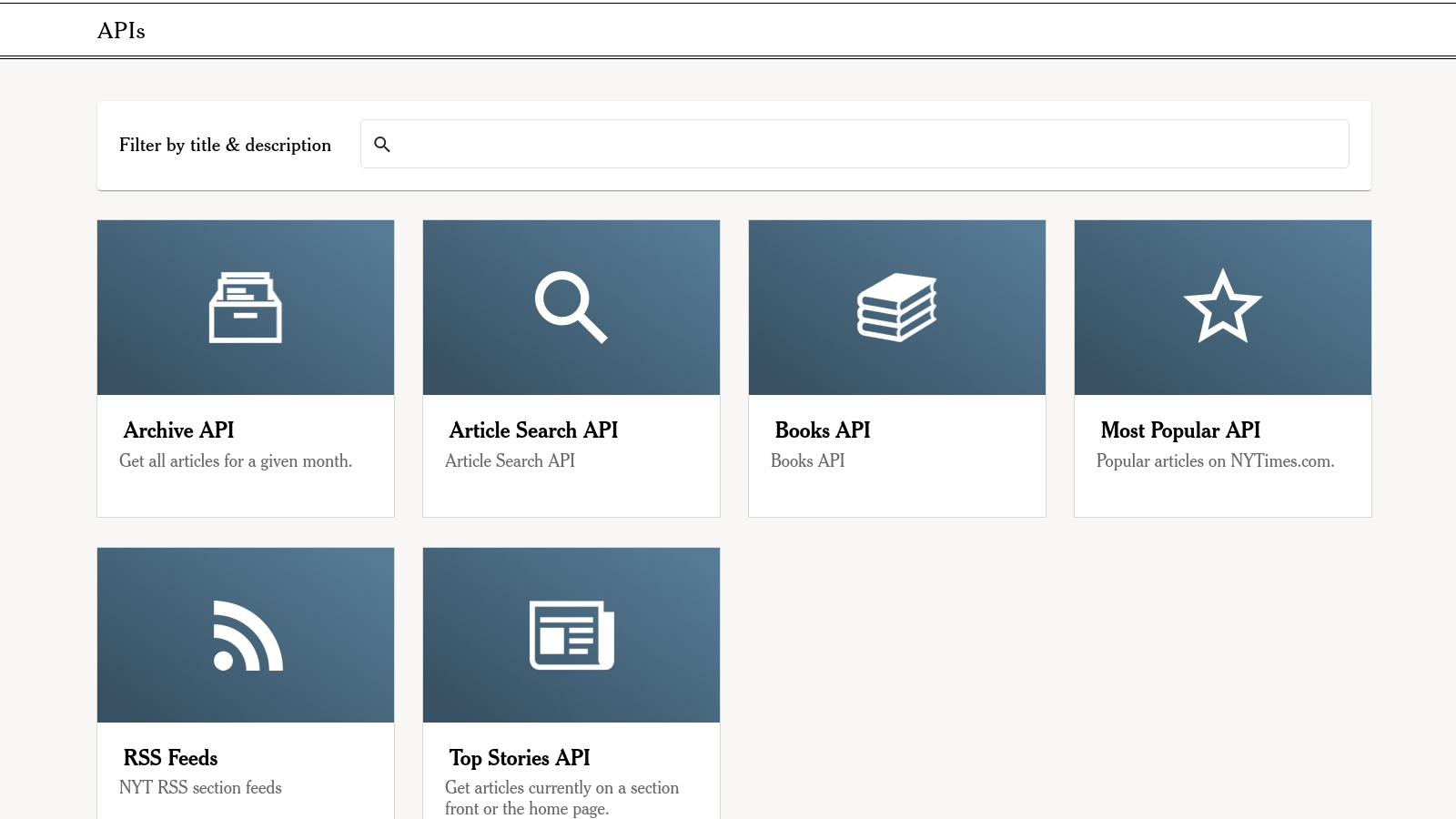
The New York Times publishes a set of free read APIs over its own content. The best known is the Archive API, which returns metadata for every article published in a given month going back to 1851. Article Search, Top Stories, Most Popular, Books and RSS feeds round out the set.
Key Features
- Each article carries rich metadata, including byline, section, keywords, and references to multimedia.
- One registered app key works across every API in the set.
- The Article Search API supports filtering by date, section, and news desk.
Pros & Cons
PROS
CONS
Pricing
Register an app for a key.
- Free: every API allows 500 requests per day and 5 requests per minute
Contify
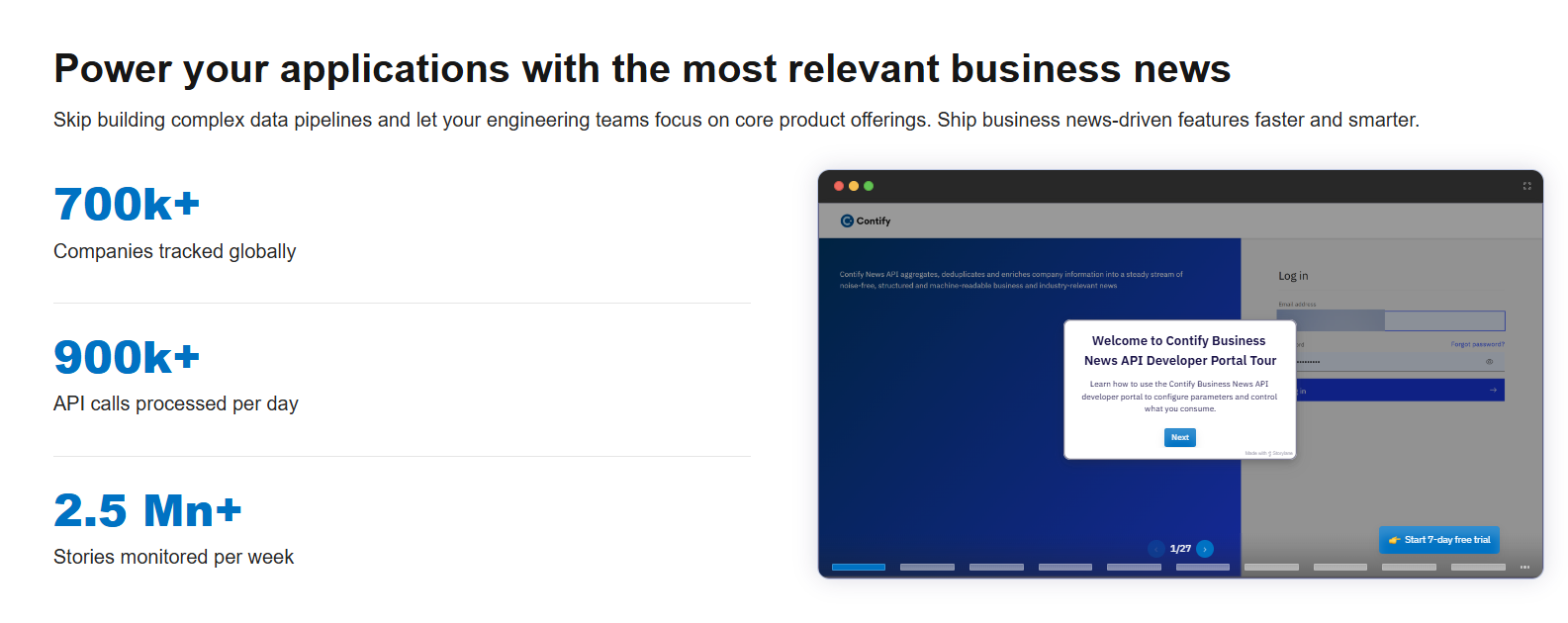
Contify is a market- and competitive-intelligence platform whose Business News API delivers only business-relevant coverage: companies, industries, funding, regulation, and leadership moves. It draws on more than a million curated sources across 190-plus countries and auto-translates 117 languages into English. Lenovo and LexisNexis use it.
Key Features
- A pipeline of NLP, machine learning, and human review filters out non-business noise before delivery.
- Every story is tagged with companies, people, locations, sentiment, and more than 50 business-event types.
- AI-generated bullet-point highlights summarize each story.
- You can add your own sources and custom tags at no extra cost.
- Delivery is by REST or webhook, with 15 or more metadata fields per story.
Pros & Cons
PROS
CONS
Pricing
Contact sales for pricing; a 7-day free trial is available.
- Sold as an enterprise subscription with a 99.9 percent uptime SLA, SOC 2, ISO 27001 and GDPR compliance
How to choose
If you are looking for something free, these 3 are free in a way you can ship on: GDELT has no key or cost at all, and the Guardian and the New York Times give away full access for non-commercial use.
GNews and NewsAPI.org restrict their free keys to development, so a deployed product needs a paid plan from day one. NewsData.io and Mediastack land in between, with free tiers you can prototype against but will outgrow quickly.
Read the license before the price. The free tiers on GNews, NewsAPI.org, Perigon, The Guardian, and NYT are all non-commercial, and the definition can be strict: NewsAPI.org counts internal tools as production. If you are building anything that generates revenue, the real entry cost is the first paid tier, so compare those columns, not the free ones.
Decide how much processing you want to inherit. NewsAPI.org, GNews and Mediastack hand back clean articles and leave entities, sentiment, and deduplication to you. Event Registry, Perigon, Webz.io, NewsCatcher and Contify do that work upstream and charge for it. For a language model or an agent, enrichment plus an MCP server, which Perigon, GNews, NewsData.io and Event Registry all publish, saves the most integration time.
Match the archive to the job. A live feed needs days of history; trend analysis needs years, and only NewsData.io, Webz.io, Event Registry, Perigon and GDELT reach that far without a custom contract. If one respected outlet is all you need, the Guardian or NYT is simpler than filtering a global aggregator down to it. And check how you buy: NewsCatcher and Contify are sales-led, while everything else starts with a form and a card.
Frequently Asked Questions
Is there a completely free news API?
Yes. GDELT is free and open with no key or account, covering global news in over 100 languages. The Guardian and the New York Times both give away full API access for non-commercial projects. NewsData.io and Mediastack have permanent free tiers, though the quotas are small and the data is delayed. GNews and NewsAPI.org also have free keys, but only for development and testing, not for a live product.
What happened to the Google News API and the Bing News API?
Google shut down its official News API in 2011 and never replaced it. Microsoft retired the Bing Search APIs, including Bing News Search, on 11 August 2025; the endpoints now return an error, and the only successor is a search tool inside Azure AI Foundry rather than a standalone API. For a direct replacement, GNews, NewsData.io, Mediastack or Event Registry cover the same ground.
Can I use a free-tier news API in a commercial product?
Often not. The free keys from GNews, NewsAPI.org and Perigon are for development only, and the Guardian and NYT free tiers are non-commercial. NewsData.io and Mediastack do allow it, but their free quotas are small enough that a real product needs a paid plan quickly. Always read the terms, since internal use sometimes counts as commercial.
Which news API works best for an AI or LLM application?
Look for two things: enrichment that structures each article, and an MCP server so an agent can call the API as a tool. Perigon, GNews, NewsData.io and Event Registry all publish MCP servers. Webz.io’s News Search API returns the most relevant passage of each article, which is convenient for retrieval-augmented generation. GDELT is the free option if you can work with its event-coded format.
Is there an API just for technology news?
The Hacker News API is free, needs no key, and covers the Y Combinator tech community, though it is one forum and not a broad source base. For wider technology coverage, most general APIs here let you filter by a technology category or a set of tech publications, which gives you a similar feed from many more outlets.