



An open banking API connects your app to a customer’s bank with their permission, then either returns their financial data or moves money on their behalf. That covers three separate jobs: reading account and transaction data, initiating a payment straight from a bank account, and verifying an account, its owner, or someone’s income and assets. Most products need only one of the three.
This guide is written for teams building financial products, where the choice comes down to three questions.
- Where are your users’ banks: the US, the UK, and Europe, Australia, or Latin America?
- Do you need data aggregation, bank payments, or plain account verification?
- How much certainty do you need about pricing and long-term access, given that the US federal rule for open banking is currently on hold?
The APIs below are compared on what they return, which of the three jobs they do well, their regional reach, whether you can start without a sales call, and their current published pricing.
What an open banking API does
The mechanics are consistent across providers. The customer authorizes access through a bank-hosted login or an OAuth screen, the API connects to the bank, and your app gets back a standardized response or a payment confirmation. You are not handling bank passwords yourself, and on the newer networks nothing is scraped from a logged-in browser session.
In the US, the common technical standard is the FDX API, published by the Financial Data Exchange and currently at version 6.4. Older screen scraping, where an aggregator logs in as the user with stored credentials and reads the page, is being replaced by these direct bank APIs. That change is most of what people mean when they say open banking is maturing in the US.
Data, payments, and verification are priced and sold separately by most vendors. A lending product might only ever call the verification endpoints. A budgeting app needs transaction data and nothing else. A checkout that offers bank payment needs payment initiation. Picking an API starts with knowing which of these you actually need.
Open banking APIs at a glance
| Provider | Main region | Best for | Start without sales | Pricing |
|---|---|---|---|---|
| Plaid | US, Canada, UK, EU | A broad platform across data, payments and identity | Yes, sandbox | Quote-based, per account or per call |
| MX | US | Clean, categorized transaction data | No | Quote-based |
| Mastercard Open Banking | US (and Australia) | Lending and mortgage verification | Sandbox yes, pricing no | Quote-based |
| Akoya | US | Contractual data access with no scraping | Sandbox yes | Two volume tiers, rates not listed |
| Yodlee | US, plus a wide global long tail | Wealth, PFM and hard-to-reach accounts | Sandbox yes | Quote-based |
| Stripe Financial Connections | US | Teams already using Stripe for payments | Yes | Published per call, from $0.10 |
| TrueLayer | UK, Europe | Pay by Bank alongside data | Console yes | Quote-based |
| Tink | Europe, 19 markets | Pan-European data and account-to-account payments | Console, Standard plan | Quote-based |
How we picked
Each API on this list was assessed on what data it returns, what it does well, its stated regional reach, whether a developer can open a test account without a sales call, and its current pricing as published for US customers.
Plaid
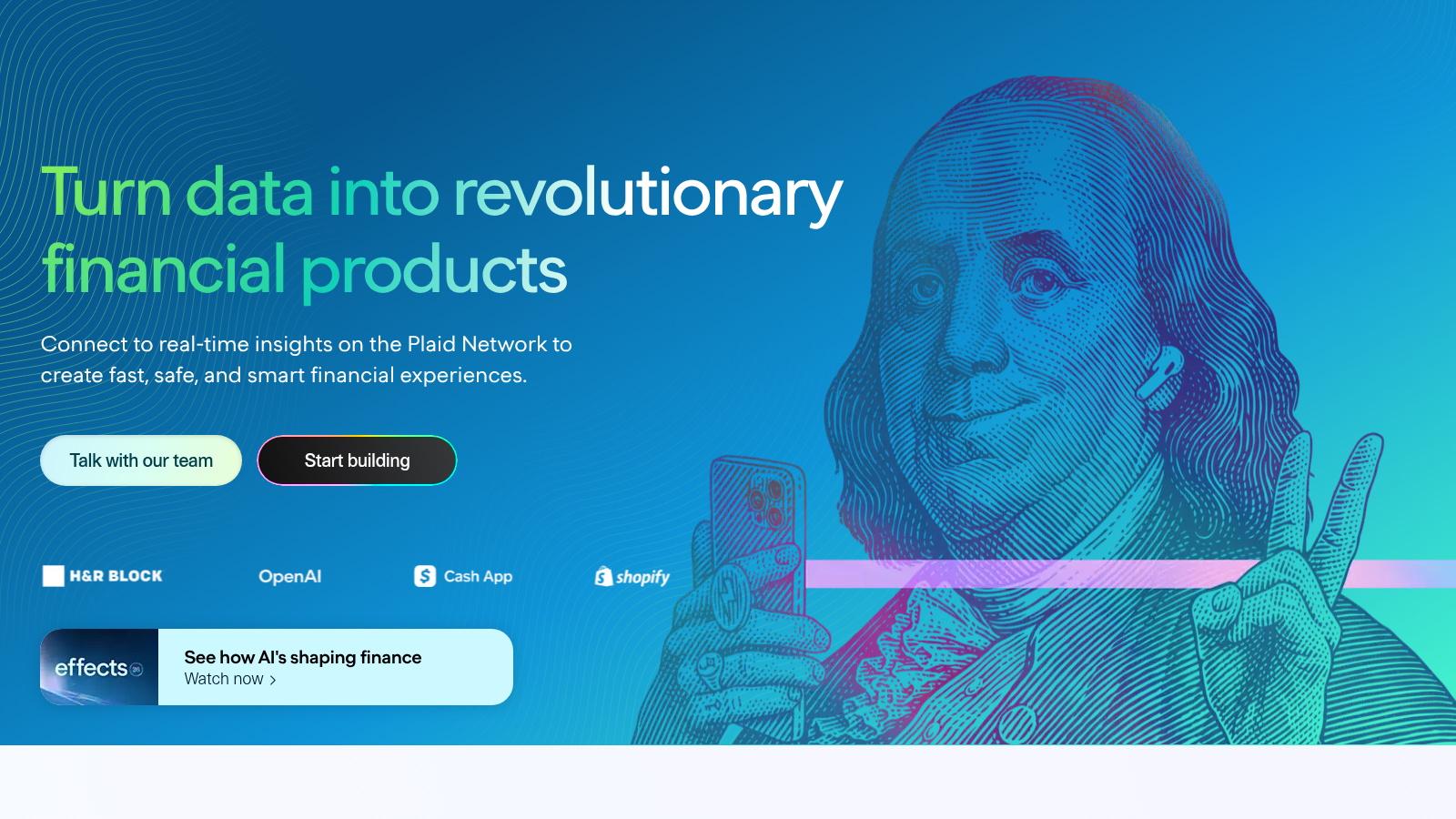
Plaid is the default account-connection API for most US and Canadian products, and it reaches into the UK and about 20 European countries as well. Plaid Link, the drop-in connection widget, covers more than 12,000 financial institutions. What began as an account-aggregation tool is now a wide platform: one account gives you transaction data, identity and income checks, ACH and real-time payments, and fraud scoring. Many well-known US consumer finance apps connect their users’ accounts through it.
Key Features
- Auth returns account and routing numbers for payments; Transactions gives up to two years of categorized history.
- Identity, Assets, and Income cover the checks a lending or onboarding flow needs.
- Signal scores the risk that an ACH payment will be returned, and Transfer moves money over ACH, RTP, and FedNow.
- Core Exchange, Permissions Manager, and the App Directory give the bank side of the network an FDX-style way to share and audit data access.
- Layer bundles identity, contact, and bank details into a single one-tap onboarding step.
- SDKs and quickstarts for common back-end languages, plus a hosted Link UI for web and mobile.
Pros & Cons
PROS
CONS
Pricing
Plaid does not publish per-call rates; you choose a plan and pay per connected account or per successful call, depending on the product.
- Pay as You Go: month to month, generally available products, unlimited live calls at standard rates
- Growth: 12-month commitment, discounted rates, platform support, single sign-on
- Custom: volume pricing, access to beta products, support for regulated industries
- Free sandbox; a limited production mode allows 200 live API calls per product for testing
MX
MX takes raw bank-transaction text, the cryptic strings that show up on a statement, and turns it into clean, categorized, merchant-labeled data. That cleanup is its main draw. MX sells to banks and credit unions as well as fintechs; the fintech-facing piece is its Data Access API, a consumer-permissioned OAuth connection to account and transaction data. US Bank, Discover, and BECU are among its named customers.
Key Features
- Data Enhancement turns each transaction into a categorized record with a tidy merchant name, so you are not writing that parser yourself.
- Account Aggregation and Instant Account Verifications return balances plus account and routing details for onboarding.
- Investment Data pulls in external brokerage and retirement accounts alongside checking and savings.
- Customer Analytics scores account holders on behavior, aimed at banks that want to see who is about to move money.
- SOC 2 Type II and PCI DSS attestations, which matter once account data counts as regulated.
Pros & Cons
PROS
CONS
Pricing
MX publishes no pricing; every plan is quoted by its sales team after a demo.
- No free tier or public test account
- Cost scales with the number of connected users and the mix of products you take
Mastercard Open Banking (formerly Finicity)
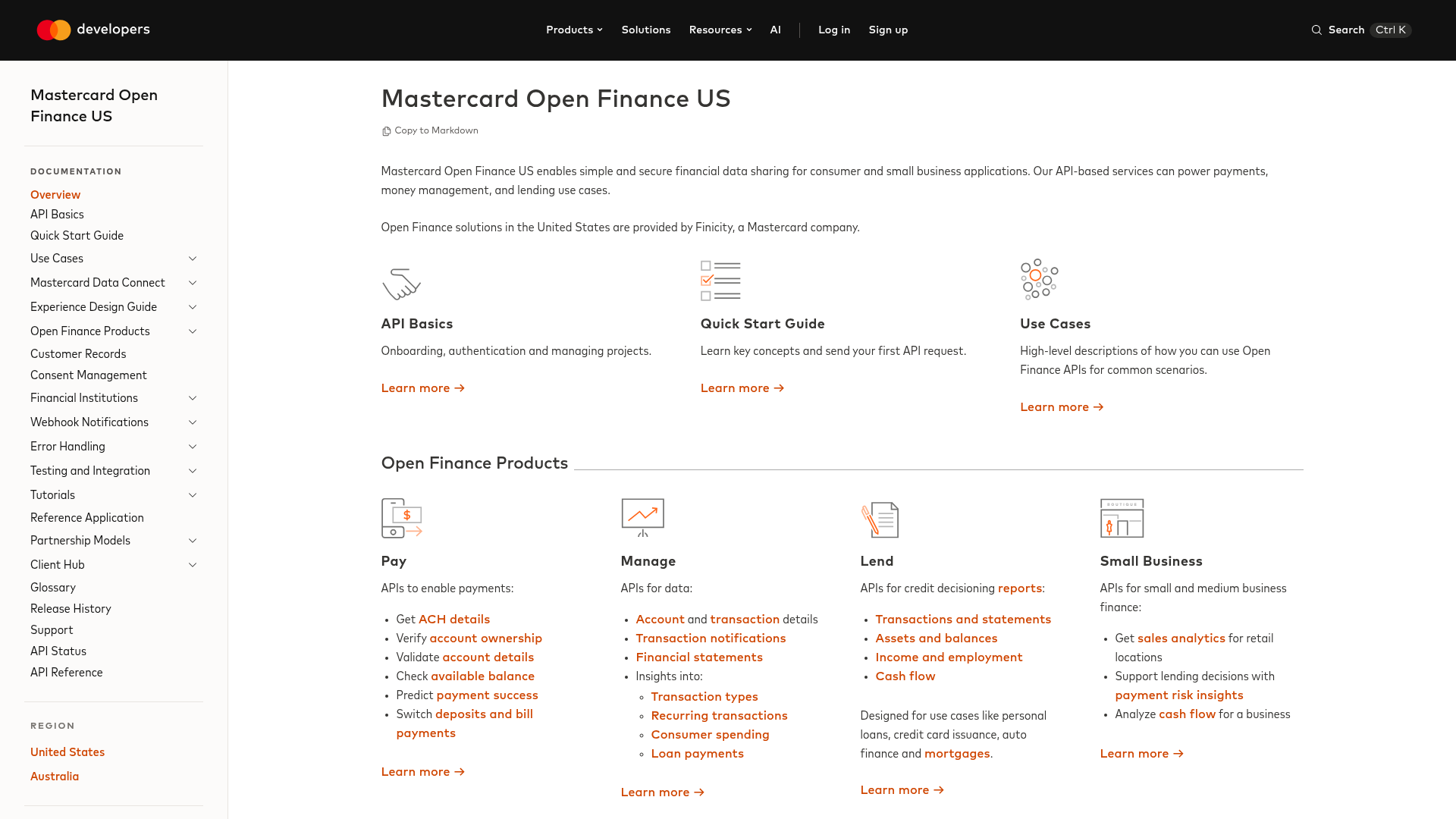
Finicity became part of Mastercard in 2020, and its US open banking work is now sold as Mastercard Open Banking, or Mastercard Open Finance, in the developer docs. Its strongest area is lending, where it returns preformatted reports for mortgage, auto, personal, and card underwriting instead of raw data you assemble yourself.
Key Features
- Lend delivers ready-made credit-decisioning reports for specific loan types: verification of assets, income, and employment, plus cash-flow analytics.
- Pay provides account and routing details, account-owner verification, balance checks, and a Payment Success Indicator that estimates whether an ACH pull will clear.
- Manage covers account aggregation, transaction history, statements, and transaction enrichment.
- Mastercard Data Connect is the account-linking widget, with web, iOS, Android, and React Native SDKs, plus a Postman collection and test profiles.
Pros & Cons
PROS
CONS
Pricing
Not published; product selection and pricing go through Mastercard’s Open Finance sales team.
- A self-serve sandbox project with test data is free to start
- Production pricing is custom, quoted by use case across Pay, Manage, and Lend
Akoya
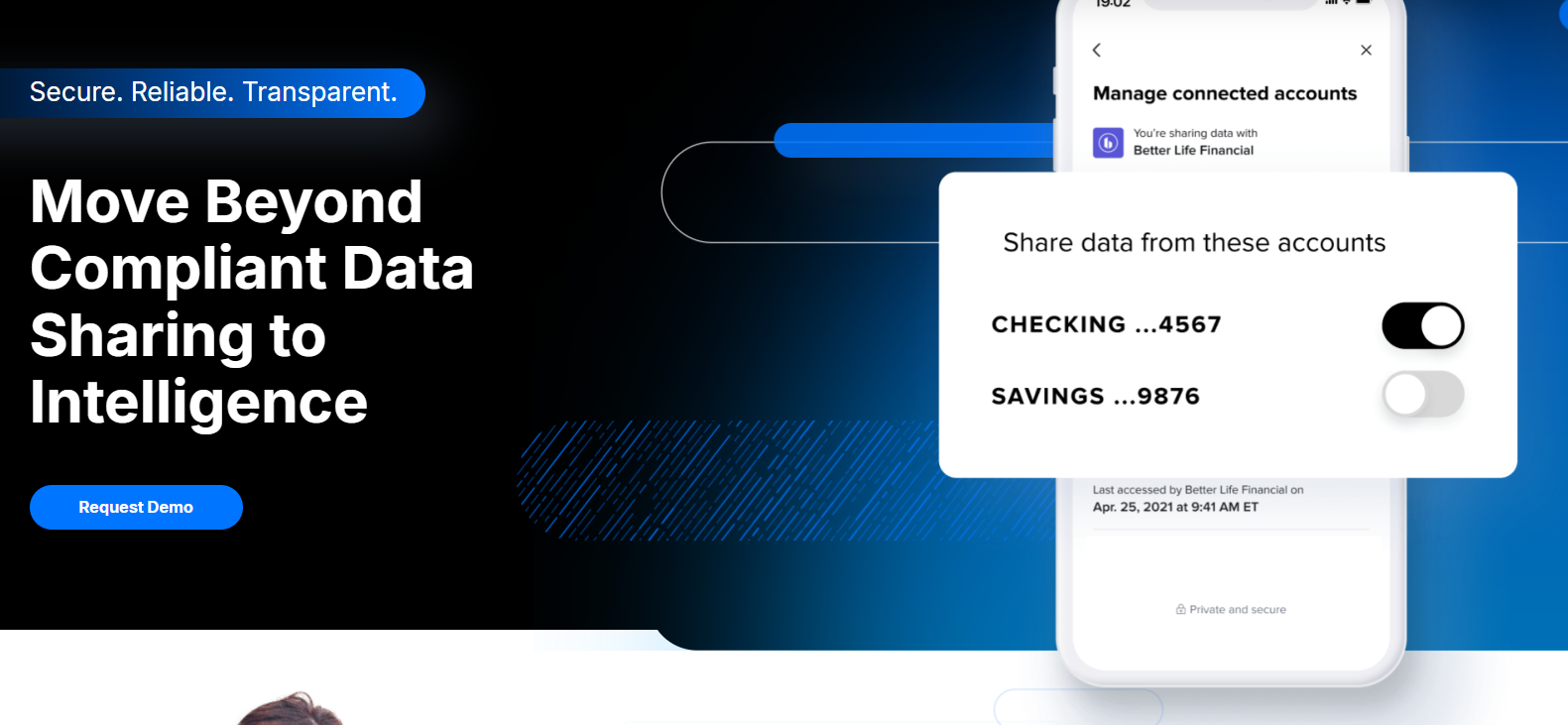
Every Akoya connection is a direct API agreement with the financial institution, so nothing is scraped and no bank login credentials are stored anywhere. Akoya was spun out of Fidelity in 2020 and is jointly owned by Fidelity’s parent, The Clearing House, and a dozen large US banks. It links to more than 4,300 US financial institutions and describes itself as the only fully API-connected, consumer-permissioned data-sharing network.
Key Features
- Six data APIs: Balances, Customers, Accounts and Investments, Transactions, Statements, and Payments.
- Because each link is a bank agreement, connections do not break when a bank changes its login page.
- An FDX-aligned data model, so responses match the US standard.
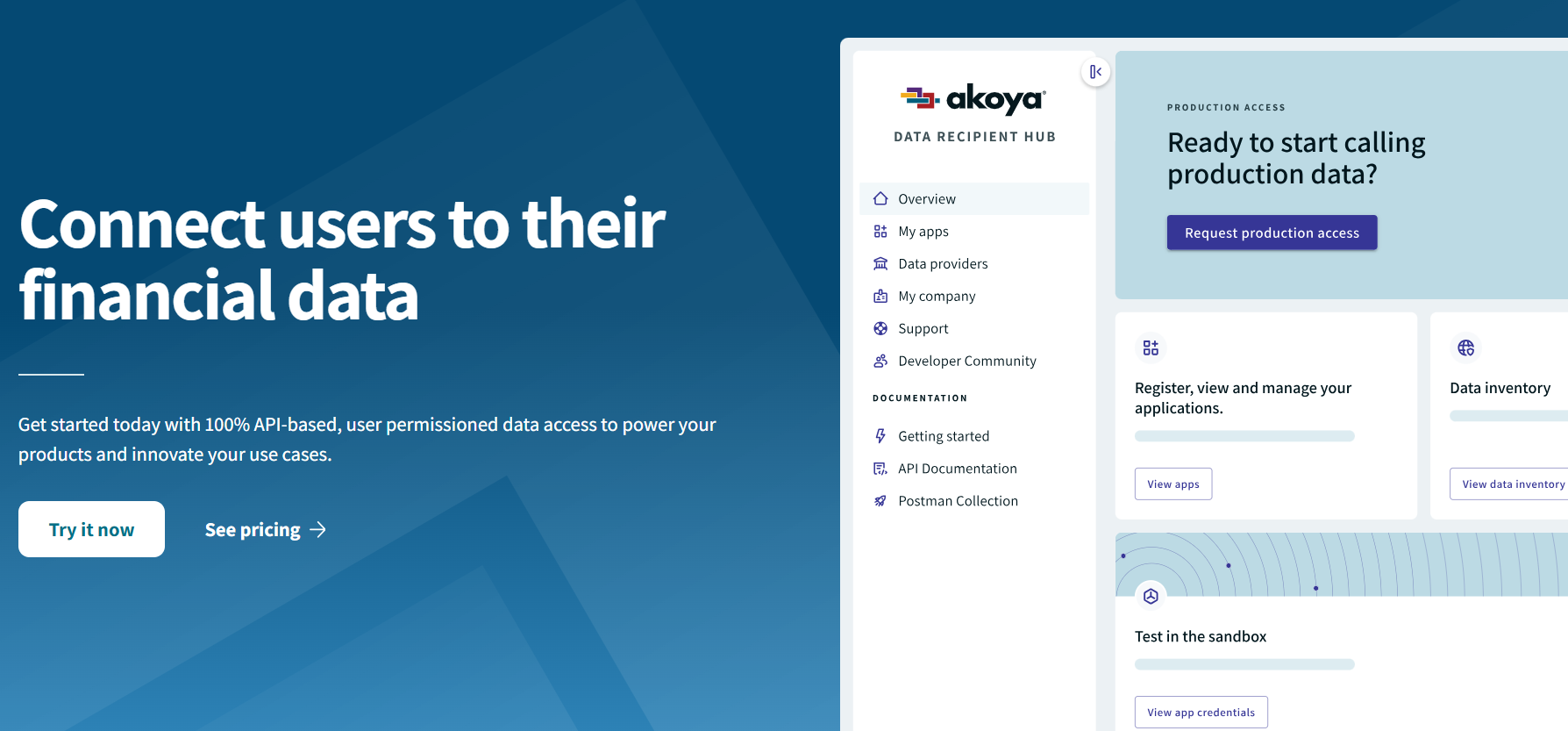
- A sandbox you can open yourself, plus full docs; production needs a signed Data Recipient agreement and bank certification.
- Reported network availability above 99.9 percent and call success above 99.5 percent.
Pros & Cons
PROS
CONS
Pricing
Akoya publishes two tiers by monthly connection volume; the per-connection rate is not listed.
- Standard: under 10,000 connections a month, self-service onboarding, sandbox, ticketed support
- Enterprise: 10,000 or more connections a month, custom pricing, dedicated support
- The self-service sandbox is free; a setup fee can apply depending on the integration
Yodlee
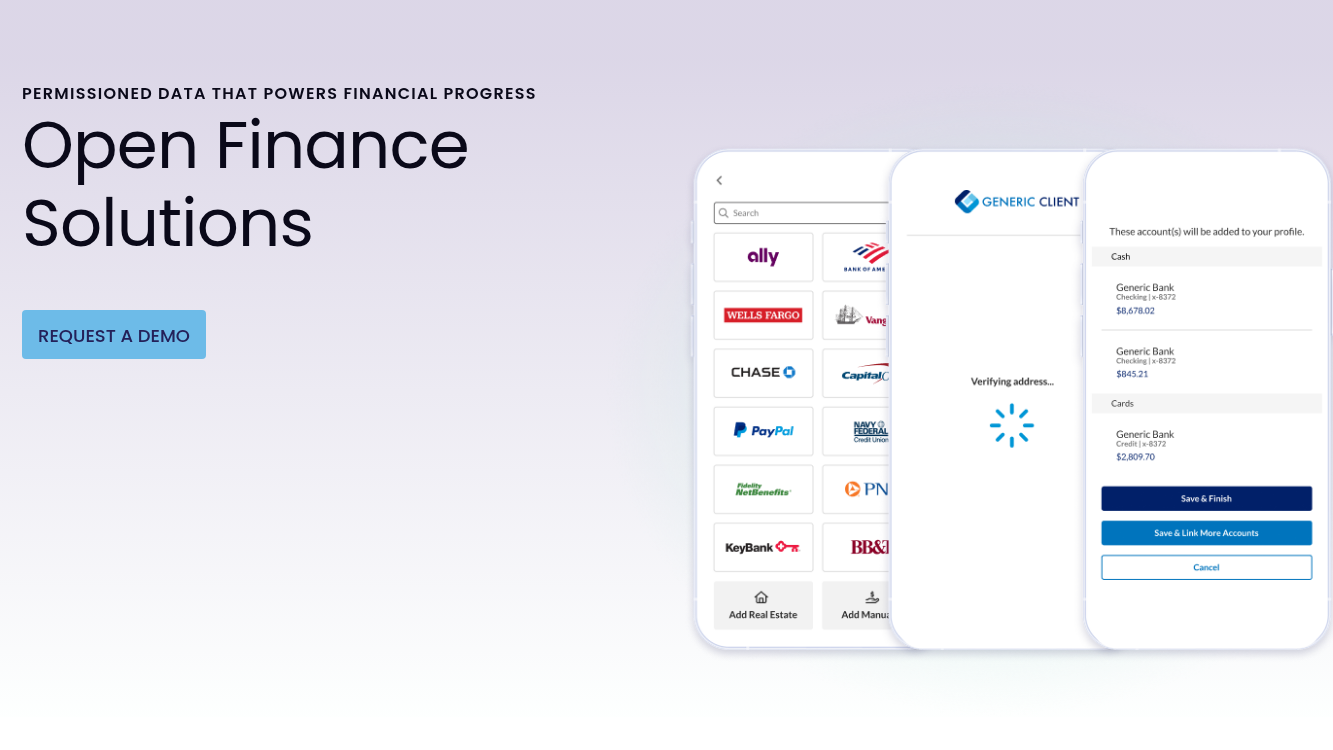
Yodlee has aggregated financial data since the late 1990s, and its reach into small banks, credit unions, and brokerages is still hard to match. It reports more than 19,000 data sources. The heritage is in wealth management, personal finance tools, and credit decisioning. Its parent Envestnet was taken private in 2024, and Yodlee was then sold to the private-equity firm STG in 2025. PayPal and Charles Schwab are among its named data customers.
Key Features
- Long-tail coverage that reaches smaller banks, brokerages, and payroll sources many newer APIs skip.
- Separate product lines for personal finance tools, cash-flow-based credit decisioning, wealth aggregation, and account verification.
- Both modern REST APIs and older connection methods on one platform, useful when you inherit a legacy integration.
- FastLink, the hosted account-linking widget, plus a developer portal with a test environment.
Pros & Cons
PROS
CONS
Pricing
Not published; Yodlee quotes production pricing after a sales conversation.
- A free developer test environment is available on the developer portal
- Production cost scales with connected users and the product set
Stripe Financial Connections
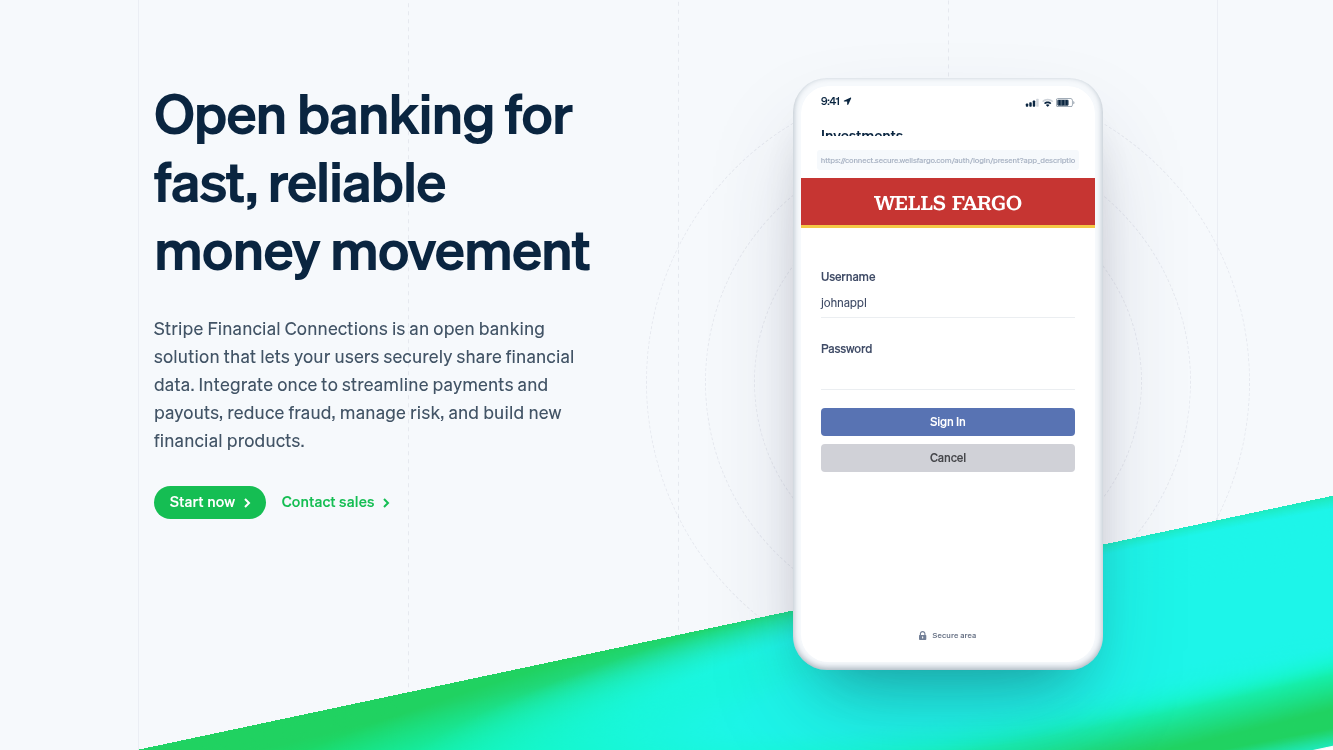
Stripe Financial Connections is Stripe’s own open banking product, and it makes sense mainly if you already handle payments on Stripe. It reaches more than 97 percent of US bank accounts across roughly 12,000 institutions, with a hosted fallback for the rest. Account linking goes through Link, Stripe’s consumer network, so returning users connect faster.
Key Features
- Instant account verification returns tokenized account and routing numbers; balance checks show available and pending funds.
- Account-owner name and address, plus a 180-day transaction history that refreshes daily.
- A hosted authentication flow you embed with Stripe.js or the iOS and Android SDKs.
- Hosted small test transfers as a fallback for any bank not covered instantly.
- Direct interoperability with Stripe Checkout, Payment Links, Connect, and Identity.
Pros & Cons
PROS
CONS
Pricing
Stripe publishes per-call pricing in US dollars with no monthly minimum.
- Account verification: $1.50 per verified account
- Balances: $0.10 per successful API call
- Account owners: $1.50 per successful API call
- Transactions: $0.30 per institution, per account holder, per month
TrueLayer
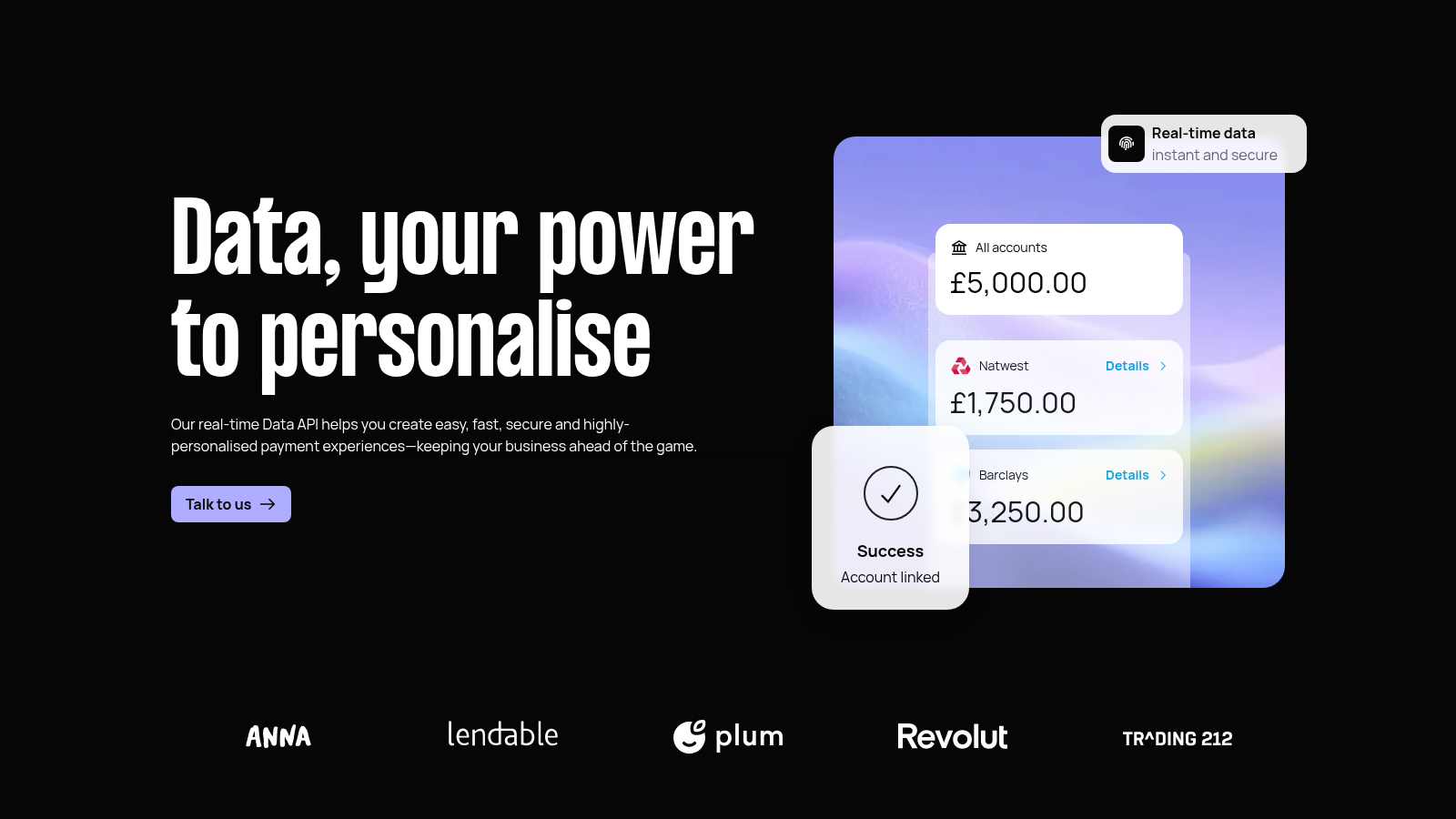
TrueLayer covers the UK and Europe, not the US. It still offers a Data API for account verification, aggregation, affordability checks, and money management, but the company’s weight is now behind Pay by Bank, where it handles close to half of all UK Pay by Bank transactions. It is authorized and regulated by the UK Financial Conduct Authority.
Key Features
- A single Data API for verified bank-customer data across UK and EU banks.
- Pay by Bank, payouts, refunds, and recurring bank payments in the same platform as the data product.
- Prebuilt payment UIs and SDKs for iOS, Android, and React Native, plus Shopify and Magento plugins.
- A Console you can sign up for yourself that provisions a merchant account so you can accept payments right away.
Pros & Cons
PROS
CONS
Pricing
TrueLayer does not publish pricing; you contact sales for data and payments rates.
- Self-serve Console access to explore the APIs before contracting
- UK and EU only, with rates quoted per use case
Tink
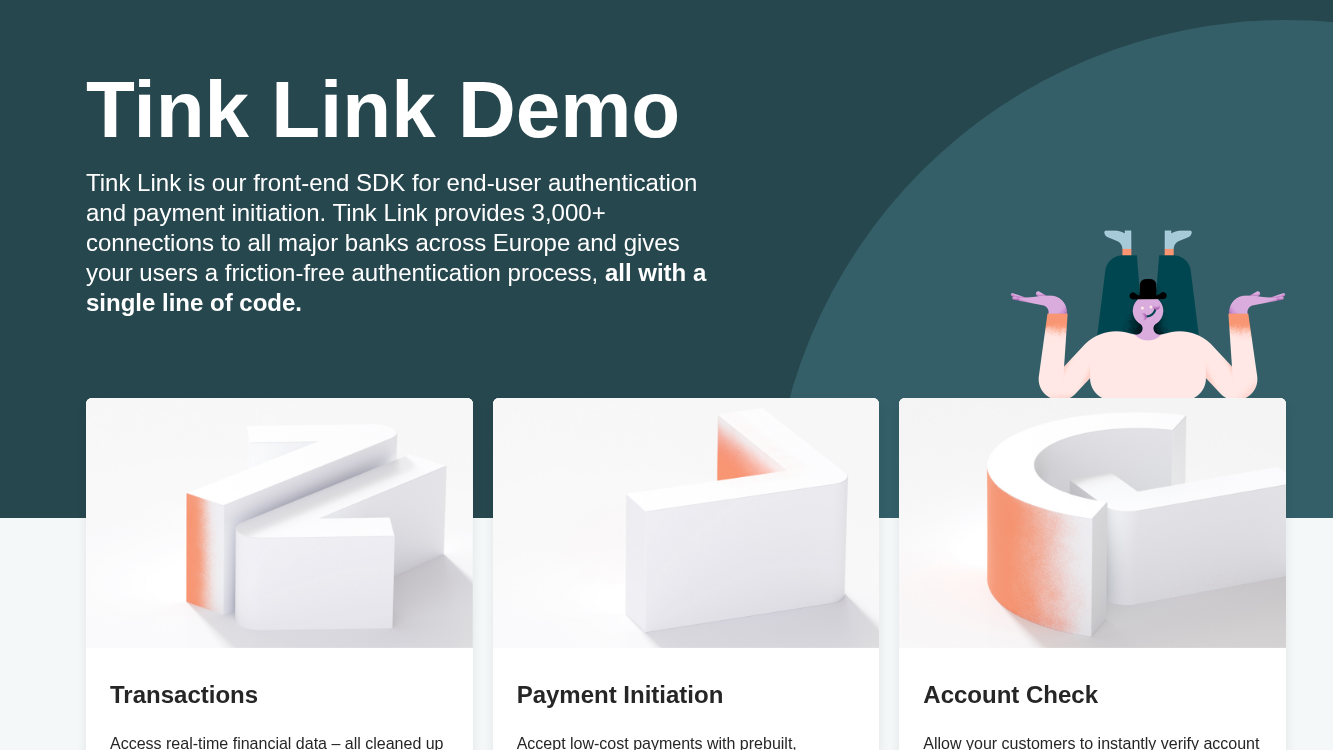
Visa owns Tink outright, and Tink connects to more European banks than the other platforms on this list: over 3,000 connections across 19 markets. It handles both account data and payment initiation, and its customers range from fintechs such as Adyen to banks such as BNP Paribas.
Key Features
- Account data products: Account Check, Transactions, Balance Check, Loans, and Investments.
- Risk products for lending decisions: Income Check, Expense Check, and Risk Insights.
- Payments: Pay by Bank, Variable Recurring Payments, and Payouts.
- Money Manager and Data Enrichment for building personal finance features.
- A login-free Tink Link demo, and a console you can register for on the Standard plan.
Pros & Cons
PROS
CONS
Pricing
Tink shows public prices only to existing customers; prospects get a custom quote.
- Standard: self-serve console, Tink’s own third-party-provider license, quote-based
- Enterprise: custom pricing, your license, or Tink’s, guaranteed SLAs, and the full product catalog
Regional and specialist options
The platforms above are the ones most US teams will shortlist. A few more are worth knowing if your needs are narrower or your users bank elsewhere.
Teller is a developer-first US bank-data API covering more than 7,000 institutions, with instant payments over Zelle and a one-line migration path from Plaid. Its pricing is published: a free tier of 100 live connections, then $1.50 per verified account, $0.10 per balance call, $0.30 per enrollment each month for transactions, and $1.75 per identity call. It works well for smaller US teams that want clear pricing without a sales call.
Basiq is the reference API for Australia and New Zealand, designed around Australia’s Consumer Data Right. It connects to more than 135 institutions and charges per user each month, not per call, starting at AUD 0.50 per user for data plus a platform fee, on a minimum twelve-month term.
GoCardless Bank Account Data is the former Nordigen, now part of GoCardless, which is itself now part of Mollie. It focuses on UK bank payments and data. The free self-serve tier that many European developers relied on is no longer open to new sign-ups; Enable Banking is the common replacement for that kind of self-service account-data access in Europe.
For wider geographic coverage, Yapily offers an API-only, white-label platform across the UK and about 19 European countries, Salt Edge has the broadest country list here at roughly 70, and Belvo spans Latin America, including Mexico, Colombia, and Brazil with Pix, behind a fast sign-up test account.
Open Bank Project is a different kind of tool. It is open-source software that a bank installs to expose its open banking APIs, not an aggregator you call as a fintech, so it belongs in a build-versus-buy conversation on the bank side.
Where US open banking regulation stands
As of 2026, there is no binding federal open banking rule in force in the US. The Consumer Financial Protection Bureau finalized the Section 1033 Personal Financial Data Rights rule in October 2024. It would have required banks to share customer data through free APIs on a shared standard.
A federal court in Kentucky blocked enforcement, the CFPB then reopened the rulemaking, and a revised proposal went to White House review in August 2026. The first compliance date passed during 2026 with no enforcement behind it. The open question is whether banks will be allowed to charge aggregators and fintechs for data access, which the 2024 rule did not permit.
For a team building now, the practical takeaway holds whichever way the rule lands:
- Keep a thin provider-abstraction layer between your code and whichever API you pick, so you can change aggregators if pricing or access terms move.
- Check each provider’s current pricing and data-access terms on its own page before you commit, because these are the terms most likely to change.
- If predictable long-term access matters more than breadth, favor providers that already operate through formal data-access agreements with banks over ones that scrape.
You can track the current status on the CFPB’s Personal Financial Data Rights Reconsideration page and follow standard updates at the Financial Data Exchange.
Frequently Asked Questions
Is open banking legally required in the US right now?
No. The CFPB finalized the Section 1033 Personal Financial Data Rights rule in October 2024, but a federal court blocked it and the CFPB is rewriting it, with a revised proposal under White House review as of August 2026. Until a rule takes effect, US data access keeps working through bilateral agreements between banks and aggregators and the FDX standard, and whether banks can charge for that access is still unsettled.
What is the difference between a data API and a payment API?
A data API reads information with the customer’s permission: balances, transactions, account and owner details, sometimes income or assets. A payment API, also called account-to-account or Pay by Bank, moves money directly between bank accounts. Some vendors do both, but many US products only need data plus verification and never touch payments.
Which of these APIs work outside the US?
Plaid works across the US, Canada, the UK, and about 20 European countries. Tink and TrueLayer serve the UK and Europe. Basiq serves Australia and New Zealand, Salt Edge reaches around 70 countries, and Belvo focuses on Latin America. MX, Mastercard Open Banking, Akoya, Teller, and Stripe Financial Connections are US-centric or US-only.
Do I have to store customers’ bank passwords?
No. Modern connections use OAuth or a bank-hosted login screen, so the credentials stay with the bank. Networks like Akoya are API-only and store no credentials at all. Screen scraping, where an aggregator logs in as the user with saved credentials, is being phased out across the industry.
Can I start without talking to a sales team?
Yes for several. Plaid, Akoya, Stripe Financial Connections, Teller, TrueLayer’s Console, Tink’s Standard plan, and Basiq all let you into a test environment or free tier without a call. MX gates everything behind a demo. Mastercard Open Banking and Yodlee open a sandbox to you but quote production pricing through sales.