



A phone number validation API takes a number as input and tells you whether it’s structurally valid for the country it claims to belong to, using the same numbering-plan rules carriers publish for every country and region. Most APIs go a step further and return the carrier name, the country, and the line type, mobile, landline, VoIP, or toll-free, pulled from carrier and numbering databases the provider maintains.
Some APIs also confirm if a number is actually active and reachable right now and not just correctly formatted. This is a very useful feature: a number can pass every formatting rule and still belong to a disconnected line, and only a live network check can catch that.
Phone number validation lets you route messages correctly and catch fake signups. Developers include this validation into a signup form, a checkout flow, or a CRM system to stop invalid numbers before they turn into an unwanted cost. A lead form that accepts anything typed into it fills a sales pipeline with numbers that bounce. An SMS campaign sent to a list with a five percent invalid rate pays full price to reach numbers that were never going to receive the message. Validation at the point of entry catches both cases immediately, before the number gets stored, dialed, or texted.
In this guide, I will discuss and compare the top phone number validation APIs built specifically for these checks.
Phone number validation APIs compared
| Provider | Known for | Notable feature | Starting price |
|---|---|---|---|
| Twilio Lookup API | Broadest single-provider lookup ecosystem | Pay only for the data fields you request | Free basic lookup; $0.008/request for carrier and line type |
| AbstractAPI | Validation bundled with fraud and risk signals | Risk score and breach history on higher tiers | Free (100 requests); $17/mo billed annually |
| NumVerify | Long-established, simple validator | One key also unlocks the wider API Layer suite | Free (100 requests/month); $14.99/mo for 5,000 |
| Plivo Lookup API | Flat, simple per-request pricing | US/Canada number-portability status | $0.004/request, pay-as-you-go |
| Telesign Phone ID | Fraud- and risk-focused phone intelligence | Subscriber name/address lookup (Phone ID Contact) | $0.011/transaction, pay-as-you-go |
| Loqate Phone Validation | Enterprise data-quality vendor (GBG) | HLR checks plus portability and roaming data | Pay-as-you-go credits; pricing not published |
| Veriphone | Budget-friendly with fully published pricing | Full feature set on every plan; credits never expire | Free (1,000/month); $12.99/mo for 10,000 credits |
| NeutrinoAPI Phone Validate | Lowest verified per-request rate here | One account also covers dozens of other data APIs | $0.00008/request, on-demand |
| Numlookupapi | Simplest option for small projects | Sandbox keys and team management on paid tiers | Free (100 requests/month); $9.99/mo for 5,000 |
Twilio Lookup API
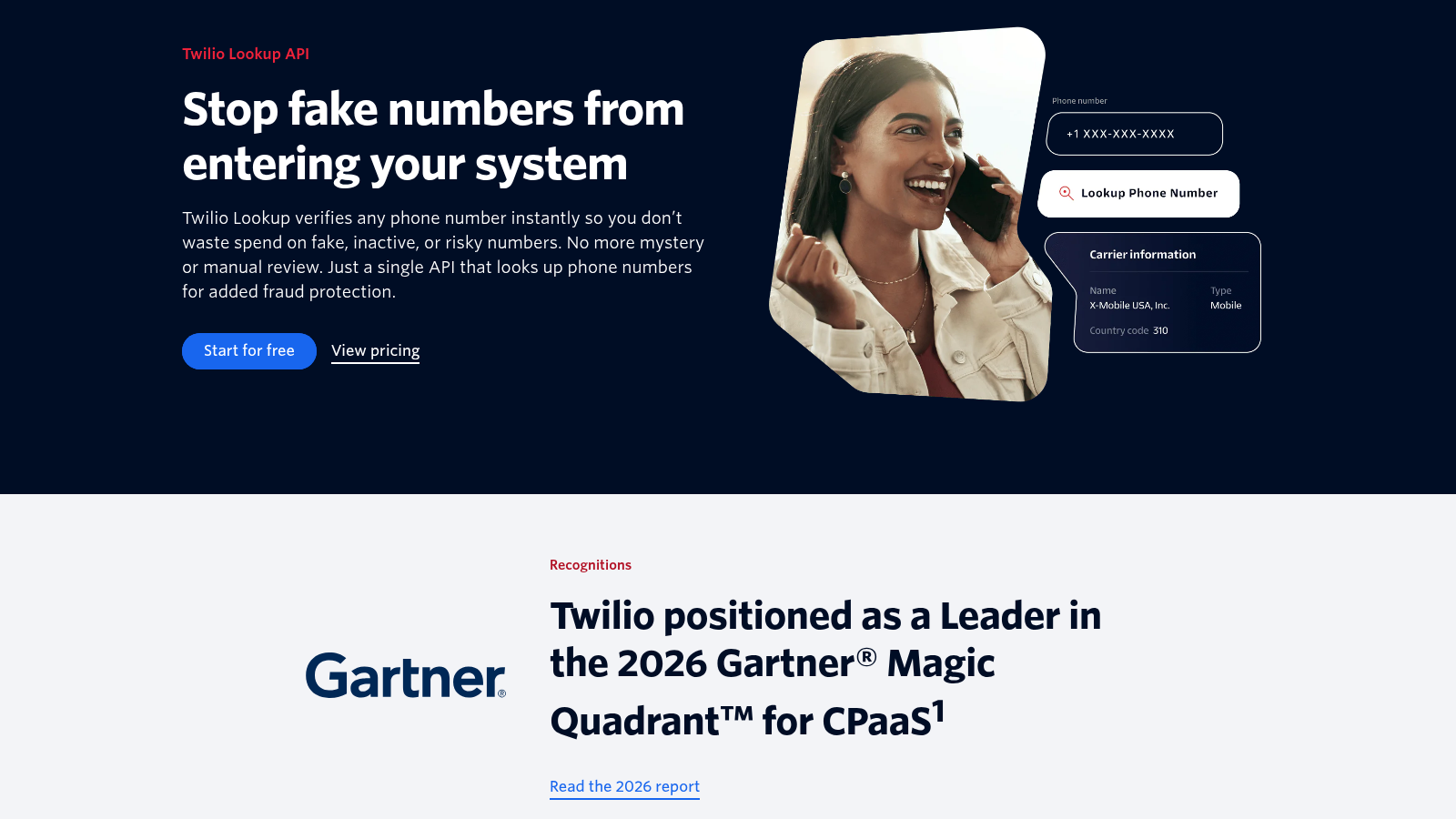
Twilio Lookup is the API most developers reach for first, built on the same platform that already runs SMS and voice for a large share of the market. It prices each data category on its own: basic formatting and validation are free, and carrier, line-type, and fraud-risk data cost extra depending on which fields you request. That structure suits a team that wants to start cheap and add depth only where it’s needed.
Key Features
- Basic Lookup returns E.164 and national formatting plus a validity check, at no cost
- Line Type Intelligence identifies the carrier and classifies the line as mobile, landline, fixed VoIP, non-fixed VoIP, or toll-free
- Line Status checks whether a number is currently active and reachable, priced on a volume-based sliding scale
- SMS Pumping Risk Score flags numbers associated with SMS-pumping fraud, and is free for North American traffic
- Reassigned Number Risk reports whether a number has changed hands since a user last gave consent
Pros & Cons
PROS
CONS
Pricing
Basic Lookup (formatting and validation) is free at any volume. Line Type Intelligence costs $0.008 per request flat. Line Status is tiered from $0.007 per request (0 to 100,000 a month) down to $0.00385 at more than 10 million a month.
Reassigned Number Risk starts at $0.02 per query and drops to $0.0015 at the highest volume tier. Identity Match costs $0.10 per request. SMS Pumping Risk Score costs $0.025 per request outside North America and is free within it.
AbstractAPI Phone Validation
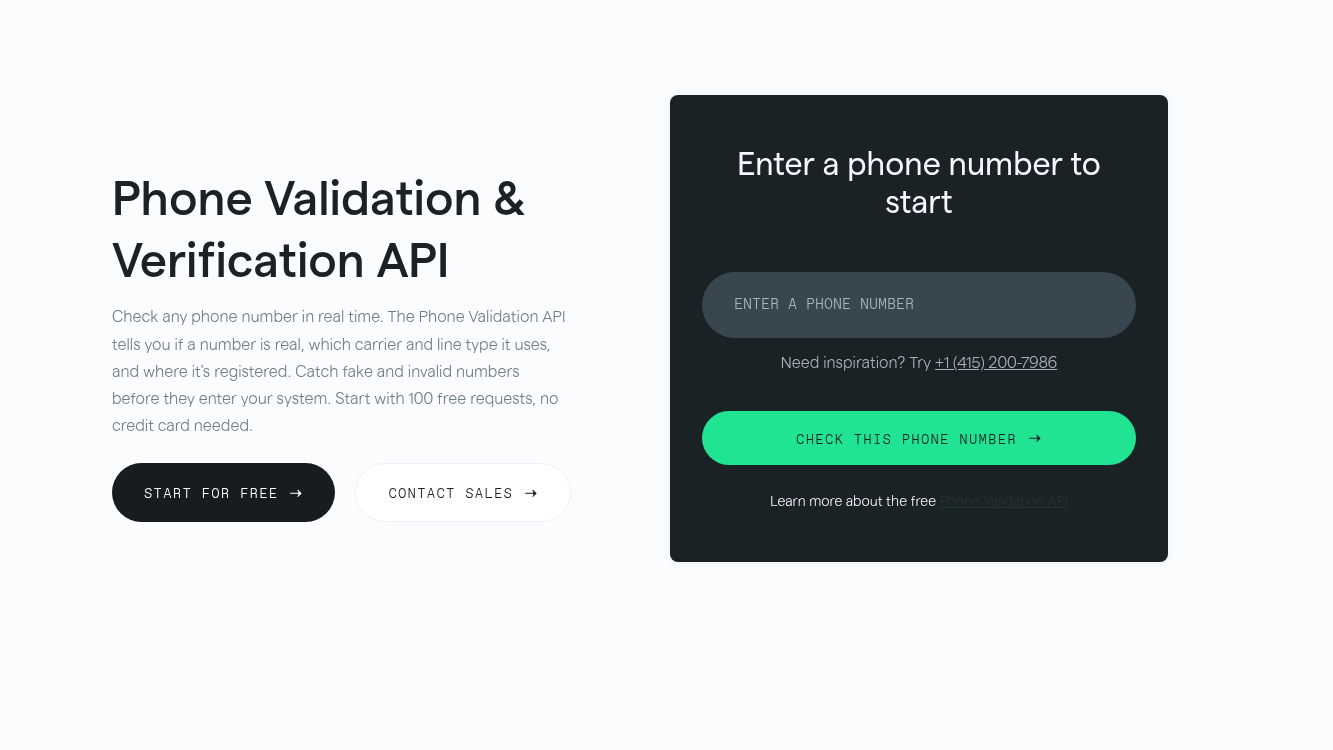
AbstractAPI goes further than a validity flag on its higher tiers, adding registration, risk, and data-breach signals to the standard validity, carrier, and location check. It’s one of several validation and enrichment APIs the company sells under one account, which matters if a project eventually needs email or IP validation from the same key.
Key Features
- Returns validity, registered location, carrier, and local/international formatting on every plan
- Standard tier adds SMS-messaging fields, including the number’s SMS email gateway domain
- The professional tier adds registration details, a risk score, and data-breach history tied to the number
- Bulk CSV upload and domain whitelisting are included from the Starter tier up
- Covers 190-plus countries and territories
Pros & Cons
PROS
CONS
Pricing
Free: 100 requests a month, 3 requests/second, no card required.
Paid tiers (Starter, Standard, Professional) start at $17/mo billed annually.
Enterprise pricing is custom, with flexible volume and a dedicated account manager.
NumVerify
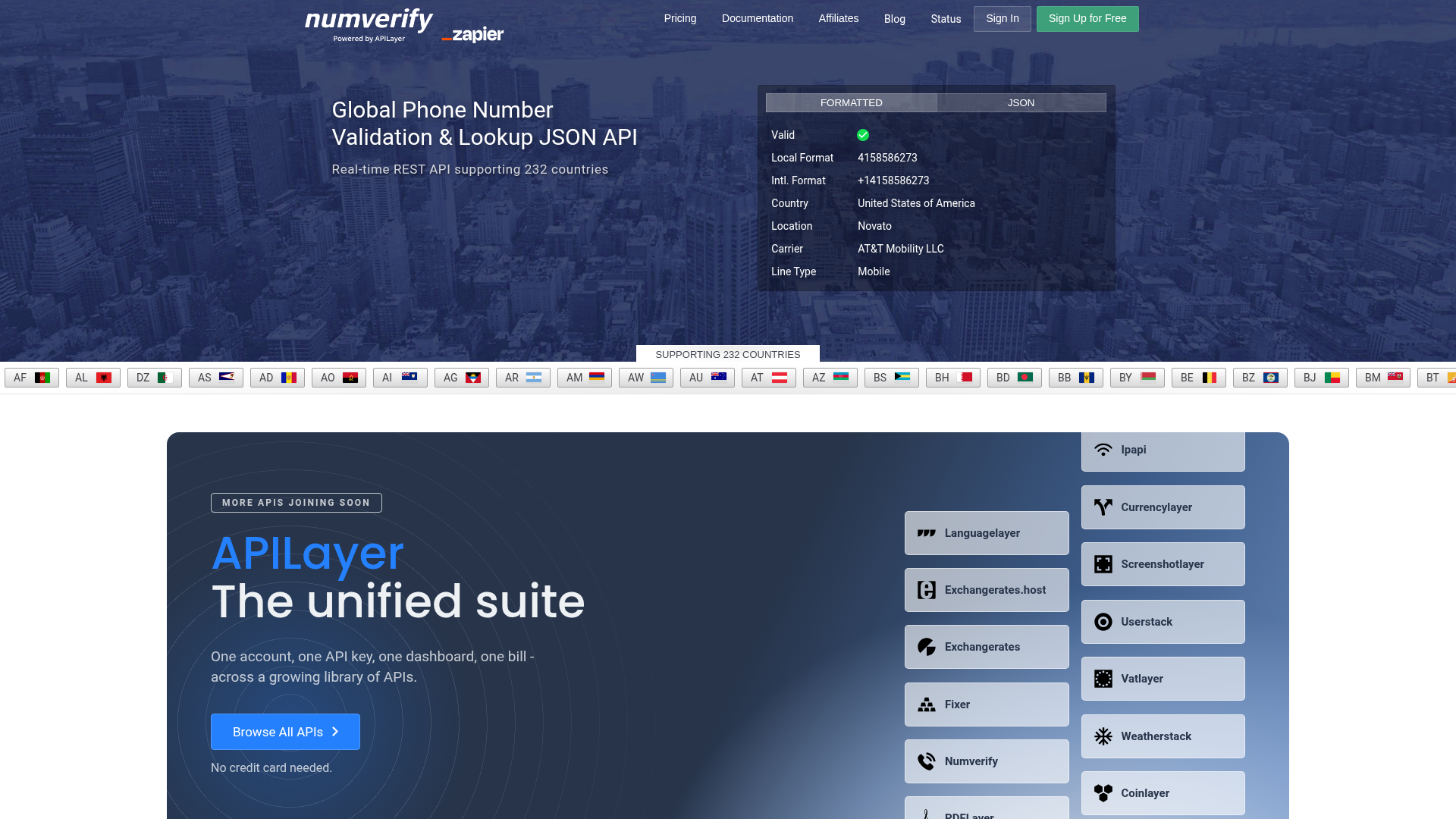
NumVerify is one of the longer-running names in this space, now operated as part of the APILayer suite rather than as an independent company. Signing up gives you a single API key that also works across APILayer’s other verification and data APIs, not just this one.
Key Features
- Validates 232 countries via a single JSON REST endpoint over 256-bit HTTPS
- Returns local and international formatting, country, location, carrier, and line type
- Extended usage statistics track daily and monthly request volume and send automatic low-balance notifications
Pros & Cons
PROS
CONS
Pricing
Free: 100 requests/month.
Basic: $14.99/mo for 5,000 requests.
Professional: $59.99/mo for 50,000 requests.
Enterprise: $129.99/mo for 250,000 requests.
Custom volume pricing is available above that through NumVerify’s sales team.
Plivo Lookup API
Plivo’s Lookup API skips tiers and plans entirely in favor of one flat per-request rate. It is available alongside Plivo’s SMS and voice products, so a team already sending messages through Plivo can add number lookups without a second account.
Key Features
- Returns number formatting in E.164, national, international, and RFC 3966 formats
- Carrier object includes mobile country code, mobile network code, and carrier name
- Classifies the line as fixed, mobile, VoIP, toll-free, or unknown
- Reports number-portability status for US and Canadian numbers specifically
Pros & Cons
PROS
CONS
Pricing
Plivo’s Lookup API is pay-as-you-go at a flat USD 0.004 per request, regardless of volume.
Telesign Phone ID
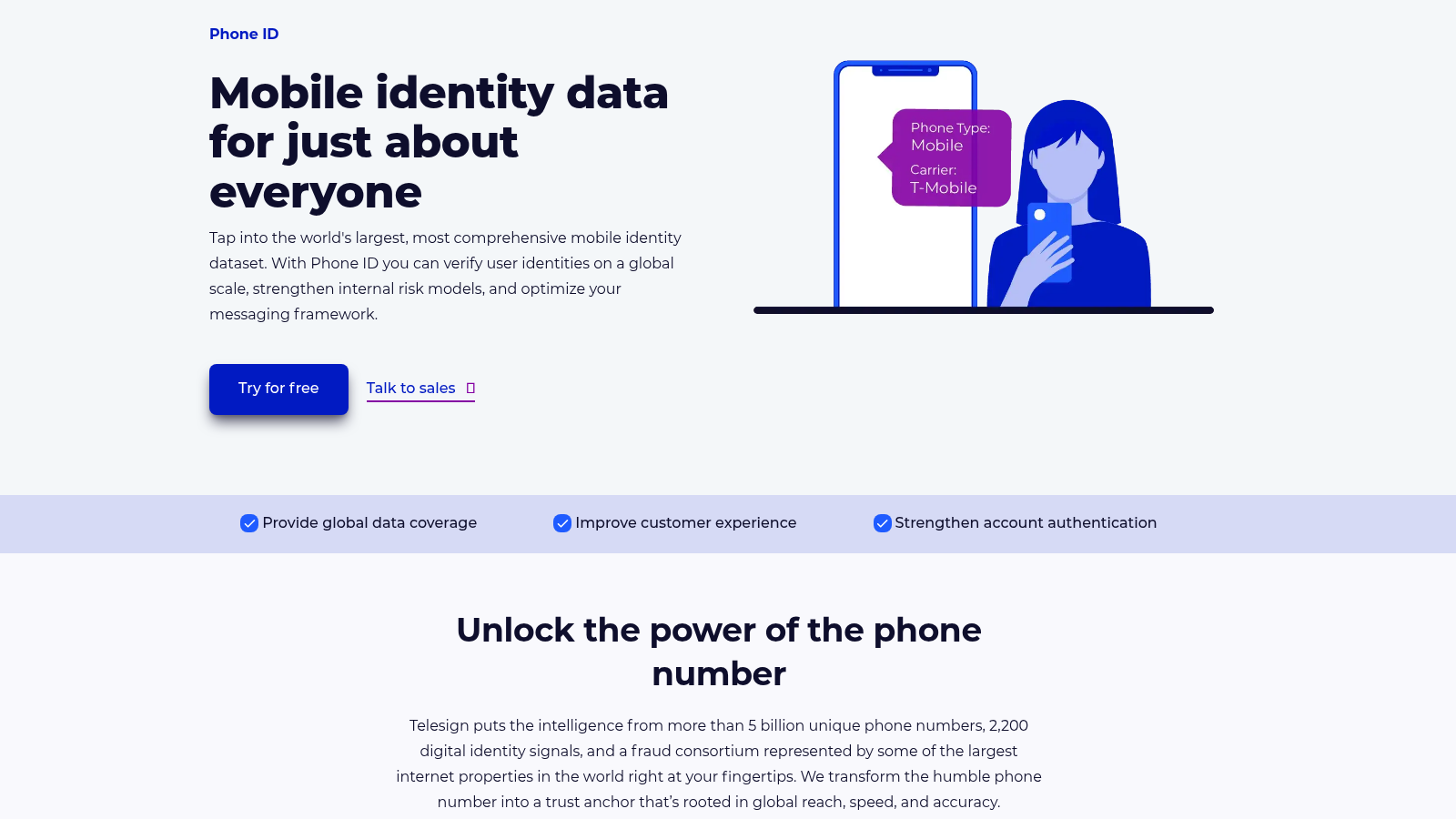
Telesign built its business on fraud prevention, and Phone ID reflects that: it treats a phone number as a signal for assessing risk, not just a string to format correctly. A companion product, Phone ID Contact, goes further and returns the subscriber’s name and address tied to the number.
Key Features
- Phone ID returns core phone number attributes for real-time risk assessment
- Phone ID Contact adds subscriber name and address as a separate, priced lookup
- A free trial account with test credits is available for both products, no card required
Pros & Cons
PROS
CONS
Pricing
Phone ID costs $0.011 per transaction, pay-as-you-go.
Phone ID Contact costs $0.10 per transaction.
Access to other phone attributes requires contacting Telesign’s sales team. Volume discounts are available for committed use.
Loqate Phone Validation
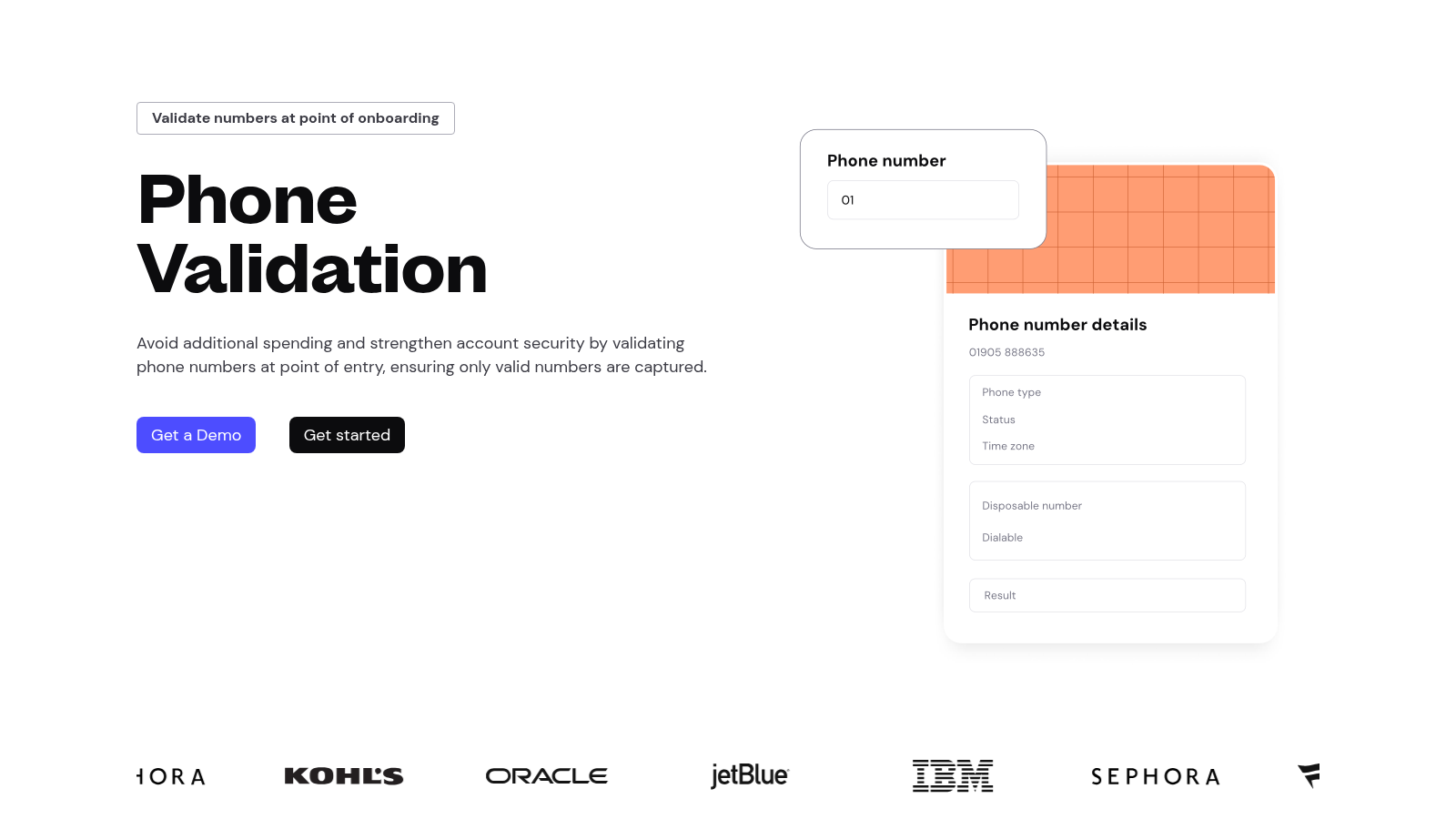
Loqate is GBG’s data-quality product, built on the same address-verification heritage the company is best known for, extended here to phone numbers with live-network checks rather than formatting rules alone.
Key Features
- Covers 241 countries and territories for validation
- HLR checks confirm carrier connectivity against the live network, not just numbering-plan formatting
- Reports portability and roaming status alongside a standard validity check
- Supports both real-time API calls and batch validation for existing customer lists
Pros & Cons
PROS
CONS
Pricing
Loqate uses pay-as-you-go credit top-ups, where larger credit packs lower the cost per lookup. There is also a bespoke enterprise plan for which specific per-lookup dollar figures aren’t published; both options require signing up for the 45-day free trial or contacting Loqate’s sales team.
Veriphone
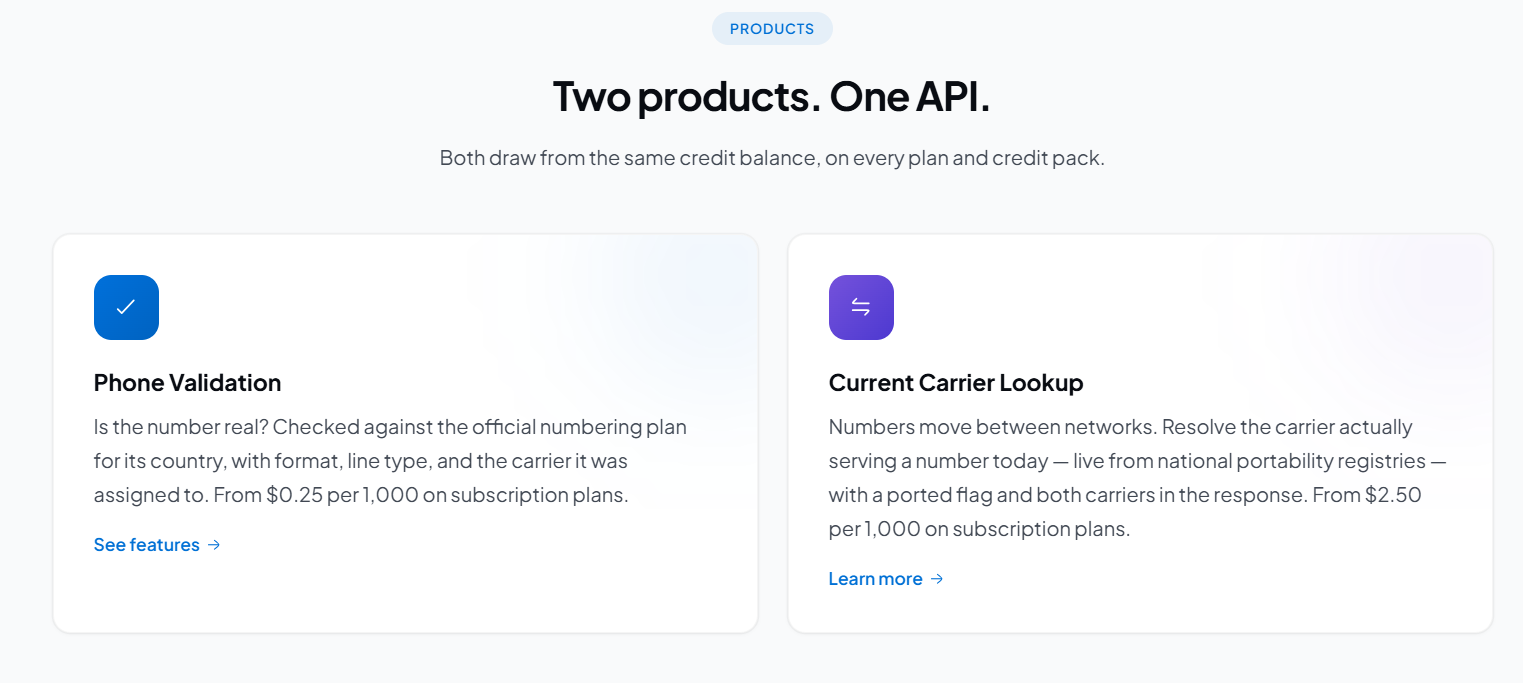
Veriphone publishes every price down to the cent, with volume the only thing that changes between its free tier and its largest subscription plan. That transparency makes it easier to estimate real costs before signing up than with a vendor that gates pricing behind a sales call.
Key Features
- Covers 243 countries and territories with validation, carrier lookup, and line-type detection on every plan
- A separate Current Carrier Lookup resolves which carrier serves a number today, useful after number porting
- Pay-as-you-go credit packs never expire, alongside monthly subscription plans
- Bulk validation via CSV upload is available on every plan, including the free tier
Pros & Cons
PROS
CONS
Pricing
Free: 1,000 validations a month, no credit card.
Pay-as-you-go credit packs range from $2.40 per 1,000 credits (10,000-credit pack) down to $0.20 per 1,000 credits (5-million-credit pack);
Subscription plans: Starter $12.99/mo for 10,000 credits, Professional $39/mo for 50,000, Business $99/mo for 250,000, Enterprise $249/mo for 1,000,000.
A standard validation costs 1 credit; Current Carrier Lookup costs 10 credits.
NeutrinoAPI Phone Validate
NeutrinoAPI treats Phone Validate as one line item inside a much larger catalog of on-demand data APIs. All of them are billed through the same flat, on-demand pricing model rather than as standalone products.
Key Features
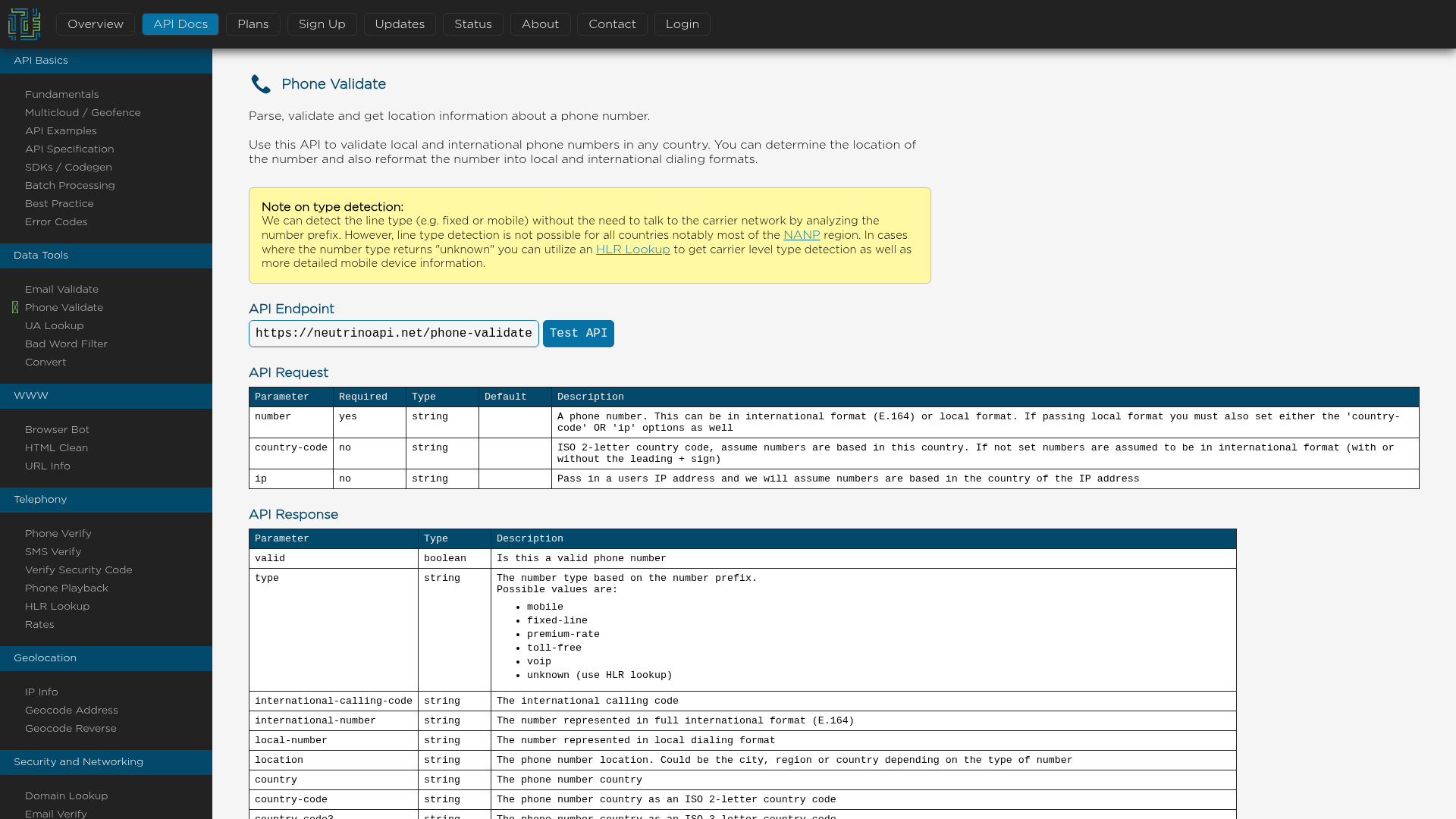
- Classifies numbers as mobile, fixed-line, premium-rate, toll-free, VoIP, or unknown
- A separate HLR Lookup endpoint resolves carrier-level detail when Phone Validate returns “unknown”
- Returns local and international number formatting alongside country and location data
- The same account covers dozens of other on-demand APIs, including email, IP, and geocoding lookups
Pros & Cons
PROS
CONS
Pricing
Phone Validate costs $0.000080 per request on-demand, equal to $0.80 per 10,000 requests.
Fixed monthly plans with daily quotas are also available.
On-demand overage on a monthly plan is billed once the plan’s daily limit, multiplied by 30, is exceeded.
Numlookupapi
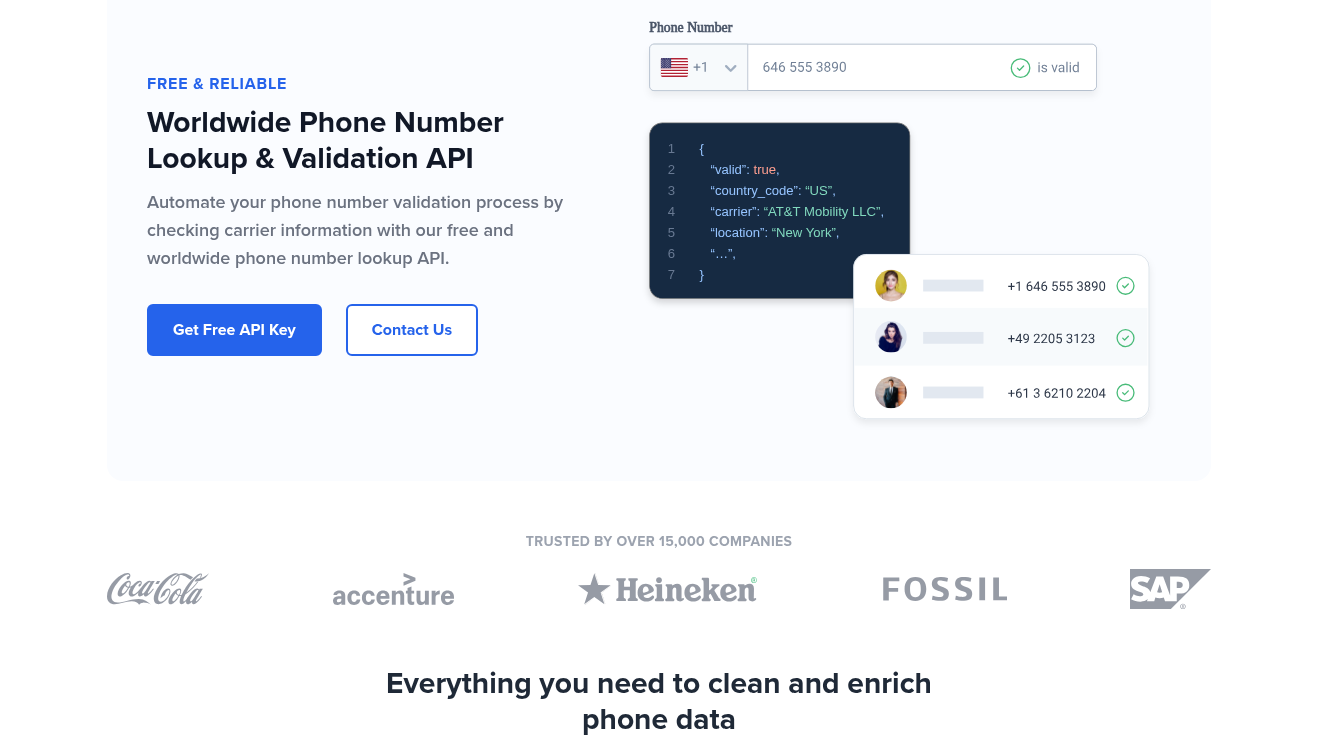
Numlookupapi keeps things simple: one JSON endpoint, a straightforward tier ladder, and no fraud-scoring or enrichment layer to configure. It suits a small project that just needs a clean phone validity check without extra complexity.
Key Features
- Provides phone data for 230-plus countries through a single JSON REST endpoint
- Pro and higher tiers add sandbox API keys, useful for testing without touching production credits
- Team management and multiple API keys are available from the Pro tier up
Pros & Cons
PROS
CONS
Pricing
Free: 100 requests/month, 10 requests/minute.
Basic: $9.99/mo for 5,000 requests.
Pro: $49.99/mo for 50,000 requests, 2 API keys, sandbox keys, team management.
Scale: $109.99/mo for 250,000 requests, 5 API keys, SLA, IP whitelisting.
Custom plans are available for above 250,000 requests a month.
How to choose a phone number validation API
Budget and expected volume are the main considerations. A side project or MVP that just needs to confirm a number looks real will just need a free tier: AbstractAPI, NumVerify, Veriphone, and Numlookupapi all include one, and Twilio’s basic formatting check costs nothing at any volume.
Once volume climbs into the tens of thousands of requests a month, flat per-request pricing from Plivo or NeutrinoAPI becomes easier to forecast than a tiered monthly plan.
When fraud prevention matters more than a simple validity flag, Telesign and AbstractAPI both offer risk signals on top of validation. You get traffic-pattern context from Telesign and a risk score and breach history from AbstractAPI’s higher tiers. Twilio’s SMS Pumping Risk Score and Reassigned Number Risk endpoints solve a narrower version of the same problem for teams already sending through Twilio.
If global reach and network-level confirmation matter more for you, Veriphone and Loqate both cover more than 240 countries and territories. Loqate’s HLR checks add live network confirmation that a static numbering-plan lookup can’t provide on its own. Plivo’s portability field only resolves for US and Canadian numbers.
Twilio, AbstractAPI, NumVerify, Plivo, Telesign, Veriphone, NeutrinoAPI, and Numlookupapi all show real pricing without talking to anyone. Loqate is the exception here: its credit pricing requires signing up or contacting sales to see: a normal trade-off for an enterprise-oriented vendor, but a real difference if comparing costs before creating an account matters to you.
Frequently Asked Questions
What data does a phone number validation API actually return?
At minimum, expect number formatting (E.164 and national format) and a validity flag. Most of the APIs in this guide also return the country and line type, mobile, landline, VoIP, or toll-free, and carrier name. Fraud-focused providers like Telesign and AbstractAPI add subscriber, risk, or breach data on top of that baseline.
Is there a free phone number validation API?
Yes. AbstractAPI, NumVerify, Veriphone, and Numlookupapi all include a free monthly request allowance that doesn’t ask for a card upfront. Twilio’s basic formatting and validation check is free at any volume; carrier and line-type data cost extra once you need them.
How accurate is phone number validation?
Most of these APIs check formatting and numbering-plan rules rather than dialing the number, so a result can confirm a number is correctly formatted without confirming it’s currently connected. Loqate’s HLR checks and NeutrinoAPI’s separate HLR Lookup endpoint are two of the few options here that query the live mobile network directly for that kind of confirmation.
Can these APIs detect VoIP or landline numbers?
Yes, line-type detection is a standard field across every API in this guide. Detection can still return “unknown” for some numbers, particularly in the US and Canada, unless the API falls back to a network-level lookup like NeutrinoAPI’s HLR endpoint or Loqate’s HLR checks.
What’s the difference between phone validation and SMS OTP verification?
A validation API checks whether a number is real and how it’s formatted before you use it. An OTP or verification API, a separate product most of these vendors also sell, sends a one-time code to confirm the person entering the number actually controls it. This guide covers validation APIs only, not OTP delivery.