


Most results for ‘QR code API’ are QR-generator websites you operate through a dashboard, not something your code can call directly. An actual API works differently: send it a URL or some text over HTTP, and you get a QR code image directly.
This list only covers products a developer can call directly: a documented endpoint and a request format, not QR-generator websites that only work through a dashboard.
A static QR code encodes its data permanently. Scanning it always leads to the same place. A dynamic QR code points to a short redirect URL that the provider controls. You can change the destination after the code has already been printed and usually get scan analytics along with it. Most of the APIs below generate static codes only; a couple of the platform-style entries also support dynamic codes tied to a subscription.
QR Code APIs Compared
| API | Free Tier | Paid From | Auth | Output Formats |
|---|---|---|---|---|
| GoQR (api.qrserver.com) | Unlimited, no key needed | Free only | None | PNG, GIF, JPEG, SVG, EPS |
| QuickChart QR API | 1,000 codes/month | $40/month | None (optional key on paid) | PNG, SVG |
| Neutrino API | ~10-25 requests/day | $10/month | API key + user ID | PNG |
| Cloudmersive Barcode API | 600 calls/month | $19.99/month | API key | PNG (plus barcode reading) |
| API Ninjas QR Code API | 3,000 calls/month (no commercial use) | $39/month | API key header | PNG, JPG, EPS, SVG |
| QRCode Monkey API | None | $9/month | API key (via RapidAPI) | PNG, SVG, PDF, EPS |
| QR.io API | 7-day trial only | $39.99/month | Account-based | PNG (dynamic codes) |
| QRCG by Bitly API | Not published | Contact sales | Account-based | Not published |
GoQR
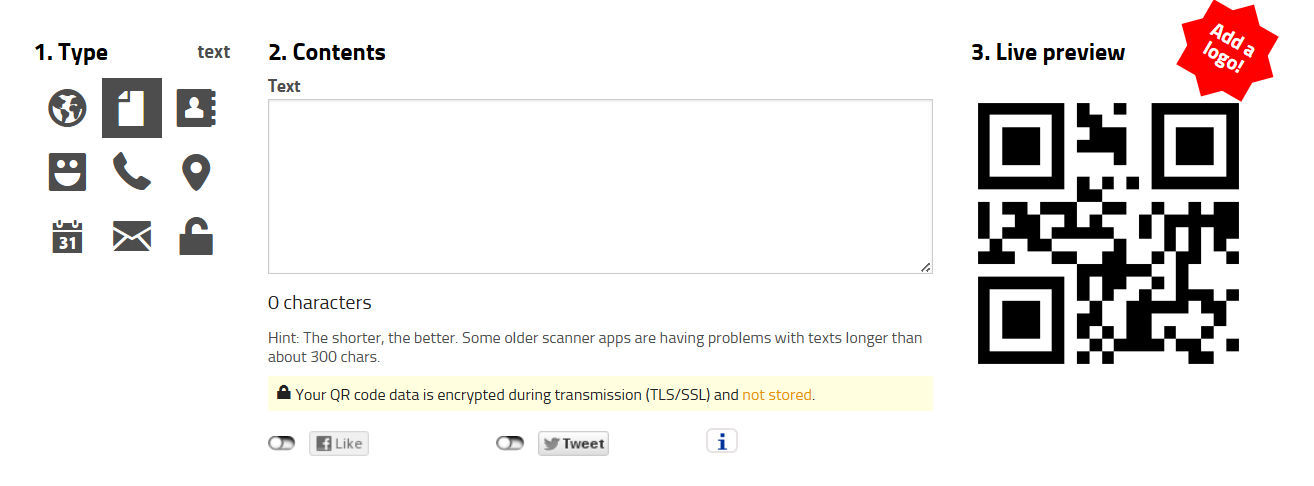
GoQR‘s free endpoint at api.qrserver.com needs no signup, no API key, and no billing setup: build a URL with your data as a query parameter, and the response is the image. It’s also one of the only entries here that can decode a QR code as well as create one, so generation and reading come from the same provider, not two separate services.
Key Features
- Generates a QR code with a single unauthenticated GET request
- Separate
read-qr-codeendpoint decodes an existing QR code image back into its original data - Supports colored codes and an embedded logo or image
- Returns PNG, GIF, JPEG, SVG, or EPS depending on the request parameters
Pros & Cons
PROS
CONS
Pricing
Free, with no paid tier. The provider asks high-volume users (over roughly 10,000 requests/day) to reach out directly rather than publishing a hard cutoff.
QuickChart QR Code API
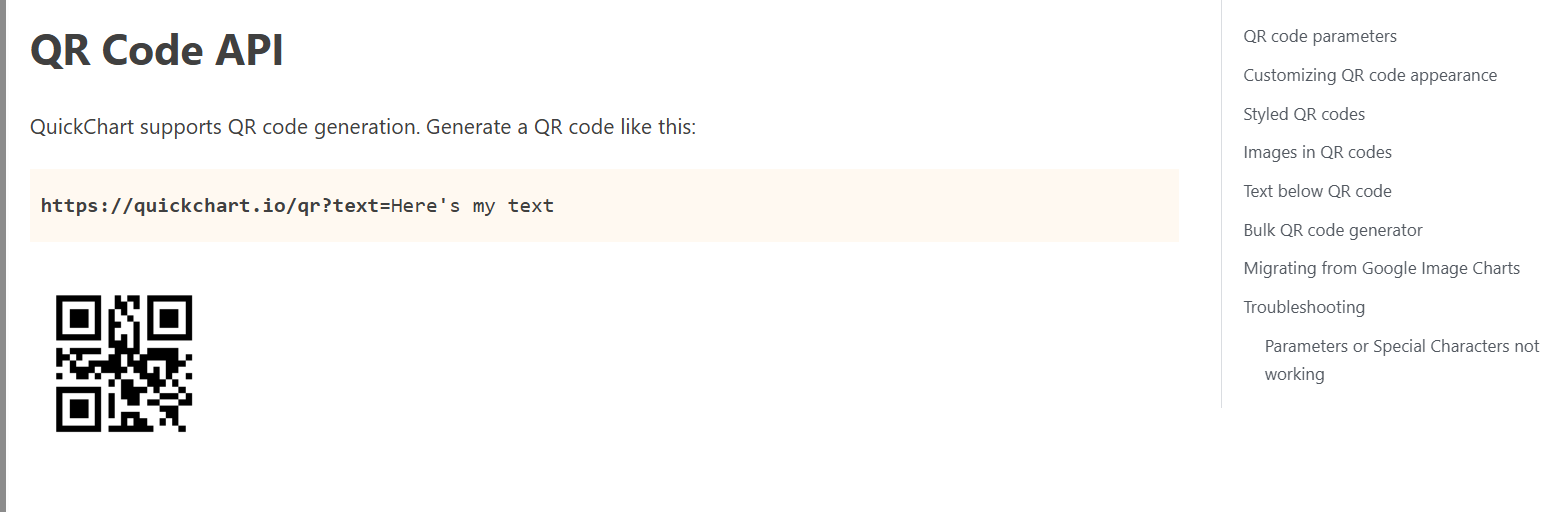
QuickChart started as an open-source chart-image API and generates QR codes through the same URL-based pattern it uses for charts: construct a request URL and drop it straight into an <img src> tag with nothing to parse or decode server-side. Because the project is open source, teams that outgrow the hosted limits can self-host it instead of upgrading.
Key Features
- URL-based requests that return an image directly, no client library required
- Open-source codebase, so the service can be self-hosted if the hosted free tier isn’t enough
- Unlimited QR code scans on every tier, including free
- Dedicated low-latency server cluster on the paid tier, versus shared infrastructure on the free tier
Pros & Cons
PROS
CONS
Pricing
The Community tier is free for 1,000 QR codes a month at up to 60 per minute.
Professional is $40/month for 10,000 QR codes a month with no rate limit and dedicated servers.
Enterprise pricing is custom and adds unlimited codes, an on-premises option, and an SLA.
Neutrino API
Neutrino API‘s QR code endpoint is one of dozens of utility APIs (IP lookup, email validation, phone validation, and others) available under a single account. This is useful if your project is already using other Neutrino APIs.
Key Features
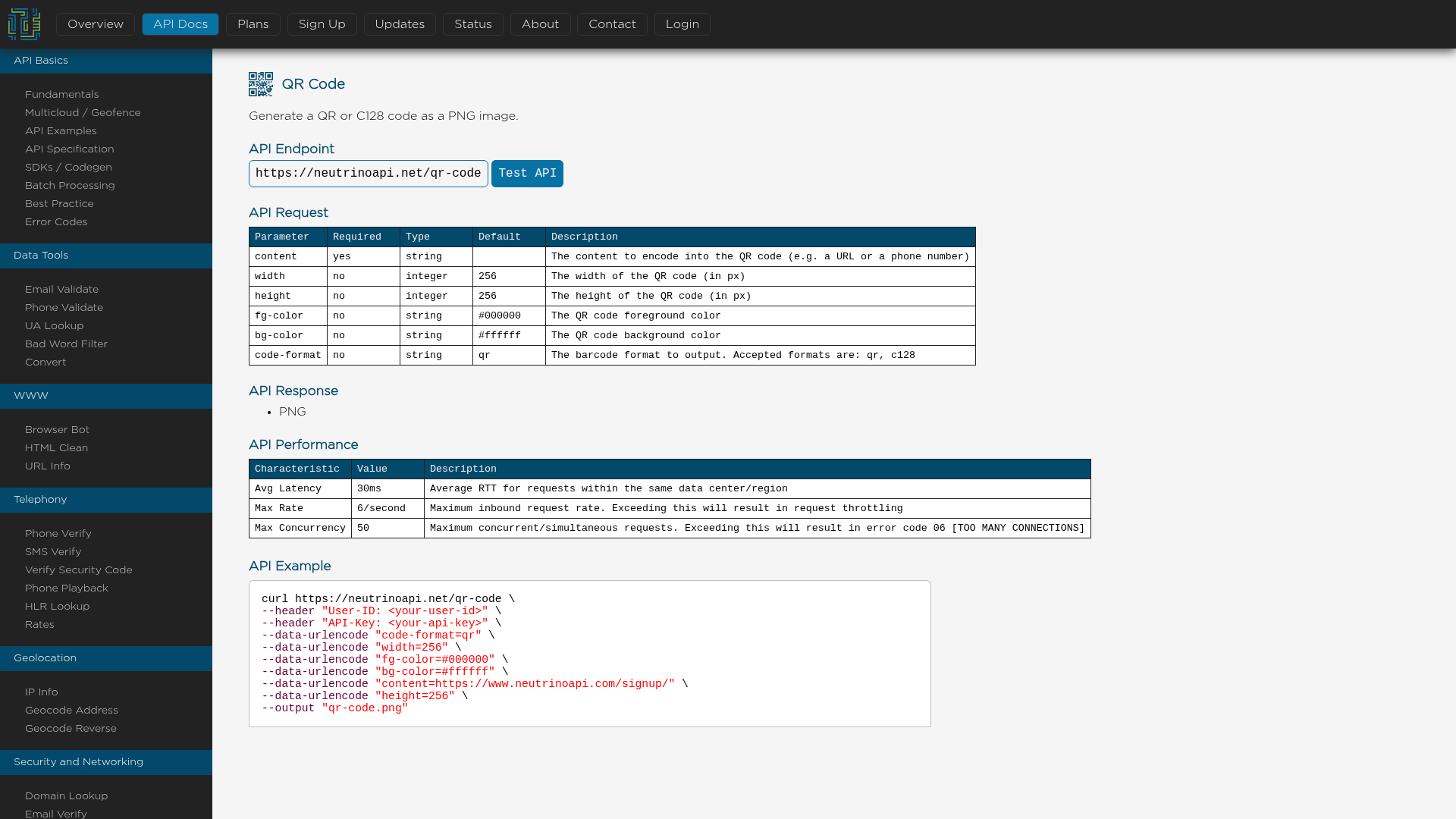
- One endpoint generates either a QR code or a Code 128 barcode based on a single parameter
- Published performance figures: roughly 30ms average latency, up to 6 requests/second, 50 concurrent requests
- Foreground and background color parameters for basic customization
Pros & Cons
PROS
CONS
Pricing
A free account allows a limited number of daily requests with no expiry. Paid plans are:
Tier 1: $10 for 100 QR codes
Tier 2: $50 for 1000 QR codes
Tier 3: $250 for 10K QR codes
Pay-per-request billing is also available for unexpected increases in demand.
Cloudmersive Barcode API
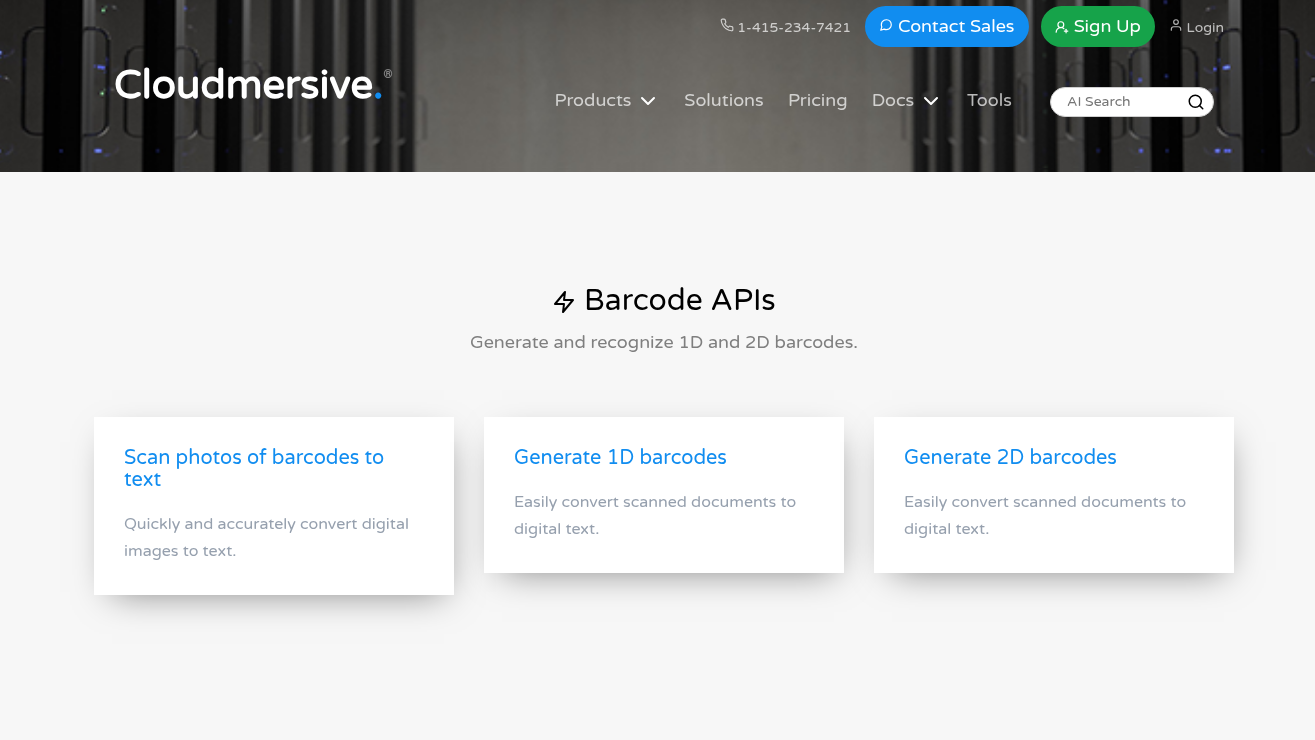
Cloudmersive’s Barcode API covers more ground than a QR-only endpoint: it reads QR codes and barcodes back from an actual photo, not just a clean digital image, which fits an app that needs to perform both actions.
Key Features
- Generates QR codes plus four common 1D barcode formats from the same API
- Scans photos of barcodes or QR codes, including imperfect or angled shots, into structured data
- SDKs published for C#, Java, Node.js, .NET Core, Python, PHP, Ruby, and Objective-C
- Interactive Swagger/OpenAPI documentation alongside code samples in each supported language
- Free tier available with no expiration date
Pros & Cons
PROS
CONS
Pricing
For small businesses, the following plans are offered.
Free for 600 calls a month at 1 request/second.
Basic is $19.99/month for 10,000 calls at 2 requests/second
Business is $49.99/month for 25,000 calls
Business premier at $99.99/month for 50,000 calls
Business Advantage at $199.99/month for 100,000 calls at 4 requests/second
Larger medium-business and enterprise tiers are available above these.
API Ninjas QR Code API
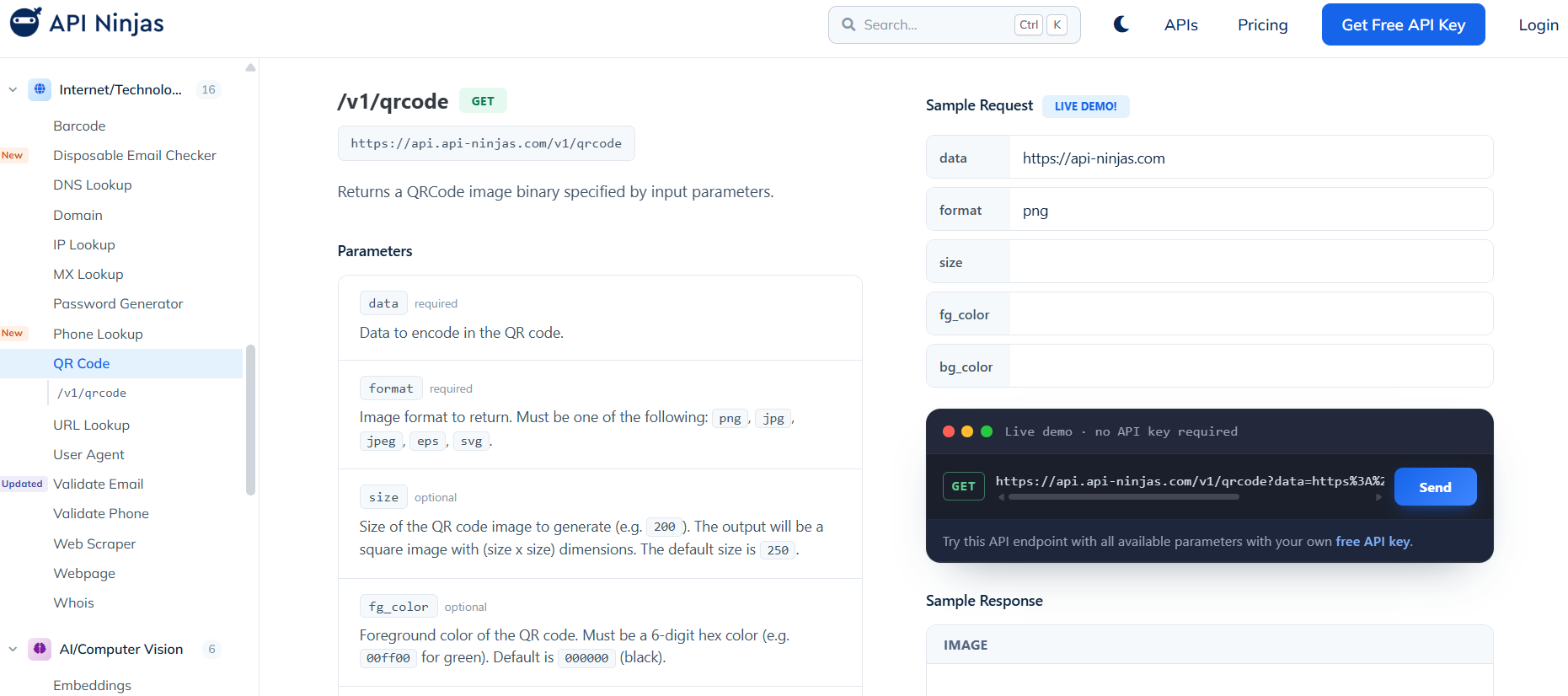
API Ninjas offers a QR Code API as one of dozens of small, single-purpose endpoints available through one account and one API key, which suits a project that already leans on a couple of their other utility APIs.
Key Features
- Accepts data, format, size, and hex color parameters in a single request
- Outputs PNG, JPG, JPEG, EPS, or SVG
- Header-based API key authentication, consistent across API Ninjas’ full catalog
- Code examples in cURL, Python, JavaScript, and Node.js
Pros & Cons
PROS
CONS
Pricing
Free tier includes 3,000 calls/month at 100/hour, for evaluation only, no commercial use, with required attribution.
Paid plans are
- Developer for $39/month (100,000 calls)
- Business at $99/month (1 million calls, the most popular tier)
- Professional at $199/month (10 million calls)
- Enterprise tier for custom pricing.
All paid plans permit commercial use.
QRCode Monkey API
The free web tool at qrcode-monkey.com and its developer API are two different products: the API is distributed through RapidAPI rather than sold directly, and it carries the heaviest design customization of anything on this list.
Key Features
- Separate endpoints for custom-styled, transparent-background, and logo-uploaded QR codes
- Outputs PNG, SVG, PDF, or EPS for print-ready use
- Granular styling controls, including per-element gradients and shape choices
Pros & Cons
PROS
CONS
Pricing
Access is sold through RapidAPI at three tiers:
- Basic is $9/month for 200 requests plus $0.04 per request over that
- Pro is $19/month for 1,000 requests plus $0.02 overage
- Ultra is $99/month for 10,000 requests plus $0.01 overage.
All tiers share a 3 requests/second rate limit.
QR.io API
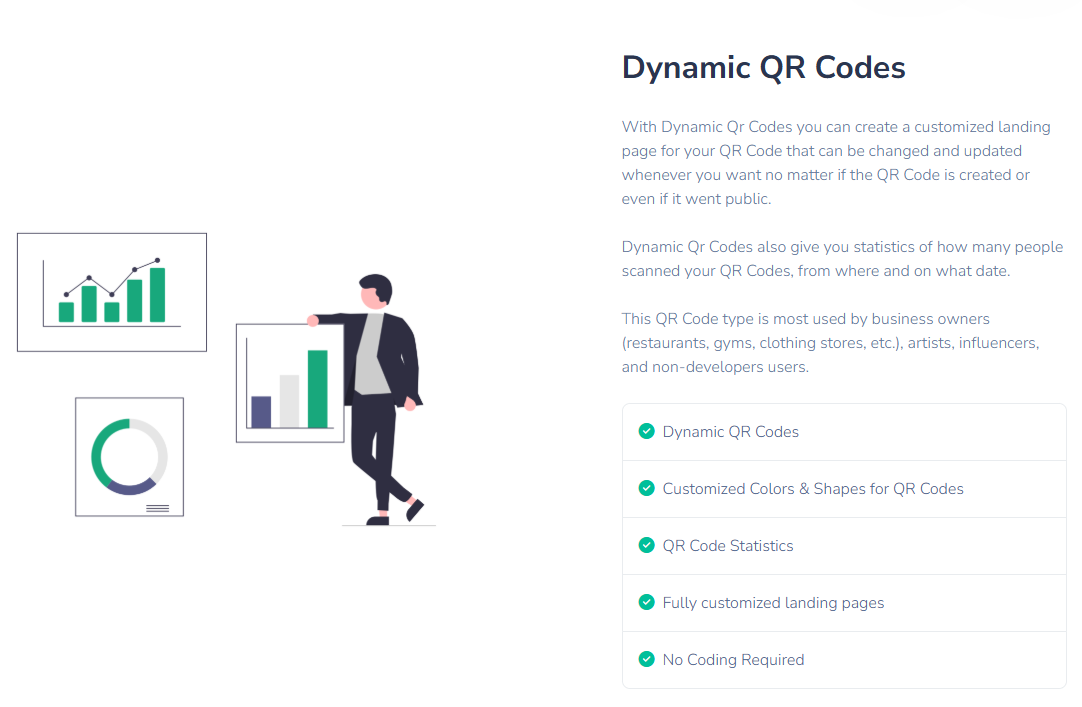
QR.io bundles API access into a flat-rate subscription rather than metering by request, which changes the calculation compared to the pay-per-call APIs above it on this list. A paid plan includes unlimited QR code creation, unlimited scans, and dynamic codes that can be redirected after printing, with API access included at the same price as the dashboard.
Key Features
- Dynamic QR codes that redirect to a new destination after the code is already printed
- Unlimited QR code creation and scans included in the subscription rather than metered per call
- Scan statistics available alongside the API
Pros & Cons
PROS
CONS
Pricing
$39.99/month billed monthly, or $350 billed yearly.
Both tiers include API access, unlimited QR codes and scans, and custom landing pages. A 7-day free trial is available, and static QR codes created during the trial keep working after it ends even without a subscription.
QRCG by Bitly API
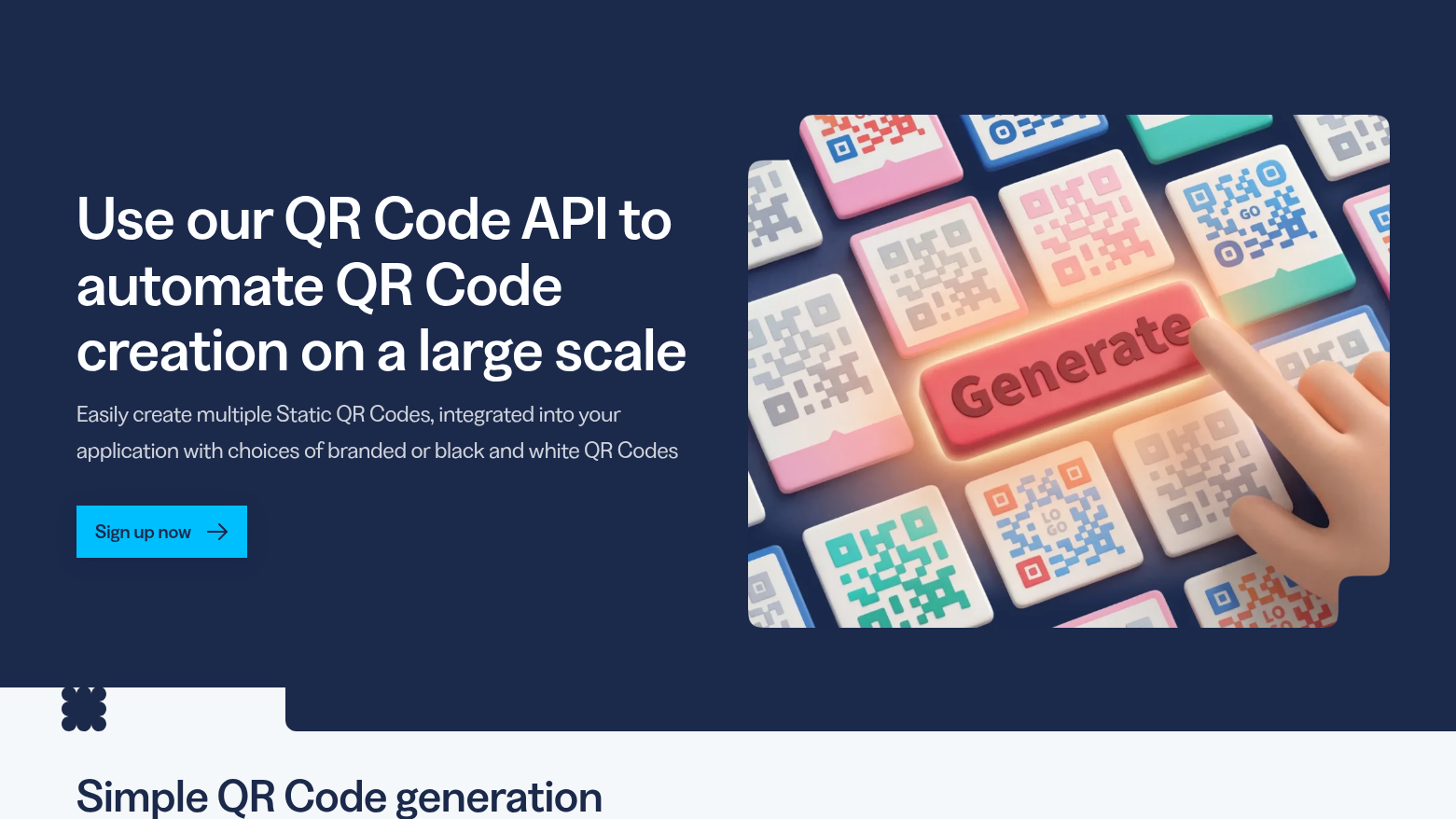
QRCG by Bitly is the current name for what used to operate as a standalone QR code generator, now integrated into Bitly’s Connections Platform. Its REST endpoint takes a text string and an access token and returns a QR code as a binary image file. It offers a bulk-creation feature on paid plans for generating many codes in one pass rather than one request at a time.
Key Features
- Single POST or GET request to a create endpoint, authenticated with an access token generated from the account dashboard
- Returns JPG, PNG, SVG, or EPS as a binary image file
- Request parameters cover foreground and background color, frame styling, and call-to-action text around the code
- Bulk creation of up to 100 codes per batch on the Advanced plan, or 500 on Professional
Pros & Cons
PROS
CONS
Pricing
API access starts on the Advanced plan at $12.50/month billed annually ($150/year), which includes 3,000 API requests, 50 dynamic QR codes, unlimited scans, and 2 users.
Professional is $37.50/month billed annually ($450/year) for 10,000 API requests, 250 dynamic QR codes, and 5 users.
An Enterprise plan with custom API limits and white-labeling is available by contacting sales.
(The entry-level Starter plan ($5/month or $60/year) does not include API access.)
How to Choose a QR Code API
Decide based on your volume and budget. GoQR and QuickChart’s free tier cover casual or low-traffic use without any billing setup, while Neutrino API and API Ninjas’ free tiers are really only enough for testing before a paid plan becomes necessary.
If the app needs to generate thousands of codes a month from day one, QuickChart’s Professional tier or Cloudmersive’s paid tiers are cheaper than starting from a free plan that will be quickly exhausted and escalate your costs.
Generation covers most use cases, but if you also need to verify or process incoming QR codes, like a ticket-scanning or check-in flow, you can choose GoQR or Cloudmersive, since they’re the only two here with a reading endpoint.
Output format matters more than it might seem. A QR code destined for a web page only needs PNG, which every API here supports. Print collateral, packaging, or anything that needs to scale without pixelation calls for a vector format like SVG, EPS, or PDF, which narrows things to QuickChart, API Ninjas, or QRCode Monkey.
Decide whether the codes need to stay editable after they’re printed. Static codes from any API on this list are permanent once generated. Dynamic codes, where the destination can change after printing and scans can be tracked, are only available through the platform-style entries here, QR.io and QRCG by Bitly, both priced as subscriptions rather than per-call APIs.
FAQs
Can any of these APIs generate a QR code without an API key?
Yes. GoQR requires no signup or key at all, and QuickChart’s free tier works without authentication too, though QuickChart supports an optional key on paid plans for tracking usage.
Which of these can read or decode an existing QR code, not just generate one?
GoQR and Cloudmersive both publish a reading endpoint. GoQR decodes a QR code image back into its original text, while Cloudmersive can scan a photo of a barcode or QR code, including an imperfect or angled shot, into structured data.
Do free tiers on these APIs allow commercial use?
It varies by provider, and it’s worth checking before shipping to production. API Ninjas explicitly excludes commercial use from its free tier, while GoQR, QuickChart, Cloudmersive, and Neutrino API don’t carry that restriction on their free access.