



Did you know that some apps let you earn money by sharing your unused internet bandwidth?
If you have an unlimited or high-data internet plan and don’t use all of it, these apps allow other users or businesses to route traffic through your connection, and you get paid in return.
However, this is not something everyone should jump into blindly. Sharing your bandwidth means allowing third-party traffic to pass through your network and IP address. That comes with privacy, security, and even legal risks, depending on how the service is used.
So, before trying any of these apps, make sure you understand how they work, what data they collect, who uses your connection, and whether your internet service provider allows this kind of usage.
Now, let’s look at some apps that let you earn money by sharing your internet bandwidth, along with the risks you should know about.
The list is based on my research and experience, but this should not be taken as a recommendation to use them without understanding the risks.
Disclaimer
This article is for informational purposes only. I am not encouraging you to sell or share your internet bandwidth without understanding the possible risks. This may affect your privacy, your network reputation, your internet speed, and, in some cases, may violate your ISP’s terms of service. Only use these apps if you fully understand how they work, trust the provider, and are comfortable with the potential consequences. If you are unsure, it is better not to use them.
Pawns.app
Pawns.app lets you earn money by sharing your unused internet bandwidth and completing surveys. Once installed, the app runs in the background and allows verified third parties to use a portion of your connection for tasks such as market research, price comparison, and web scraping.
It is available on multiple platforms, including Windows, macOS, Linux, Android, and iOS. However, like any bandwidth-sharing app, it comes with privacy and security considerations. Since third-party traffic may pass through your IP address, you should review its terms, understand how your connection is used, and only use it if you are comfortable with the risks.
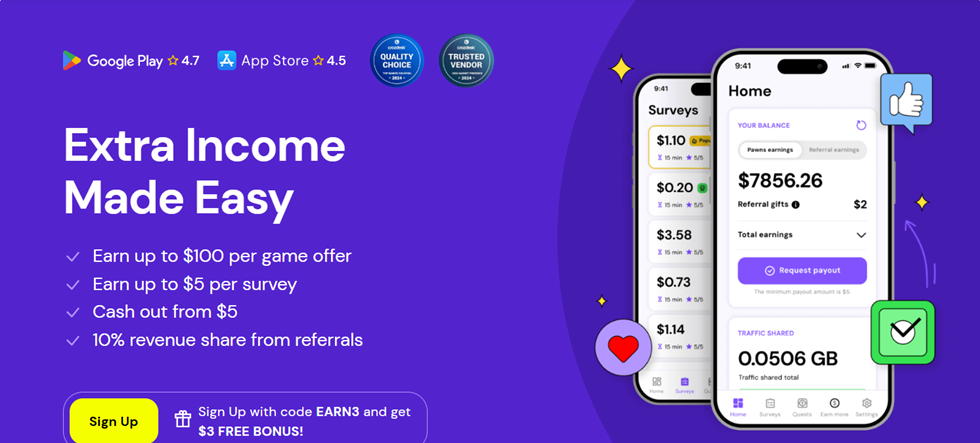
They pay $0.20 for every one GB of shared data.
The website’s user experience is straightforward.
Furthermore, because few people are aware of the website, you will have a better chance of sharing more bandwidth.
Honeygain
Honeygain is one of the most popular apps for earning money by sharing unused internet bandwidth. Once installed, it runs in the background and uses a portion of your internet connection for tasks such as web intelligence, market research, and content delivery.
The app is available for Windows, macOS, Android, and Linux through Docker. Honeygain pays users based on the amount of bandwidth shared, with earnings depending on factors like location, internet speed, network type, and demand. It also offers referral bonuses and payout options such as PayPal and crypto once you reach the minimum payout threshold.
For every 10 MB of data you share, you get one credit. You must have 20,000 credits, equivalent to $20, to check out the payment. For every 10 GB of data you share, you get $1.
That said, you should not treat Honeygain as completely risk-free. Even though the company says it does not access personal data and works with trusted partners, third-party traffic still passes through your connection.
PacketStream
PacketStream is a more straightforward bandwidth-selling service compared to some other apps. You install the client, keep it running, and it pays you for the internet bandwidth shared through your connection.
PacketStream works as a residential proxy network. In simple terms, businesses may use your connection to view the web from a real residential IP address instead of a data center. This can be useful for things like price comparison, ad checks, brand protection, and web research.
PacketStream may be worth looking at if you want a hands-off bandwidth-sharing app, but it is not something to run without reading the terms first.
More options
You can also check out the following options, but do note these all follow the same risks.
- TrafficMonetizer
- Repocket
- Mysterium Network
- Grass.io
Now that you’re aware of bandwidth sharing apps, you should also have a clear idea of how they work before trying one out.
How Does a Bandwidth Sharing App Work?
You must install an application on your mobile or PC and keep it running in the background to share the bandwidth.
Location, IP addresses, and network speed are the factors that influence how much you earn.
Of course, since you’re sharing your bandwidth, your privacy will also be a legitimate concern for you. So, we’ve broken down how privacy works with the utilization of such apps and software.
Privacy Concerns With a Bandwidth-Sharing App
You are allowing unknown third parties to use your internet connection and IP address. That means traffic from other users may appear as if it is coming from your network. The biggest concern is that you usually have little or no control over what others do through your connection. Someone may access websites, services, or content that you would not personally visit.
In some cases, certain websites may be restricted in your country, blocked by platforms, or considered suspicious. This can create problems such as:
- Your IP address being flagged or blocked by websites
- Slower internet speeds
- Possible violation of your ISP’s terms
- Privacy and security concerns
- Difficulty knowing who is using your connection and for what purpose
No service can guarantee that sharing your bandwidth is completely safe. Some of these apps may also not be available or supported on major app stores due to policy concerns. While bandwidth-sharing apps can generate passive income, they operate in a grey area. You should only use them if you know what you are doing and understand the risks.