



A flight booking API lets your application search live fares and complete a real reservation, either directly with an airline or through a global distribution system (GDS). That’s different from a flight data API, which reports status, delays, and tracking information without selling anything. If you actually need tracking or status data instead, see our guide to the best flight data APIs.
This guide covers APIs that search fares, manage reservations, or connect to GDS inventory for travel businesses. Access requirements vary a lot across this category, from instant self-serve signup to sales-gated enterprise accreditation.
I checked each flight booking API provider for the following features: access model (self-serve versus sales-gated), GDS or direct-airline coverage, pricing transparency, and whether the API completes bookings or only returns search results.
Flight Booking APIs Compared
| Provider | Best For | Access Model | Pricing |
|---|---|---|---|
| Duffel | Modern self-serve booking | Instant signup | $3/order + 1% + fees |
| Sabre | Enterprise GDS access | Developer application, then accreditation | Custom quote |
| Travelport | AI-driven multi-source content | Trial request, sales onboarding | Custom quote |
| Amadeus | Existing GDS-accredited enterprises | Enterprise accreditation only | Custom quote |
| Kiwi.com Tequila | Virtual interlining fares | Affiliate team request | Custom quote |
| Skyscanner Travel API | Partner-only price search | Partner application | No per-call fee for partners |
| Trawex | Agency booking engines | Direct sales contact | Custom quote |
| FlightsLogic | Small and mid-size agency booking | Direct sales contact | Custom quote |
Duffel
Best for: Modern self-serve integration
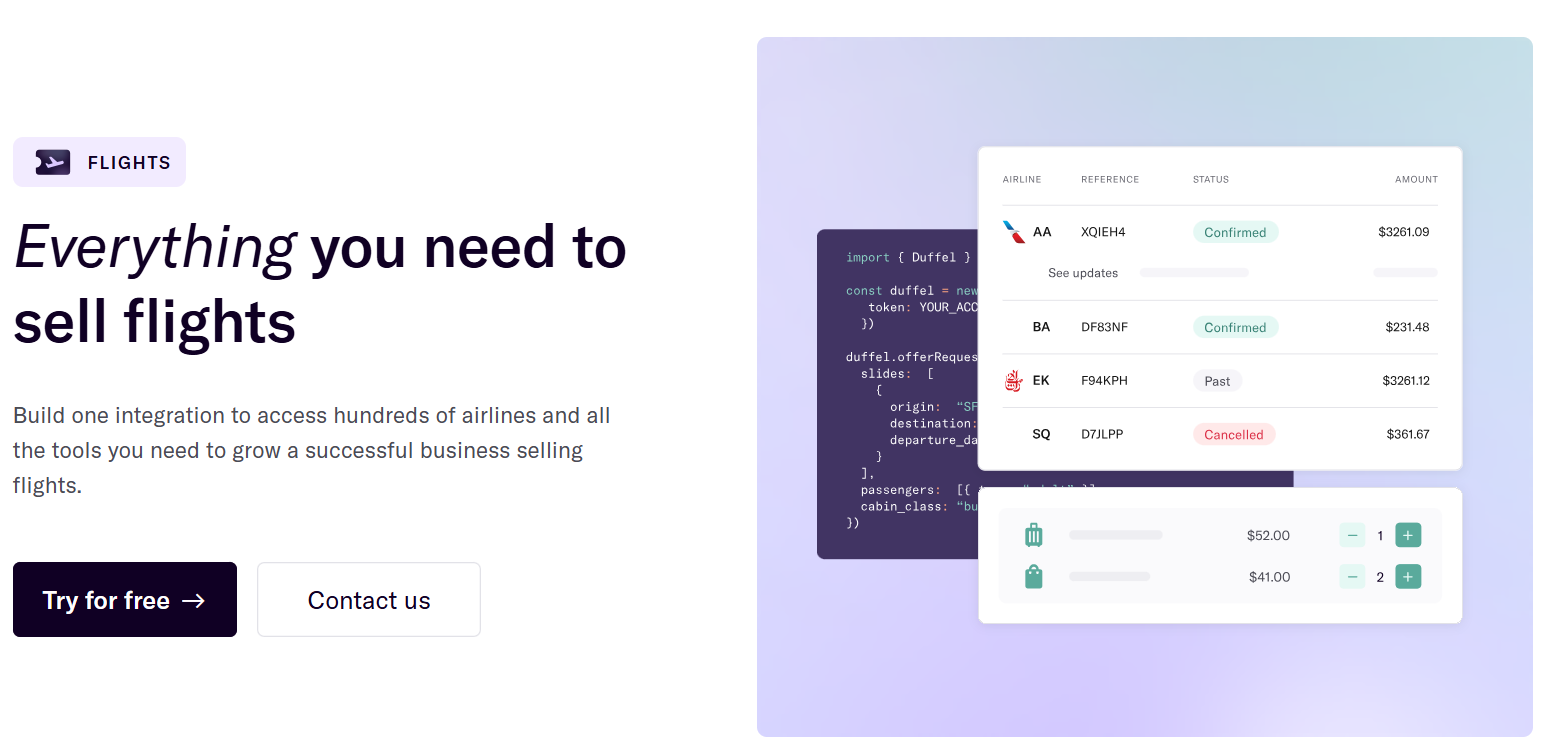
Duffel is a REST API for selling flights, hotels, and travel extras. It covers search, booking, and order management in one API, with client libraries in Node.js, Python, and Ruby. Sign-up is instant and self-serve.
Key Features
- Add-on sales for seats and baggage are built directly into the booking flow, not a separate integration
- Managed Content gives instant access to Duffel’s own IATA accreditation across 5 IATAs worldwide, no paperwork required
- Prebuilt UI components for seat selection and payments, not just raw endpoints
- Also covers hotel bookings, called Stays, with a commission on over 1 million properties
Pros & Cons
PROS
CONS
Pricing
Flights cost $3 per confirmed order, plus 1% of order value for Managed Content and $2 per paid ancillary. An excess search fee of $0.005 applies beyond a 1,500 to 1 search-to-book ratio.
Sabre
Best for: Enterprise-grade global GDS access
Sabre is one of the three major global distribution systems, giving travel platforms access to airline inventory, fares, and booking through its GDS network. Its flagship shopping product, Flight Shop, is currently replacing the long-running Bargain Finder Max API with a unified model for searching fares.
Key Features
- Flight Shop combines Sabre’s own EDIFACT and NDC content with third-party providers and pre-computed cached offers in one search call
- Supports virtual interlining, combining offers from multiple suppliers into a single itinerary, alongside traditional single-source fares
- A Sandbox collection running on Sabre’s PLAY CERT environment lets you build and certify integrations before going to production
- A beta MCP server gives AI agents direct access to Sabre’s APIs, an early move most competitors haven’t matched yet
Pros & Cons
PROS
CONS
Pricing
Sabre doesn’t publish self-serve pricing. Access starts with a developer application through its Developer Hub, followed by accreditation for production use. Contact Sabre for commercial terms.
Travelport
Best for: AI-driven multi-source content
Travelport is a popular GDS, now pushing its API strategy through TripServices, its cloud-native API platform aimed at AI-driven travel search and booking.
Key Features
- One connection reaches 400-plus airlines, NDC content, low-cost carriers, and 3 million-plus bookable stays
- Content comes normalized and deduplicated, meant for AI-driven comparison rather than raw feed parsing
- Sandbox environments and self-service credential requests are available before going live
- Legacy Travelport APIs remain supported for existing customers migrating at their own pace
Pros & Cons
PROS
CONS
Pricing
Trial access to TripServices can be requested directly on its site. Full commercial onboarding runs through a sales proposal tailored to agency size and usage.
Amadeus
Best for: Existing GDS-accredited enterprises
Amadeus is the largest global distribution system by volume, providing access to hundreds of airlines worldwide. Its free self-service developer portal, once the easiest way to start testing Amadeus APIs, was decommissioned on July 17, 2026. It now mainly caters to businesses that already hold GDS accreditation or that have the scale to justify a full enterprise onboarding process.
Key Features
- Enterprise APIs cover flight search, booking management, cars, transfers, hotels, and payments
- Supports NDC distribution alongside traditional GDS content
- A sandbox environment is available for enterprise-accredited developers to test before going live
Pros & Cons
PROS
CONS
Pricing
Amadeus no longer offers self-serve or free-tier pricing. Access requires requesting Amadeus Enterprise API access, with commercial terms negotiated directly.
Kiwi.com Tequila
Best for: Virtual interlining fares
Kiwi.com’s Tequila API powers its own virtual interlining search engine, combining separate tickets across airlines that don’t normally connect. In May 2024, Kiwi.com deliberately closed Tequila to public self-serve signups, shifting to an invitation-only model focused on a smaller number of strategic partnerships.
The B2B portal bundles reporting and company/user management tools alongside the API itself, not just raw endpoints.
Pros & Cons
PROS
CONS
Pricing
No public pricing information. New signup requests go through its affiliates team rather than an open signup form.
Skyscanner Travel API
Best for: Partner-only price comparison
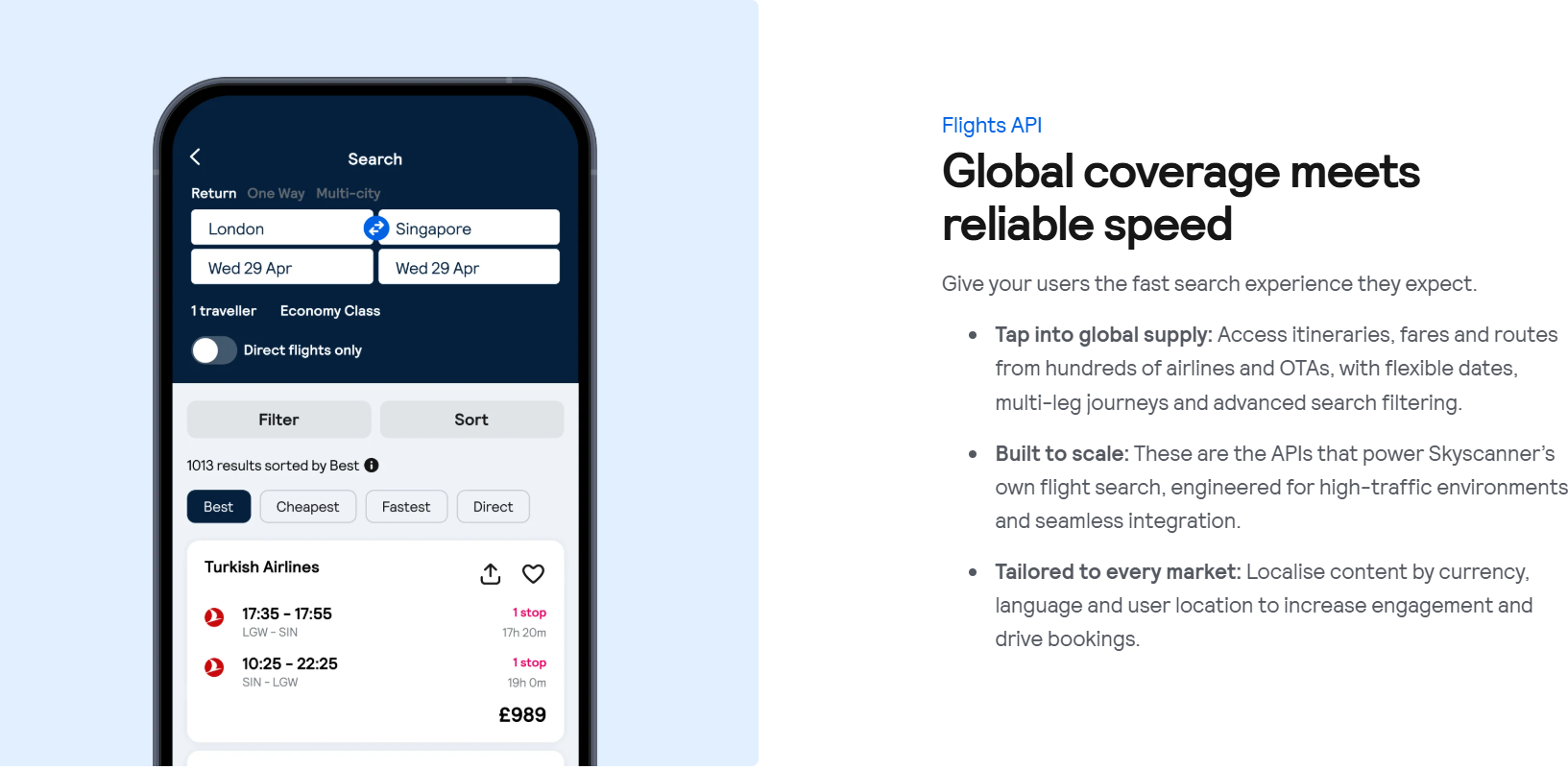
Skyscanner Travel API powers live fare search across the same inventory behind Skyscanner’s consumer site, covering flights, hotels, and car hire. Access is restricted to approved partners.
Key Features
- Flights Live Prices API for real-time fare search across 52-plus markets and 30-plus languages
- Car Hire Live Prices API for live rental rates alongside flight search
Pros & Cons
PROS
CONS
Pricing
Skyscanner doesn’t charge approved partners per call. Access requires applying through the Skyscanner Partner Portal, including a business review and commercial agreement, before credentials are issued.
Trawex
Best for: White-label agency booking engines
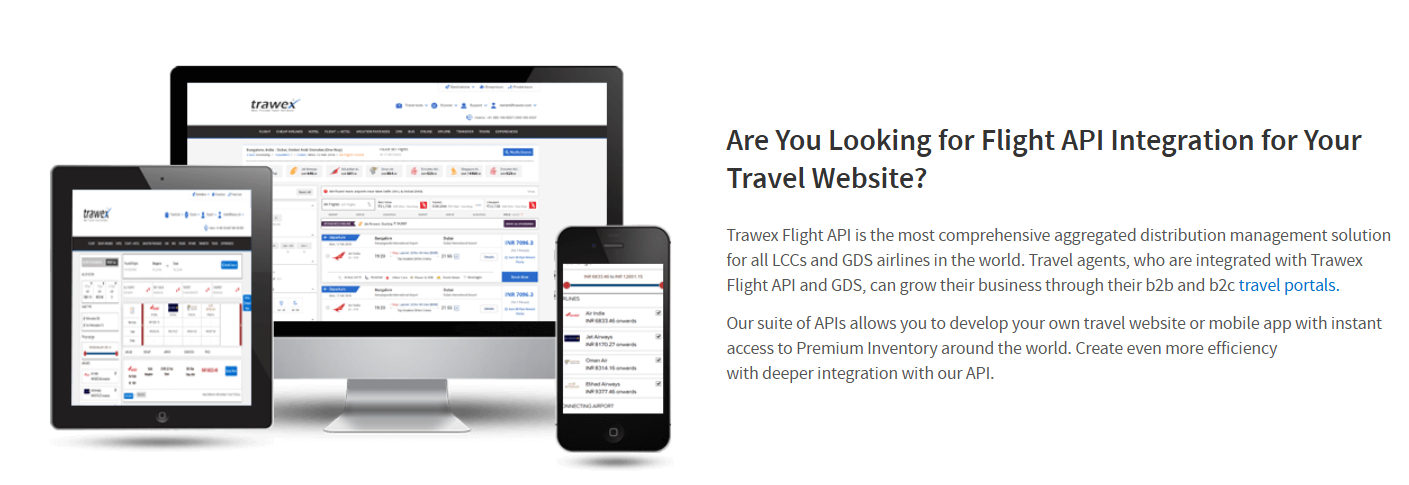
Trawex builds white-label flight booking engines for travel agencies, integrating GDS systems including Amadeus, Sabre, and Galileo into one interface. It targets B2B and B2C travel businesses rather than individual developers.
Key Features
- Covers the full booking lifecycle: search, select, book, confirm, modify, cancel, and refund
- Beyond the core GDS providers, it also connects to over 100 consolidator suppliers, including Mystifly, TBO, and Travefusion
- Agencies can add their own markups or discounts on top of retrieved fares before showing prices to customers
- Also bundles hotel and car rental booking alongside flights
Pros & Cons
PROS
CONS
Pricing
Trawex doesn’t publish pricing. Cost depends on the specific GDS integrations and services selected, available by contacting Trawex directly.
FlightsLogic
Best for: Small and mid-size agency booking
FlightsLogic offers a white-label booking engine similar to Trawex, connecting travel agencies to Amadeus, Sabre, and Galileo GDS content. It’s aimed at small and midsized agencies building out a booking portal.
Key Features
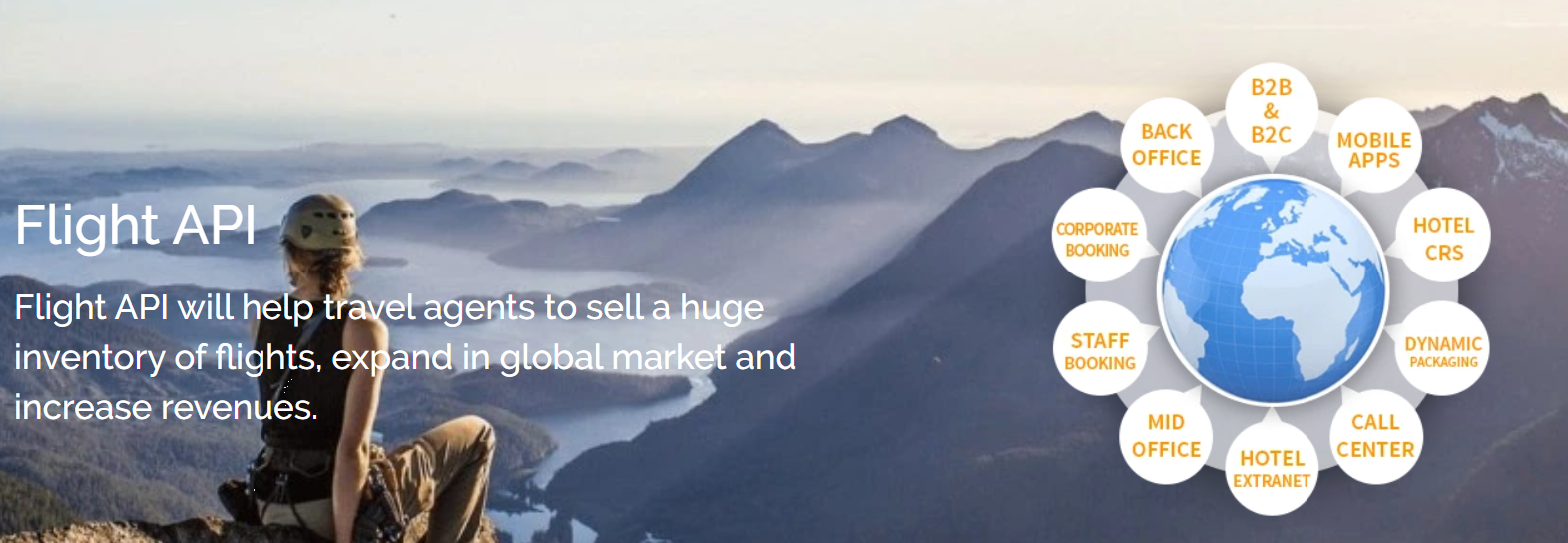
- Supports B2B, B2C, and B2B2C booking models for different agency structures
- Also offers APIs beyond flights, including hotels, sightseeing, transfers, cruises, and trains
- Handles 25-plus currencies, suitable agencies serving customers across multiple countries
Pros & Cons
PROS
CONS
Pricing
Cost depends on which GDS integrations and services you need, available by contacting FlightsLogic directly rather than checking a price list.
How to Choose the Right Flight Booking API
If you’re building a modern app or startup and need to start selling flights fast, go with Duffel. Instant signup and pay-as-you-go pricing mean you can be live within the hour
If you already hold GDS accreditation or have the budget for enterprise onboarding, Sabre, Travelport, and Amadeus give you the broadest airline coverage in this list. But you’ll have to go through a sales-driven process before you get access.
Trawex and FlightsLogic exist specifically for travel agencies, wrapping GDS access into a white-label booking engine you can brand as your own.
If all you want is to show live prices without handling the reservation yourself, the Skyscanner Travel API does exactly that and nothing more.
And if your users need routes that don’t officially connect, airlines with no formal partnership between them, Kiwi.com Tequila is built for exactly that. However, getting access is the hard part.
Frequently Asked Questions
What’s the difference between a flight booking API and a flight data API?
A flight booking API, like the ones in this guide, searches fares and completes reservations. A flight data API returns status, tracking, schedule, or historical information instead, without selling anything. See our guide to the best flight data APIs if tracking is what you actually need.
How to get free access to Amadeus’s flight APIs?
Amadeus decommissioned its free self-service developer portal on July 17, 2026. Access now requires Amadeus Enterprise API approval, with commercial terms negotiated directly.
Is Kiwi.com’s Tequila API still available to new developers?
Not through open self-serve registration. New access now goes through Kiwi’s affiliate team rather than an instant signup form.
What is virtual interlining?
Virtual interlining is the process of combining separate tickets from airlines that don’t have a formal partnership into one bookable itinerary. It often offers cheaper or more convenient route options than any single airline offers alone. Kiwi.com’s Tequila API is built specifically for this.
Do I need IATA accreditation to sell flights?
Not necessarily. Providers like Duffel offer managed content that includes their own IATA accreditation, so you can start selling without obtaining your own. Enterprises that already hold IATA or ARC accreditation can typically use it directly with providers like Duffel, Sabre, or Amadeus.