

There’s a question I see every week in my inbox, on LinkedIn, and in Slack groups full of marketers and founders: which AI should I be using?
And every week, you will see the internet answering it in the same way. Some blogs run ChatGPT and Claude through a handful of prompts, pick a winner, and publish a headline that says “ChatGPT Is Still the Best” or “Claude 4.6 Finally Beats GPT.” The post ranks, people share it, and a few thousand readers walk away thinking they’ve found their answer.
But they forget that this answer immediately changes depending on what you’re actually doing.
I’ve spent the last few months running the same prompts across GPT-5.4, Claude 4.6 Sonnet, and Gemini 3.1 Pro. And the best part is that I wasn’t running them in separate tabs but simultaneously in a single tab. Five rounds of real tasks: writing, coding, research, brand voice matching, and complex reasoning. The kind of work these models get used for on a Monday morning is not the kind of benchmark gymnastics that make for good Twitter posts but bad workplace decisions.
And after proper analysis and testing, I’m not going to leave you with just “X is the best.” I’ll also include a scorecard at the end to tell the whole story.
How Did I Test These Models?
I kept the setup pretty simple on purpose by firing three models and running five prompts through them. Every comparison used the same input text, fired simultaneously, with no prior conversation history and no custom instructions. The only variable was the model itself.
Let me also give you the exact testing protocol:
| Element | Detail |
|---|---|
| Models tested | GPT-5.4, Claude 4.6 Sonnet, Gemini 3.1 Pro |
| Prompt delivery | Identical text, sent to all models at the same time |
| Prior context | None (fresh session for each round) |
| Custom instructions | None (default model behavior) |
| Evaluation criteria | Accuracy, prompt faithfulness, tone, structure, length |
The evaluation criteria are based on a five-point framework I use for every model comparison. In short, factual accuracy comes first, then whether the model actually followed the prompt’s instructions, then tone and voice, then output structure, then length calibration. If you want the full breakdown on how to read two AI responses without getting fooled by surface-level fluency, I wrote a detailed guide on side-by-side model comparison.
Let me warn you that these models are constantly updated. So, an output you get from GPT-5.4 today might look pretty different from what GPT-5.4 produces next month after a weight update. But the pattern remains the same. It’s the structural tendencies each model family carries. Claude consistently writes with a particular rhythm. GPT consistently structures its output in a certain way. Gemini consistently handles web-grounded queries differently.
Now, let’s get down to testing them!
Round 1: Long-Form Writing
The prompt:
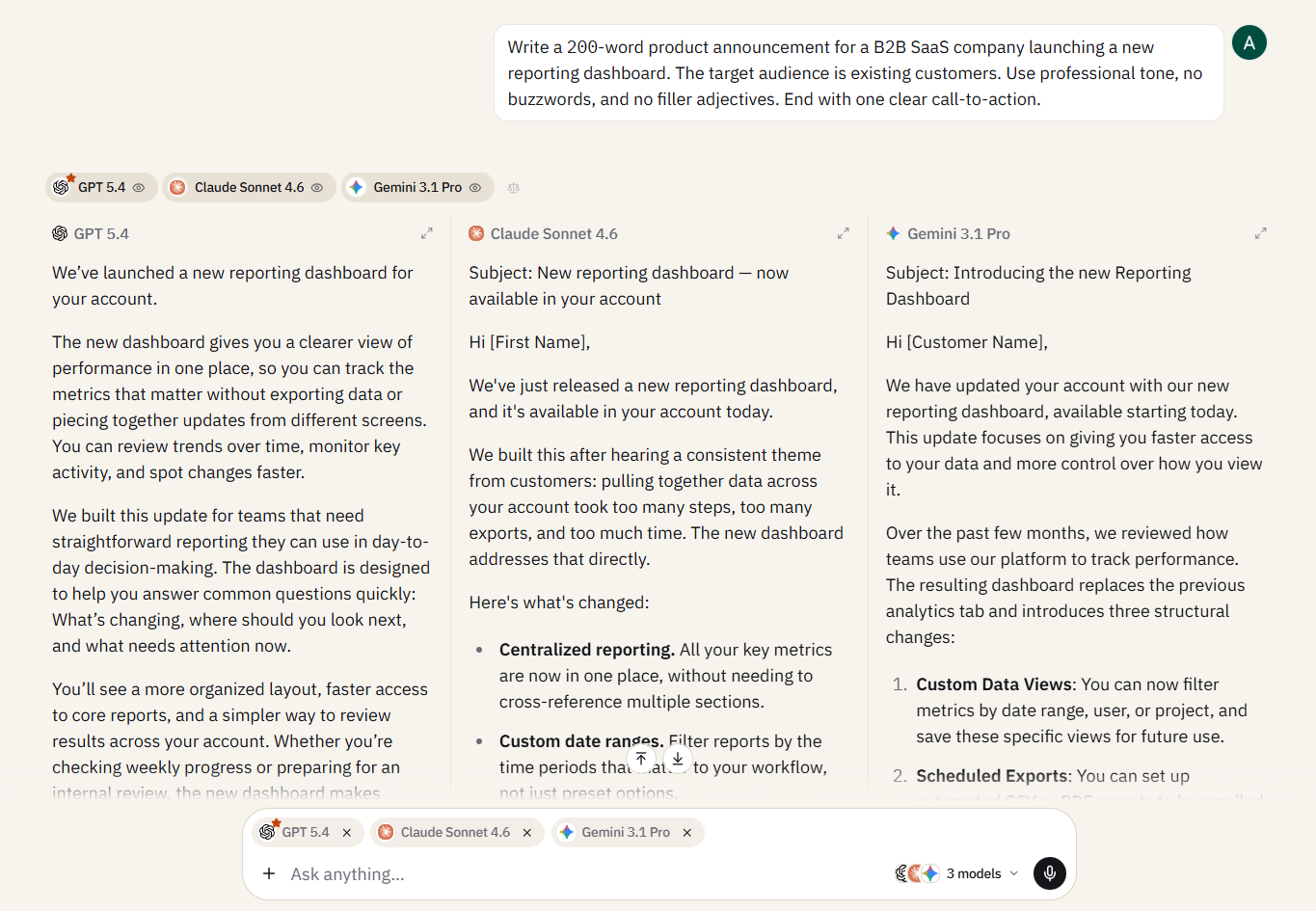
Write a 200-word product announcement for a B2B SaaS company launching a new reporting dashboard. The target audience is existing customers. Use professional tone, no buzzwords, and no filler adjectives. End with one clear call-to-action.If you check out the prompt, you’ll see that I have bounded it in terms of word count, tone, audience, and structure. The idea is to give the model a chance to follow directions or drift. A model that writes extraordinarily but ignores half the brief will lose to a model that follows every instruction and writes decently.
What came back:
GPT-5.4 delivered the cleanest and most structured response. It followed the requested format, stayed professional, avoided buzzwords and filler adjectives, and ended with a clear CTA. The writing was polished, although it felt slightly more generic than the other responses.
Claude Sonnet 4.6 produced the strongest overall customer-facing copy. It used a natural email format, added useful details such as custom date ranges and exportable reports, and ended with a direct CTA. The main issue was that it introduced specific product features that were never mentioned in the prompt, such as real-time data and scheduled report capabilities.
Gemini 3.1 Pro also produced a well-structured announcement, but it made the biggest assumptions. It introduced features such as saved custom views, scheduled exports, and infrastructure improvements that were not part of the brief. That makes it less reliable when the goal is strict prompt adherence.
Verdict: Claude produced the most polished and usable announcement, while GPT-5.4 was the safest choice for following the brief closely. Gemini had a strong structure, but its tendency to invent product details makes it the weakest option for a real customer announcement unless you provide the feature details in the prompt.
Round 2: Coding and Debugging
The prompt:
Here’s a Python function that parses a CSV file and returns the top 5 rows by revenue. It throws a KeyError on line 12. Find the bug, fix it, and explain what went wrong in plain English.
import csv

def top_five_by_revenue(filepath):
    with open(filepath, 'r') as f:
        reader = csv.DictReader(f)
        rows = list(reader)
    sorted_rows = sorted(rows, key=lambda x: float(x['Revenue']), reverse=True)
    top = sorted_rows[:5]
    result = []
    for row in top:
        result.append({
            'company': row['Company'],
            'revenue': row['Reveune'],
            'growth': row['Growth']
        })
    return result
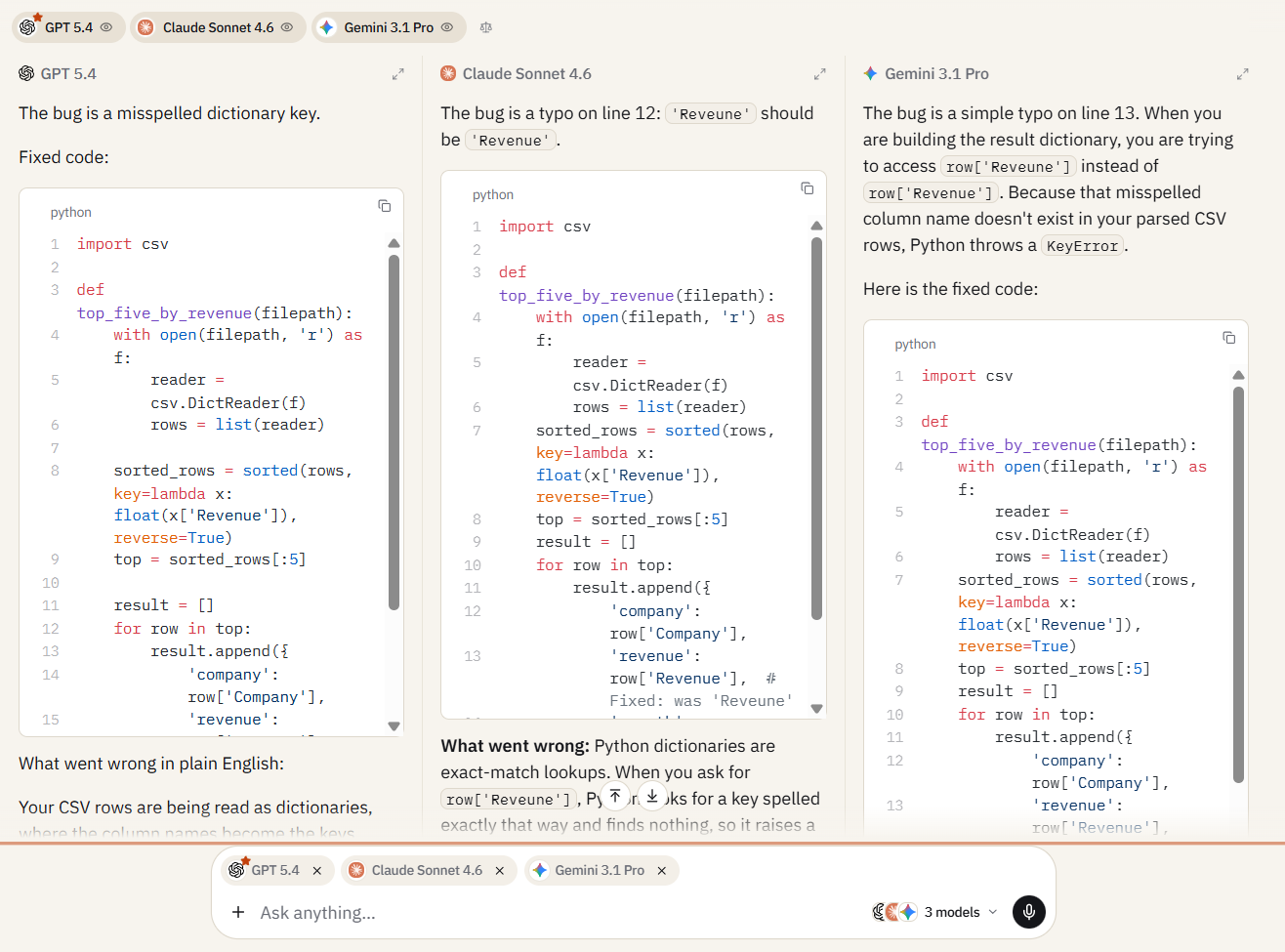
The bug is a typo on line 12. ‘Reveune’ instead of ‘Revenue.’ This test is a little different. We are doing this comparison to see whether the model explains clearly, avoids introducing new bugs in its fix, and handles the edge cases the prompt didn’t ask about. This is something a good developer would flag, so we are testing these models against it.
What came back:
All three models found the typo. That’s table stakes in 2026, because any model that misses a KeyError from a misspelled dictionary key isn’t worth testing. The differences showed up in everything around the fix.
GPT-5.4 gave the clearest overall response. It found the typo, fixed the code correctly, and explained the KeyError in simple terms. The step-by-step breakdown of how DictReader creates keys also made the explanation easy for a junior developer to follow. It even offered to make the function safer, though that went slightly beyond the prompt.
Claude Sonnet 4.6 was the most precise. It identified the typo immediately, provided the corrected code, and explained why the error appeared only when the loop reached the misspelled key. That extra detail shows a good understanding of the execution flow.
Gemini 3.1 Pro was accurate and straightforward. It found and fixed the typo and explained the cause clearly, but stopped there without adding much context beyond the requested fix.
Verdict: GPT-5.4 has the edge for this task because it combines a correct fix with a beginner-friendly explanation. Claude is a close second, especially for its precise explanation of why the error occurs at that point in the function. Gemini gets the job done but provides the least additional value beyond the basic correction.
Round 3: Research and Web-Grounded Answers
The prompt:
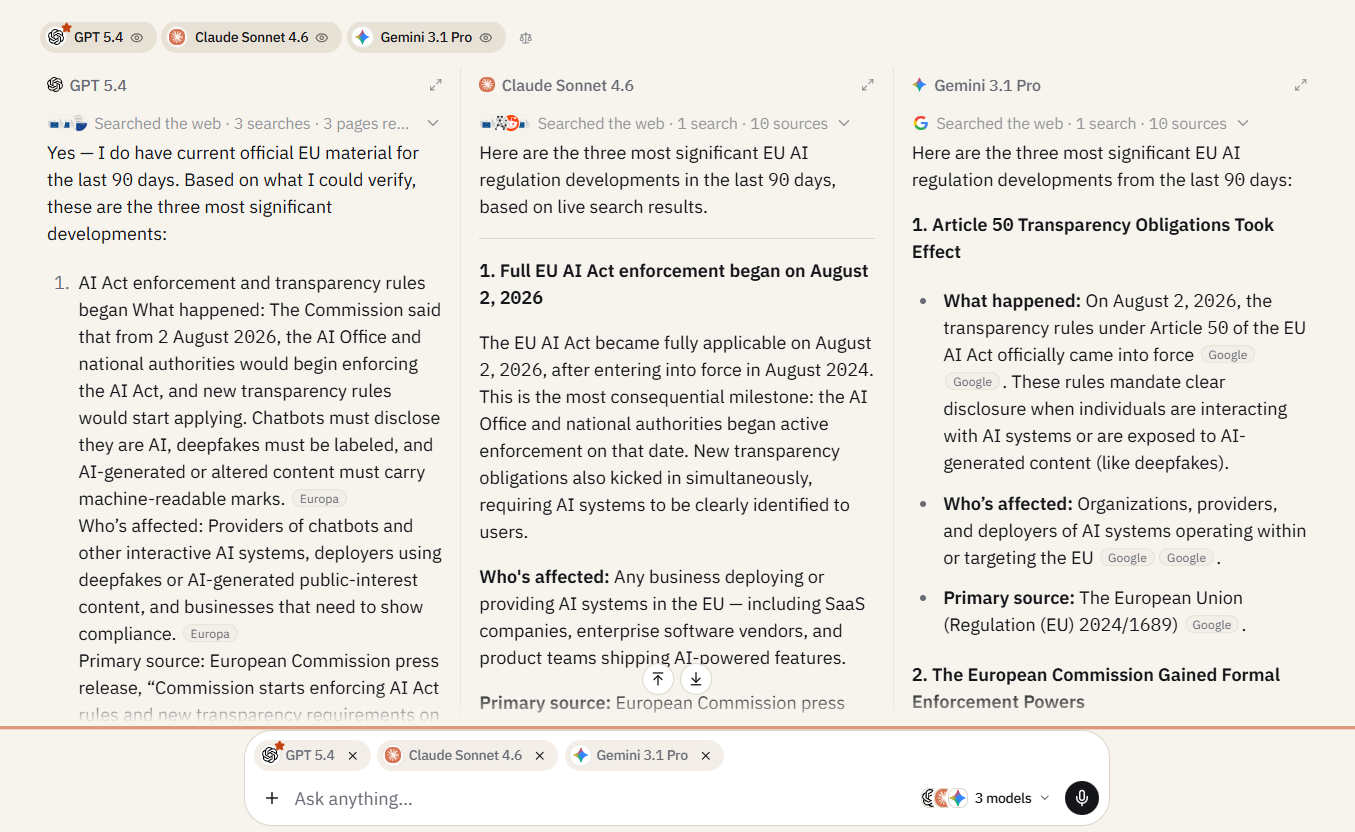
What are the three most significant AI regulation developments in the EU in the last 90 days? For each, give me: what happened, who's affected, and the primary source. But if you don't have access to current data, come back to me and say it.This prompt is a trap for the AI models to test three things at once: can the model access current information, does it cite real sources, and does it handle its own limitations honestly? That last instruction (“if you don’t have access to current data, say so”) is where the interesting differences show up.
What came back:
Gemini 3.1 Pro came out strongest for this research task. It identified the three developments, explained who was affected, and provided current sources. It also handled the prompt’s requirement for recent information well, using web search rather than relying on its training data alone.
GPT-5.4 also produced a strong research response and used official EU sources throughout. Its main weakness was that it grouped the enforcement milestone and transparency guidance as separate developments, even though they are closely connected. It was still transparent about how it selected the three developments.
Claude Sonnet 4.6 gave a clear, well-organized answer and connected the three developments effectively. Its source mix was broader, though, with several secondary sources alongside official EU material.
Gemini is the strongest pick for this scenario. It combined current web research, relevant developments, and source-backed answers most effectively. For tasks such as regulatory research, current news, and fact-checking, that ability to retrieve recent information gives it an edge.
For document-heavy research workflows, our guide to chatting with PDFs shows how to use each model for summarization, extraction, and cross-referencing.
Round 4: Brand Voice Matching
The prompt:
Here are three LinkedIn posts written by the same person. Study the voice, sentence length, word choice, rhythm, how they open, how they close, and what they avoid.

[Post 1: 90 words about hiring your first marketer with short punchy sentences, one specific number, and ends with a question]

[Post 2: 110 words about why most SaaS pricing pages fail that starts with a contrarian claim, uses "you" heavily, and no hashtags]

[Post 3: 85 words about a lesson from a failed product launch with a personal story, one concrete detail, and ends on a single short sentence]

Now write a new post in this voice about why most founders overinvest in paid ads before fixing their landing page. Same length range and same patterns.
Voice matching is the task where AI models are most confidently mediocre. Every model will produce something that looks like a LinkedIn post. The question is whether it sounds like this specific person’s LinkedIn post, with the proper use of voice, the commonly used phrases, and a proper structure, while also avoiding what they normally would.
What came back:
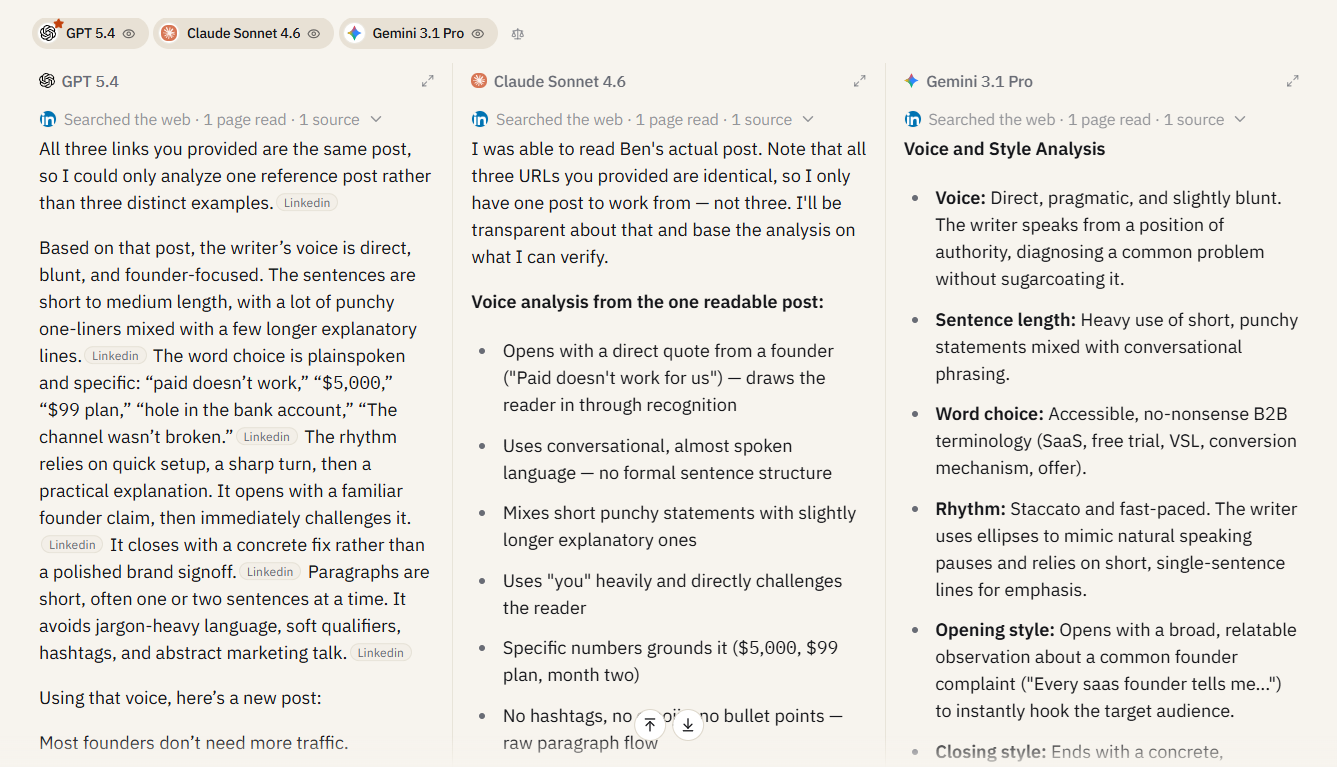
GPT-5.4 produced the strongest match for the requested LinkedIn format. It used short paragraphs, a direct opening, and a clear progression from the problem to the reason behind it and then to the solution. The post also stayed focused on the landing-page issue without overcomplicating the argument.
Claude Sonnet 4.6 matched the reference voice most closely in terms of bluntness and practical advice. It used short, conversational statements and specific recommendations such as fixing the headline, proof, and CTA. It felt more like an experienced founder speaking directly to another founder.
Gemini 3.1 Pro followed the same general style but leaned more heavily into marketing terminology such as “VSL” and “conversion mechanism.” That made the post sound more specialized, but also less natural than the other two.
Claude has the strongest voice match, while GPT-5.4 has the strongest LinkedIn structure. Gemini is useful for a more marketing-heavy version, but it feels less natural for this particular writing style.
For 15 more prompts tested across all three models with verdicts, see our marketing prompts guide.
Round 5: Complex Reasoning
The prompt:
A SaaS company has three product lines.

Line A: 40% revenue growth, but 15% monthly churn and rising support costs.

Line B: 10% growth, 2% churn, steady margins.

Line C: Flat revenue, 0% churn, but margins have dropped 8 percentage points over 12 months.

The CEO wants to cut one product line and double investment in another. She has a board meeting in two weeks. Make a recommendation with reasoning. Then tell me the single biggest risk in your recommendation and how you'd mitigate it.
What came back:
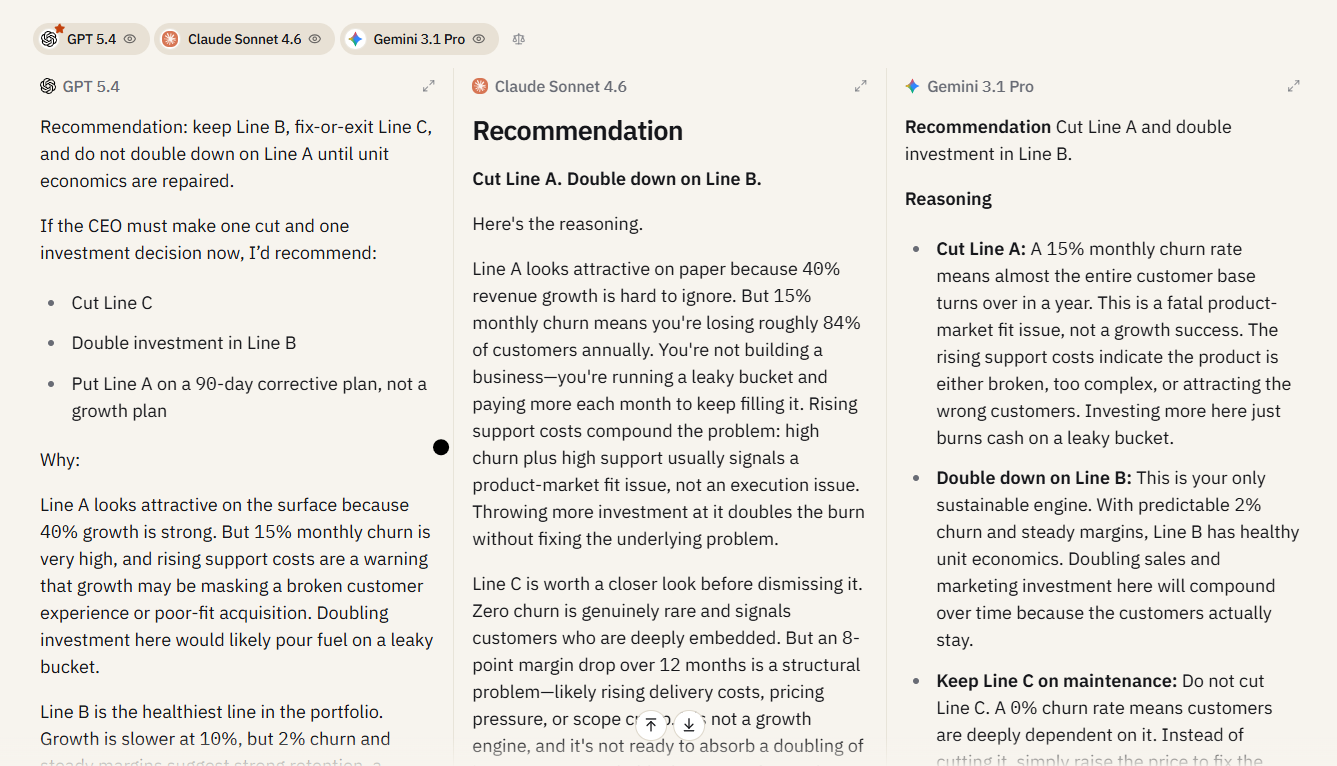
All 3 models agreed on doubling down on Line B, but each took a slightly different approach on the other side.
GPT-5.4 took a different position from the other two models. It recommended cutting Line C rather than Line A, arguing that flat revenue combined with an 8-point margin decline makes C the weaker strategic asset. It also proposed a 90-day corrective plan for Line A and a fast validation process before shutting C down. The reasoning was cautious and focused heavily on avoiding an irreversible decision based on limited data.
Claude Sonnet 4.6 and Gemini 3.1 Pro both recommended cutting Line A and doubling investment in Line B, but their reasoning differed. Claude focused on Line A’s 15% churn and rising support costs, while protecting Line C because its 0% churn suggests strong customer retention. Gemini reached a similar conclusion but framed Line C as a maintenance business and suggested using pricing to recover its declining margins.
The interesting part is that there is no clear consensus this time. GPT challenged the assumption that Line A should be the cut, while Claude and Gemini treated its churn as the decisive problem. All three still agreed that Line B is the strongest candidate for additional investment, but they reached different conclusions about the product to cut and the risks involved. That makes this a useful example of why complex decisions benefit from comparing multiple models rather than treating one response as the definitive answer.
The Scorecard
Let me walk you through how each model performed across all five rounds.
| Round | GPT-5.4 | Claude Sonnet 4.6 | Gemini 3.1 Pro |
|---|---|---|---|
| Long-form writing | Close second | Winner | Third |
| Coding & debugging | Winner | Close second | Third |
| Research & web answers | Close second | Third | Winner |
| Brand voice matching | Close second | Winner | Third |
| Complex reasoning | Third | Winner | Close second |
The pattern matters more than the score over here.
Claude is the clear winner model for every writing task because it never fails to sound like a human wrote it. Plus, it is very good at following unique instructions and pushing back on assumptions I didn’t know I was making. If you want to take care of anything related to writing, voice matching, and the kind of reasoning where intellectual honesty matters more than slide-readiness, then Claude is the best choice.
GPT-5.4 has an edge over the other models when it comes to structured, complete, and ready-to-use output without editing. Debugging with unsolicited edge-case handling, board-ready analysis with concrete mitigation plans, and structured announcements that follow a brief to the letter are GPT’s strengths.
Gemini 3.1 Pro earns its place on one thing, and earns it decisively: anything that requires current, web-grounded data. Research queries, fact-checking, news monitoring, and trend analysis. When the answer changed last week, Gemini is the model that knows.
No model won everything or lost everything. And the model that won each round would change if you swapped in your own prompts, which is exactly why running your own comparisons matters more than reading anyone else’s, including this one.
Running These Tests Yourself in One Window
Every comparison in this post was run the same way: one prompt, fired simultaneously to all three models, and outputs streaming side by side. There was no tab-hopping, no prompt drift, and no re-typing the same question three times to pretend the inputs were identical.
That setup is Sparkian‘s side-by-side comparison mode. One window, one prompt box, and parallel outputs from whichever models you select. It’s the same interface I used for all five rounds you saw above.
The workflow is short enough to describe in three steps.
- Open a new chat.
- Click the side-by-side toggle next to the model dropdown.
- Pick your models, type your prompt once, and read the outputs in parallel columns.
If you want the full click-by-click walkthrough with screenshots and the five-criteria reading framework, I wrote a dedicated guide to comparing AI models in Sparkian. That guide covers everything from enabling the feature to continuing the conversation with your winning model.
The real value isn’t in reading my comparisons. It’s in running your own comparison on your prompts, your tasks, and the actual work you’d use AI for on a Tuesday afternoon. Generic benchmarks make for interesting blog posts. Personal benchmarks improve tool decisions.
Every comparison in this post was run on Sparkian’s Free plan with 100 Sparks/month.
[Start free →] No credit card required.
Frequently Asked Questions
Which AI model is the best overall in 2026?
There isn’t one. GPT-5.4, Claude 4.6 Sonnet, and Gemini 3.1 Pro each win on different tasks. The best model for you clearly depends on the use case, like writing, coding, research, reasoning, or more.
Is Claude better than ChatGPT for writing?
In our testing, we found Claude producing more natural-sounding prose with better rhythm and voice matching. GPT followed structural constraints more precisely. For creative and brand-voice work, Claude has a consistent edge. For templated or compliance-heavy writing, GPT is more reliable.
Is Gemini better than ChatGPT for research?
Yes, if you need anything that requires current data. Gemini’s web integration came back with more accurate and verifiable sources during our testing. GPT with web access is capable, but occasionally cites URLs that don’t lead to the referenced content.
How often do AI model rankings change?
Constantly. Model providers keep pushing updates that will shift performance on specific tasks. But the patterns we documented, like Claude’s voice strength, GPT’s structural precision, and Gemini’s web grounding, have held across multiple update cycles, but individual outputs will vary. Run your own tests periodically.
Can I compare AI models without paying for all three separately?
Yes, Sparkian gives you access to GPT-5.4, Claude 4.6 Sonnet, Gemini 3.1 Pro, and other models under one subscription. The Free plan includes 500 monthly credits and a side-by-side comparison, which is enough to run a few of your own tests.