



SEO determines who gets found first organically. Two sites can offer the same service, but the one that understands what search engines and searchers actually want will win the click every time. If a competitor consistently outranks you, that is rarely luck. It usually means they have mapped what their audience searches for and built content specifically to answer it.
I use Claude and Geekflare MCP to uncover that strategy directly. In this article, I map a competitor’s keyword targeting across multiple pages and find topics they cover that a client’s site does not. The goal is not to copy what already works. It is to find the specific gap a competitor left open.
What is Geekflare MCP?
The Geekflare MCP server connects your AI agents such as Claude, Cursor, ChatGPT, and Kilo to Geekflare tools such as Web Scraping, Meta Scraping, Screenshot, and Search APIs.
This means users can scrape pages, run real-time searches, capture screenshots, and perform DNS and network checks, and so much more without leaving their AI chatbots, such as Claude. You can check our article on how to connect Geekflare MCP to Claude if you want to follow this guide practically.
What “Reverse-Engineering” Means Here
This is not about pulling a competitor’s backlink profile or seeing their exact traffic numbers. Geekflare MCP combined with Claude does not expose that kind of data. However, it shows everything visible on a competitor’s own pages, their keyword targeting, and their content coverage.
Three Geekflare tools do the work here.
- Search API finds which competitor pages are actually ranking, instead of guessing at a URL list.
- Meta Scraping API, run across several pages instead of just the homepage, reveals a pattern in what keywords a competitor is targeting.
- Web Scraping API pulls the actual content, showing which topics they cover in depth.
Case Study 1: Targeting Computer Shops
I base my articles on real case studies. For now, I am building Snow Wave Technologies for a client that sells laptops, desktops, and accessories.
Searching for Competitors
Before reverse-engineering anyone, I first need to find out who’s actually winning. I ran this against a core term for the business, “buy laptops online Kenya,” to see who ranks above everyone else selling the same thing.
My prompt:
Search for ‘buy laptops online Kenya’ and list the top-ranking independent operators, excluding directories and aggregator sites. Present the results in PDF format for easier perusal.
Results:
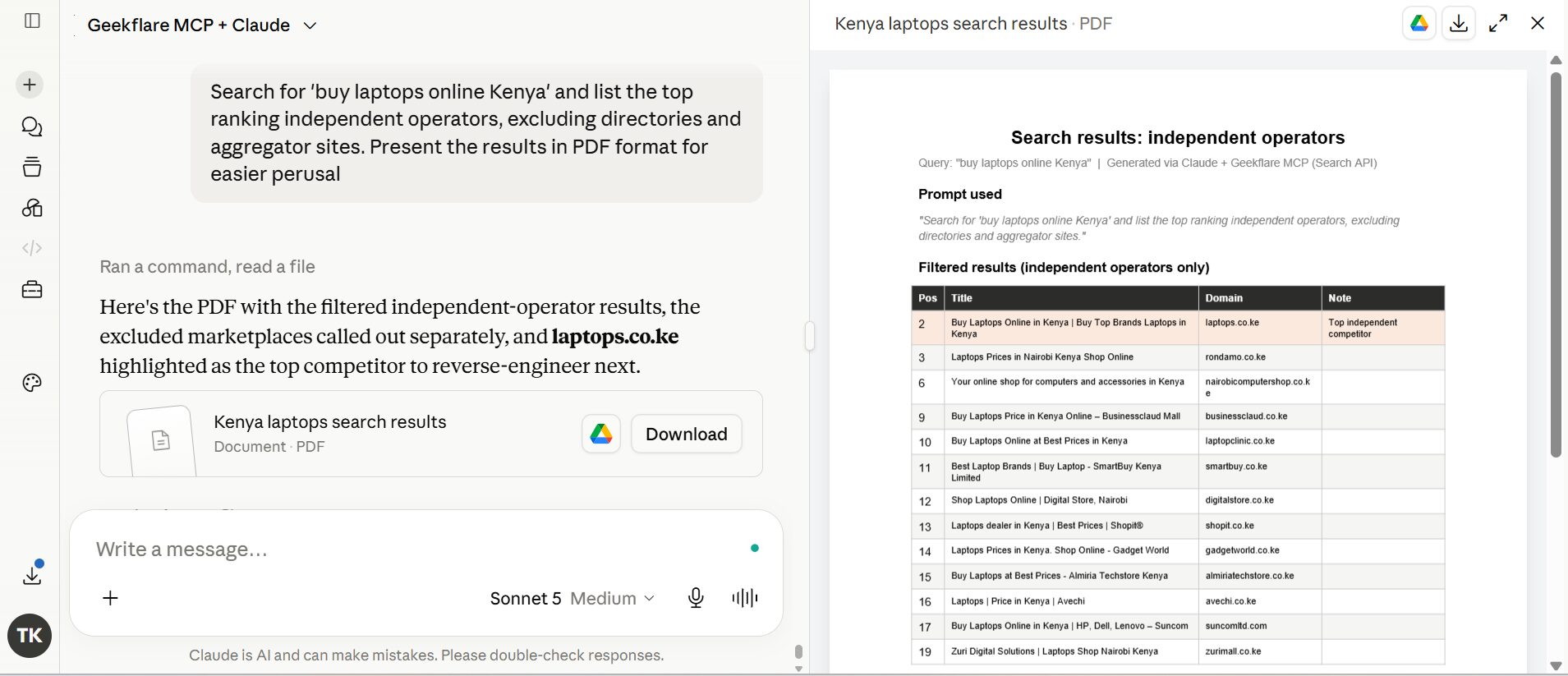
Filtering out marketplaces like Jumia, Jiji, PigiaMe, and OLX, one competitor stood out clearly: laptops.co.ke. It ranks second overall, behind only Jumia, a marketplace with far more resources and no single-store SEO strategy to compete against.
Mapping a Competitor’s Keyword Targets
A single homepage title only shows one keyword bet. To see the actual strategy, I need to look across several of laptops.co.ke’s ranking pages at once, since the pattern across pages reveals what they are systematically targeting, not just one headline claim.
With laptops.co.ke identified as the strongest independent competitor, the next step is finding their actual indexed pages, not just the homepage. Rather than guessing at URLs, I search their site directly before pulling metadata from what comes back.
My prompt:
Search site:laptops.co.ke and list their key content pages beyond the homepage. Pull the meta title and description for these pages and compare what keyword each one is built around. Present the results in PDF format for easy scanning.
These were my results:
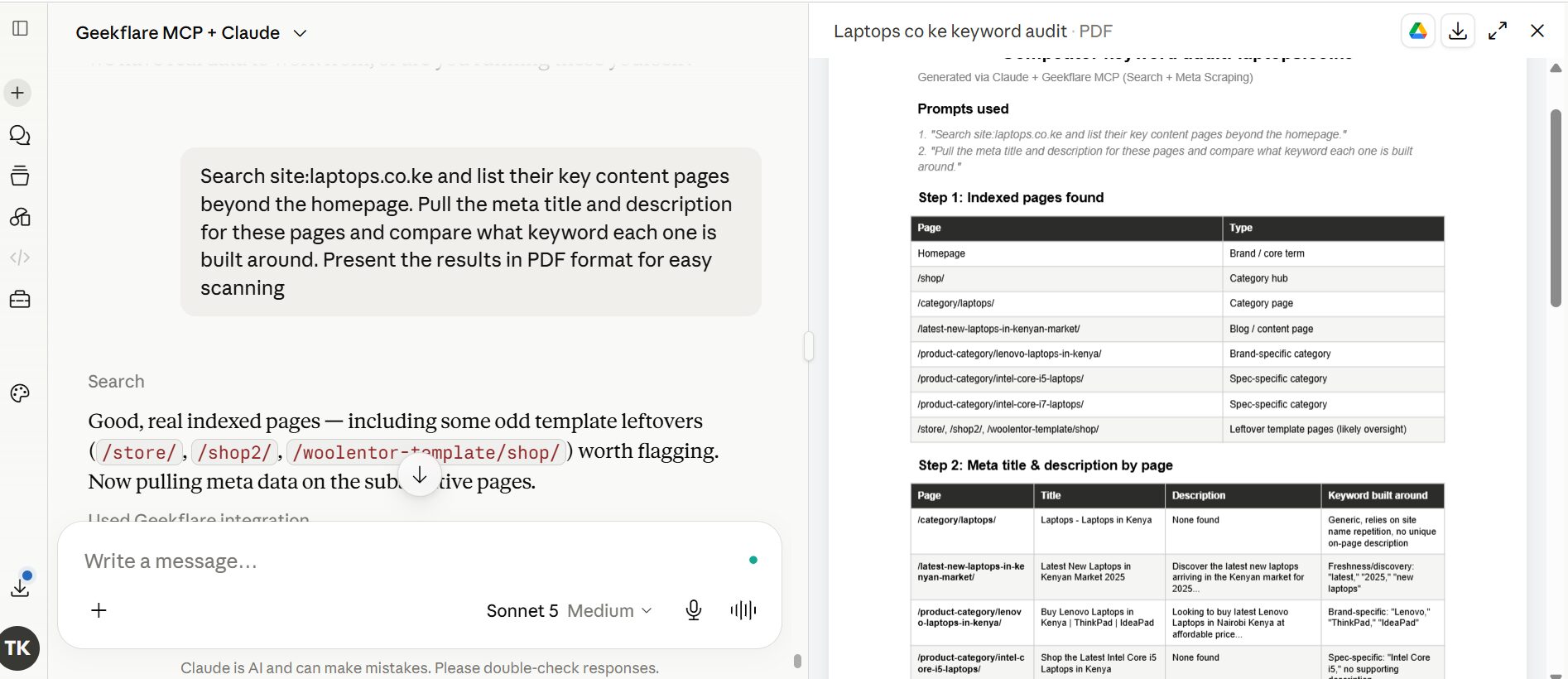
My prompt combined 2 APIs: Search and Meta Scraping.
From the results, laptops.co.ke targets keywords three ways: by brand (Lenovo, ThinkPad), by spec (Intel Core i5, i7), and by freshness (“latest,” “2025”). Every page carries the same keyword-stuffed dc.title tag, an outdated tactic, but two of the four pages checked have no meta description at all. That’s a real gap: a competitor deliberate about keyword coverage is still leaving click-through rate on the table.
Finding Content Gaps
A competitor’s content strategy is not just what they’ve written; it’s also whether it’s actually organized into something visitors can browse. To check this properly, I need to first establish whether laptops.co.ke even has a dedicated blog page, then look at what’s actually there.
My prompt:
Check if laptops.co.ke has a dedicated blog page. If one exists, list all posts with their publish dates and summarize the overall content angle. Present the results in PDF format.
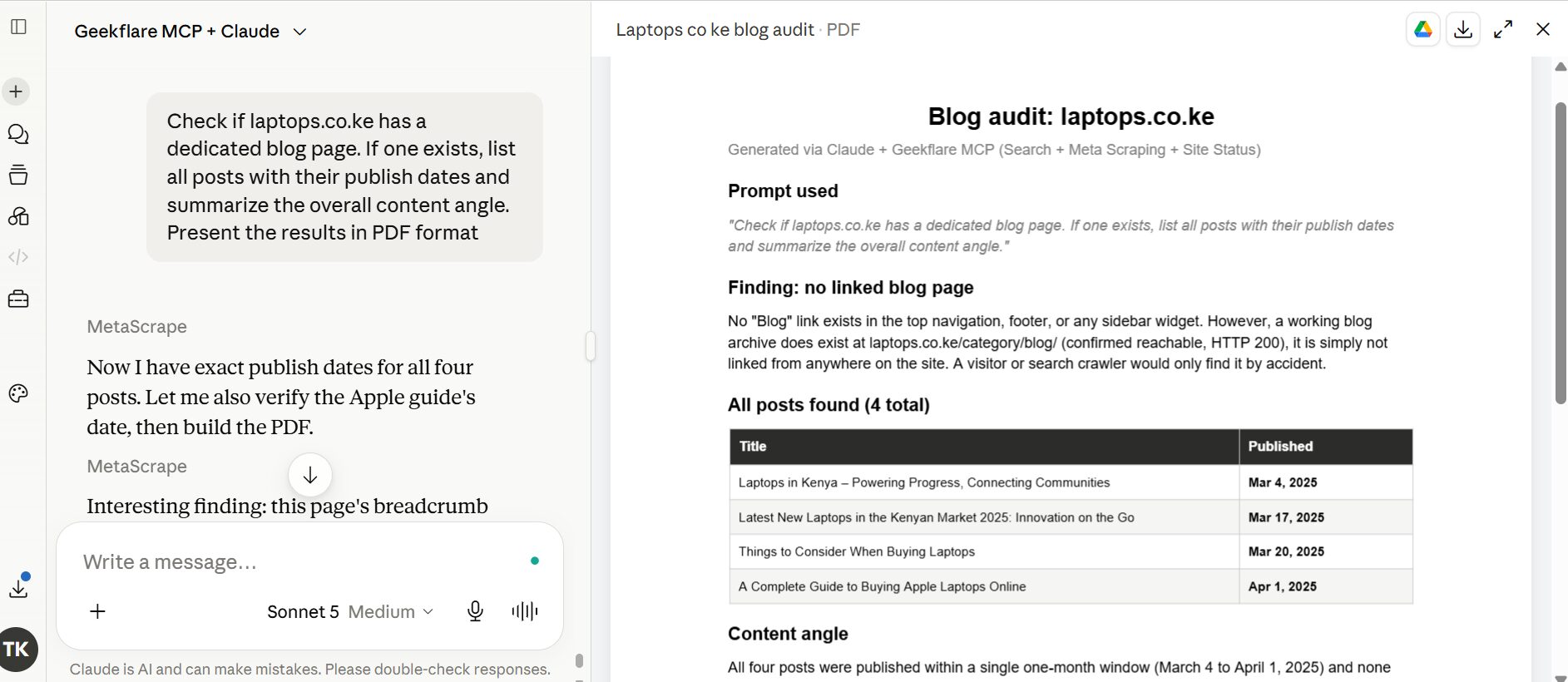
The results showed there was no dedicated blog page in the navigation, footer, or widgets. However, there is a blog archive that a search crawler or visitor will only find organically or by accident.
What This Means for a Content Strategy
Snow Wave Technologies just launched, so there is no content yet either. However, Snow Wave isn’t behind a competitor with a real content library; it’s behind a competitor with four disconnected posts and no way to browse them. Building one properly structured blog page, even a handful of posts deep, would immediately match or exceed what the market leader has managed.
Pulling the three findings together points to a clear priority order.
- A linked, navigable blog page from day one, since laptops.co.ke still hasn’t managed this after a year.
- Meta descriptions written for every page, since the market leader is leaving click-through rate on the table on half the pages checked.
- Content built around the same three angles that already work: brand-specific guides, spec-specific guides, and freshness-driven roundups, since these are proven to earn indexing and structured targeting.
None of this requires outspending laptops.co.ke. It requires doing consistently what they did once and abandoned: publishing consistently, linking the archive properly, and filling in the metadata gaps they left open. That is a realistic, low-cost roadmap for a brand-new site to compete against the strongest name in its market from week one.
Case Study 2: Tour Company
My second case study was on a different niche, the service-providing industry. I wanted to reverse-engineer competitor SEO for another website I am managing and understand their main competitors and their strategies.
Searching for Competitors
I searched for a more specific angle, one that reflects a real, growing traveler concern (sustainable safari) rather than a generic category term.
My prompt:
Search for ‘sustainable safari tours Kenya’ and list the top-ranking independent operators, excluding directories and aggregator sites. Present the results in PDF format.
Results:
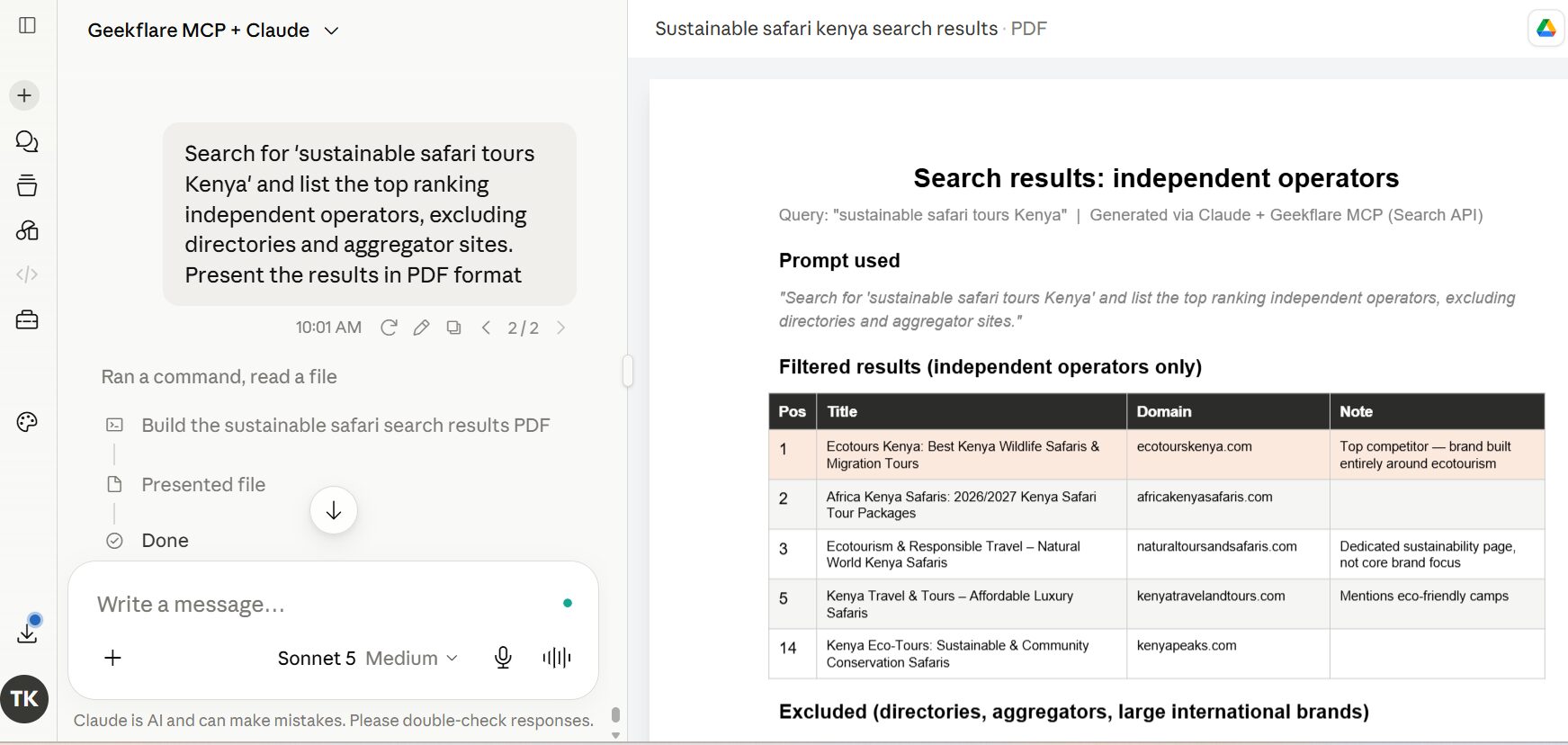
My results filtered out Reddit, Tripadvisor, and large international brands like Abercrombie & Kent and National Geographic. From this, Ecotours Kenya ranked first overall. Unlike competitors who mention sustainability as a side point, Ecotours Kenya’s entire brand, including its domain name, is built around the term. That makes it a stronger, more specific target to reverse-engineer than a generalist operator would be.
Mapping a Competitor’s Keyword Targets
With Ecotours Kenya identified, the next step is finding their actual indexed pages, not just the homepage, since a single title only shows one keyword bet.
Prompt:
Search site:ecotourskenya.com and list their key content pages beyond the homepage. Pull the meta title and description for their top pages and check how much of the content is actually built around sustainability, versus general safari terms. Present the results in PDF format.
Results:
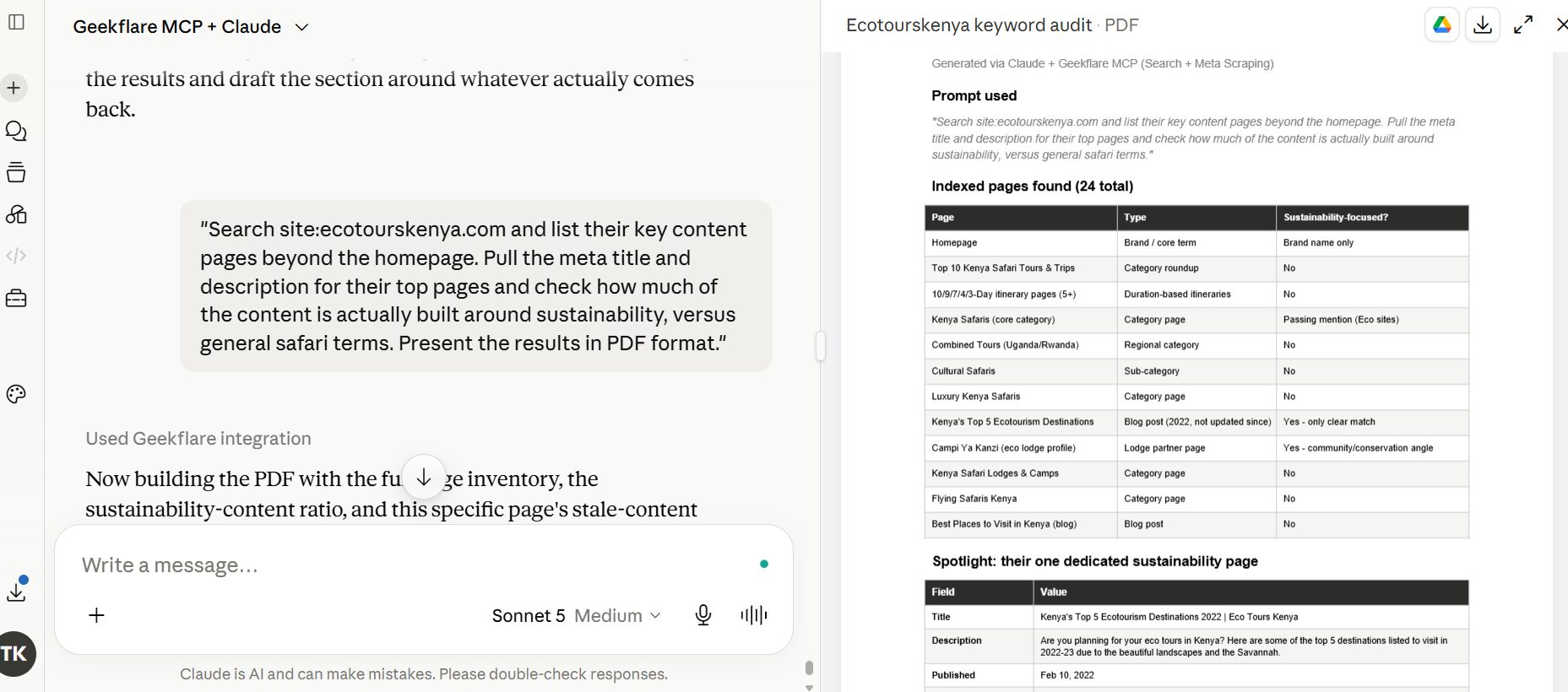
Out of 24 pages on Ecotours Kenya’s site, only 2 actually talk about sustainability, and one of those hasn’t been updated since 2022. The rest are just regular safari itinerary and destination pages, no different from any other operator. This suggests they rank well mostly because of their name, not because they’ve built real content around sustainability.
Finding Content Gaps
Ranking for a term is not final. We also have to check whether the competitor’s actual content backs up that ranking with depth or whether the topic is thin once you look past the title tags. A content gap is simply a topic a competitor should be covering well, given what they rank for, but isn’t. Finding one gives a clear opening: a specific, underserved angle worth building content around.
Prompt:
Check Ecotours Kenya’s blog for total post count, publishing frequency, and whether their content covers sustainability topics specifically (certifications, conservation partnerships, community impact) versus general safari topics. Present the results in PDF format.
Results:
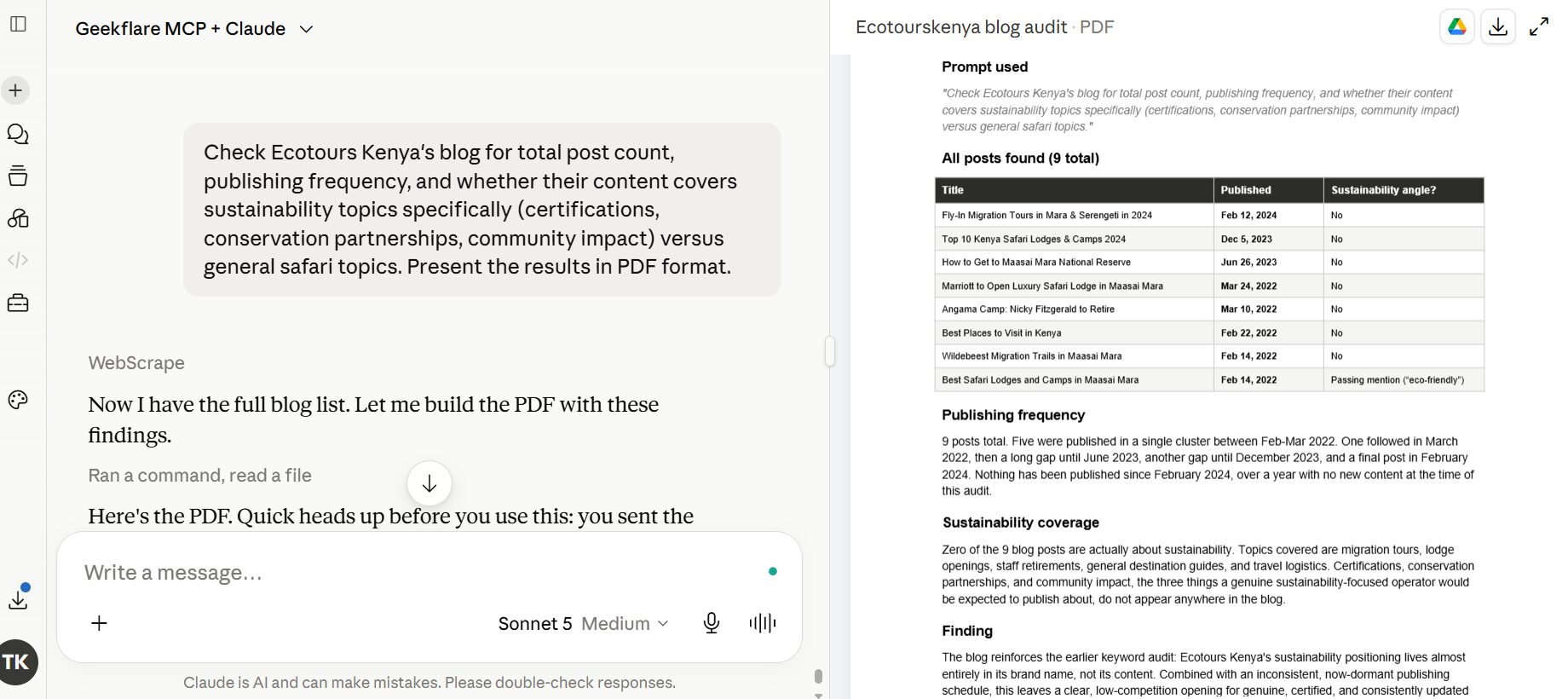
Ecotours Kenya has only 9 blog posts, and none of them are actually about sustainability. Most posts came out in early 2022, and they haven’t published anything new since February 2024. This means their “eco” reputation comes mostly from their name, not their content, leaving room for a competitor to fill that gap.
What Case Study 2 Means for a Content Strategy
Both findings point in the same direction. Ecotours Kenya ranks first for “sustainable safari tours Kenya,” but that position rests almost entirely on its brand name. Only 2 of 24 indexed pages touch sustainability at all. Also, the blog, which could have built real authority on the topic, has published nothing since February 2024. Lastly, it never covered certifications, conservation partnerships, or community impact even when it was active.
For Adventure Feet Safaris, this is a genuinely low bar to clear. Publishing real, current content around certifications, conservation partnerships, and community impact, then keeping it updated, would give it a stronger claim to the term than the current top-ranking result actually earns.
Applying This to Your Own Site
Both case studies followed the same three-step pattern, regardless of industry. Use this as a repeatable checklist for any niche:
- Find the real competitor: Search the core term your business competes on, filter out directories and aggregators, and identify who actually ranks first among independent operators, not who you assume is the competition.
- Map their keyword targeting: Pull meta titles and descriptions across their top pages, not just the homepage. Look for whether their positioning is backed by dedicated content, or whether it’s riding on brand name and domain authority alone.
- Check their content depth: Count their posts, check publishing dates, and see whether the topics match what they’re actually ranking for. A competitor can rank well on a thin or outdated content base, and that gap is exactly what’s usable.
The tools stay the same across every niche, laptops or safaris, e-commerce or tourism. What changes are the specific term you search and the specific gap you find once you look closely enough.
Closing
Reverse-engineering a competitor’s SEO isn’t about copying what already works. It’s about finding what they left unfinished: an unlinked blog archive, a missing meta description, a publishing schedule that stopped cold. Those gaps are where a newer or smaller site can compete on equal footing from day one.
Both case studies point to a short, specific action list rather than guesswork.
Snow Wave Technologies:
- Build a linked, navigable blog page from launch, laptops.co.ke still hasn’t managed this after a year.
- Write meta descriptions for every product and category page, half of the market leader’s pages skip this entirely.
- Publish content around brand, spec, and freshness angles, the three patterns already proven to earn indexing.
Adventure Feet Safaris:
- Publish real, current content on certifications, conservation partnerships, and community impact, the exact ground Ecotours Kenya claims but hasn’t covered.
- Keep the content updated, Ecotours Kenya’s one sustainability post has sat untouched since 2022.
- Maintain a consistent publishing schedule, the competitor’s blog went dormant after February 2024, and no one has taken the gap yet.
Neither roadmap requires outspending the market leader. Both require doing consistently what the competition did once and abandoned.