



Applicant tracking systems sit at the center of almost every hiring process, and the numbers around them changed a lot between 2024 and 2026. Applications per job more than doubled, AI moved into screening and interviews, and regulators started paying attention.
We pulled the statistics below from the original reports, surveys, and government sources, not from other stats roundups. Each figure links to where it came from, and we note the date and sample where it matters.
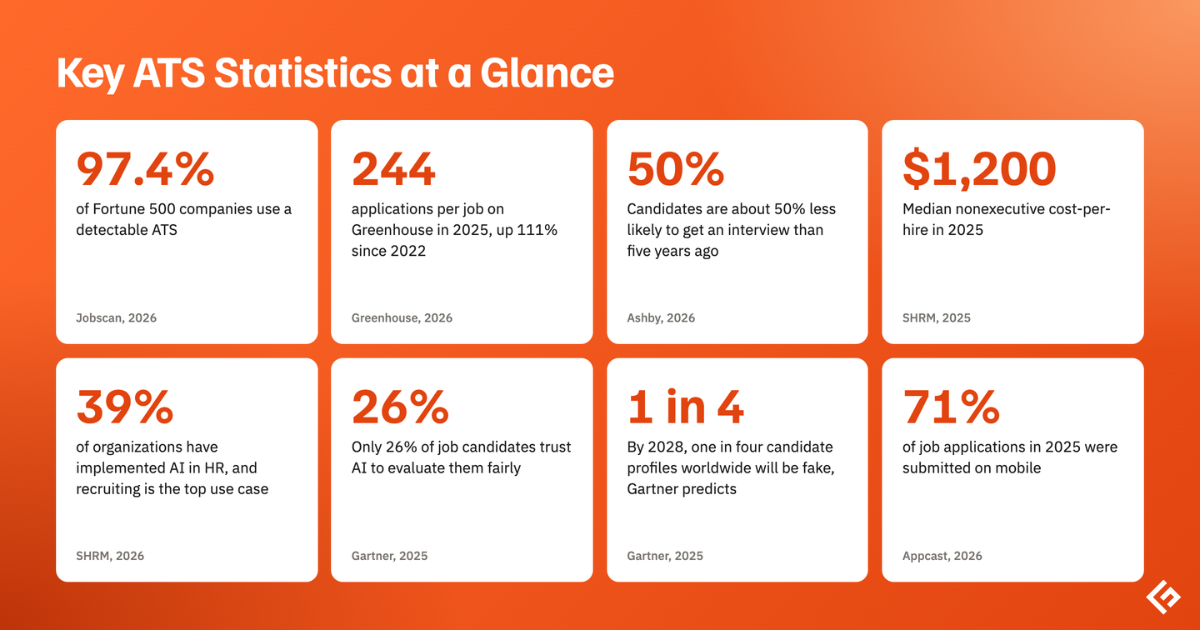
Key ATS Statistics at a Glance
- 97.4% of Fortune 500 companies use a detectable ATS (Jobscan, 2026).
- Over 40% of the Fortune 500 use Workday for talent acquisition (Jobscan, 2026).
- Jobs on Greenhouse received 244 applications each in 2025, up 111% since 2022 (Greenhouse, 2026).
- Candidates are about 50% less likely to get an interview than five years ago (Ashby, 2026).
- Median nonexecutive cost-per-hire was $1,200 in 2025 (SHRM, 2025).
- 39% of organizations have implemented AI in HR, and recruiting is the top use case (SHRM, 2026).
- Only 26% of job candidates trust AI to evaluate them fairly (Gartner, 2025).
- By 2028, one in four candidate profiles worldwide will be fake, Gartner predicts (Gartner, 2025).
- 63% of job seekers have been interviewed by an AI (Greenhouse, 2026).
- 71% of job applications in 2025 were submitted on mobile (Appcast, 2026).
ATS Adoption and the Most Common ATS Platforms
Large companies almost universally run an ATS. Jobscan checks the career sites of every Fortune 500 company each year and found a detectable ATS at 487 of 500 companies (97.4%) in its 2026 report. The share has stayed between 97% and 99% since 2018.
| Year | Fortune 500 companies with a detectable ATS |
|---|---|
| 2026 | 97.4% |
| 2025 | 97.8% |
| 2024 | 98.4% |
| 2023 | 97.4% |
| 2019 | 98.8% |
| 2018 | 98.2% |
Enterprise hiring is concentrated in two vendors:
- Workday is used by over 40% of Fortune 500 companies for talent acquisition in 2026, up from 39.2% in 2025.
- SAP SuccessFactors fell to 12% in 2026, from 13.2% in 2025.
The picture looks different beyond the Fortune 500. Across the 13,000+ companies in Jobscan’s wider data set, the most common systems are Greenhouse (19.0%), Workday (17.5%), Lever (15.6%), and iCIMS (14.4%). Our list of the best applicant tracking systems compares these and other options.
A gap in the data
We couldn’t find a reliable, original source for ATS adoption among small businesses.
ATS Market Size
Market research firms agree the ATS market is growing at about 7% to 8% a year. They disagree a lot on how big it is, mostly because they define the market differently. Treat any single number with caution.
| Research firm | Market size | Forecast | Growth rate (CAGR) |
|---|---|---|---|
| MarketsandMarkets | $3.28 billion (2025) | $4.88 billion by 2030 | 8.2% |
| IMARC Group | $3.14 billion (2025) | $6.35 billion by 2034 | 8.14% |
| Mordor Intelligence | $2.65 billion (2026) | $3.76 billion by 2031 | 7.25% |
| Fortune Business Insights | $17.22 billion (2025) | $34.83 billion by 2034 | 8.20% |
Fortune Business Insights’ estimate is five to six times higher than the others, which points to a much broader definition of the category. A few other findings from these reports:
- Cloud deployments held 88.12% of the market in 2025, according to Mordor Intelligence.
- North America is the largest region, with a share estimated between 26.6% (Fortune Business Insights) and 39.02% (Mordor Intelligence).
Application Volume and Recruiter Workload
The biggest change for ATS users is sheer volume. Easy-apply buttons and AI-written applications have flooded hiring pipelines, while recruiting teams got smaller.
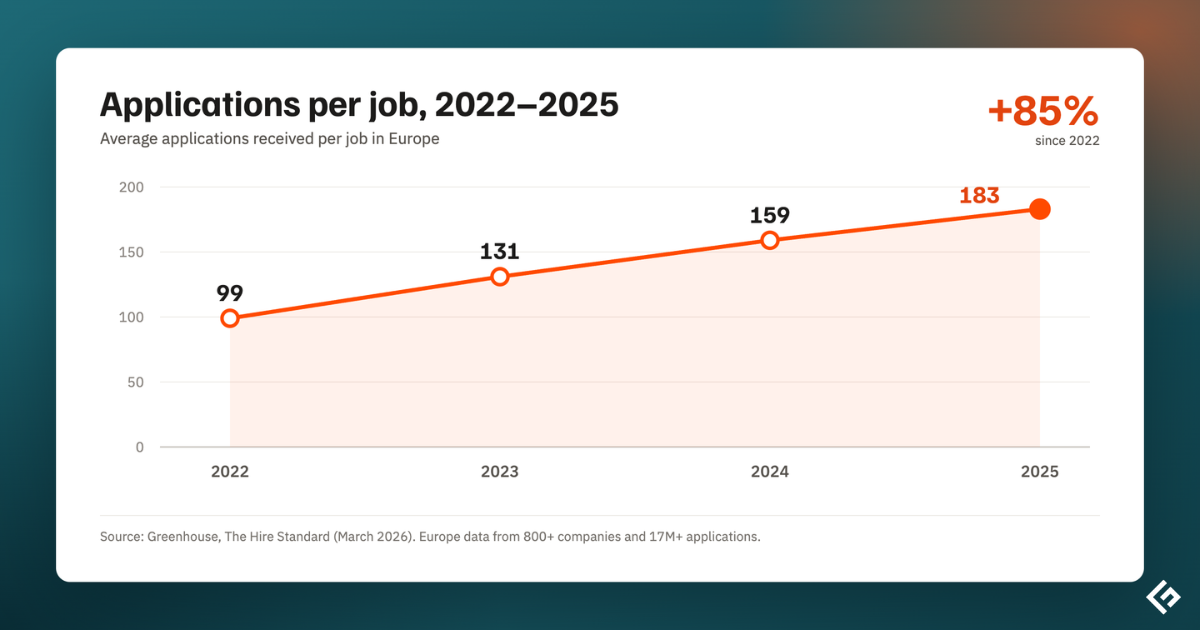
- Jobs on Greenhouse received an average of 244 applications in 2025, up 111% since 2022. Each recruiter handled 4,890 applications a year, up 203.7%, while the average number of recruiters per company fell 56% to 4.62 (Greenhouse, The Hire Standard, March 2026; data from 6,000+ companies).
- Applications per hire tripled between 2021 and 2024 and reached about 291 per hire in Q1 2026, compared with about 100 in early 2021 (Ashby Talent Trends, April 2026; 109 million applications).
- Only about 3.6% to 4.7% of applications now lead to an interview, down from 7% to 8% in 2021 (Ashby, 2026).
- About 8,200 job applications are submitted every minute on LinkedIn (LinkedIn Pressroom).
- Small businesses received an average of 180 applicants for every hire in 2024. Just 3% of applicants reached an interview, and 27% of interviewees were hired (CareerPlug, 2025 Recruiting Metrics Report; 60,000+ small businesses).
- The median dedicated recruiter handles 20 requisitions a year, rising to 50 at large organizations and 60 at extra-large ones (SHRM, 2025 Recruiting Benchmarking; 2,371 members).
- iCIMS customers saw 30 applicants per opening in September 2026, and job openings rose 13% year over year while hires grew only 2% (iCIMS Insights, September 2026).
Time to Hire and Cost per Hire
| Metric | Figure | Source |
|---|---|---|
| Median nonexecutive cost-per-hire | $1,200 (2025), down 27% since 2017 | SHRM, 2025 |
| Median executive cost-per-hire | $10,625 (2025), up 113% since 2017 | SHRM, 2025 |
| Median time-to-fill | About 45 days for both executive and nonexecutive roles | SHRM, 2025 |
| Median time to hire | 30 days (business roles), 40 days (technical roles) | Ashby, 2026 |
| Time to first fill by level | 52 days (junior), 63 (mid-level), 71 (senior) | Ashby, May 2026 |
| Average time to fill | 59.67 days in 2025, up 37% since 2022 | Greenhouse, 2026 |
| Time to fill | 40 days (September 2026) | iCIMS, 2026 |
Time-to-fill figures vary by source because each platform measures a different mix of companies and roles. Use them as rough benchmarks, not targets.
Two more cost data points from Appcast‘s 2026 benchmark report on recruitment advertising: the median cost-per-application was $19.32 in 2025, and the median cost-per-interview was $275. Only 20% of organizations measure quality of hire at all, according to SHRM.
AI in Recruiting and Applicant Tracking
How employers use AI
- 39% of organizations have implemented AI in HR. Recruiting is the most common use (27%), ahead of HR technology (21%) and learning and development (17%) (SHRM, State of AI in HR 2026; 1,908 HR professionals).
- 43% of HR professionals used AI to support HR work in 2025, up from 26% in 2024, and nearly 90% of those users say it saves time or improves efficiency (SHRM, 2025 Talent Trends).
- 37% of organizations were actively integrating or experimenting with generative AI in recruiting, up from 27% a year earlier (LinkedIn, Future of Recruiting 2025; 1,271 recruiting professionals).
- 70% of US hiring managers say AI helps them make faster and better hiring decisions (Greenhouse, AI in Hiring Report, November 2025).
- 77% of HR teams use AI weekly or daily, but only 41% trust these systems (HireVue, 2026 Global AI in Hiring Report; vendor survey of 3,100+ hiring managers).
How candidates feel about it
- Only 26% of candidates trust AI to evaluate them fairly, while 52% believe AI screens their application. 32% worry AI could fail their application (Gartner; 2,918 candidates).
- Only 8% of US job seekers believe AI makes hiring fairer (Greenhouse).
- 63% of job seekers have been interviewed by an AI, up 13 points in six months. 38% have walked away from a hiring process because it included an AI interview, and 70% were never clearly told upfront that AI would evaluate them (Greenhouse, May 2026; 2,950 candidates).
- After an AI interview, 51% of candidates never heard back (Greenhouse, May 2026).
- In 2022, 66% of US adults said they would not want to apply for a job with an employer that uses AI to help make hiring decisions (Pew Research Center; about 11,000 adults).
How candidates use AI
- 39% of candidates used AI during the application process, most often to write resume text (54%) and cover letters (50%) (Gartner; 3,290 candidates, late 2024).
- 41% of US job seekers admit to using prompt injections, such as hidden text in a resume, to get past AI filters (Greenhouse, 2025).
That last figure is why some ATS vendors now scan resumes for hidden instructions, one of the newer features covered in our guide to AI in applicant tracking systems. We explain how that kind of attack works in our guide to prompt injection.
Hiring Fraud and Fake Candidates
- Gartner predicts that by 2028, one in four candidate profiles worldwide will be fake (Gartner, July 2025).
- 6% of candidates admitted to interview fraud, either posing as someone else or having someone pose as them (Gartner; 3,000 candidates, Q2 2025).
- 91% of US recruiters have spotted candidate deception, and 69% of job seekers have come across fake job postings (Greenhouse, 2025).
- 64% of hiring teams call AI cheating a significant or extremely significant issue (HireVue, 2026).
- Only half of candidates trusted that the jobs they applied for were real (Gartner, 2025).
Candidate Experience
- Mobile accounted for 63% of job ad clicks and 71% of applications in 2025 (Appcast, 2026).
- 60% of frontline job seekers started but didn’t finish an application, most often because it was too long (iCIMS, 2025 State of Frontline Hiring).
- 61% of job seekers have been ghosted after a job interview, up 9 points since April 2024 (Greenhouse, State of Job Hunting, December 2024; 2,500 workers).
- Poor experiences led 26% of job seekers to decline offers in 2024, and 33% have abandoned applications that required one-way video interviews (CareerPlug, 2025 Candidate Experience Report).
- Only 51% of candidates accepted a job offer in their most recent application process in Q2 2025, down from 74% in Q2 2023 (Gartner).
- 41% of HR professionals say candidates ghosting them is a recruiting challenge (SHRM, 2025).
Resume Screening: Myths vs. Data
You’ll often read that an ATS rejects 75% of resumes before a human sees them. There’s no study behind that number. As Fortune reported in 2014, it came from Preptel, a resume-optimization company that closed around 2013 without publishing its method.
What the data actually shows:
- 99.7% of recruiters use filters in their ATS. The most common are skills (76.4%), education (59.7%), job titles (55.3%), and certifications or licenses (50.6%) (Jobscan, State of the Job Search 2025; 384 recruiters).
- In a small 2025 study of 25 US recruiters, 23 (92%) said their ATS doesn’t reject resumes automatically (Enhancv, November 2025). The sample is small, but it matches how most systems work: they filter and rank, and a person decides.
In other words, filters are nearly universal, but outright automatic rejection is not. For more on how screening works, see our explainer on what an ATS is and how it works.
ATS Metrics Benchmarks
If you track your own hiring funnel, these benchmarks give a rough point of comparison.
| Metric | Benchmark | Source |
|---|---|---|
| Recruiter screen pass-through rate | 35% | Ashby, 2026 |
| Onsite interview pass-through rate | 24% | Ashby, 2026 |
| Referred candidates passing the recruiter screen | 52% | Ashby, 2026 |
| Offer acceptance rate | 78% average, 2021 to early 2024 | Ashby, 2024 |
| Applicant-to-interview rate (small businesses) | 3% | CareerPlug, 2025 |
| Interview-to-hire rate (small businesses) | 27% | CareerPlug, 2025 |
| Share of applications from job boards | 60% | CareerPlug, 2025 |
| Median apply rate on job ads | 5.19% | Appcast, 2026 |
AI Hiring Regulations to Know
| Law | What it requires | Status |
|---|---|---|
| New York City Local Law 144 | Bias audit within one year of using an automated employment decision tool, public audit results, and notice to candidates | Enforced since July 5, 2023 |
| Illinois HB 3773 | Bans AI use that discriminates in hiring, bans zip codes as a proxy for protected classes, requires notice when AI is used | In effect since January 1, 2026 |
| Colorado SB26-189 | Rules for automated decision-making, including a right to human review after adverse employment decisions | Replaced the 2024 Colorado AI Act; takes effect January 1, 2027 |
| EU AI Act | Treats AI for recruiting, filtering applications, and evaluating candidates as high risk | High-risk obligations delayed to December 2, 2027 |
What These Numbers Mean
Taken together, the data points to three shifts. Volume has outgrown recruiting teams, so screening automation is no longer optional for most employers. AI is now part of the process on both sides, which raises new problems around trust, fairness, and fraud. And the rules around automated hiring are tightening, so employers need audit trails and clear candidate notices.
If you’re choosing a system, our guide to the types of ATS helps narrow the field.
Methodology
We used only original sources: research reports, surveys, platform data, and government pages, all checked in September 2026. Where a survey came from a software vendor, we say so. Where figures conflict, we show both. Numbers reflect each source’s own sample and definitions, so compare them with care.