



Not long ago, an “AI-powered” applicant tracking system meant a resume parser and a match score that mostly counted keywords.
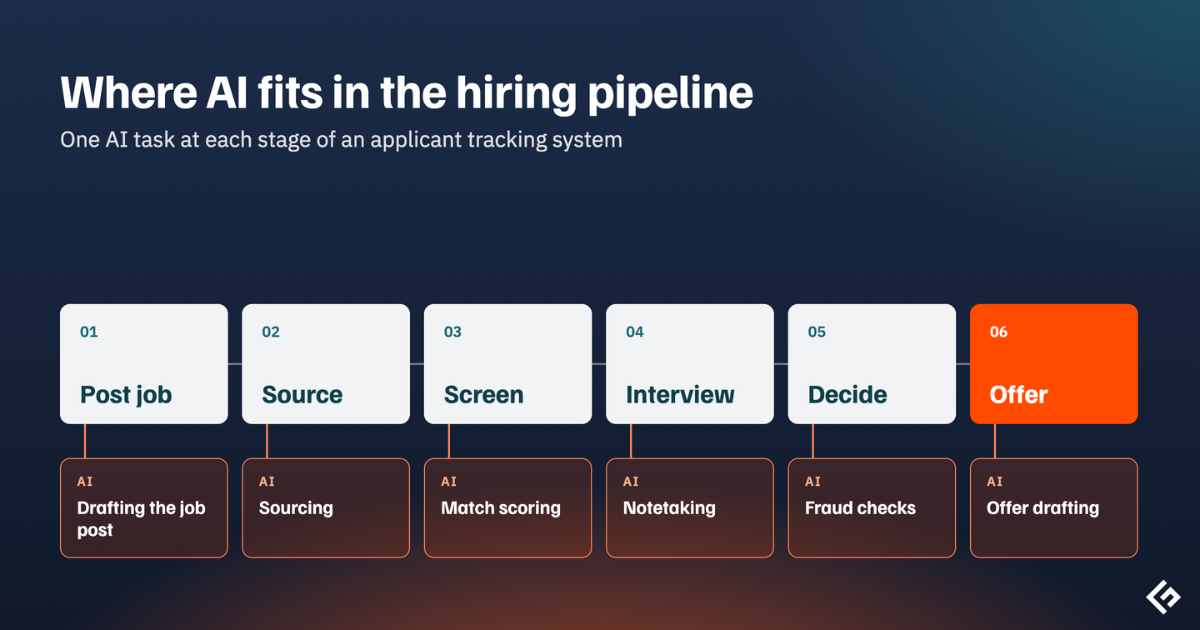
It means a lot more now. While researching this piece, I went through the release notes and product pages of most of the big ATS vendors, and nearly every one shipped something substantial in the last year, like agents to screen applicants, notetakers during interviews, fraud checks for fake candidates, assistants you can ask about your pipeline in your language.
Some of it is genuinely useful. Some of it raises questions you should ask before you switch it on. This guide covers both.
What AI Means Inside an ATS
It helps to separate three different things that all get called AI.
The oldest is machine learning on structured data. Resume parsing, ranking candidates against a job, and predicting who might drop out all fall here. Most applicant tracking systems have had some version of this for decades.
Generative AI is newer. It reads and writes language, so it can draft a job description, summarize a three-page resume, or turn a 45-minute interview into a page of notes.
Agents are the newest, and the most talked about. Instead of helping with one task when you click a button, an agent takes a goal, like screening everyone who applied this week, and works through the steps on its own.
The Features Worth Knowing About
Writing help
Drafting job descriptions and rejection notes is the most common AI feature by far. It saves time and but produces generic copy, so treat the draft as a starting point.
Match scores that explain themselves
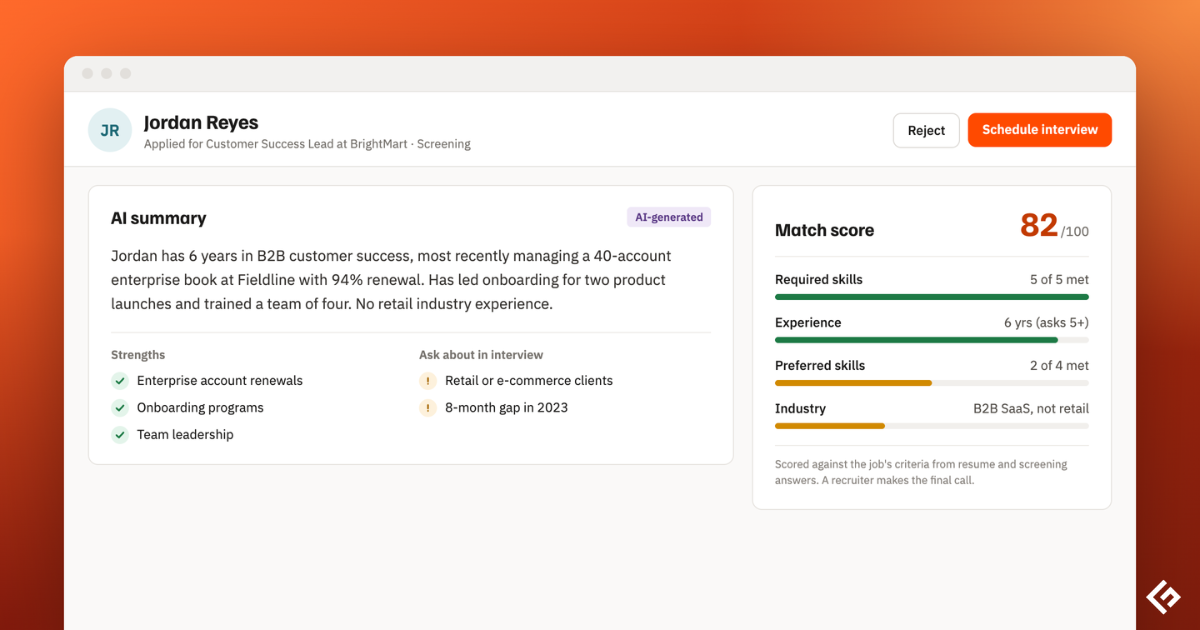
Every ATS now ranks applicants somehow. The ones I’d trust explain why. Workable’s agent, for example, scores candidates against up to 14 criteria and writes out its reasoning for each one, so a recruiter can check whether the score makes sense before acting on it.
Interview notetakers
This one has probably saved hiring teams the most. Greenhouse, Lever, Ashby, and Rippling all offer this where AI joins the call, transcribes it, and summarizes it.
Conversational assistants
For high-volume hiring, chat assistants now handle most of the back-and-forth. Candidates apply by text, answer a few screening questions, and book an interview without speaking to anyone. Paradox runs entire applications this way.
Fraud detection
I didn’t expect this to be such a big thing, but it came up at almost every vendor. Systems now check phone numbers, email addresses, IP addresses, and work history for signs of fake or bot applications. Greenhouse added optional identity checks through CLEAR.
Teamtailor goes a step further and flags hidden instructions inside resumes, a trick some applicants use to manipulate AI screeners.
Asking questions instead of building reports
Several systems now answer questions like “What’s our time to hire for engineering this quarter?”. A few vendors, including Greenhouse, Ashby, Workable, and Pinpoint, also connect their ATS to outside AI assistants like Claude or ChatGPT through MCP, so a recruiter can query hiring data from tools they already use.
Agents, and the Question That Matters
Between late 2025 and late 2026, Workable, Ashby, iCIMS, SmartRecruiters, and Greenhouse all added agents. Some source candidates and draft outreach, much like the standalone AI tools in our recruitment software guide. Some screen an entire pipeline and hand back a shortlist. Some coordinate interview times across several calendars.
Whether a vendor has agents isn’t really the interesting question. What matters is what those agents can do without a person signing off. If I were evaluating one, that’s the first thing I’d ask, and I’d want to see the configuration.
Also check the bill as AI is metered through credits or sold as add-ons like notetakers and screening agents, and it’s easy to underestimate. Our ATS pricing guide has examples.
Where It Helps
Volume is the main reason teams turn to AI. Applications per job more than doubled between 2022 and 2025 (more stats on our ATS statistics page), and recruiting teams didn’t double with them. Summaries and first-pass screening let a small team keep up without reading every resume.
Beyond that, the gains are practical. Debriefs are faster when everyone has the same interview notes. Candidates get answers quickly and hiring managers can get a number without going through a reporting tool.
Where It Goes Wrong
→ Bias
AI learns from data and rules that people set. If your past hiring favored certain backgrounds, a model can repeat that pattern quietly and at scale. Explained scores, regular bias testing, and a human reviewing decisions are the main defenses.
→ Candidates don’t trust it
In a Gartner survey of nearly 3,000 candidates, only 26% said they trust AI to evaluate them fairly. Greenhouse found that just 8% of US job seekers think AI makes hiring fairer, while 70% of hiring managers say it helps them decide faster and better. That’s a big gap between the two sides of the same process.
Greenhouse’s survey found 63% of job seekers have faced one, 38% have walked away from a hiring process because of one, and 70% weren’t clearly told upfront that AI would be evaluating them.
→ Candidates are gaming it back
Greenhouse also found that 41% of US job seekers admit to using prompt injections to get past AI filters. It’s the same technique attackers use against chatbots, which we explain in our guide to prompt injection.
→ People stop reading
Teams that treat AI rankings as decisions, rather than suggestions, are the ones most likely to miss a good candidate who described their experience in a traditional way.
The Laws You Should Know
Regulators now treat hiring AI as high stakes. If you use AI to screen or rank candidates, these may apply to you:
| Law | What it requires | Status |
|---|---|---|
| New York City Local Law 144 | Annual bias audit of automated hiring tools, published results, and notice to candidates | Enforced since July 2023 |
| Illinois HB 3773 | No AI use that discriminates in hiring, no zip codes as a proxy, and notice when AI is used | In effect since January 2026 |
| Colorado SB26-189 | Rules for automated decisions, including a right to human review after an adverse employment decision | Takes effect January 2027 |
| EU AI Act | Treats AI used for recruiting and evaluating candidates as high risk, with requirements for oversight and transparency | High-risk rules apply from December 2027 |
They all ask you to tell candidates when AI is involved, test for bias, keep records, and make sure a person can review important decisions. This isn’t legal advice, so check with counsel for your own situation.
What I’d Ask Before Turning It On
Which steps can the AI complete without a person approving them, and can you change that? Then ask whether every score comes with an explanation, and whether the system has been independently audited for bias.
Is your candidate data used to train the vendor’s models? Some vendors are clear that it isn’t, like Deel, for example, says so outright. Ask how the system tells candidates that AI is involved, too, because in several places that’s now a legal requirement.
Finally, what does the AI cost, and is it metered? And does the vendor hold any AI governance certification? Example, Pinpoint is certified to ISO 42001. That’s not a guarantee of anything, but it shows someone has thought about it.
Where This Is Heading
More of the pipeline will run on its own, with people approving the key decisions. iCIMS, for example, announced a Hiring Agent and most vendors are moving the same way.
Your ATS will also become something other AI tools plug into. With MCP connectors from several vendors already live, recruiters can work with hiring data from whichever assistant their company uses.
Fraud checks will likely become standard. Gartner predicts that by 2028, one in four candidate profiles worldwide will be fake, and it’s hard to see identity verification and deepfake detection staying optional add-ons with numbers like that.
Matching will keep moving from keywords toward skills and evidence.
And regulation will keep pushing vendors toward disclosure and audit tools built into the product, which is probably the most useful change of all.
If you’re comparing systems, our list of the best applicant tracking systems notes each vendor’s AI features.