



Ask an ATS vendor what their product costs and there’s a good chance you’ll get a demo invite instead of a number.
It’s a little maddening, because the range is huge. You can run a decent applicant tracking system for free. You can also sign a contract worth more than a junior recruiter’s salary. Most companies land somewhere between $3,000 and $12,000 a year, but where you end up has more to do with how a vendor bills than with what the software does.
I went through the pricing pages of a dozen vendors to get real numbers. Below is what I found.
The Short Version
Very small teams can start free, or pay somewhere between $15 and $300 a month. A company with 20 to 200 employees usually spends $3,000 to $12,000 a year. Past that, almost everyone wants to quote you, and the few enterprise vendors that do publish a starting price begin around $15,000.
How Vendors Bill
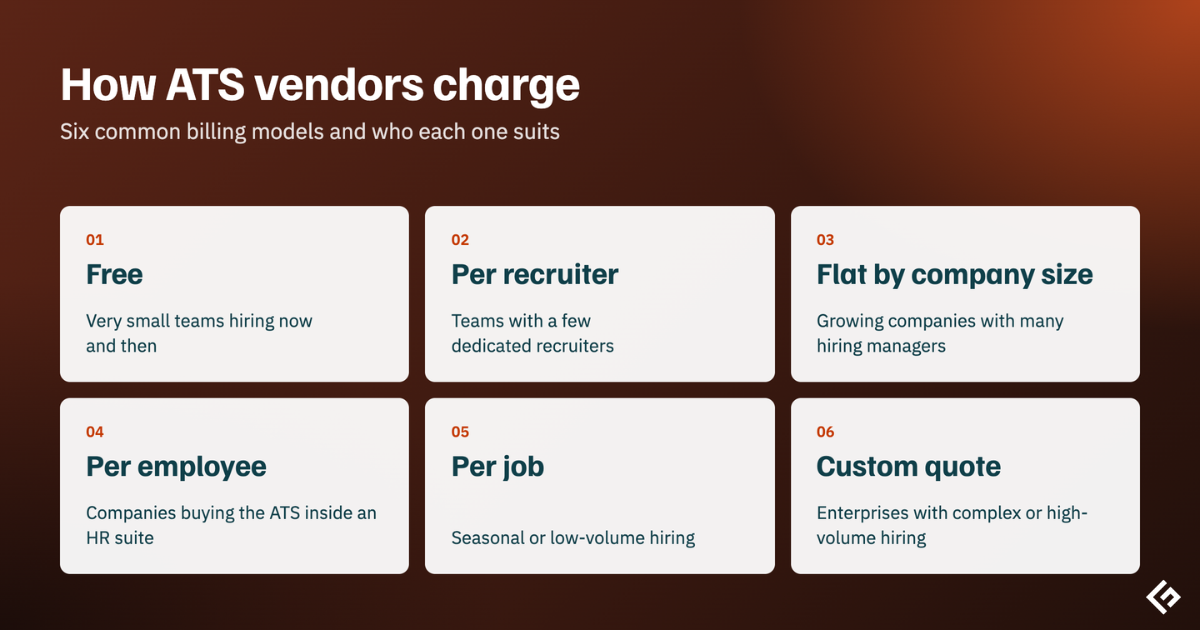
Two tools with the same sticker price can end up costing very different amounts a year later.
Per-recruiter pricing looks cheap until you add a coordinator. It works nicely if you have one or two recruiters and lots of hiring managers who only need free seats. Zoho Recruit and Manatal both bill this way.
Flat pricing by company size is the opposite. You pay one monthly fee no matter how many people log in, but it jumps every time your headcount crosses a band. Workable and Ashby use this model.
Then there’s per-employee pricing, which is how HR suites like BambooHR and Deel charge. Recruiting is a module, and you pay for every employee on the platform. A few vendors charge by active job slot, which suits companies that hire in bursts. And above a certain size, nearly everyone moves to a custom quote.
Free plan is limited, usually to one recruiter or one open job.
What You’ll Pay
Up to 20 employees
At this size you might not need to pay anything. Dover’s ATS is free with unlimited users and jobs, and Zoho Recruit and Breezy HR both have free plans that cover one open role.
If you do go for paid plan, expect anything from about $15 a user per month on Manatal to roughly $300 a month on Workable.
20 to 200 employees
This is where most growing companies are, and where flat pricing by headcount kicks in. On Workable’s Standard plan, a company of 21 to 50 people pays $419 a month on annual billing. At 101 to 200 people, it’s $949. Ashby’s entry plan is $400 a month for up to 100 employees.
So, roughly $3,000 to $12,000 a year before add-ons.
200 to 1,000+ employees
You’ll want approval workflows, proper reporting, and an integration with your HR system, and vendors price those case by case. ATS vendors doesn’t publish pricing for this size.
Greenhouse, iCIMS, and Workday Recruiting are all quote-only. SmartRecruiters is one of the rare vendors with a starting price $14,995 for its Essential plan.
Known Prices, Side by Side
This is what a sample of vendors list on their own sites. If you’re comparing features too, our list of the best applicant tracking systems goes deeper.
| ATS | How it bills | starting price |
|---|---|---|
| Dover | Free plan | Premium $199/month |
| Zoho Recruit | Per recruiter | Standard $25/recruiter/month billed annually |
| Manatal | Per user | $15/user/month billed annually |
| Breezy HR | Flat by plan | Startup $157/month billed annually |
| JazzHR | Flat by plan | Hero $1,000/year |
| Gem | By company size | Startup program from $130/month (1 to 10 employees) |
| Workable | By company size | $299/month for 1 to 20 employees, billed annually |
| Ashby | By company size | $400/month for up to 100 employees |
| BambooHR | Per employee (HR suite) | $10/employee/month on Core, for companies over 25 employees |
| Deel | Per worker (HR suite) | $14/worker/month for Find Talent, plus Deel HR from $5/employee/month |
| SmartRecruiters | Enterprise | Essential from $14,995 |
| Greenhouse, iCIMS, Lever | Custom quote | Not published |
These were accurate when I checked in September 2026. Vendors change pricing pages often, so treat them as a starting point and confirm before you buy.
The Costs That Show Up Later
The subscription is the number everyone negotiates. It’s rarely the number that surprises people.
Add-ons are the usual culprit. Texting, video interviews, assessments, and referral tools are often sold separately. On Workable’s Standard plan, for instance, texting is $89 a month and video interviews another $109. Bundle a few of those and your “$299” plan is suddenly closer to $500.
More vendors now meter AI features with credits. Workable includes 3,000 AI credits and sells more in packs (5,000 credits cost $600), and Breezy HR sells AI credits starting at $30 per 100,000.
Job ads can quietly cost more than the ATS itself. Posting to free boards is free, but sponsored listings add up fast. Appcast’s 2026 benchmark report put the median cost-per-application at $19.32 in 2025, and the median cost-per-interview at $275.
And ask about renewals before you sign. Some buyers report sizable increases in next year. A cap written into the first contract is much easier to get than a discount later.
Is It Worth It?
The honest answer depends on two things: how many people you hire, and whether you currently pay recruiting agencies. The math is simple.
ROI (%) = (Annual benefits - Annual cost) / Annual cost x 100For cost, add up the subscription, add-ons, extra ad spend, and the time it takes to set up and run the system.
For benefits, most of the value comes from time your recruiters and hiring managers stop spending on admin, and from agency fees you no longer pay.
A worked example
Take an example company with 150 employees, two recruiters, about 40 hires a year. Every number below is an assumption, so swap in your own.
| Item | Assumption | Annual value |
|---|---|---|
| ATS cost | Plan plus add-ons | $12,000 |
| Recruiter time saved | 5 hours a week each, 2 recruiters, 46 weeks, $45 an hour | $20,700 |
| Hiring manager time saved | 1 hour per hire, 40 hires, $70 an hour | $2,800 |
| Agency fees avoided | 2 fewer agency placements at $15,000 each | $30,000 |
| Total benefits | $53,500 |
ROI = ($53,500 - $12,000) / $12,000 x 100 = 346%Look at where that return actually comes from. More than half is two agency placements. Time savings alone would still cover the cost about twice over.
If your company never uses agencies and only hires a handful of people a year, the numbers get tight. A free plan, or a very cheap one, might be the smarter call.
To sanity-check your inputs, SHRM’s 2025 recruiting benchmarks put the median nonexecutive cost-per-hire at $1,200 and median time-to-fill at about 45 days. There’s more on hiring speed and volume in our ATS statistics.
Paying Less Without Buying the Wrong Tool
Pay annually once you’re confident. Discounts run from about 10% to 20%, Ashby takes 10% off, Zoho Recruit up to 16%, and Workable 20%.
Start without the extras. You can always add texting or AI credits once you see people using them.
Use the trial on a real job, with your real hiring managers. A week of actual use tells you more than three demos.
And don’t buy more system than you need. An enterprise suite at a 30-person company is money spent on features nobody opens. Our guide to the types of ATS can help you work out which category fits.