



Recruiting now runs on a stack. The ATS is still the system of record, but the work around it, finding people, talking to them, screening, scheduling, and interviewing, happens in separate tools, and most of them now run on AI agents.
This guide covers that stack. If you’re choosing the ATS system itself, see our guide to applicant tracking systems. Here we look at the tools that sit on top of an ATS, plus the platforms agencies and frontline employers use in place of one.
AI on its own no longer sets anyone apart. Nearly every tool below ships agents. What matters is what those agents actually do, what they cost, and how cleanly they hand work back to a person.
One caveat, most of these type of tools don’t publish public prices. So, you got to get a demo or request quote to estimate the pricing.
AI Recruitment Software Comparison
| Tool | Category | Best for | Starting price | Free trial | AI highlights | Role with your ATS | Link |
|---|---|---|---|---|---|---|---|
| 01 Humanly | Conversational AI | High-volume hourly and frontline hiring | Custom quote | None | AI recruiter, interviewer, notetaker | On top of it, or its own | Visit |
| 02 Paradox | Conversational AI | Large employers hiring hourly workers at scale | Custom quote | None | Olivia, the candidate experience agent | On top of it, or its own | Visit |
| 03 Phenom | Talent experience platform | Enterprises that want one AI layer for career sites, CRM, and mobility | Custom quote | None | Voice screening, fraud detection, career coach agents | Works alongside it | Visit |
| 04 Gem | Sourcing and recruiting CRM | Tech and professional hiring teams that source heavily | Custom quote (startups from $130/month) | 6 months free under 30 employees | Sourcing, application review, fraud agents | On top of it, or its own | Visit |
| 05 Juicebox | AI sourcing | In-house teams and agencies doing outbound sourcing | $99/seat/month | Free plan | Plain-English search, sourcing agents | Works alongside it | Visit |
| 06 Recruit CRM | Agency ATS and CRM | Small and mid-sized recruitment agencies | $95/user/month | 30 days | Parsing, matching, submission agents | Replaces it | Visit |
| 07 Recruiterflow | Agency ATS and CRM | Executive search and boutique recruiting firms | $119/user/month | None (demo only) | AIRA agents for sourcing, matching, notes | Replaces it | Visit |
| 08 Bullhorn | Staffing platform | Staffing firms that want front and back office in one system | $99/user/month | None | Amplify Digital Workers | Replaces it | Visit |
| 09 Fountain | Frontline hiring platform | Enterprise employers hiring hourly staff | Custom quote | None | Cue orchestrator and voice agents | Replaces it | Visit |
| 10 Metaview | Interview intelligence | Recruiters who lose hours writing up calls | Free; paid from $60/user/month | Free plan | Notes, sourcing, application review agents | Works alongside it | Visit |
| 11 GoodTime | Interview scheduling | Enterprise teams juggling complex interview panels | Custom quote | None | Cori scheduling and screening agent | Works alongside it | Visit |
| 12 Eightfold AI | Talent intelligence | Large enterprises hiring and redeploying at scale | Custom quote | None | AI Interviewer, candidate agents, skills matching | Works alongside it | Visit |
Best Recruitment Software
01. Humanly
Conversational AIHigh-volume hourly and frontline hiring
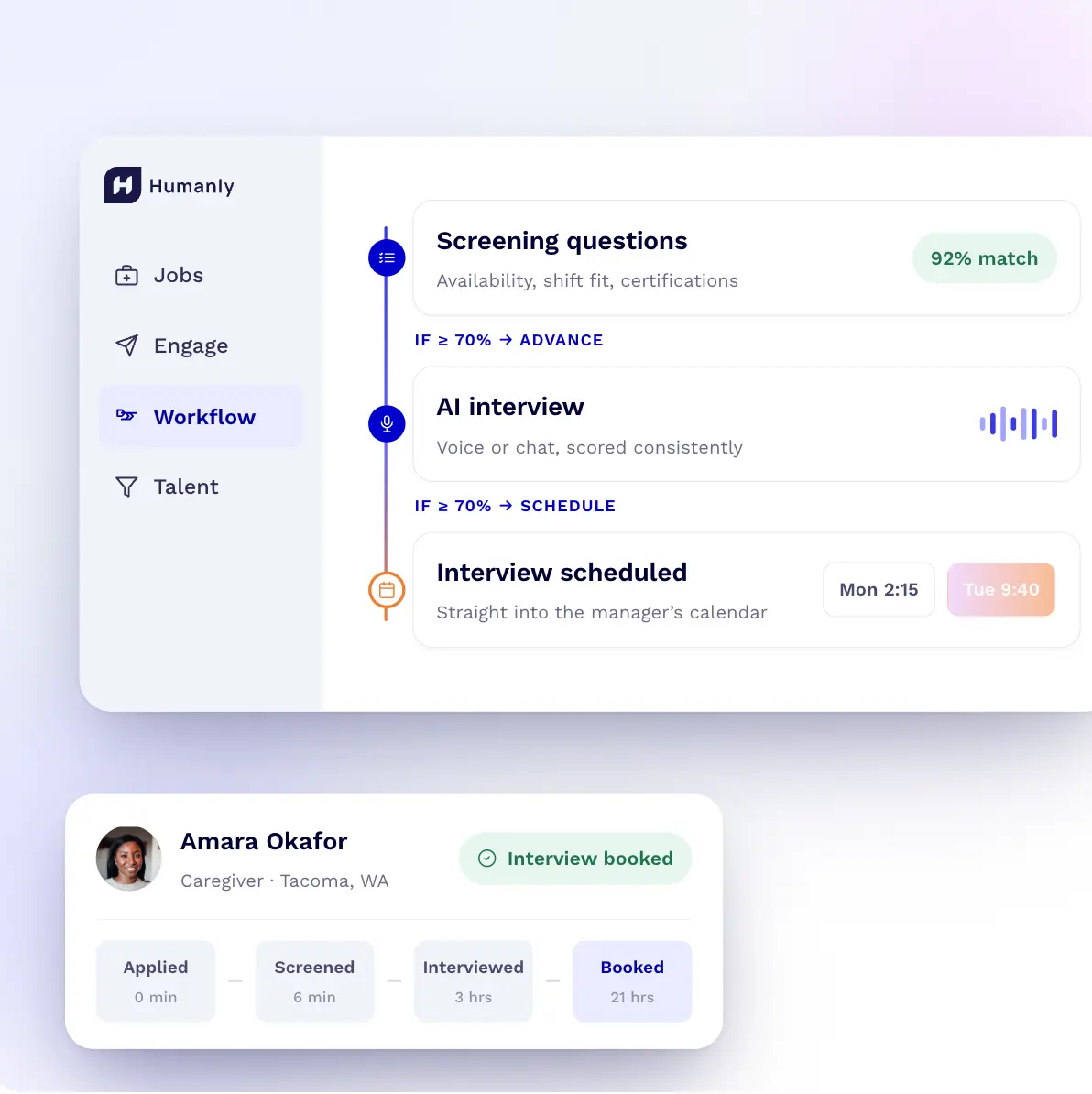
Humanly takes over the part of frontline hiring that consumes a recruiter’s day in replying to applicants, asking screening questions, and booking interviews. Its AI Recruiter does that around the clock by text, chat, and email, then hands recruiters a ranked shortlist with the interview transcript behind every name.
It grew fast through acquisitions. In October 2025 it bought Sprockets, Qualifi, and HourWork, which brought voice screening, an AI Interviewer that runs structured chat, voice, and video interviews, and onboarding and retention tools.
It fits whatever you already run. Humanly can sit on top of Workday, iCIMS, Greenhouse, UKG, or SAP SuccessFactors, or you can use its own high-volume ATS, which connects to payroll systems such as ADP and Gusto.
Pros & Cons
PROS
CONS
Pricing
Humanly doesn’t publish pricing, and the company has said it’s moving toward pay-per-candidate and pay-per-hire models. You can try a sample AI interview on its site before booking a demo.
02. Paradox
Conversational AILarge employers hiring hourly workers at scale
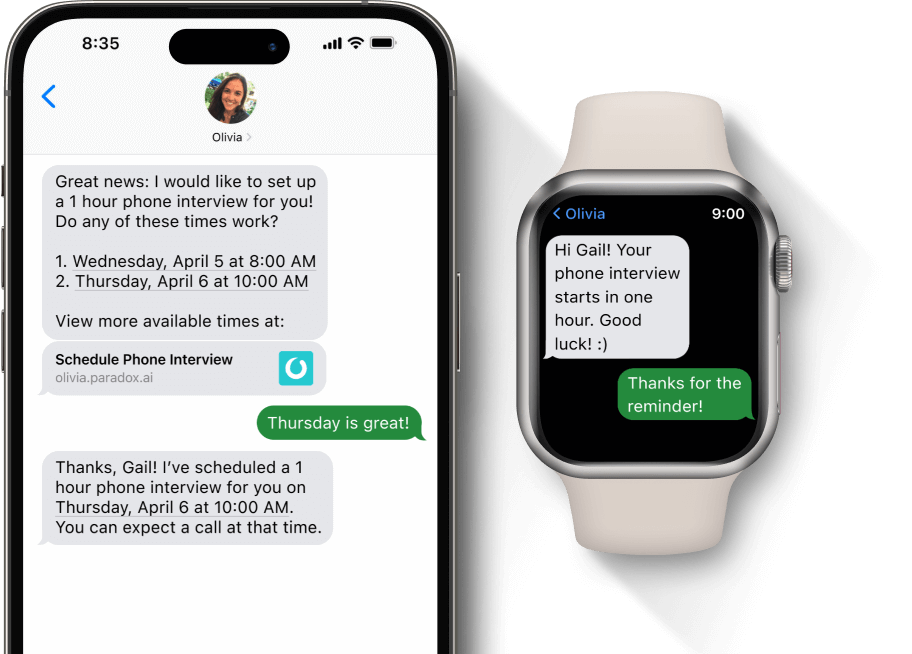
Paradox’s assistant, Olivia, runs the hiring flow at employers such as Chipotle, 7-Eleven, and GM. A candidate texts a keyword or taps apply, and Olivia handles the rest including screening, interview scheduling and rescheduling, reminders, offers, and onboarding paperwork down to I-9 forms. It answers in more than 100 languages.
Workday bought Paradox in October 2025 and now sells Olivia as its Candidate Experience Agent. You can still buy it directly, and it connects to other ATS platforms including SAP SuccessFactors, iCIMS, UKG, and Greenhouse. Whether that stays true long term is an open question.
Pros & Cons
PROS
CONS
03. Phenom
Talent experience platformEnterprises that want one AI layer for career sites, CRM, and mobility
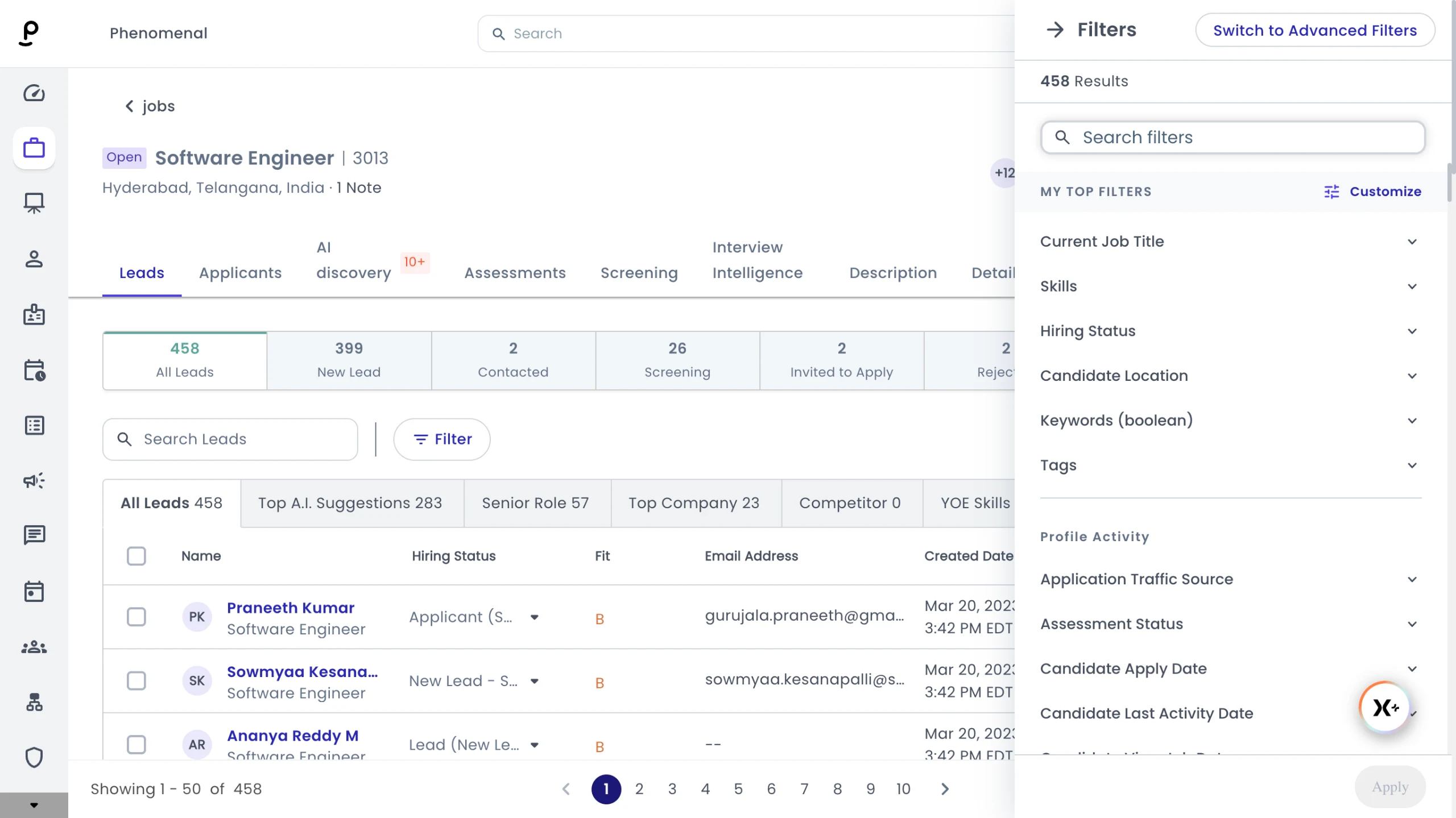
Phenom covers the parts of hiring that candidates actually see. Its career site recommends jobs to each visitor, a talent CRM keeps in touch with people who aren’t ready to apply, and automated scheduling and onboarding carry them the rest of the way. The same platform then serves current employees, with a talent marketplace, career pathing, and succession planning.
Its AI agents go after problems that got worse recently. A Voice Screening Agent runs pre-screens, a Fraud Detection Agent flags fake applications, and a Career Coach Agent helps employees plan their next move.
The fraud focus explains its buying spree: Phenom added Included AI for people analytics, Be Applied for cognitive assessments, and Plum for behavioral assessments, all aimed at checking skills an AI-written resume can fake.
Gartner ranked it among the top vendors across many use case in Critical Capabilities report for talent acquisition suites. Customers include Southwest Airlines, HPE, ABB, and Thales.
It sits on top of your existing ATS and HR system. That’s both the strength and the catch, because connecting it to a legacy system can take months and often needs an implementation partner.
Pros & Cons
PROS
CONS
04. Gem
Sourcing and recruiting CRMTech and professional hiring teams that source heavily
Gem began as a sourcing and CRM layer on top of an ATS, and plenty of teams still use it that way. You add candidates in one click from more than 20 sites, find emails without a cap, and run multichannel outreach sequences, all synced back to Greenhouse, Lever, Workday, Ashby, or another ATS. An All-in-One plan adds Gem’s own ATS if you’d rather consolidate.
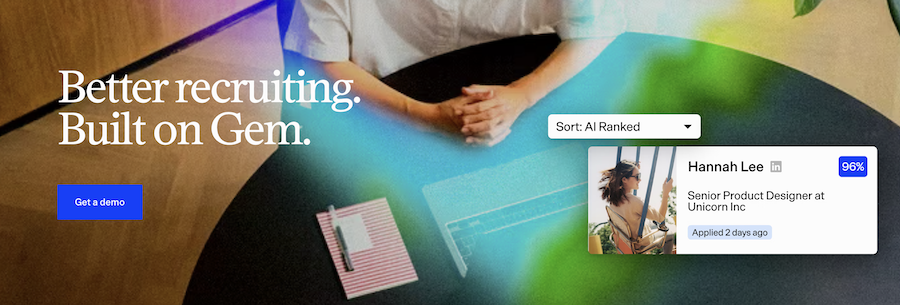
Its AI agents are the practical kind. The Sourcing Agent searches 800 million profiles and drafts outreach. The Application Review Agent scores every applicant and explains each score in plain language. Talent Rediscovery surfaces strong past candidates, and a Fraud Detection Agent checks each application against six signals. GeMCP connects Gem to Claude and ChatGPT.
Talent Compass covers analytics, with forecasting and benchmarks that heads of talent tend to rely on for planning.
Pros & Cons
PROS
CONS
Pricing
| Startup program (per company) | Billed yearly | Billed monthly |
|---|---|---|
| 1 to 10 employees | $130/month | $300/month |
| 11 to 30 employees | $180/month | $400/month |
| 31 to 50 employees | $225/month | $500/month |
| 51 to 75 employees | $315/month | $700/month |
| 76 to 100 employees | $405/month | $900/month |
Good to know
Companies under 30 employees get the All-in-One plan free for six months, then 50% off.
05. Juicebox
AI sourcingIn-house teams and agencies doing outbound sourcing
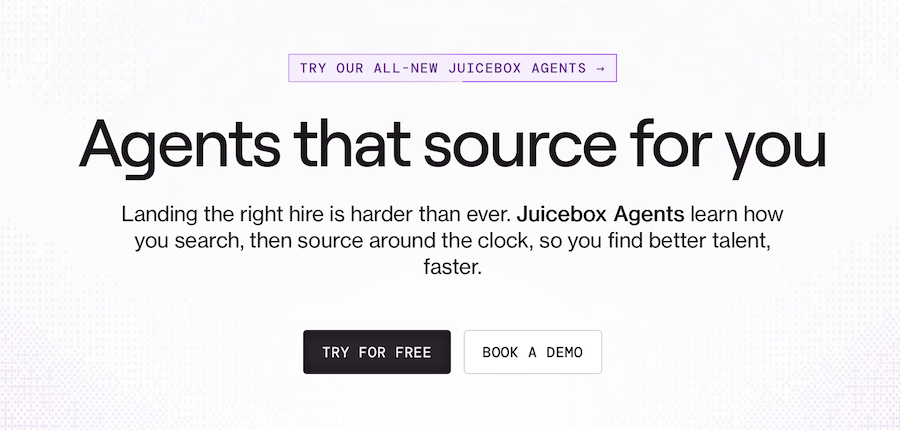
Juicebox made its name with PeopleGPT, a search box where you describe the person you want in plain English and get a ranked list back, each with a match score. It searches more than 800 million profiles drawn from over 30 data sources.
Juicebox Agents is the new thing. After a short calibration, an agent keeps searching, assessing, and emailing candidates around the clock, and you can let it shortlist or send outreach on its own.
It works beside your ATS, with connections to 40+ ATS platforms and 20+ CRMs, including Greenhouse, Lever, Ashby, and Bullhorn. The catch is that those integrations come only with the Business plan.
Pros & Cons
PROS
CONS
Pricing
| Plan | Billed yearly | Billed monthly |
|---|---|---|
| Free | $0 | $0 |
| Starter | $99/seat/month | $119/seat/month |
| Growth | $179/seat/month | $199/seat/month |
Good to know
Juicebox Agents cost $199 per agent per month on top of a seat.
06. Recruit CRM
Agency ATS and CRMSmall and mid-sized recruitment agencies
Recruit CRM is built for agencies, and it shows in the details. Candidates, clients, and jobs live in one place, and a Chrome extension pulls profiles from LinkedIn, Xing, and ZoomInfo straight into your database.
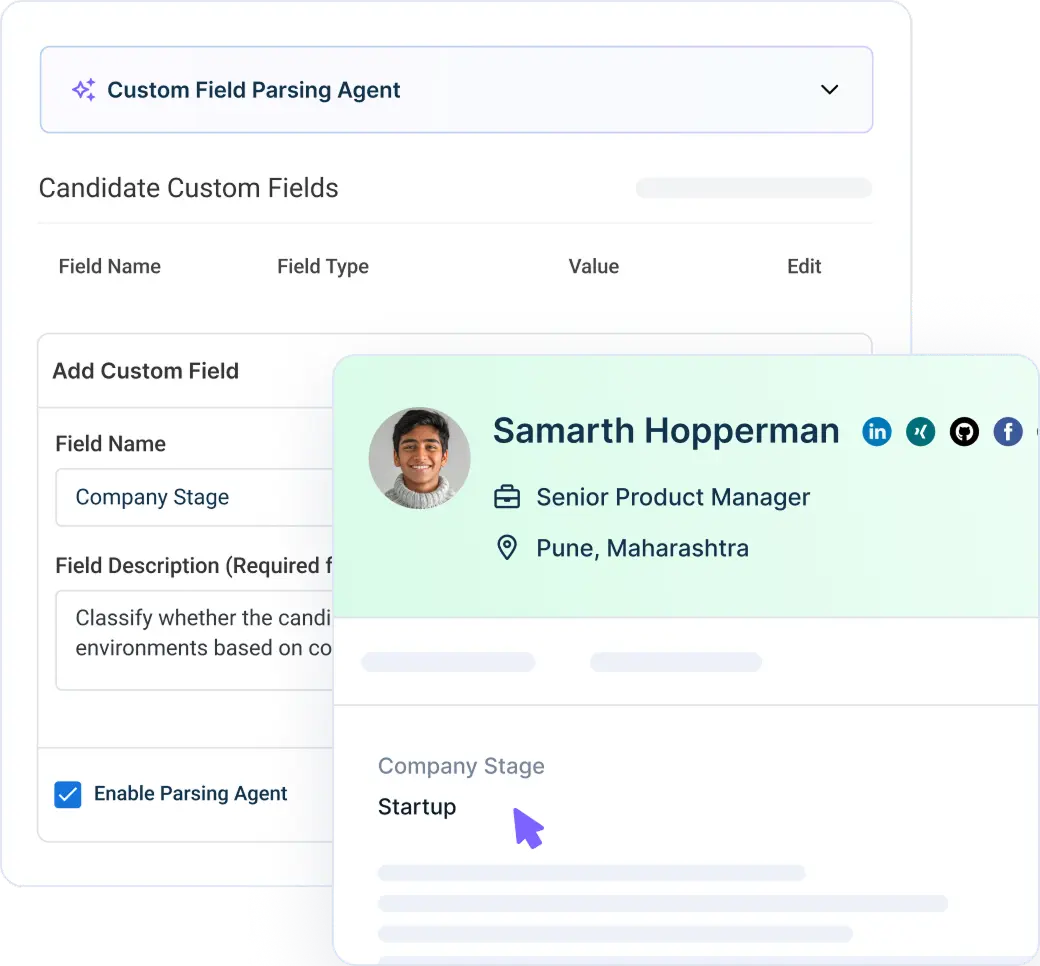
Lately, they moved into contract staffing with timesheets, invoicing, and four new AI agents. Its agents now handle field parsing, candidate submissions, CV formatting, candidate pitching, and email replies. An MCP connector also lets you query your Recruit CRM data from Claude or ChatGPT.
Recruit Craft, its website builder, handles careers pages and candidate portals, and a report generator speeds up shortlists for executive search.
Watch the add-ons. Workflow automation, multiposting, LinkedIn messaging, and advanced analytics all cost extra below Enterprise, and the Pro plan caps AI matching at two matches.
Pros & Cons
PROS
CONS
Pricing
| Plan | Billed yearly | Billed monthly |
|---|---|---|
| Pro | $95/user/month | $109/user/month |
| Business | $135/user/month | $159/user/month |
| Enterprise | $215/user/month | $259/user/month |
07. Recruiterflow
Agency ATS and CRMExecutive search and boutique recruiting firms
More than 2,100 search firms run on Recruiterflow, and it’s bootstrapped, which is rare in a market full of venture-funded rivals.
The Platform plan costs $119 per user a month on annual billing, and the page promises no add-ons. The AI is a separate story: AIRA, Recruiterflow’s set of 36 agents, sits on its own custom-priced plan.
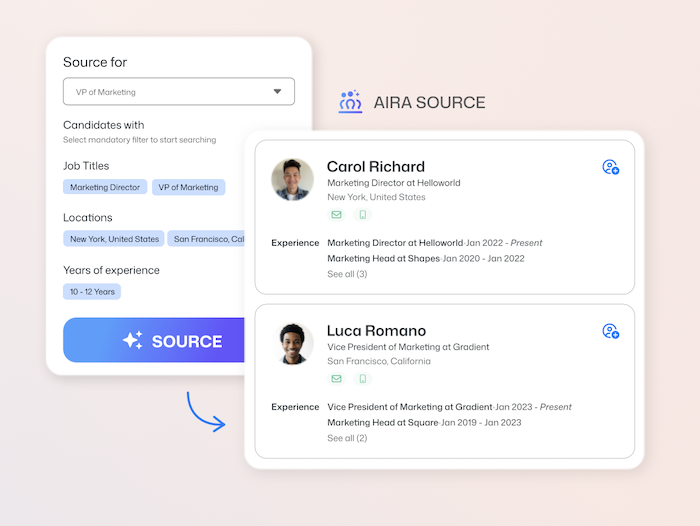
Once you have it, AIRA does a lot. It searches your own database in plain English, sources from more than 850 million external profiles, ranks past candidates against a new job, joins calls to take notes, fills in scorecards, and flags when someone in your database changes jobs.
Outreach runs as sequences across email, LinkedIn, SMS, and calls, and the same automation recipes work for business development as well as recruiting.
Pros & Cons
PROS
CONS
Pricing
| Plan | Billed yearly | Billed monthly |
|---|---|---|
| Platform | $119/user/month | $149/user/month |
Good to know
AIRA, the plan with Recruiterflow’s AI agents, is priced on request.
08. Bullhorn
Staffing platformStaffing firms that want front and back office in one system
Bullhorn is the default for staffing firms with real volume. More than 10,000 customers use it, and it covers the whole chain: sourcing, submissions, onboarding, timesheets, and pay-and-bill. Its VMS automation connects to more than 110 vendor management systems, which is often the deciding feature for larger firms.
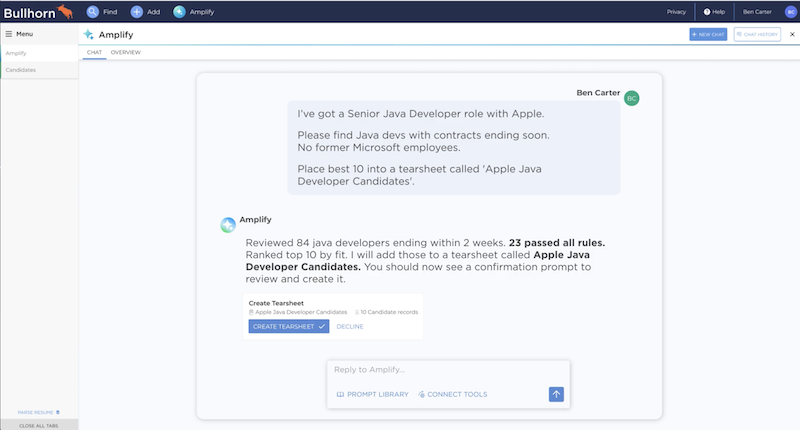
Amplify Digital Workers cover more than 15 skills, including matching, screening, candidate presentation, outreach, prospecting, and transcription. Amplify Chat runs on Bullhorn’s own recruiting language model. The Prospect, Verify, Audit, and Transcribe skills were released in May 2026.
Pros & Cons
PROS
CONS
Pricing
| Plan | Price |
|---|---|
| Bullhorn Starter | $99/user/month |
| Bullhorn Core | $165/user/month |
Good to know
Amplify, the middle-office tools, and the larger bundles are quote-based, so the cost of a full setup isn’t clear until you talk to sales.
09. Fountain
Frontline hiring platformEnterprise employers hiring hourly staff
Fountain was built for hourly hiring from the start, and it says it has processed more than 91 million applicants across 75 countries. Candidates apply from their phones, book their own interviews, and go through onboarding, including I-9 and E-Verify checks, in the same flow.
Recently, they launched Cue, an orchestrator that runs the pipeline with little manual work. It sources and screens around the clock, adjusts workflows, fills shift gaps, and sends offers. Three voice agents work under it: Anna screens candidates, Emma helps new hires with onboarding forms, and Sam handles engagement and retention.
Unlike Humanly and Paradox, Fountain is the ATS, so it replaces your current system. It connects to Workday, UKG, ADP, and SAP SuccessFactors on the HR side, and to Checkr, HireRight, and First Advantage for background checks. Gartner added it to its 2026 Magic Quadrant for talent acquisition suites as a Niche Player.
Pros & Cons
PROS
CONS
10. Metaview
Interview intelligenceRecruiters who lose hours writing up calls
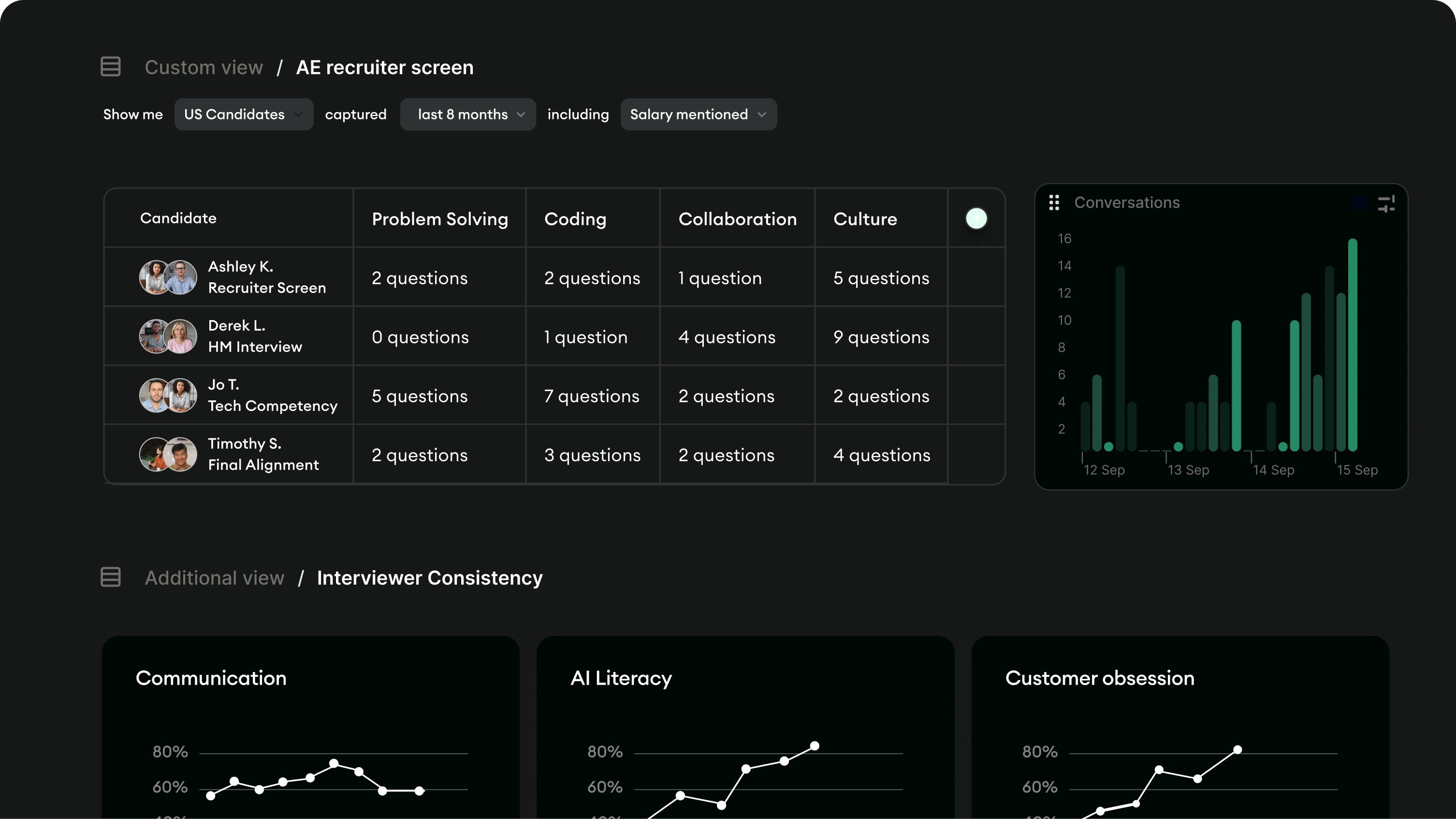
Metaview started as the recruiter’s notetaker, and that’s still the easiest way in. It joins interviews on Zoom, Meet, Teams, or Webex, writes structured notes and scorecards in more than 50 languages, and pushes them into your ATS.
The free plan covers 25 calls a month.
It has since grown into a set of agents. The Sourcing agent builds an ideal candidate profile from the job description, learns from your hiring decisions, and can start searching right after an intake call. The Application Review agent screens inbound applicants and is priced by volume, with unlimited users. Every recommendation shows its reasoning.
Fillmore, an AI coworker that sources, runs outreach, and books screening calls, is releasing soon, and Metaview bought Reval in August 2026 to speed it up. It connects to more than 100 ATS platforms, from Greenhouse and Ashby to Workday and Bullhorn.
Pros & Cons
PROS
CONS
Pricing
| Plan | Price |
|---|---|
| Notetaker Pro (unlimited calls) | $60/user/month |
| Sourcing Pro (200 profiles) | $100/user/month |
| Sourcing Max (unlimited) | $300/user/month |
| Application Review Pro (500 reviews) | $150/month |
Good to know
Free tiers include 25 notetaker calls a month, your first 100 sourced profiles, and 50 application reviews. Application Review scales by volume, up to $25,000 a month for 100,000 reviews.
11. GoodTime
Interview schedulingEnterprise teams juggling complex interview panels
Scheduling a five-person panel across three time zones is where recruiting hours vanish, and GoodTime exists for exactly that. It handles multi-day and panel interviews, balances load across interviewers, and lets candidates book their own slots.
Cori, the AI agent goes further. When an interviewer cancels, Cori finds a replacement. It also screens candidates, answers their questions, and handles reminders and follow-ups by email, SMS, Slack, or Teams.
It trains interviewers too. New interviewers follow a training path and shadow sessions automatically before they run interviews alone. GoodTime sits on top of Workday, SuccessFactors, Greenhouse, iCIMS, Lever, and other ATS platforms, and plugs into CoderPad and HackerRank for technical rounds.
Pros & Cons
PROS
CONS
12. Eightfold AI
Talent intelligenceLarge enterprises hiring and redeploying at scale
Eightfold is the enterprise pick. Salesforce, Citi, HSBC, and Bayer use it, and it holds FedRAMP Moderate authorization for government work. Its matching is based on skills, drawn from what it says are 1.6 billion career paths, so it can surface people whose job titles would never match a keyword search.
It reaches past external hiring. Workforce Exchange runs an internal talent marketplace, so companies can fill roles from inside before posting them.
The AI lineup has grown fast. An AI Interviewer runs high-volume screening, an Interview Companion coaches human interviewers in real time, and Candidate Agents help applicants find jobs, apply, and book interviews. Eightfold works alongside Workday, SAP SuccessFactors, Oracle, and Greenhouse and doesn’t try to replace them.
Pros & Cons
PROS
CONS
Honorable Mentions
Skills testing before the first interview. It has more than 350 tests plus AI-scored video interviews, and a free plan with 10 credits a month. Paid plans start at $142 a month, billed annually.
Rebuilt in August 2026 around AI agents that source, screen by voice, and schedule across more than a billion open-web profiles. Solo plans start at $494 a month, with a 7-day free trial.
AI search across more than a billion profiles, with extra depth for technical and hard-to-fill roles. Recruit Core costs $149 a month on annual billing, and there’s a 14-day free trial.
An agency ATS and CRM with an 850-million-person talent graph and AI agents that build shortlists and find contact details. From $149 per user per month, billed annually.
Interview recording, transcripts, and AI notes, plus an AI interviewer for first-round screens. Zoom bought it in late 2025. Pricing isn’t published.
Video interviews and assessments for large employers, with a voice-based AI interviewer added in June 2026. Pricing isn’t published.
A talent CRM that has moved toward workforce planning, with skills intelligence and an AI consultant called Ray. Pricing isn’t published.
How to Choose Recruitment Software
Start with where hiring actually stalls. Buying a tool for a problem you don’t have is the most common mistake in this category.
- Not enough good candidates? Look at sourcing and CRM tools such as Juicebox or Gem.
- Too many applicants to screen? Conversational AI from Humanly, Paradox, or Fountain fits hourly hiring. Metaview or Gem application review fits professional roles.
- Scheduling chaos? GoodTime was built for it.
- Hours lost writing up calls? Metaview’s notetaker pays for itself quickly.
- Running an agency? You need clients, placements, and billing in the same system. That points to Recruit CRM, Recruiterflow, or Bullhorn.
- Need skills tests? Add an assessment tool such as TestGorilla or HireVue from the honorable mentions.
Then discuss with vendors on three things.
- Ask which steps an agent completes without a human and which need approval. Rejections and offers are where you want a person in the loop.
- New York City requires bias audits for automated hiring tools, and the EU AI Act treats AI used in recruitment as high risk. Ask for audit results, how candidates are told about AI screening, and how admin access is protected.
- Agents, AI seats, and contact credits often cost extra. Get the clarity on cost.
FAQ
What’s the difference between an ATS and recruitment software?
An ATS tracks applicants through your hiring pipeline and acts as the system of record. Recruitment software is the wider category for sourcing, candidate engagement, screening, scheduling, interview notes, and assessments.
Do small teams need AI recruiting tools?
Not always. A small team hiring a few people a year gets more from a good ATS. Tools like Juicebox and Metaview have free plans, so you can test whether they save time before paying.
Is AI screening legal?
Generally yes, but it’s increasingly regulated. Rules on notice, bias audits, and candidate consent vary by city, state, and country. Check with legal counsel before letting AI reject candidates on its own.