



Say you’re hiring a senior backend engineer. You post the job, and 300 applications arrive in a week. Most are a poor fit. The person you actually want has a job they like and hasn’t looked at a job board in two years.
An ATS deals with the 300. A recruiting CRM is how you reach the one who never applied.
That’s the whole difference, and it’s why the two tools get confused so often. Both store candidate profiles and send emails. Plenty of products now sell them as one platform. But they were built for opposite ends of the hiring funnel, and knowing which end you’re weak at tells you which one to buy.
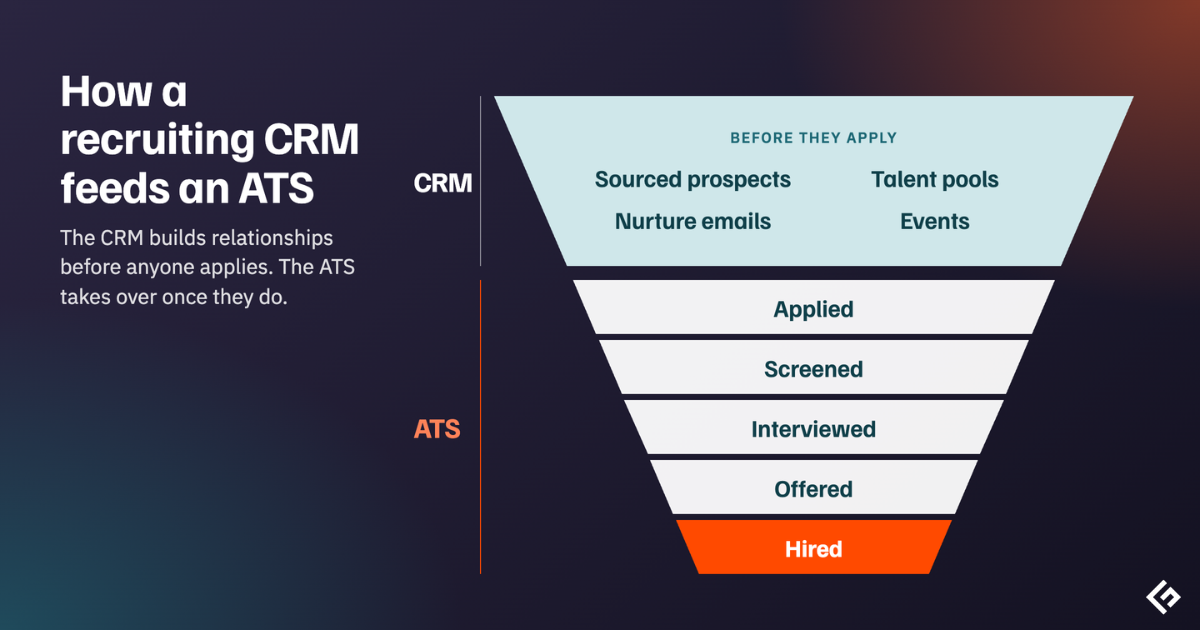
What an ATS Is For
An applicant tracking system starts working the moment someone applies. It stores the resume, pulls out the useful details, and drops the candidate into a pipeline for that specific job.
When the role is filled, the pipeline closes, and the people in it mostly stop getting attention.
What a Recruiting CRM Is For
A recruiting CRM (candidate relationship management) borrows its logic from sales. You don’t wait for leads to show up but go find them, keep notes on them, and stay in touch until the timing is right.
In practice, a recruiter adds people from LinkedIn, GitHub, a conference, or an employee referral, often with a browser extension. They tag them by skill or by the role they might fit next year. Then they run outreach, usually a short sequence of personal emails that stops the moment someone replies. People who aren’t ready to move get a quarterly update or an invite to an event instead.
The CRM is organized around people and relationships, which is exactly why it’s good at long timelines.
Where They Actually Differ
| ATS | Recruiting CRM | |
|---|---|---|
| Who’s in it | People who applied | Prospects, past applicants, alumni, event contacts |
| Starts when | A candidate applies | A recruiter finds or meets someone |
| Organized around | Open jobs | Skills, interests, relationships |
| Typical timeline | Days to weeks | Months to years |
| Success looks like | Fast, fair decisions | Replies, a growing pipeline, sourced hires |
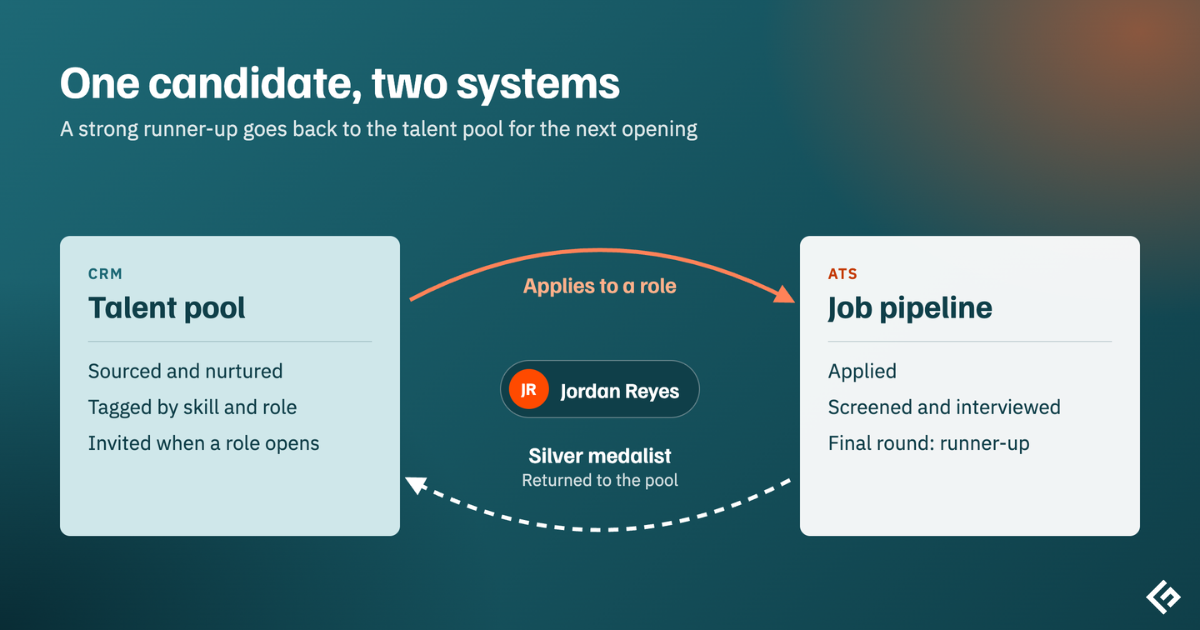
The timeline is the one that matters most. Think about your silver medalists, the finalists who almost got the offer. In an ATS they sit in a closed pipeline, tagged as rejected. In a CRM they’re some of the warmest leads you have, and the next time a similar role opens you can call them before you post anything.
Reporting follows the same split. ATS reports ask how long hiring took and where candidates dropped out. CRM reports ask how many people replied, how big the pipeline is, and how many sourced prospects turned into hires.
Why This Got More Important Recently
Greenhouse data shows the average job got 244 applications in 2025, more than double the number in 2022 (we track this and more in our ATS statistics). A lot of those are AI-written, mass-applied, or simply off target.
When you get irrelevant resumes, a short list of people you already know and have spoken to is worth a lot. Teams that kept a CRM going through the quiet periods have a real head start.
Do You Need One, the Other, or Both?
If most of your roles fill from people who apply, an ATS on its own is fine. Plenty of companies never need more than that, and buying a CRM you won’t feed is a waste of money.
A CRM starts paying off when the same few problems keep showing up. You hire for skills that rarely apply on their own, like senior engineers or specialist clinicians. You open the same kind of role every few months. Or you run campus, or referral programs and need something to store those contacts.
Agencies are a different case. A recruiting agency has to manage clients as well as candidates, so agency software always includes a CRM. If that’s you, the agency tools in our recruitment software guide are a better starting point.
One Platform or Two?
Lever, Ashby, and Gem all put the ATS and CRM in one product, so a prospect you sourced in March and an applicant in June are the same profile with one history. Most agency systems, Bullhorn and Recruit CRM among them, have worked that way for long.
Separate tools still make sense for big teams with dedicated sourcers. A standalone CRM like Beamery can be deeper on campaigns and talent pools, and it integrates with ATS you already use. For most small and mid-size teams, one combined platform is the easier to maintain. Our list of the best applicant tracking systems explains which ones include CRM features.
Can’t I Just Use HubSpot or Salesforce?
You can for sometime, some small teams track candidates as contacts in their sales CRM, and it works for the first few hires.
It breaks down quickly after that. A sales CRM has no careers page and no application form. It won’t parse a resume, schedule an interview against three people’s calendars, or collect scorecards.
It doesn’t know anything about candidate consent or how long you’re allowed to keep applicant data. And every hiring manager who needs to see a candidate needs a seat in a tool built for your sales team.
How the Two Work Together
In a setup that works well, a candidate moves back and forth between the two tools. A sourcer finds someone and starts a conversation in the CRM. Months later a matching role opens, and that person moves into the ATS. If they don’t get the offer, they go back into a talent pool with a note about why.
When someone does accept an offer, the ATS hands them over to your HR system, which is a separate handoff covered in ATS vs HRIS.