


An AI voice agent talks to people over the phone, understands what they say, and acts on it by updating a CRM, making a booking, or handing over the call to a person.
It covers more ground than an AI receptionist, which mainly answers inbound calls at the front desk. Voice agents also run outbound work like appointment reminders, lead follow-up, and payment calls, and many are built for teams that want to design the agent themselves.
I built the same appointment reminder agent on Retell, Vapi, ElevenLabs, and Bland, then called each one to see how they compare.
AI Voice Agent Platforms Comparison
| Tool | Type | Best for | Starting price | Free to try | Setup | Link |
|---|---|---|---|---|---|---|
| 01 Retell AI | No-code and API voice agents | Balance of no-code and API | $0.07 to $0.31/min | $10 in credits | No-code and API | Visit |
| 02 Vapi | Developer voice agent platform | Developers building custom stacks | $0.05/min, plus models | $5 in credits | Dashboard and API | Visit |
| 03 Aircall | AI agents with a phone system | Teams wanting phone system and agents together | $0.29/min ($100/mo minimum) | 100 free minutes | No-code, with engineer support | Visit |
| 04 ElevenLabs Agents | Voice-first agent platform | Voice quality and free testing | Free; paid from $6/mo | Free plan, 15 minutes | No-code and API | Visit |
| 05 Bland AI | High-volume call automation | High-volume outbound | $0.14/min | 2 credits, no card | No-code and API | Visit |
| 06 PolyAI | Enterprise dialog agents | Large contact centers | Custom (per minute) | $100 API credit, limited time | Managed, with no-code to code tools | Visit |
| 07 Parloa | Enterprise agent management | Enterprise customer service | Custom (per minute) | Demo only | Low-code, sold through sales | Visit |
| 08 Synthflow | Enterprise voice AI | Enterprise call workflows | Annual contract | None | Visual builder, with launch support | Visit |
| 09 Deepgram Voice Agent API | Voice agent API | Single API for speech and model | $0.075/min | $200 in credit | API only | Visit |
| 10 Telnyx | Voice AI on a carrier network | Telephony and AI on one network | $0.05/min | Free sign-up | API and agent builder | Visit |
How Voice Agent Platforms Differ
Three questions narrow this.
- How much do you want to build? Vapi, Deepgram, and Telnyx suit developers, Retell and ElevenLabs work for both builders and non-developers, and PolyAI, Parloa, and Synthflow are sold with implementation help.
- Do you already have a phone system? Aircall and Synthflow include telephony, while several developer platforms bill carrier minutes separately or ask you to bring your own.
- Is the work inbound, outbound, or both? Outbound brings extra limits, so check daily call caps and caller ID options early.
What the Agents Did in My Test
Each agent got the same prompt.
Maya, a reminder agent for a fictional dental clinic, had to confirm a Thursday cleaning, offer two other slots, avoid medical advice, and offer a transfer to the front desk. I then played the patient through four text turns covering a reschedule, a choice of Monday, a question about bleeding gums and ibuprofen, and a request for a real person.
Retell, ElevenLabs, and Bland all passed. They offered the right slots, refused the medical question, and offered the front desk.
All three also promised a human transfer which is great.
| Platform | Text test | Default cost shown | Default latency shown |
|---|---|---|---|
| Retell | Passed | $0.134/min | 820 to 1,290 ms |
| Vapi | Passed | About $0.09/min | About 1,530 ms |
| ElevenLabs | Passed | Not shown in builder | Not shown |
| Bland | Passed | Not shown in builder ($0.14/min on its pricing page) | Not shown |
Those cost and latency figures are each platform’s own estimates for its default setup. Treat them as a starting point for your own calls.
What Happened on the Calls
I then made one short browser call to each agent and pushed on something different each time.
| Platform | What I tried | What happened | Cost and latency |
|---|---|---|---|
| Retell | Moving the cleaning to Monday | Confirmed the new date and ended the call itself | $0.09 for 30 seconds, 1,228 ms average |
| Vapi | Asking about bleeding gums and ibuprofen | Gave no medical advice and promised a transfer | $0.05 for 45 seconds, 1,147 ms average |
| ElevenLabs | Moving the cleaning to Monday | Asked me to confirm, then said I was all set | 202 credits for 30 seconds, timing shown by layer |
| Bland | Speaking over the greeting, then asking for a person | Restarted the greeting and promised a transfer | 0.07 credits for 31 seconds, no latency shown in the transcript view |
Retell and ElevenLabs sounded very natural to me. Vapi was decent, and Bland felt a bit slower to respond than the rest. Try a few voices on each, since the one you pick changes the result.
The transfer problem got worse on a live call. Vapi told me three separate times that it was moving me to the front desk, and the line simply stayed open until I hung up. Bland promised to do it right away, then said goodbye when I did.
These calls ran in a browser and lasted under a minute each, so a real phone line will add its own delay and a longer call will give you a fairer cost figure.
What 1,000 Minutes Really Costs
Headline rates aren’t comparable, since some include the language model and phone minutes and others don’t. This table prices a 1,000-minute month on US rates from each vendor’s pricing page.
| Platform | Estimate | What to add |
|---|---|---|
| Telnyx | About $60 | Nothing, if you use its default model and carrier rates |
| Deepgram | $75 on Standard | Phone minutes |
| Vapi | About $90 on default settings | Phone minutes |
| ElevenLabs | $99 on Pro, which includes 1,238 minutes | Phone minutes and model usage |
| Retell | About $134 on default settings | Any phone number fee and add-ons |
| Bland | $140 on Start | Transfer minutes at $0.05 each |
| Aircall | $250 for a 1,000-minute bundle | Nothing, as telephony is included |
Best AI Voice Agent Platforms
01. Retell AI
No-code and API voice agentsBalance of no-code and API
Retell suits teams that want a working agent quickly and it is developer-friendly. You can start from a template, have its Conductor assistant generate an agent from your website, or write a single prompt.
Testing Retell
I chose a single prompt and had the agent ready to test in a few minutes. The builder shows estimated cost and latency above the prompt, which makes it easier to weigh model and voice choices before you make a call.
Its Test LLM tab runs a text conversation at $0.0208 per message. Maya handled all four turns, and even turned Monday into a specific date, November 9. That date was right.

Maya sounded very natural on a browser call. She gave the same date and hung up by herself after I said goodbye. That 30-second call cost $0.09, while the builder’s $0.134 per minute would suggest about $0.07, so compare a few real calls against the estimate before you budget.
Average latency was 1,228 ms, close to the top of the estimated range, with one reply at 789 ms and another at 1,668 ms.
Our take: Retell is where I’d start if you’re unsure how technical you need to go. A single-prompt agent is quick to build, and conversational flows are there when you need tighter control.
Standout features:
- Single-prompt and conversational flow agents
- Live cost and latency estimates in the builder
- Text tests and AI-simulated conversations
- Post-call extraction, webhooks, and quality monitoring
Pros & Cons
PROS
CONS
Pricing
Pay-as-you-go runs from $0.07 to $0.31 per minute, with $10 in free credits.
02. Vapi
Developer voice agent platformDevelopers building custom stacks
Vapi gives developers control of every layer. You pick the transcriber, model, and voice separately, pay Vapi for hosting, and pay the model providers at cost.
Testing Vapi
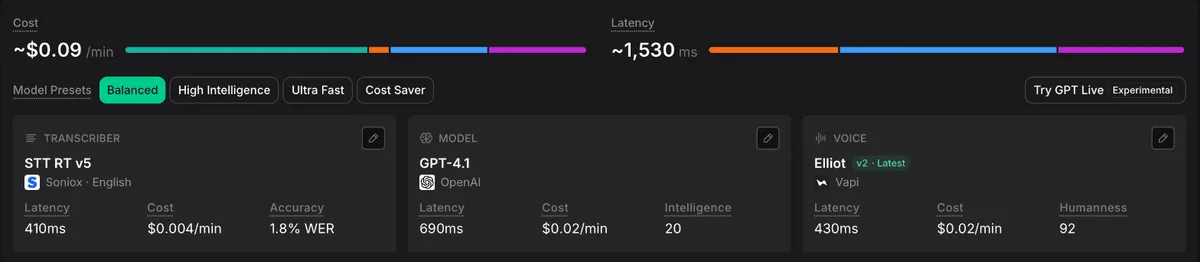
The assistant page breaks cost and latency down by layer. My default setup combined Soniox, GPT-4.1, and a Vapi voice for about $0.09 per minute and 1,530 ms, and presets like Ultra Fast and Cost Saver let you compare trade-offs in one click.
Publishing agent is more careful. A new version opens a review of what changed, then lets you send all, some, or none of your traffic to it, which is useful for trying a new prompt on a small share of calls.
Text chat asks for a card on file even if you have free credits, but a browser call worked without one. The voice was decent, and Maya stayed away from the ibuprofen question and offered the front desk.
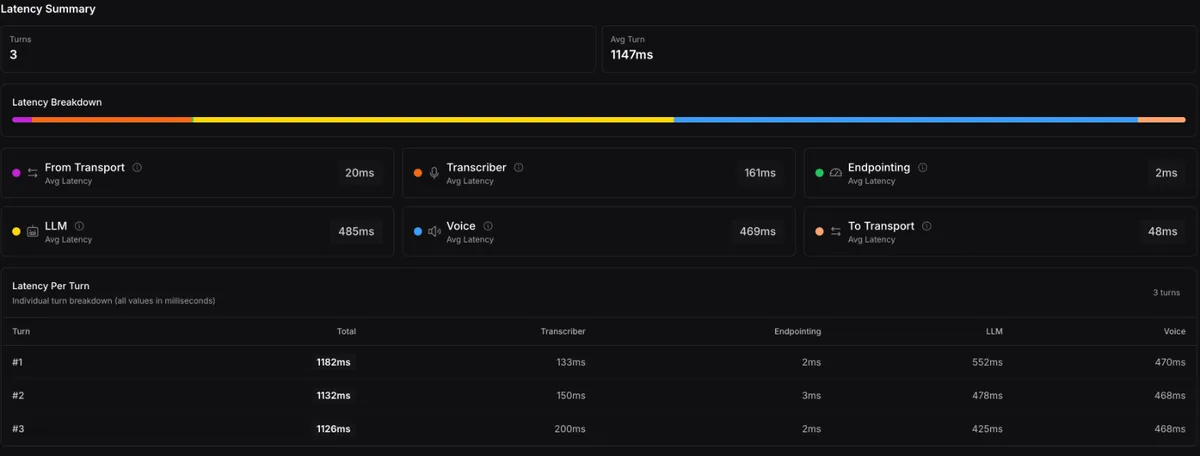
The call log is the best of the four. My 45-second call cost $0.05, with Vapi’s platform fee making up about 82% of it, and each reply is split by layer. Turns averaged 1,147 ms, faster than the 1,530 ms the assistant page estimated.
Our take: Choose Vapi if you have engineers and want control over each part of the stack. Non-developers will find Retell or ElevenLabs easier.
Standout features:
- Separate choice of transcriber, model, and voice
- Presets for balance, intelligence, speed, and cost
- Version publishing with traffic splitting
- Evals, simulations, and call logs
Pros & Cons
PROS
CONS
Pricing
The pay-as-you-go option charges $0.05 per minute for hosting, with models at cost and $5 in free credits.
Core is $29 per month.
Pro has a $999 monthly minimum.
03. Aircall
AI agents with a phone systemTeams wanting phone system and agents together
Aircall has been a phone system for a decade, and its AI agents resides on that same network. That means no SIP trunks, call forwarding, or separate carrier bills, and the AI can hand a call to your team inside the same system.
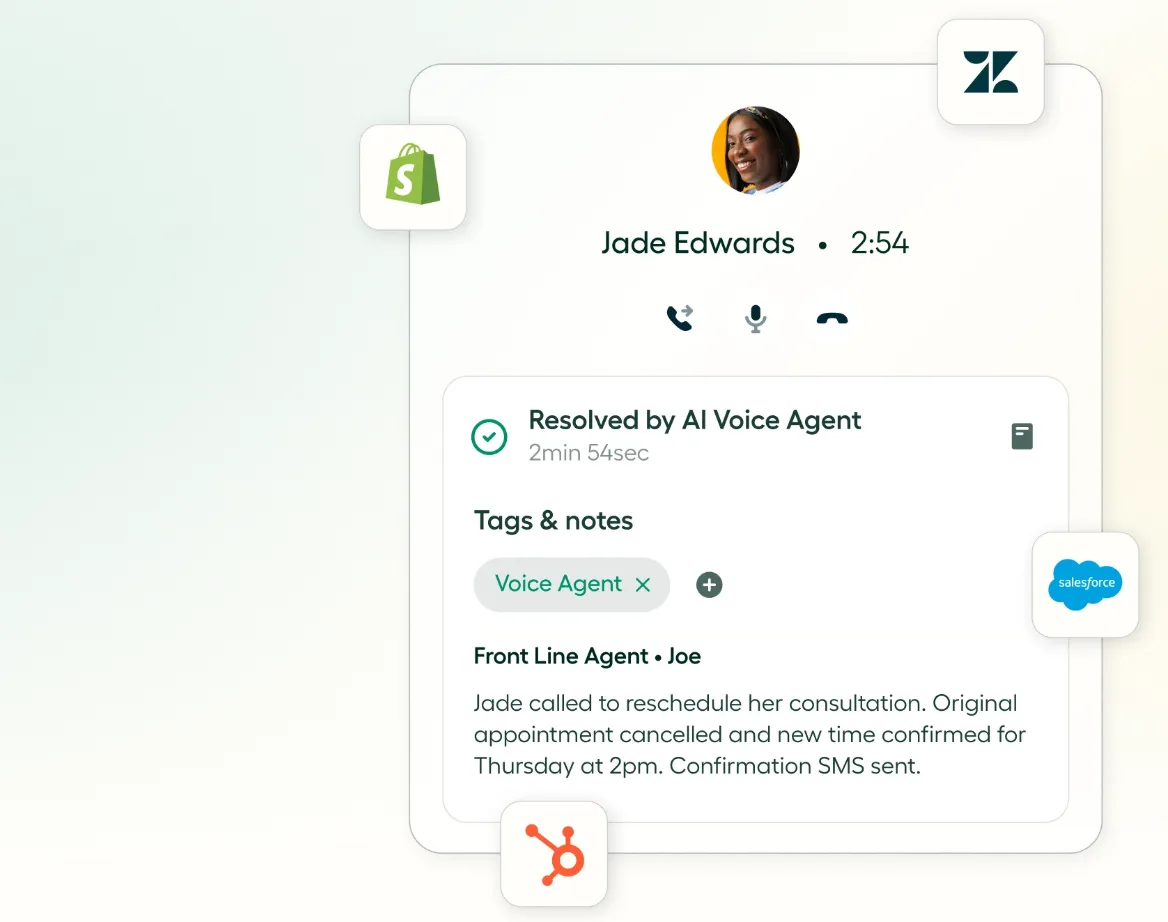
The agents cover inbound calls, outbound calls, SMS, and WhatsApp. An outbound agent can call when a lead arrives, a payment comes due, or an appointment approaches, and it can update your CRM, create tickets, and book meetings along the way.
US and Canadian accounts can try four pre-built agents from the browser or phone without setup.
Our take: Aircall makes the most sense if you want AI and human agents in one phone system with one bill. It isn’t the cheapest per minute, but the rate includes the model, voice, and telephony.
Standout features:
- Inbound and outbound voice agents, plus SMS and WhatsApp messaging agents
- 38 languages and numbers in 100+ countries
- 250+ integrations, including HubSpot, Salesforce, and Zendesk
- Performance tracking for resolution rate, CX score, and transfer rate
Pros & Cons
PROS
CONS
Pricing
In the US, pay-as-you-go is $0.29 per minute with a $100 monthly minimum.
Bundles cost $250 for 1,000 minutes, $805 for 3,500, and $1,900 for 10,000, billed monthly on an annual term.
New accounts get 100 free minutes.
04. ElevenLabs Agents
Voice-first agent platformVoice quality and free testing
ElevenLabs started in AI voices, and that remains the main reason to look here. Its agent platform adds workflows, a knowledge base, multilingual support, and a choice of language models.
Testing ElevenLabs
The template gallery is the most visual of the four I tried, with ready agents for support, lead qualification, renewals, and appointment setting. Selecting one shows its full workflow, so you can see the branching logic before you commit.
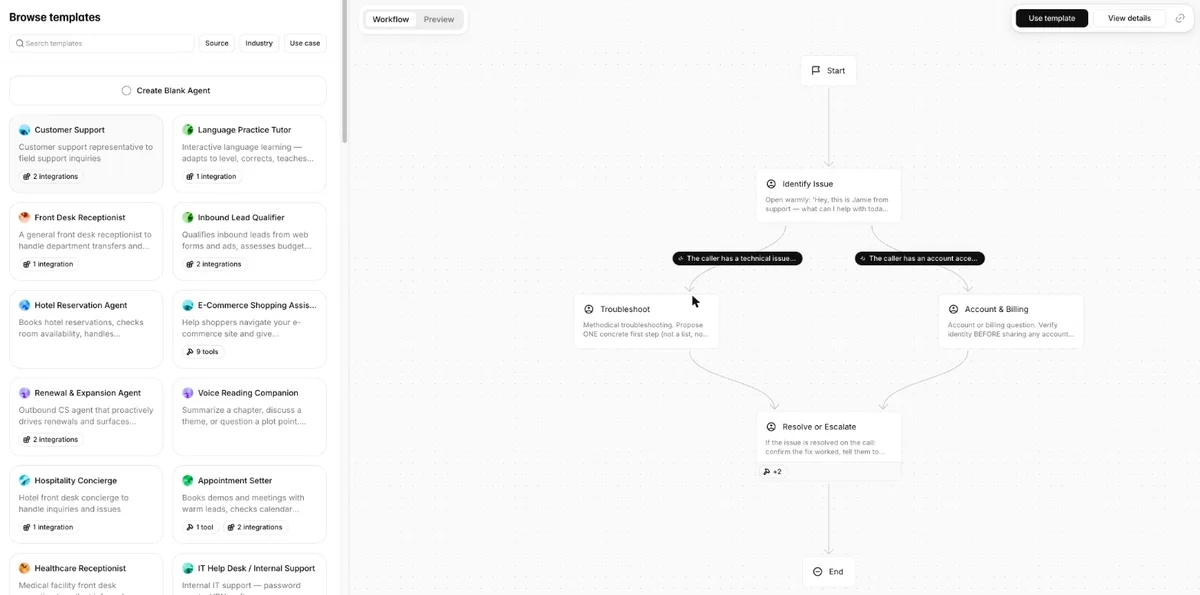
A blank agent needed only the prompt and first message. Maya passed the text test, though a text chat there starts with your first message, so her opening line never appeared. It came through on a browser call, where she sounded very natural and asked me to confirm the move to Monday before treating it as done.
That 30-second call used 202 credits. The log times each reply by layer, and the model was the part that varied most, from 130 to 798 ms, while voice output stayed under 120 ms.
Our take: ElevenLabs is the easiest place to start for free, and a strong pick where the voice itself matters. Remember that phone charges from your provider is outside its prices.
Standout features:
- Template gallery with visual workflows
- Choice of voices, languages, and language models
- Mock tools for testing without live systems
- Realtime and custom voice modes
Pros & Cons
PROS
CONS
Pricing
The free plan includes 15 minutes.
Starter is $6 per month for 75 minutes, Creator is $22 for 275, and Pro is $99 for 1,238.
Scale is $299 for 3,738 minutes, Business is $990 for 12,375.
Creator charges $0.08 for each extra minute.
05. Bland AI
High-volume call automationHigh-volume outbound
Bland focuses on calls at volume, with flat per-minute pricing that doesn’t ask you to add up model and voice costs. Pathways let you script conversations as a visual flow when a single prompt isn’t strict enough.
Looking Inside Bland
Bland puts unusual detail into how the agent sounds. You can set how easily callers interrupt, how often the agent says mm-hm, whether it reacts to what it hears, and even add office or coffee shop noise behind the voice.
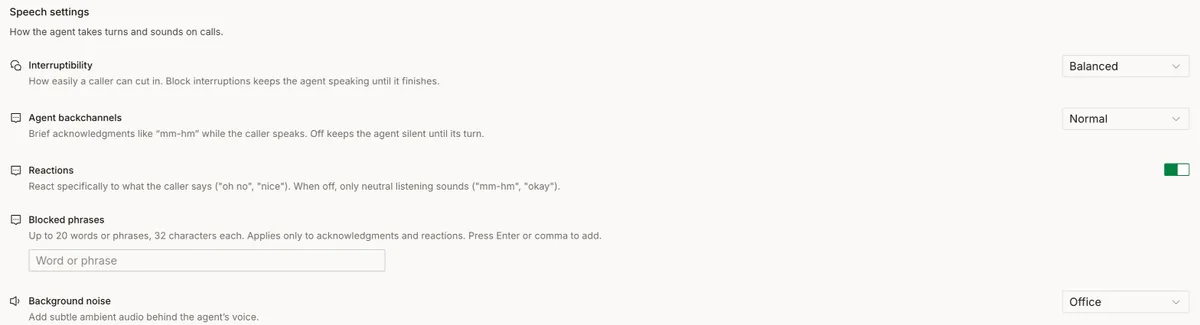
Maya passed the text test here too. One setting to review is the system prompt, as a new agent starts with a template full of bracketed placeholders that you need to replace.
The browser call was rougher. Replies felt a bit slower than on the other three, and Maya restarted her greeting from the top each time I spoke over her, so it took three attempts before she finished it. The 31 seconds used 0.07 credits, in line with the $0.14 per minute rate. Call recording was off on this agent, which left a transcript but no audio to replay, so switch it on before you test.
Our take: Bland suits teams planning a lot of outbound calling who like simple billing. Check the Start plan’s limit of 100 calls a day, since a real campaign will quickly need Build plan.
Standout features:
- Flat per-minute pricing
- Pathways for scripted conversations
- Interruption, backchannel, and background noise controls
- Babel mode for automatically switching languages
Pros & Cons
PROS
CONS
Pricing
Start is $0.14 per minute with no platform fee, 10 concurrent calls, and 100 calls a day.
Build is $0.12 per minute plus $299 per month, with 50 concurrent calls and 2,000 calls a day.
Transfer time costs $0.05 or $0.04 per minute, and Enterprise is custom.
06. PolyAI
Enterprise dialog agentsLarge contact centers
PolyAI builds agents for large companies with heavy call volumes, on its own dialog models. Its latest, Dialog-RSN-1, works directly on call audio, and the company reports response times under 300 ms.
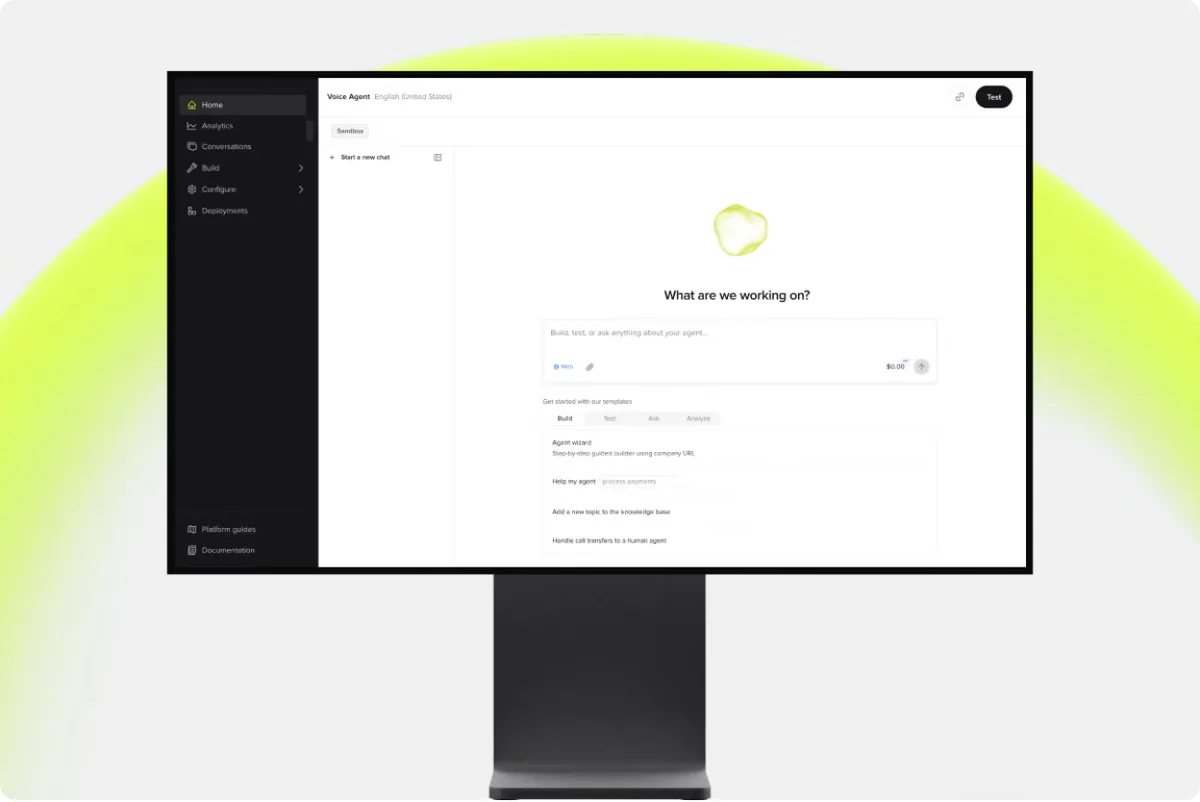
Agent Studio covers flows, tools, and brand voice from no-code to full code, and agents connect to systems like Zendesk, NICE, and Twilio. PolyAI’s customer stories include one with 1 million calls handled a month.
Our take: PolyAI is worth a conversation if phone support is a major cost and you want a vendor involved in the build. Smaller teams will get going faster elsewhere.
Standout features:
- Proprietary audio-native dialog models
- Agent Studio, from no-code to full code
- Same agents across voice, chat, SMS, and messaging
- Prebuilt integrations and open APIs
Pros & Cons
PROS
CONS
Pricing
Voice agent use is priced per minute through sales.
New API accounts get $100 in free credit for a limited time.
07. Parloa
Enterprise agent managementEnterprise customer service
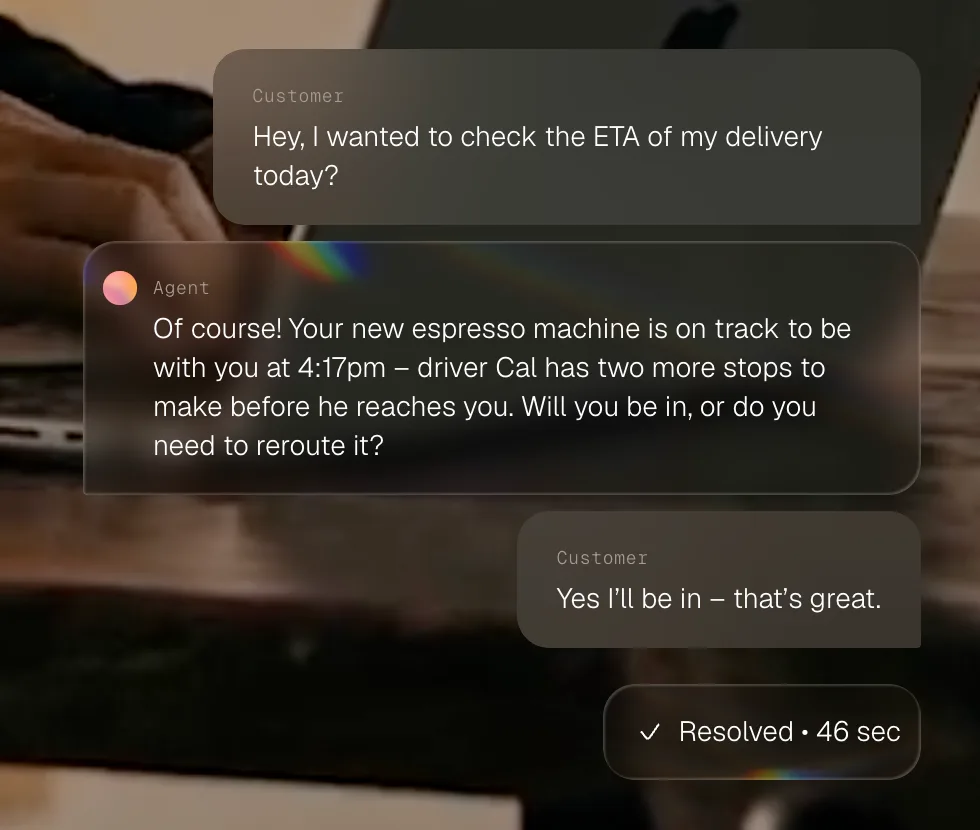
Parloa manages the whole life of an AI agent across voice and chat, from design to orchestration and improvement. The people closest to customers can build agents themselves through a low-code interface.
Our take: Parloa fits enterprises that want service teams to own their agents. Its per-minute rates vary by use case, so get quotes for your specific call types.
Standout features:
- Agent lifecycle management on one platform
- Low-code building for non-specialists
- Consumption-based pricing for voice and chat
- SAP solution extension
Pros & Cons
PROS
CONS
08. Synthflow
Enterprise voice AIEnterprise call workflows
Synthflow is sold only through annual enterprise agreements. It runs on its own telephony, and it can also connect through SIP or approved enterprise systems.
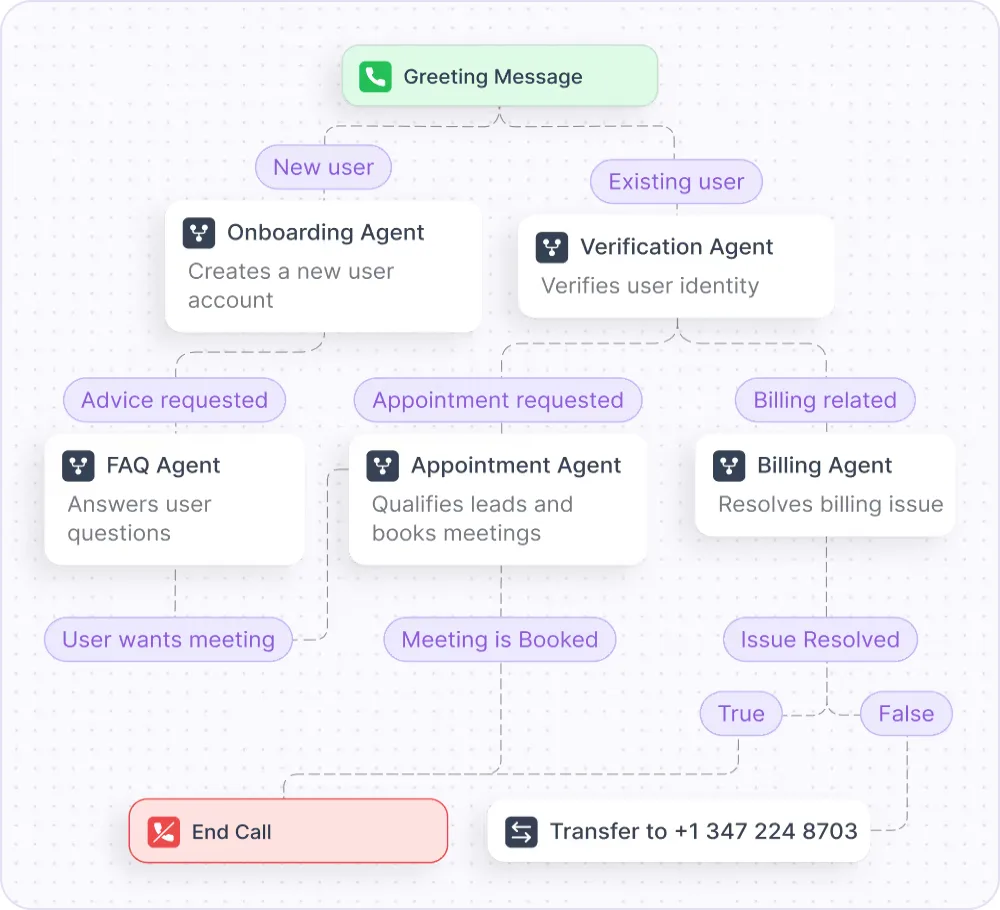
Its process follows four stages. You design in a visual flow builder, test with simulated calls in the Test Center, launch on its network, and monitor with Auto-QA. Batteries Plus runs its agents inside Zoom Phone across more than 700 US locations.
Our take: Synthflow suits mid-market and enterprise teams that want a structured rollout with engineers helping. Anyone wanting to test first should use Retell or ElevenLabs, as Synthflow has no free plan or trial.
Standout features:
- Visual Flow Designer with multi-agent routing
- Test Center for simulated calls
- Auto-QA and live monitoring
- In-house telephony, SIP trunking, and contact center connections
Pros & Cons
PROS
CONS
09. Deepgram Voice Agent API
Voice agent APISingle API for speech and model
Deepgram began in speech recognition, and its Voice Agent API now combines speech-to-text, a language model, and text-to-speech behind one WebSocket. Turn-taking, interruptions, and conversation state are handled inside the API.
You can bring your own model or voices for a lower rate, change the agent mid-conversation, and fall back automatically if a model or voice provider fails. Endpoints are available globally and in the EU, India, and Australia.
Our take: Deepgram is recommended for developers who want one vendor for the speech stack without building turn detection themselves. There’s no visual builder to lean on, so you’ll need someone with technical expertise.
Standout features:
- One API for speech, model, and voice
- Built-in end-of-turn and interruption handling
- Bring your own LLM or text-to-speech
- Regional endpoints for data requirements

Pros & Cons
PROS
CONS
Pricing
Standard is $0.075 per minute on pay-as-you-go, and $0.068 on Growth.
Bringing your own model and voice lowers it to $0.05, and Advanced is $0.163.
New accounts get $200 in free credit.
10. Telnyx
Voice AI on a carrier networkTelephony and AI on one network
Telnyx is a licensed carrier in more than 45 countries that also runs speech and language models on its own GPUs. Since calls and AI sit on one network, it reports response times under 200 ms and sends everything on one invoice.
Its voice engine rate covers orchestration, speech-to-text, and text-to-speech. Telnyx estimates a production agent lands near $0.06 per minute once you add its hosted model and carrier minutes, among the lowest figures on this list.
Outbound teams should also note its A-level STIR/SHAKEN attestation, which helps eligible US calls present as trusted. If you only need programmable calling, see our voice call API guide.
Our take: Telnyx is the one to price if per-minute cost at volume decides the deal and you have developers to build with.
Standout features:
- Licensed carrier in 45+ countries
- 1,400+ voices and 80+ languages
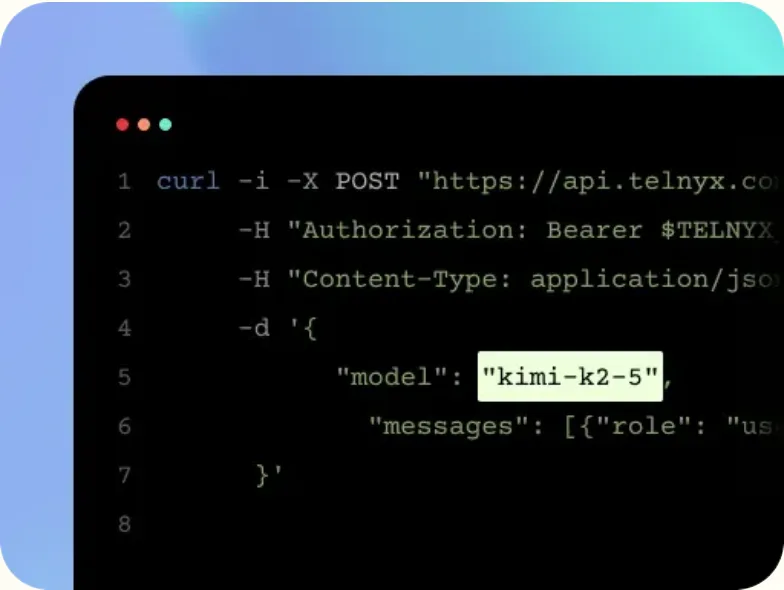
- OpenAI-compatible endpoints
- End-to-end tracing and latency breakdowns
Pros & Cons
PROS
CONS
Pricing
The voice engine is $0.05 per minute.
Hosted models typically add about $0.006 per minute, and telephony starts at $0.0032 per minute.
Honorable Mentions
Customer service agents across chat, SMS, WhatsApp, email, and voice, with outcome-based pricing.
Conversational AI building blocks on Twilio’s communications network, for teams already using it.
Voice agents built on Salesforce CRM data, a natural fit for existing Salesforce customers.
General AI assistant with phone calls among its skills, from $29.99 a month per user.
Newer platform with pay-as-you-go agents from $0.09 to $0.21 a minute.
How to Test a Voice Agent Before Launch
- Write down the three or four outcomes the agent must reach, and one thing it must never do.
- Connect every action you need, including transfers and bookings, then confirm each one works.
- Call it on a real phone line in a noisy room, because a browser test hides many problems.
- Interrupt it mid-sentence, change your mind, and give a confusing answer.
- Tell callers they’re talking to AI, and check consent and recording rules where you operate, particularly for outbound calls.
- Start with a small share of calls, and review transcripts daily for the first week.
FAQ
What is the difference between an AI voice agent and an AI receptionist?
An AI receptionist is a ready-made voice agent for answering inbound business calls, booking appointments, and routing callers. A voice agent is the broader category, which also covers outbound calling and custom workflows such as sales qualification, reminders, and collections.
How much does an AI voice agent cost?
It costs about $0.05 to $0.31 per minute, and they don’t all cover the same things. Check whether the language model and phone minutes are included before comparing.
Can AI voice agents make outbound calls?
Yes, and most platforms here support it. Outbound calling comes with extra legal duties, including consent and disclosure rules in many countries, so review them before running a campaign.
Do I need a developer to build one?
Not always. Retell, ElevenLabs, and Bland let you start from a prompt or template without code, although connecting calendars and CRMs often takes some technical knowledge.
Conclusion
Developers should compare Vapi, Deepgram, and Telnyx. Teams wanting a quick start with room to grow should try Retell or ElevenLabs, and Bland suits outbound volume.
If you want AI and people in one phone system, look at Aircall. Large contact centers should talk to PolyAI, Parloa, and Synthflow.