


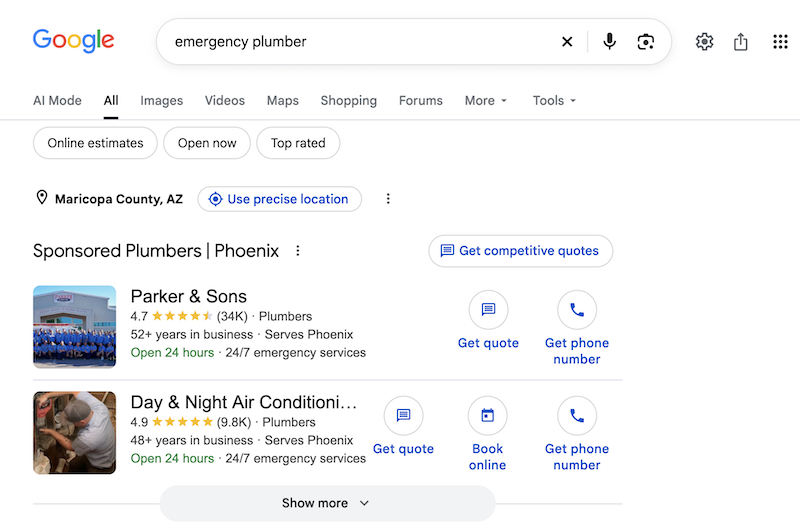
Search for “emergency plumber” and the first regular website on the page is usually the eighth thing you see. Ads come first, then a map with local businesses, sometimes an image strip, and only then the organic results most SEO reports are built around.
Everything that isn’t a plain blue link is a SERP feature. We checked Google’s first page for 100 keywords across 20 US cities. The average page carried four to five features.
This guide covers what each SERP feature is, how often it appeared in our data, how to earn a spot in it, and how to track features for free or with a few lines of code.
What Are SERP Features?
SERP features are the blocks Google adds to a results page on top of the standard organic listings. Some answer the question directly like AI Overviews, knowledge panels, some point to other formats like videos, images, forums, some are paid ads, and some help people refine their search like People Also Ask, related searches.
Google take clicks that would otherwise go to organic results, and they push those results down the page. A #1 organic ranking under an AI Overview, a map, and ads is a very different thing from a #1 ranking at the top of the page. A good rank tracking setup records both your organic rank and your position on the whole page.
How Common Is Each SERP Feature?
We grouped our keywords into three types:
- Local (“dentist”, “pest control”)
- Commercial (“best crm software”, “standing desk”)
- Informational (“how to file taxes”, “what is kubernetes”).
This is how often each feature showed up on desktop.
| SERP feature | Local | Commercial | Informational |
|---|---|---|---|
| People Also Ask | 100% | 100% | 100% |
| Related searches | 100% | 99% | 100% |
| AI Overview | 5% | 93% | 99% |
| Ads | 26% | 59% | 38% |
| Local pack (map) | 100% | 6% | 0% |
| Videos | 0% | 12% | 61% |
| Short videos | 0% | 1% | 17% |
| Perspectives | 31% | 12% | 22% |
| Discussions and forums | 2% | 8% | 15% |
| Images | 25% | 5% | 6% |
| Popular products | 0% | 18% | 0% |
| Knowledge panel | 2% | 1% | 0% |
| Featured snippet | 0% | 0% | 0% |
How we collected this
These numbers come from the same study behind our rank tracking guide where we tested 100 keywords (35 local, 35 commercial, 30 informational) on Google US across 20 cities on October 5, 2026, using the Geekflare SERP API.
The AI Overview, People Also Ask, and related searches rows come from 1,540 desktop result pages. The other rows come from 651 desktop pages where every feature type was captured. Our keywords are generic rather than brand or entity searches, which is why knowledge panels barely appear.
The search type predicts the features almost perfectly: local searches get a map, commercial searches get ads and AI Overviews, informational searches get AI Overviews and videos. People Also Ask and related searches appear nearly everywhere. And the featured snippet, once the most coveted spot on Google, didn’t show up once.
The features also decide how far down your organic result sits. For local keywords, the first organic result was typically the eighth item on the page. For commercial and informational keywords it was usually second, right under the AI Overview, but on about 30% of pages it was third or lower.
The SERP Features That Matter Most
AI Overviews
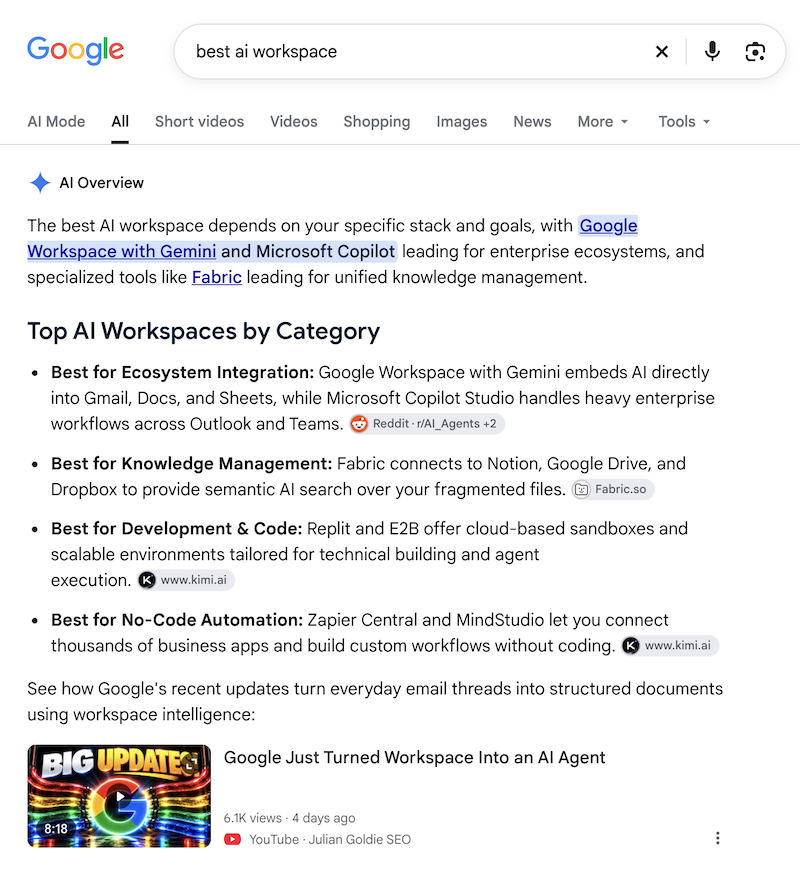
AI Overviews are the AI-written summaries at the top of the page, with links to the sources Google used. In our data they appeared on 93% of commercial and 99% of informational searches, and on only 5% of local ones.
Across 1,010 result pages with an AI Overview, each one linked to between four and five sources on average. Only 58% of those cited pages also ranked in the organic top 10 for the same search. About four in ten cited pages didn’t rank on page one at all, so a citation is not simply a reward for ranking well.
| Most-cited domains | Share of AI Overviews citing them |
|---|---|
| youtube.com | 60% |
| reddit.com | 29% |
| zapier.com | 14% |
| wikipedia.org | 12% |
| pcmag.com | 12% |
If your topic can be explained on video, a good video may earn you a citation faster than another blog post. For written content, put a quotable answer near the top of the page, use clear headings that match the questions people ask, and keep facts like prices and dates current. Citations change often, so it’s worth tracking which pages get cited for your keywords.
Featured snippets
Featured snippets were the boxed answers pulled from one web page and shown above the organic results. They’ve largely been replaced by AI Overviews. In an Ahrefs analysis of 1 million SERPs, featured snippets fell from 15.41% of results pages in January 2025 to 5.53% in June 2025, a 64% drop that tracked AI Overview growth almost exactly. In our October 2026 data, we didn’t find a single one.
People Also Ask
People Also Ask is the list of related questions that expand into short answers. It appeared on every desktop page in our data, usually with four questions. The questions themselves are the valuable part.
Treat them as free research on what searchers want to know next. Answer the most relevant ones on your page, under headings phrased as questions, with an answer in the short sentences. Track which questions appear for your main keywords over time, too. When new questions show up, interest is shifting.
Local pack
The local pack is the map with businesses that appears for searches with local intent. It showed up on every local search in our data, and on 6% of commercial ones, for example “business phone system”, where Google assumes you might want a local provider.
You win local pack spots through your Google Business Profile. The right primary category, accurate hours, real photos, and a steady reviews. Track it per city, since the businesses change completely from one city to the next.
Ads
Ads appeared on 59% of commercial searches, 38% of informational ones, and 26% of local ones. When ads ran above the results, there were usually about three of them. They’re the least stable feature, since advertisers’ budgets and bids change through the day.
Even if you don’t buy ads, it’s worth recording them. A keyword that suddenly gets four top ads will send fewer clicks to your organic listing even if your rank doesn’t change, and the advertisers tell you who’s willing to pay for that audience.
Videos
Video carousels showed up on 61% of informational searches, almost all from YouTube. Short videos, from YouTube Shorts, Facebook, and Instagram, appeared on 17% of informational searches.
A clear title that matches the search and an accurate description help it appear in the carousel, and the same video can be cited in the AI Overview.
Perspectives
Perspectives shows posts from people on social platforms like Reddit, Facebook, Instagram, and LinkedIn in our data. Discussions and forums pulls threads from sites like Reddit and Quora. Together they’re Google’s answer to people adding “reddit” to their searches. Perspectives appeared on 31% of local searches and 22% of informational ones, and forums on up to 15%.
You can’t optimize a forum thread directly, but you can take part honestly in the communities where your topic comes up, and make sure your own content answers the questions those threads keep asking.
Images, popular products, and knowledge panels
Image packs appeared on a quarter of local searches and a few commercial ones. Popular products, Google’s shopping-style product grid, showed up on 18% of commercial searches, from standing desks and headphones to payroll and business phone software.
For physical products, it draws on Merchant Center product feeds. Knowledge panels belong to brand and entity searches, so they barely appeared for our generic keywords. For your own brand, consistent details across your site, Wikipedia or Wikidata, and Organization schema are what Google draws on.
Related searches
Related searches are at the bottom of the page. They rarely get clicks, but they’re one of the best free sources of long-tail keyword ideas, and they show how Google groups topics together.
How to Track SERP Features
Search Console and manual checks (free options)
Google Search Console’s Performance report has a Search appearance filter that shows clicks and impressions for some rich results and features you already appear in. Google’s newer generative AI performance reports show how often your pages appear in AI Overviews and AI Mode, by page, country, and device.
Rank tracking tools
Most SEO monitoring tools show feature icons next to each tracked keyword and flag the ones you own. That’s the easiest option but expensive.
With a SERP API
A SERP API returns each feature as its own field, so tracking means checking which fields are present and comparing them with the last check. In the Geekflare SERP API, the fields look like this:
| SERP feature | Field in the response |
|---|---|
| AI Overview | ai_overview |
| People Also Ask | people_also_ask |
| Related searches | related |
| Local pack | snack_pack |
| Ads | top_ads, bottom_ads |
| Videos | videos, short_videos |
| Perspectives | perspectives |
| Discussions and forums | forums |
| Images | images |
| Popular products | popular_products |
| Knowledge panel | knowledge |
The Google Sheet from our rank tracking guide already does this. Alongside your rank, each run logs the SERP features on the page and a Feature changes column, such as “+Videos, -Local pack”, so you can spot shifts at a glance.
Copy this rank tracker Google Sheet.
NOTE
You need Geekflare API key to track the ranking in Google Sheet or Python script.
If you prefer code, this Python script checks a list of keywords, saves a snapshot, and prints what changed since the last run, including new sources cited in the AI Overview:
import datetime, json, os, requests

API_KEY = os.environ["GEEKFLARE_API_KEY"]
KEYWORDS = ["best crm software", "how to make sourdough bread", "emergency plumber"]
CITY = "Chicago,Illinois,United States"
FEATURES = ["ai_overview", "people_also_ask", "related", "snack_pack", "top_ads", "bottom_ads",
            "videos", "short_videos", "forums", "perspectives", "images", "popular_products", "knowledge"]
SNAPSHOT = "serp_features.json"

def snapshot(keyword):
    r = requests.post("https://api.geekflare.com/search", headers={"x-api-key": API_KEY}, timeout=90,
                      json={"query": keyword, "serp": True, "location": "us", "city": CITY})
    data = r.json()["data"]
    aio = data.get("ai_overview") or {}
    cited = {x.get("url") or x.get("href") for x in aio.get("references", [])} - {None}
    return {"features": sorted(f for f in FEATURES if data.get(f)), "aio_sources": sorted(cited)}

previous = json.load(open(SNAPSHOT)) if os.path.exists(SNAPSHOT) else {}
current = {k: snapshot(k) for k in KEYWORDS}

for k, now in current.items():
    before = previous.get(k)
    if not before:
        print(f"{k}: first check, features = {', '.join(now['features'])}")
        continue
    added = set(now["features"]) - set(before["features"])
    removed = set(before["features"]) - set(now["features"])
    new_sources = set(now["aio_sources"]) - set(before["aio_sources"])
    if added or removed or new_sources:
        print(f"{k}: +{sorted(added)} -{sorted(removed)} new AI Overview sources: {sorted(new_sources)}")

json.dump(current, open(SNAPSHOT, "w"), indent=1)
print(f"Checked {len(current)} keywords on {datetime.date.today()}")
Run it daily with cron and send the output to email or Slack, and you have SERP feature alerts. For more ways to pull and parse results pages, see our comparison of the best SERP APIs.
Common Mistakes When Tracking SERP Features
- Tracking only whether a feature appears
- Treating People Also Ask or related searches as a win
- Ignoring video for how-to topics
- Checking features from one location for local keywords
- Looking at organic rank without its position on the whole page
FAQ
What are SERP features?
SERP features are any elements on a Google results page beyond the standard organic links, such as AI Overviews, People Also Ask, local packs, ads, video carousels, images, and knowledge panels.
Which SERP features are most common in 2026?
In our study of 100 keywords, People Also Ask and related searches appeared on almost every page. AI Overviews appeared on 93% of commercial and 99% of informational searches, local packs on every local search, and video carousels on 61% of informational searches.
Do you need to rank on page one to be cited in an AI Overview?
No. In our data, only 58% of pages cited in AI Overviews also ranked in the organic top 8 for the same search, and YouTube was cited in 60% of AI Overviews.
Final Thoughts
Organic rankings still matter, but they’re only part of what a searcher sees. On a typical search result page you’re competing with an AI Overview, a handful of questions, and depending on the search, ads, a map, or a row of videos.
Start by checking which features appear for your ten most important keywords and whether you’re in any of them. That short list usually shows where the easiest wins are, whether that’s a video for a how-to topic, a better Google Business Profile, or an answer an AI Overview can quote.